Sermon Title:
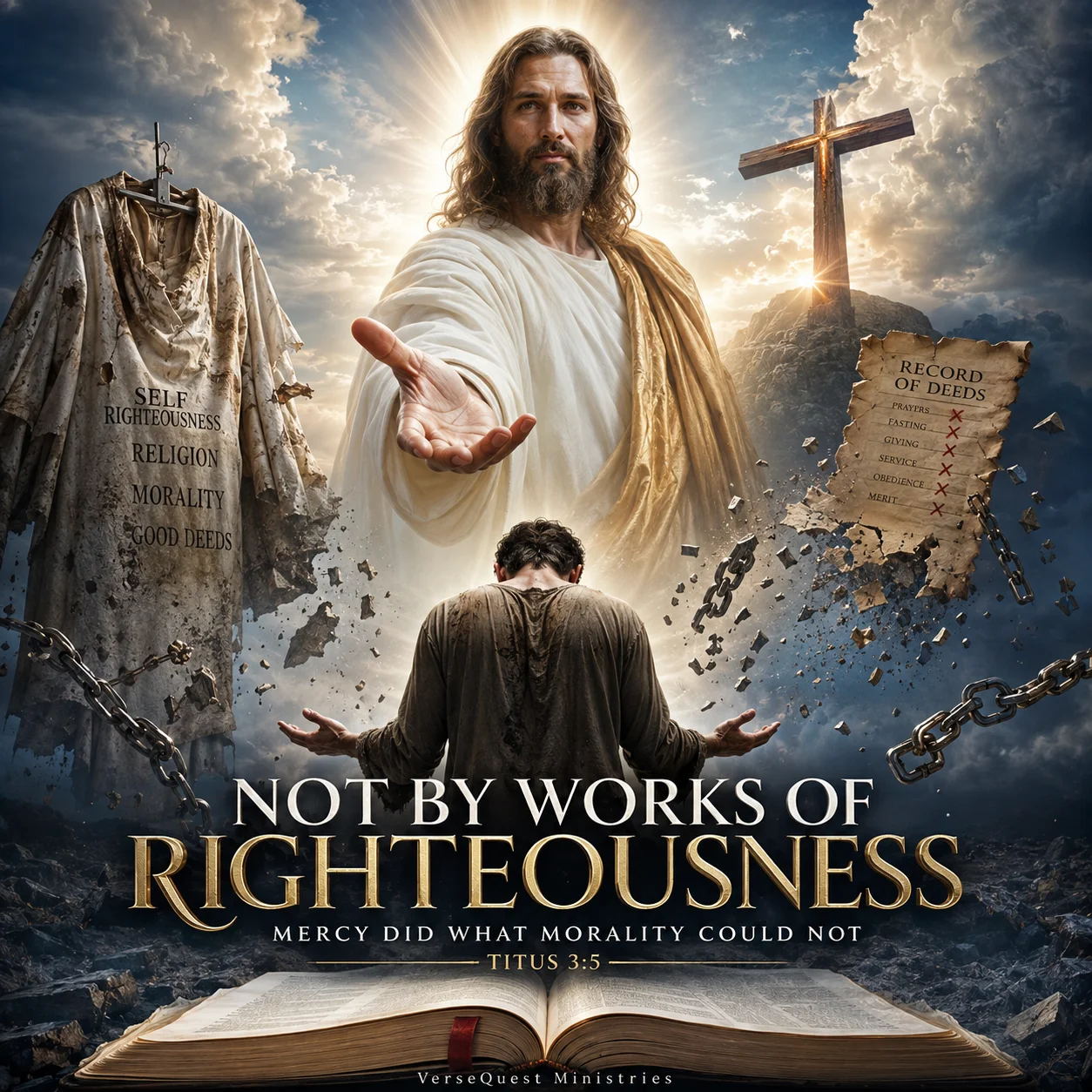
Mercy Did What Morality Could Not: Not by Works of Righteousness
Key Passage:
Titus 3:5 — “Not by works of righteousness which we have done, but according to his mercy he saved us, by the washing of regeneration, and renewing of the Holy Ghost.”
Series:
Foundations of the Gospel of Grace
Topic:
Salvation by God’s Mercy Apart From Works of Righteousness
Book:
Titus, Romans, Ephesians, Galatians, 2 Timothy, 1 Corinthians, John, Philippians
Speaker:
Paul Tackett
Suggested Sermon Text:
Titus 3:3–8; Ephesians 2:8–10; Romans 3:19–28; Romans 4:4–5; Romans 5:6–11; Romans 11:6; Galatians 2:16; Galatians 3:10–14; Philippians 3:4–9; 2 Timothy 1:9; 1 Corinthians 15:1–4; John 3:3–7; 1 Peter 1:23
Short Sermon Description:
This detailed VerseQuest Ministries sermon outline explains the gospel truth of Titus 3:5: salvation is “not by works of righteousness which we have done,” but according to God’s mercy. The verse does not merely reject bad works as a means of salvation; it rejects even man’s best religious and moral works as the cause of salvation. This sermon shows why sinners cannot be saved by morality, law-keeping, baptism, sacraments, church membership, charitable deeds, reform, or religious discipline. It explains man’s lost condition before salvation, God’s mercy as the source of salvation, the washing of regeneration, the renewing of the Holy Ghost, and the proper place of good works after salvation. Designed for pastors, preachers, teachers, Bible students, and believers, this outline defends the gospel of grace, magnifies the finished work of Jesus Christ, rightly divides salvation from service, and shows that true holiness is the fruit of salvation, not the price of it.
Mercy Did What Morality Could Not
Not by Works of Righteousness
Introduction
Titus 3:5 is a verse religion cannot survive without rewriting in practice. The Holy Ghost says, “Not by works of righteousness which we have done.” That does not say, “Not by wicked works only.” It does not say, “Not by bad works.” It says works “of righteousness.” That means man’s best deeds are excluded from the cause of salvation. His charity, morality, baptism, church attendance, fasting, tithing, religious vows, confessions, sacraments, law-keeping, self-denial, and spiritual résumé are all pushed off the foundation. God is not merely rejecting the sinner’s filth; He is rejecting the sinner’s attempt to use his supposed righteousness as currency before heaven.
The religious man can understand why God would reject drunkenness, adultery, theft, blasphemy, murder, and open wickedness. What he cannot stand is God rejecting his righteousness as a saving cause. That is where pride gets exposed. A man will admit he has done some bad things if you let him keep credit for the good things. He will confess he has stains if you allow him to present a few trophies. But Titus 3:5 sweeps the table clean. Salvation is not by works of righteousness which we have done. The sinner does not walk into God’s courtroom with good deeds in one hand and sins in the other hoping the scale tips in his favour. The scale already broke under the weight of guilt.
The verse gives the only true source of salvation: “according to his mercy he saved us.” Not according to our effort. Not according to our religion. Not according to our promise to improve. Not according to our membership certificate. According to His mercy. Mercy is God acting toward the guilty in compassion because Jesus Christ has provided the righteous basis for salvation through His blood, death, burial, and resurrection. Mercy does not mean God overlooked sin. Mercy means God provided a Saviour. The sinner brings the need; Christ brings the payment. The sinner brings guilt; Christ brings redemption. The sinner brings death; Christ brings life. Mercy did what morality could not.
I. Before Salvation, We Were Not Righteous but Ruined
Key Text: Titus 3:3
Supporting Texts: Romans 3:10–18; Ephesians 2:1–3; 1 Corinthians 6:9–11
Paul does not begin Titus 3 by flattering man. Verse 3 says, “For we ourselves also were sometimes foolish, disobedient, deceived, serving divers lusts and pleasures, living in malice and envy, hateful, and hating one another.” That is God’s description of man before salvation. It is not pretty, but it is true. The sinner is not a noble creature who merely needs religious polishing. He is foolish in mind, disobedient in will, deceived in heart, enslaved to lusts, and corrupted in his relationships.
Romans 3 says there is none righteous, no, not one. That is the divine verdict. Men may be different in education, manners, culture, religion, and public respectability, but all are under sin. The gutter sinner and the pew sinner may look different to men, but both need mercy from God. One man may sin with a bottle, another with a Bible under his arm and pride in his heart. Sin is still sin when it learns religious vocabulary.
Ephesians 2 says sinners are dead in trespasses and sins and by nature children of wrath. Dead men cannot save themselves by performing works of righteousness. A corpse may be dressed better than another corpse, but both need life. This is why Titus 3:5 says “he saved us.” Salvation is rescue from a condition man could not repair. God does not help the spiritually alive finish the job. He gives life to the dead.
Main Truth:
Salvation begins with the truth that sinners are ruined, guilty, deceived, and spiritually dead apart from the mercy of God.
II. Works of Righteousness Cannot Save
Key Text: Titus 3:5
Supporting Texts: Ephesians 2:8–9; Romans 3:20; Galatians 2:16
Titus 3:5 specifically rejects “works of righteousness.” That phrase is critical. God is not merely saying that evil works cannot save. He is saying man’s good works cannot save. A man may feed the poor, attend church, give money, pray, fast, live cleanly, keep religious ordinances, avoid public scandal, and still remain lost if he trusts those works for salvation. Works of righteousness may impress men, but they cannot justify the sinner before God.
Ephesians 2:8–9 says salvation is by grace through faith, “not of works, lest any man should boast.” Romans 3:20 says, “by the deeds of the law there shall no flesh be justified in his sight.” Galatians 2:16 repeats that a man is not justified by the works of the law. God does not stutter on this doctrine. He repeats it because religious flesh keeps trying to smuggle works back into the foundation.
If works of righteousness could save, Christ died in vain. If law-keeping could justify, Calvary was unnecessary. If baptism, sacraments, morality, and religious discipline could regenerate a sinner, then the cross becomes an accessory instead of the altar of redemption. But the Bible does not present Jesus Christ as a helper to man’s righteousness. It presents Him as the only Saviour of sinners who have no saving righteousness of their own.
Main Truth:
No work of righteousness performed by man can save, justify, regenerate, or redeem a sinner.
III. Salvation Is According to God’s Mercy
Key Text: Titus 3:5
Supporting Texts: Ephesians 2:4–5; Romans 9:16; 1 Peter 1:3
The verse says, “according to his mercy he saved us.” Mercy is the fountain from which salvation flows. Ephesians 2 says God is “rich in mercy.” That is good news because sinners are rich in guilt. Mercy is not God being careless with sin. Mercy is God providing salvation for sinners who deserve judgment. God’s mercy is not sentimental weakness; it is blood-bought compassion grounded in the finished work of Jesus Christ.
Romans 9:16 says, “So then it is not of him that willeth, nor of him that runneth, but of God that sheweth mercy.” That knocks the legs out from under human pride. Salvation is not produced by the sinner’s willpower or religious running. A man may run hard in religion and still run straight into hell if he is not in Christ. Mercy is not earned by motion. Mercy is shown by God.
First Peter 1:3 says God “according to his abundant mercy hath begotten us again unto a lively hope by the resurrection of Jesus Christ from the dead.” Mercy is tied to resurrection. God’s mercy reaches sinners through the risen Christ. The sinner does not need a religious coach. He needs mercy from the God he has offended, and that mercy is found only in the Lord Jesus Christ.
Main Truth:
Salvation is not according to man’s merit but according to God’s mercy in Jesus Christ.
IV. Christ’s Finished Work Is the Basis of Mercy
Key Text: 1 Corinthians 15:3–4
Supporting Texts: Romans 3:24–26; Romans 5:8–9; 2 Corinthians 5:21
Mercy does not mean God simply waved away sin. First Corinthians 15:3–4 gives the gospel: Christ died for our sins according to the Scriptures, was buried, and rose again the third day according to the Scriptures. That is the basis on which God saves sinners today. Christ did not die to make man’s works more effective. He died because man’s works could not answer sin.
Romans 3 says God set forth Christ to be a propitiation through faith in His blood, that God might be just and the justifier of him which believeth in Jesus. That means God does not save by compromising justice. He saves because justice was satisfied at Calvary. The blood of Christ paid what works of righteousness never could. The cross did not decorate mercy; it made mercy righteous.
Second Corinthians 5:21 says Christ was made sin for us, who knew no sin, that we might be made the righteousness of God in Him. That is the great exchange. The sinner’s sin was laid on Christ. Christ’s righteousness is counted to the believer. No religious work can improve that. No ceremony can complete it. No sacrament can add to it. Mercy saves because Christ finished the work.
Main Truth:
God’s mercy saves sinners on the righteous basis of Christ’s death, burial, resurrection, and shed blood.
V. The Washing of Regeneration Is God’s Work, Not Religious Water
Key Text: Titus 3:5
Supporting Texts: John 3:3–7; Ephesians 5:26; 1 Peter 1:23
Titus 3:5 says God saved us “by the washing of regeneration.” Religious systems often run to this phrase and try to pour baptismal regeneration into it. But the verse has already said salvation is not by works of righteousness which we have done. If water baptism is made the cause of regeneration, then a humanly administered religious act becomes part of the saving cause, contradicting the first half of the verse. God is not confused. Religion is.
Regeneration means new birth, new life, the imparting of spiritual life by God. Jesus told Nicodemus, “Ye must be born again.” He did not tell him to become more religious. First Peter 1:23 says believers are born again by the word of God. Ephesians 5:26 speaks of “the washing of water by the word.” The washing connected with regeneration is not a sinner being made alive by church water; it is God cleansing and giving life through His Spirit and His word.
Water baptism has its proper place as a testimony after salvation, but it cannot create spiritual life. Paul said Christ sent him not to baptize, but to preach the gospel. If baptism caused regeneration, Paul’s statement would be impossible. The gospel saves. The Spirit regenerates. The word of God brings faith. Religious water can touch the skin, but only God can give life to the soul.
Main Truth:
The washing of regeneration is God’s saving work of new life and cleansing, not water baptism producing salvation.
VI. The Renewing of the Holy Ghost Gives Life From God
Key Text: Titus 3:5
Supporting Texts: Romans 8:9–16; 2 Corinthians 5:17; Ephesians 1:13–14
Titus 3:5 also says salvation comes by the “renewing of the Holy Ghost.” The Holy Ghost is not an optional religious feeling. He is the divine Agent who gives life, seals the believer, and places him into relationship with God through Christ. The sinner does not renew himself. He may reform habits, change environments, quit certain sins, and become religious, but only the Holy Ghost can renew the inner man.
Romans 8 says if any man have not the Spirit of Christ, he is none of His. That is strong doctrine. A man may have church membership and not have the Spirit. He may have water baptism and not have the Spirit. He may have morality and not have the Spirit. Without the Holy Ghost, there is no life in Christ. Salvation is not the flesh becoming religious; it is the Spirit giving life.
Ephesians 1:13 says that after hearing the word of truth, the gospel of salvation, and believing, the believer is sealed with the Holy Spirit of promise. That is Church-age order: hear the gospel, believe in Christ, be sealed by the Spirit. The renewing of the Holy Ghost is not earned by religious effort. It is part of the salvation God gives according to mercy.
Main Truth:
The Holy Ghost renews, seals, and gives life to the believer through faith in the gospel of Jesus Christ.
VII. Grace and Works Cannot Share the Foundation
Key Text: Romans 11:6
Supporting Texts: Galatians 3:10–14; Romans 4:4–5; Ephesians 2:8–9
Romans 11:6 says, “And if by grace, then is it no more of works: otherwise grace is no more grace.” That verse is God’s answer to every religious mixer. Grace and works cannot be co-saviours. If salvation is by grace, works are excluded as the cause. If salvation is by works, grace is no more grace. You cannot mix poison with water and call it pure because the water was good before you added the poison.
Romans 4:5 says God justifies the man who “worketh not, but believeth on him that justifieth the ungodly.” That phrase “worketh not” is a landmine under every works-based gospel. The sinner is justified by faith apart from works. He does not bring righteousness to the transaction. He receives righteousness in Christ.
Galatians 3 says those under the works of the law are under the curse. Christ redeemed us from the curse of the law, being made a curse for us. If a man places himself under law as a means of justification, he has chosen a system that curses him for failure. Grace delivers through Christ. Law condemns the guilty. Works boast. Faith rests. Grace saves.
Main Truth:
Grace and works cannot share the foundation of salvation; if salvation is by grace, works are excluded as the cause.
VIII. Good Works Follow Salvation but Never Cause It
Key Text: Titus 3:8
Supporting Texts: Ephesians 2:10; Titus 2:11–14; 2 Corinthians 5:14–15
Titus 3:8 says those who have believed in God should be careful to maintain good works. That comes after Titus 3:5. The order matters. Verse 5 excludes works as the cause of salvation. Verse 8 commands works as the fruit of salvation. God is not against good works. He is against putting good works where only Christ belongs.
Ephesians 2:8–9 says salvation is not of works, but verse 10 says believers are created in Christ Jesus unto good works. Works are not the root; they are fruit. A tree does not become alive by hanging apples on dead branches. It produces fruit because it has life. Religion tries to staple fruit to corpses. Grace gives life, and good works grow from that life.
Titus 2 says grace teaches believers to deny ungodliness and worldly lusts. Grace is not permission to sin. The same grace that saves also trains. A saved man should live soberly, righteously, and godly. But he lives that way because he is saved, not to earn salvation. Gratitude is the engine; grace is the foundation; Christ is the life.
Main Truth:
Good works are the result of salvation, not the cause, price, or security of salvation.
IX. The Gospel Must Be Kept Clear From Religious Additions
Key Text: Galatians 1:8–9
Supporting Texts: 1 Corinthians 15:1–4; Acts 16:31; 2 Timothy 1:9
Paul warned against another gospel. Any message that adds works of righteousness to the saving work of Christ is not a fuller gospel; it is a corrupted gospel. The gospel by which sinners are saved is that Christ died for our sins, was buried, and rose again. The sinner receives salvation by believing on the Lord Jesus Christ, not by performing religious additions to help Christ save him.
Second Timothy 1:9 says God “hath saved us…not according to our works, but according to his own purpose and grace.” That is clear Pauline doctrine. If a preacher cannot say salvation is not according to our works, he is not preaching Paul’s gospel clearly. If he adds law, baptism, sacraments, church membership, morality, or endurance as the cause of salvation, he has clouded the message.
The Church must be militant about gospel clarity. A foggy gospel sends sinners into eternity with false hope. Religious effort may produce members, donors, workers, and moral citizens, but it cannot produce saved men. The message must remain: not by works of righteousness which we have done, but according to His mercy He saved us.
Main Truth:
The gospel must be preached without religious additions, because salvation is by God’s mercy through Christ alone.
Conclusion
Titus 3:5 destroys every religion of human merit with one sentence: “Not by works of righteousness which we have done.” Man’s bad works condemn him, but his good works cannot save him. His morality cannot regenerate him. His baptism cannot justify him. His sacraments cannot redeem him. His church membership cannot give him life. His law-keeping cannot remove guilt. Salvation is not according to man’s works but according to God’s mercy.
God saves through the washing of regeneration and renewing of the Holy Ghost. That is divine work, not human performance. The Spirit gives life. The word brings truth. The gospel points sinners to the death, burial, and resurrection of Jesus Christ. Mercy flows through Calvary, not through religious machinery. The believer is saved because Christ finished the work, not because man decorated the work with ceremonies.
Good works matter, but they must remain where God placed them. They follow salvation. They do not cause it. The saved man should maintain good works, live soberly, deny ungodliness, and serve Christ faithfully. But his works are gratitude, not payment. They are fruit, not root. They are service, not salvation. The sinner’s boast is silenced, Christ’s mercy is magnified, and grace receives all the glory.
Final Call
You cannot save yourself by works of righteousness. You may clean up your life, join a church, receive a ritual, give money, help people, and become outwardly moral, but none of those things can wash away sin or give life to a dead soul. You need mercy.
Jesus Christ died for our sins according to the Scriptures. He was buried. He rose again the third day according to the Scriptures. Believe on the Lord Jesus Christ, and thou shalt be saved. Trust His blood, His cross, His resurrection, and His finished work.
Believer, stand firm in this gospel. Do not let legalists turn fruit into root. Do not let religion put works on the foundation. Preach mercy. Preach grace. Preach Christ. Preach the new birth. Preach the gospel so plainly that no sinner walks away thinking his righteousness can do what only Jesus Christ could do.
Closing Verse:
2 Timothy 1:9 — “Who hath saved us, and called us with an holy calling, not according to our works, but according to his own purpose and grace.”
Closing Statement:
Man’s works of righteousness cannot open heaven, but God’s mercy in Jesus Christ saves the sinner who has nothing left to bring but faith in the finished work.