Sermon Title:
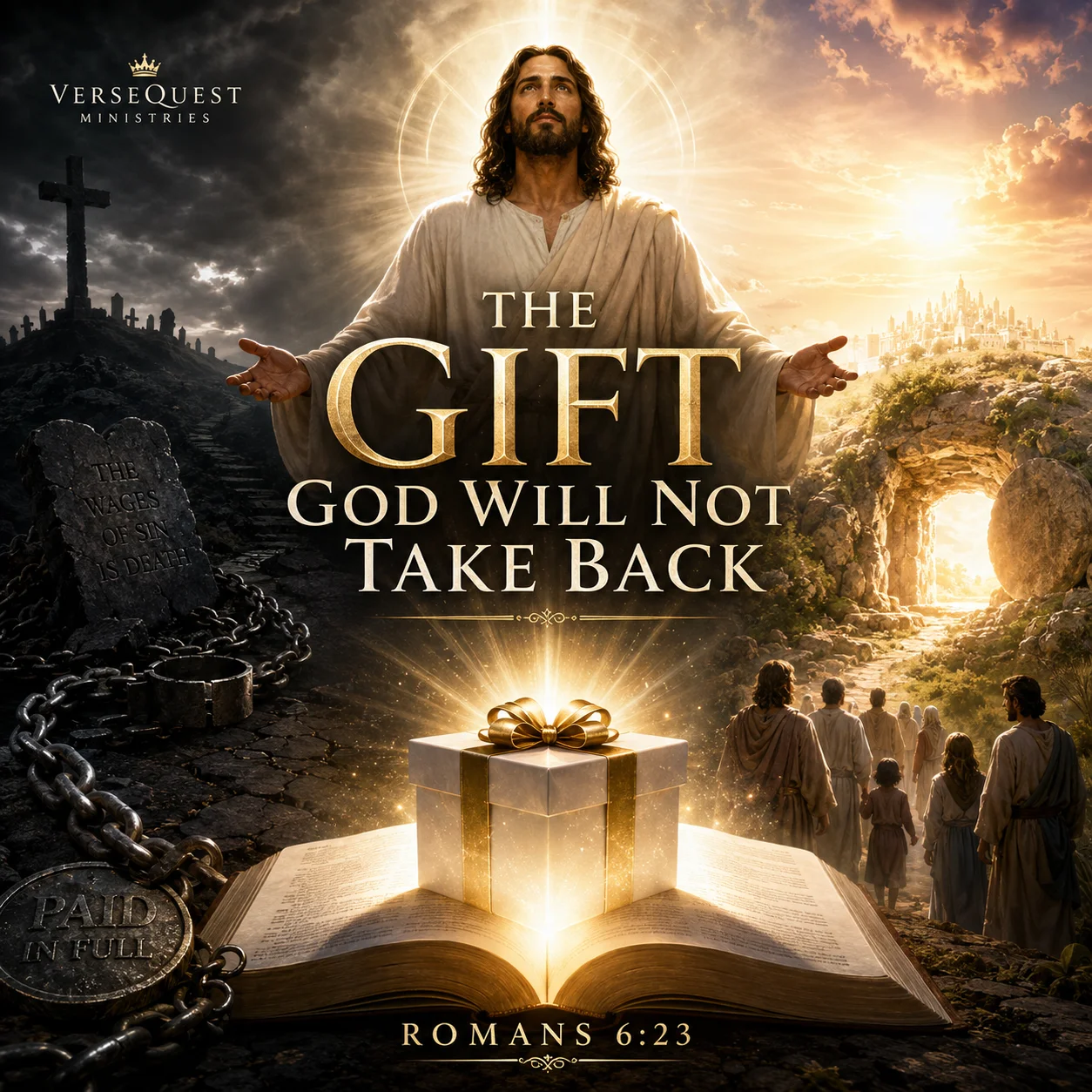
The Gift God Will Not Take Back: Eternal Life Through Jesus Christ Our Lord
Key Passage:
Romans 6:23 — “For the wages of sin is death; but the gift of God is eternal life through Jesus Christ our Lord.”
Series:
Foundations of the Gospel of Grace
Topic:
Eternal Life as the Free Gift of God and the Security of the Believer in Jesus Christ
Book:
Romans, Ephesians, John, Titus, 1 John, 2 Timothy, Colossians, Galatians, 1 Corinthians
Speaker:
Paul Tackett
Suggested Sermon Text:
Romans 6:1–23; Romans 5:15–21; Romans 8:1, 31–39; Ephesians 2:8–9; John 3:16; John 5:24; John 10:27–30; Titus 3:5–7; 1 John 5:11–13; 2 Timothy 1:12; 2 Timothy 2:13; Colossians 2:13–14; 1 Corinthians 15:1–4; Galatians 2:16
Short Sermon Description:
This detailed VerseQuest Ministries sermon outline explains the gospel truth of Romans 6:23: “the wages of sin is death; but the gift of God is eternal life through Jesus Christ our Lord.” The verse contrasts what man has earned through sin with what God freely gives through Christ. Death is the wage sin pays; eternal life is the gift grace gives. This sermon shows that eternal life is not a temporary lease, probationary salvation, religious reward, or fragile blessing dependent upon human merit, but God’s free gift through the finished work of Jesus Christ. It explains the difference between wages and gifts, the meaning of eternal life, why salvation cannot be earned or maintained by works, why the believer is secure in Christ, and why grace does not excuse sin but delivers the believer from sin’s dominion. Designed for pastors, preachers, teachers, Bible students, and believers, this outline defends the gospel of grace, eternal security, and the sufficiency of Christ’s death, burial, and resurrection.
The Gift God Will Not Take Back
Eternal Life Through Jesus Christ Our Lord
Introduction
Romans 6:23 is one of the clearest gospel verses in the King James Bible because it divides all men into two realities: wages and gift, sin and God, death and eternal life, Adam and Christ. “For the wages of sin is death; but the gift of God is eternal life through Jesus Christ our Lord.” A wage is what a man earns. A gift is what a man receives. Sin pays wages. God gives a gift. Death is earned. Eternal life is given. The verse does not say the wages of sin is inconvenience, temporary discomfort, social embarrassment, religious uncertainty, or a bad self-image. It says death. And it does not say the reward of religious effort is eternal life. It says “the gift of God is eternal life through Jesus Christ our Lord.”
This verse destroys two great lies at once. First, it destroys the lie that sin is harmless. Sin pays, and its paycheck is death. It pays in the conscience, the body, the home, the heart, the grave, and finally in judgment if the sinner remains outside Christ. Second, it destroys the lie that salvation is earned. Eternal life is not the salary of a church worker, the medal of a religious performer, the bonus of a moral reformer, or the retirement package of a law-keeper. It is “the gift of God.” Religion keeps trying to turn the gift into wages because flesh loves to boast. Grace keeps pointing to Christ because salvation belongs entirely to Him.
The subject is not merely whether a sinner can receive eternal life, but whether eternal life is actually eternal. If God gives “eternal life,” and then takes it away the next time the believer fails, the Bible’s words have been emptied of meaning. If eternal life can become temporary life, then “eternal” means whatever a nervous denomination needs it to mean. But God does not speak like a confused theologian trying to protect his system. He says “eternal life.” The gift is in Jesus Christ. The believer’s life is bound up in Christ, secured by Christ, kept by Christ, and promised by Christ. The gift God gives in Christ is not a rented blessing with a revocation clause hidden in small print.
I. Sin Pays Wages, and the Wage Is Death
Key Text: Romans 6:23
Supporting Texts: Romans 5:12; James 1:15; Ezekiel 18:20; Genesis 2:17
Paul begins with the bad news: “For the wages of sin is death.” Sin is not a charity. Sin is an employer, and it always pays its servants. The world advertises sin as liberty, pleasure, self-expression, independence, and personal fulfillment. God exposes the contract. Sin pays death. The Devil may decorate the road, polish the chains, and put music in the waiting room, but the final paycheck is always the same. “The wages of sin is death.”
Romans 5:12 says, “by one man sin entered into the world, and death by sin.” Death is not natural in the sense of being God’s original blessing upon creation. Death entered because sin entered. Adam sinned, and the grave opened. Every funeral, every hospital room, every aging body, every broken heart, every cemetery, and every obituary preaches Romans 6:23 whether men listen or not. The world calls death a transition, a celebration of life, or the cycle of nature. The Bible calls it wages.
Sin’s payment is more than physical death. It includes spiritual death and, for the lost, the second death. A sinner outside Christ is already dead in trespasses and sins, living under condemnation even while breathing God’s air. If he dies without Christ, the final wage is the lake of fire. Sin never pays what it promised. It promises life and pays death. It promises freedom and pays bondage. It promises satisfaction and pays emptiness. The sinner who serves sin will be paid by sin, and sin’s payroll office has never bounced a check.
Main Truth:
Sin always pays its servants, and the full wage of sin is death.
II. Eternal Life Is a Gift, Not a Wage
Key Text: Romans 6:23
Supporting Texts: Ephesians 2:8–9; Romans 4:4–5; Titus 3:5; Romans 11:6
Paul does not say the wages of righteousness is eternal life. He says, “the gift of God is eternal life.” That wording is not accidental. A wage is earned. A gift is received. Romans 4:4 says, “Now to him that worketh is the reward not reckoned of grace, but of debt.” If salvation were earned by works, God would owe it as a debt. But God owes sinners nothing but judgment. Eternal life comes as a gift because Jesus Christ paid what sinners could never pay.
Ephesians 2:8–9 says, “For by grace are ye saved through faith… Not of works, lest any man should boast.” Religion cannot tolerate that because religion survives by giving man something to do, count, display, and boast in. Baptism, sacraments, law-keeping, church membership, moral reform, penance, rituals, and endurance are all dragged to the foundation by men who cannot bear the humility of receiving a gift. But the verse says “gift.” A gift that must be earned is not a gift. A gift that must be maintained by wages is not a gift. A gift that can be repossessed because the recipient was weak is not eternal life.
Titus 3:5 says, “Not by works of righteousness which we have done, but according to his mercy he saved us.” God did not save believers because He saw enough merit in them to justify the transaction. He saved them according to mercy, by grace, through Christ. Romans 11:6 says if it is by grace, it is no more of works. Grace and works cannot share the throne of salvation. One must rule, and in Paul’s gospel, grace reigns through righteousness unto eternal life by Jesus Christ our Lord.
Main Truth:
Eternal life is God’s free gift in Christ, not a wage earned by religious effort or human merit.
III. The Gift Comes Through Jesus Christ Our Lord
Key Text: Romans 6:23
Supporting Texts: John 14:6; Acts 4:12; 1 Timothy 2:5–6; 1 Corinthians 15:1–4
The gift of God is not handed out through every religious system on earth. Romans 6:23 says eternal life comes “through Jesus Christ our Lord.” That phrase shuts the door on universalism, sacramentalism, religious pluralism, and every man-made path to God. Eternal life is not through Mary, not through a priest, not through a pope, not through a denomination, not through a water ceremony, not through Moses, not through a religious institution, and not through human sincerity. It is through Jesus Christ our Lord.
Jesus Christ is the only sufficient Saviour because He alone did the saving work. First Corinthians 15:3–4 defines the gospel: Christ died for our sins, was buried, and rose again the third day according to the Scriptures. He paid the debt. He bore the sin. He shed the blood. He satisfied justice. He conquered death. He rose bodily from the grave. A sinner receives eternal life through Christ because Christ alone has life, righteousness, redemption, and resurrection power.
Acts 4:12 says, “Neither is there salvation in any other.” John 14:6 says, “no man cometh unto the Father, but by me.” First Timothy 2:5 says there is “one mediator between God and men, the man Christ Jesus.” God did not provide twelve roads, seven sacraments, five religious ladders, and one optional Saviour. He provided one Lord Jesus Christ. The gift is exclusive because the Redeemer is exclusive. The sinner either receives eternal life through Christ or remains under the wages of sin.
Main Truth:
Eternal life is given only through the Lord Jesus Christ and His finished gospel work.
IV. Eternal Life Means Eternal Life
Key Text: Romans 6:23
Supporting Texts: John 3:16; John 5:24; John 10:27–30; 1 John 5:11–13
The verse says “eternal life.” It does not say temporary life, conditional life, probationary life, revocable life, denominational life, or life until the next failure. Eternal means eternal. If the life God gives can be lost, forfeited, revoked, or cancelled after being received, then the word “eternal” has been robbed. God does not give the believer a spiritual trial subscription. He gives eternal life.
John 5:24 is one of the strongest verses on this truth: “He that heareth my word, and believeth on him that sent me, hath everlasting life, and shall not come into condemnation; but is passed from death unto life.” Notice the threefold strength. The believer “hath” everlasting life as a present possession. He “shall not come into condemnation” as a future security. He “is passed from death unto life” as a completed transfer. That is not shaky language. That is divine certainty.
First John 5:13 says believers may “know” that they have eternal life. God does not want His saints living under a cloud of religious suspense, wondering whether the next bad day will undo Calvary. The believer’s confidence is not in his flesh, his mood, his discipline, or his consistency. It is in the Son of God. John 10 says Christ’s sheep shall never perish, and no man can pluck them out of His hand. Eternal life is as secure as the Shepherd who gives it.
Main Truth:
Eternal life is a present, permanent possession of the believer because God gives exactly what He promises.
V. The Gift Is Secured by Christ’s Finished Work, Not the Believer’s Performance
Key Text: Romans 6:23
Supporting Texts: Colossians 2:13–14; Hebrews 10:10–14; Romans 8:1; Ephesians 1:13–14
The gift God gives is secured by the finished work of Jesus Christ. Colossians 2:13–14 says God has forgiven all trespasses, blotted out the handwriting of ordinances that was against us, took it out of the way, and nailed it to Christ’s cross. If all trespasses are forgiven, then the believer is not living under a remaining unpaid balance. If the handwriting was blotted out, no religious debt collector has authority to reopen the account. If the debt was nailed to the cross, it is not waiting to be collected at the next failure.
Hebrews 10:14 says, “For by one offering he hath perfected for ever them that are sanctified.” One offering. Perfected forever. That is not the language of religious uncertainty. Christ did not make a partial offering that must be completed by sacraments, law-keeping, confession booths, repeated sacrifices, or personal merit. His one offering accomplished what endless religious effort could never do.
Ephesians 1:13–14 says believers are sealed with the Holy Spirit of promise after believing the gospel. The Spirit is the earnest of the inheritance until the redemption of the purchased possession. God does not seal a man unto the next mistake. Ephesians 4:30 says believers are sealed unto the day of redemption. The security of eternal life rests on Christ’s work, God’s promise, and the Spirit’s seal. That is stronger than the trembling grip of human performance.
Main Truth:
The believer’s eternal life is secured by Christ’s finished work, not by the believer’s unstable performance.
VI. Eternal Security Does Not Give Freedom to Sin
Key Text: Romans 6:1–2
Supporting Texts: Romans 6:11–14; Titus 2:11–14; Galatians 5:13; 2 Corinthians 5:14–15
Every time grace is preached clearly, some legalist pops up like a prairie dog and asks, “So you’re saying people can just go sin?” Paul answered that lazy accusation before the ink was dry on Romans: “Shall we continue in sin, that grace may abound? God forbid.” Eternal security is not freedom to sin. It is freedom from condemnation so the believer can serve Christ from love, gratitude, and new life rather than terror of losing salvation.
Romans 6 teaches that the believer is dead to sin and alive unto God through Jesus Christ our Lord. Sin shall not have dominion over him because he is not under the law, but under grace. That verse is often abused by both sides. The legalist fears grace because he thinks law is the only thing keeping people holy. The lawless man abuses grace because he wants excuse for the flesh. Paul rejects both. Grace does not excuse sin; grace dethrones sin.
Titus 2:11–12 says the grace of God that brings salvation teaches us to deny ungodliness and worldly lusts. Grace is not a permission slip for the flesh. It is a teacher. It teaches holiness better than law ever could because it begins with a new standing and a new life in Christ. The believer does not obey to keep eternal life; he obeys because eternal life has been given. He does not work to become accepted; he works because he is accepted in the Beloved.
Main Truth:
Eternal security does not excuse sin; it establishes the believer in grace so he can serve Christ from new life and gratitude.
VII. God Chastens His Children, but He Does Not Unbirth Them
Key Text: Hebrews 12:6
Supporting Texts: 1 Corinthians 11:30–32; Galatians 6:7–8; 2 Timothy 2:13; Romans 8:15–17
The fact that eternal life cannot be lost does not mean sin has no consequences. God chastens His children. Hebrews 12:6 says, “For whom the Lord loveth he chasteneth, and scourgeth every son whom he receiveth.” Chastening proves sonship; it does not cancel sonship. A father may correct his child, but correction is not the same as disowning. God deals with saved men as sons, not as strangers.
First Corinthians 11 shows that some believers were weak, sickly, and even dead because of sin connected to the Lord’s supper. That is serious. God can judge sin in a believer’s life severely. Galatians 6 says a man reaps what he sows. Sin can wreck fellowship, ruin testimony, destroy joy, damage the body, cost rewards, invite chastening, and bring shame. But chastening is not the same as eternal condemnation. Romans 8:1 says there is no condemnation to them which are in Christ Jesus.
Second Timothy 2:13 says, “If we believe not, yet he abideth faithful: he cannot deny himself.” The believer is in Christ. God does not deny His own Son because a member of the Body fails. This does not make failure acceptable; it makes Christ faithful. Eternal security rests on God’s faithfulness, not man’s flawless record. A saved man should fear sin because God is holy, not because eternal life is a fragile glass ornament dangling from the flesh.
Main Truth:
God may chasten His children for sin, but He does not revoke eternal life or cast them out of Christ.
VIII. The Gift Cannot Be Separated From the Giver
Key Text: 1 John 5:11–12
Supporting Texts: Colossians 3:3–4; John 10:28–30; Romans 8:38–39
First John 5:11–12 says, “God hath given to us eternal life, and this life is in his Son. He that hath the Son hath life.” Eternal life is not an object God tosses into the sinner’s pocket apart from Christ. The life is in the Son. The believer has eternal life because he has Christ. To lose eternal life, the believer would have to be separated from Christ, removed from His Body, unsealed by the Spirit, unborn from God’s family, and severed from the risen Head. Scripture teaches no such thing for the Church-age believer.
Colossians 3:3 says, “your life is hid with Christ in God.” That is security stacked inside security. The believer’s life is not hidden in his church attendance, his emotional consistency, his daily performance, or his ability to remember every sin in confession. It is hid with Christ in God. If the Devil wants the believer’s life, he has to get through God and Christ first. That is a bad day for the Devil.
Romans 8 says nothing can separate believers from the love of God which is in Christ Jesus our Lord. Death cannot. Life cannot. Angels cannot. Principalities cannot. Powers cannot. Things present cannot. Things to come cannot. Height, depth, nor any other creature can do it. Any doctrine that makes the believer separable from Christ must crawl over Romans 8 to get there. The gift is secure because the Giver is secure, and the life is in the Son.
Main Truth:
The believer’s eternal life is secure because that life is in Christ and cannot be separated from Him.
IX. The Gift Produces Service, Worship, and Hope
Key Text: Romans 6:22–23
Supporting Texts: Ephesians 2:10; 1 Corinthians 6:20; Titus 3:8; 2 Corinthians 5:14–15
Romans 6 does not end with grace leading to laziness. Verse 22 says believers are made free from sin and become servants to God, having fruit unto holiness and the end everlasting life. The gift of eternal life does not produce spiritual idleness when understood properly. It produces service. The believer has been freed from sin’s wages and given life in Christ; therefore, he should live as a man purchased by grace.
Ephesians 2:10 says believers are created in Christ Jesus unto good works. Works do not cause salvation, but they should follow it. First Corinthians 6:20 says believers are bought with a price and should glorify God in body and spirit. Titus 3:8 says those who believe in God should be careful to maintain good works. Grace gives the foundation, and gratitude builds upon it. Good works are not the root of eternal life; they are fruit from it.
The gift also produces hope. A believer who knows he has eternal life can serve without fear-driven bondage. He can endure suffering, resist sin, confess failure, get back up, and keep preaching because his standing rests in Christ. Uncertainty does not create holiness; it creates either despair or hypocrisy. Assurance creates grateful service. The man who knows he has been given eternal life should spend his remaining earthly life magnifying the Giver.
Main Truth:
The gift of eternal life produces holiness, service, worship, and hope in the believer who understands grace.
Conclusion
Romans 6:23 divides the whole matter with divine simplicity: “For the wages of sin is death; but the gift of God is eternal life through Jesus Christ our Lord.” Sin pays death. God gives eternal life. Death is earned. Eternal life is received. The sinner brings the problem; Christ provides the answer. Religion tries to turn the gift back into wages, but the Bible refuses to cooperate with man’s pride.
Eternal life is not a temporary arrangement. It is not probation. It is not a fragile emotional experience. It is not a denominational privilege. It is not a reward for law-keeping, baptism, sacraments, or religious effort. It is the gift of God through Jesus Christ our Lord. Christ died for our sins, was buried, and rose again. The believer is sealed, forgiven, justified, placed in Christ, and given life in the Son. God does not give eternal life and then rename it temporary life.
The Church must preach this truth boldly and responsibly. Eternal security is not a license to sin; it is the foundation of grateful service. Grace does not make sin harmless; Calvary proves sin was so deadly that only the blood of Christ could answer it. The believer should live holy, serve faithfully, preach clearly, and worship deeply because the gift he has received cannot be bought, earned, or lost. The gift God gives in Christ is eternal life, and God does not need religious men to attach return policies to His promises.
Final Call
The sinner outside Christ is earning wages every day, and the final wage is death. No religion can change that payroll. No church membership can erase sin. No baptism can purchase life. No moral reform can cancel guilt. The sinner needs the gift of God.
Jesus Christ died for our sins according to the Scriptures. He was buried. He rose again the third day according to the Scriptures. Through Him, God offers eternal life as a free gift. Believe on the Lord Jesus Christ, and thou shalt be saved.
Believer, rejoice in the gift and live like a man who belongs to the Giver. Stop letting legalists rename eternal life as temporary life. Stop letting fear replace gratitude. Stand in grace, reckon yourself alive unto God, resist sin, serve Christ, and tell sinners that the gift of God is eternal life through Jesus Christ our Lord.
Closing Verse:
1 John 5:11 — “And this is the record, that God hath given to us eternal life, and this life is in his Son.”
Closing Statement:
Sin pays death as wages, but God gives eternal life as a gift—and what God gives in Jesus Christ, no wage-earning religion has authority to take away.