Sermon Title:
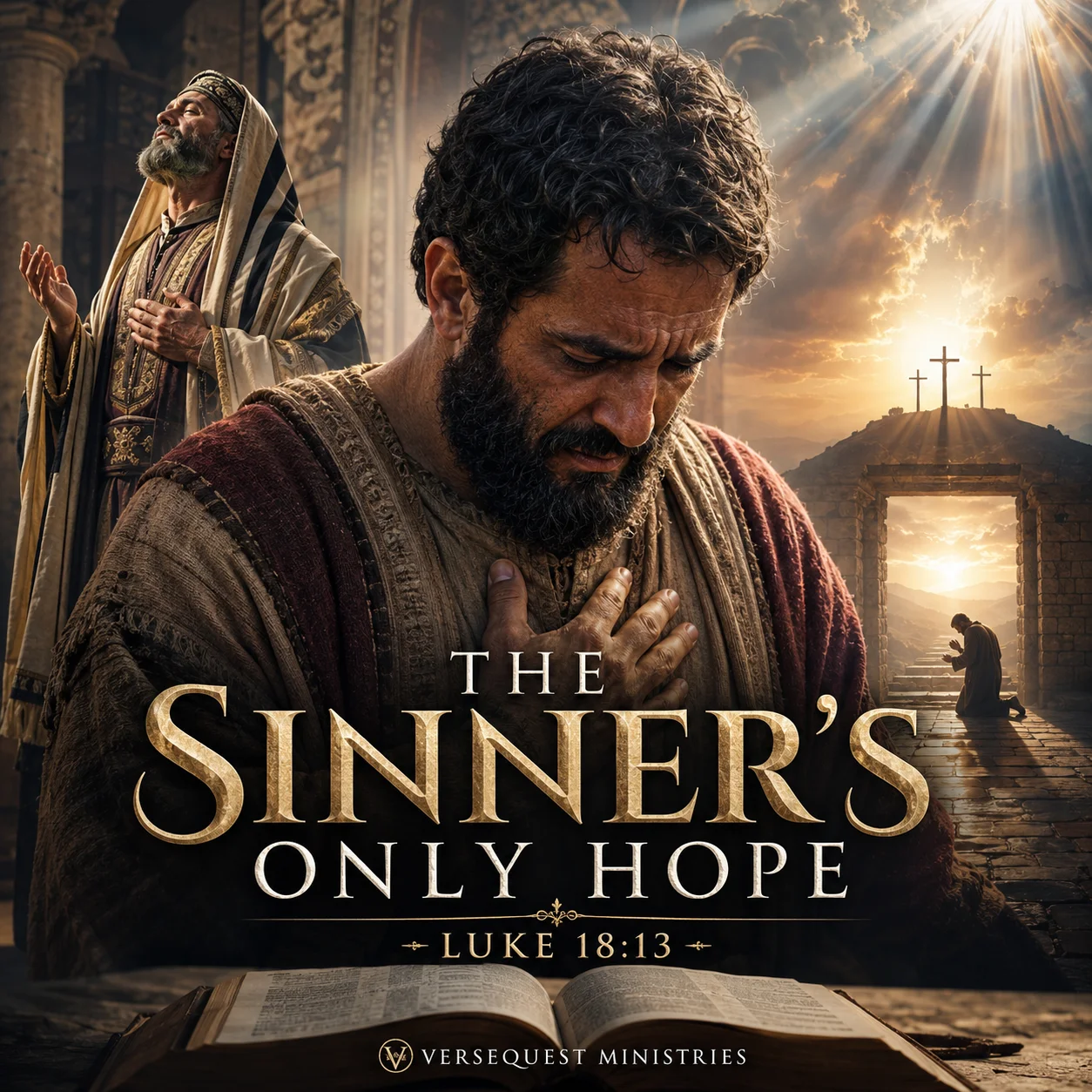
The Sinner’s Only Hope: God Be Merciful to Me a Sinner
Key Passage:
Luke 18:13 — “And the publican, standing afar off, would not lift up so much as his eyes unto heaven, but smote upon his breast, saying, God be merciful to me a sinner.”
Series:
Foundations of the Gospel of Grace
Topic:
The Sinner’s Helpless Condition and the Mercy of God as the Only Hope of Salvation
Book:
Luke, Romans, Ephesians, Titus, 1 Corinthians, 1 Timothy, John, Psalms
Speaker:
Paul Tackett
Suggested Sermon Text:
Luke 18:9–14; Romans 3:9–28; Romans 4:4–8; Romans 5:6–11; Ephesians 2:1–9; Titus 3:3–7; 1 Timothy 1:15–16; Psalm 51:1–4; Isaiah 53:4–6; John 3:16–18; Acts 16:30–31; 1 Corinthians 15:1–4; 2 Corinthians 5:21
Short Sermon Description:
This detailed VerseQuest Ministries sermon outline explains Luke 18:13 and the desperate cry of the publican: “God be merciful to me a sinner.” The passage exposes the difference between religious self-righteousness and true repentance before God. The Pharisee trusted in himself that he was righteous, compared himself with other sinners, rehearsed his religious record, and went home unjustified. The publican stood afar off, would not lift up his eyes, smote upon his breast, confessed himself a sinner, and cast himself upon the mercy of God. This sermon shows that the sinner’s only hope is not religion, morality, fasting, tithing, church membership, sacraments, law-keeping, self-reform, or comparison with others, but the mercy of God provided through the blood, death, burial, and resurrection of Jesus Christ. Designed for pastors, preachers, teachers, Bible students, and believers, this outline magnifies justification by faith, exposes the danger of religious pride, and points sinners to the only Saviour who can save the guilty.
The Sinner’s Only Hope
God Be Merciful to Me a Sinner
Introduction
Luke 18:13 is not the prayer of a man trying to polish his religious reputation. It is not the language of a respectable churchman arranging his virtues on a shelf so God can admire them. It is the cry of a guilty sinner who has run out of self-defense, self-improvement, self-comparison, and self-congratulation. “God be merciful to me a sinner.” That prayer has no decorations. It has no boasting, no excuses, no bargaining, no religious résumé, no promise to turn over a leaf and present the leaf as payment. It is short because the man’s pride has been broken. It is direct because the man’s danger is real. It is honest because the sinner finally sees himself before God instead of measuring himself against another sinner.
The passage begins with a warning: Jesus “spake this parable unto certain which trusted in themselves that they were righteous, and despised others.” That is the oldest religious disease in the world. A man looks at his ceremonies, his discipline, his donations, his morality, his denomination, his fasting, his tithing, his separation, his religious habits, and then he looks down at someone else and says, “God, I thank thee, that I am not as other men are.” Self-righteousness does not need a Bible to be dangerous, but when it borrows Bible language it becomes twice as poisonous. The Pharisee had religion, prayer, fasting, tithing, public morality, and confidence. The publican had nothing but guilt and a plea for mercy. Yet Jesus said the publican went down to his house justified rather than the other.
That is a dagger in the ribs of every religion built on human merit. God justified the man with no boast and rejected the man with the religious speech. The Pharisee stood near and went home lost. The publican stood afar off and went home justified. The Pharisee bragged about what he had done. The publican cried for what God alone could do. The Pharisee compared himself to other men. The publican saw himself before God. The sinner’s only hope is not to become better than the publican beside him, but to be shown mercy by the God above him. Heaven is not opened by the key of self-righteousness. It is opened by mercy grounded in the blood of Jesus Christ.
I. The Parable Exposes Religious Self-Trust
Key Text: Luke 18:9
Supporting Texts: Proverbs 30:12; Romans 10:3; Philippians 3:4–9
Luke 18:9 tells us exactly who this parable targets: those “which trusted in themselves that they were righteous.” That is the heart of false religion. The sinner trusts himself. He may mention God, quote Scripture, attend worship, give money, fast, pray, and condemn public wickedness, but underneath the activity sits a throne, and self is sitting on it with a hymnbook in its hand. Religious self-trust is still self-trust. It does not become safer because it wears a suit and carries a Bible.
Romans 10:3 says Israel, “being ignorant of God’s righteousness, and going about to establish their own righteousness, have not submitted themselves unto the righteousness of God.” That is exactly what the Pharisee does. He establishes his own righteousness. He has a list. He has comparisons. He has visible disciplines. He has religious achievements. He has a speech ready for God. But a sinner presenting his own righteousness before God is like a bankrupt man walking into court with counterfeit money and expecting the Judge to be impressed.
Philippians 3 shows Paul taking his religious credentials and counting them loss for Christ. Circumcision, Hebrew bloodline, Pharisaical zeal, legal blamelessness, and religious status could not justify him. He needed to be found in Christ, “not having mine own righteousness.” That is the difference between the Pharisee and the publican. The Pharisee had his own righteousness. The publican knew he had none. A man cannot receive the righteousness of God while still hugging his own righteousness like a life raft made of paper.
Main Truth:
Religious self-trust is deadly because it keeps a sinner clinging to his own righteousness instead of submitting to the righteousness of God.
II. The Pharisee Had Religion Without Justification
Key Text: Luke 18:11–12
Supporting Texts: Matthew 23:25–28; Romans 3:20; Isaiah 64:6
The Pharisee “stood and prayed thus with himself.” That phrase is a sermon all by itself. He talked toward God, but the conversation circled around himself. “I thank thee.” “I am not.” “I fast.” “I give.” His prayer had God’s name at the beginning, but self was the subject, object, and centerpiece. That is religious narcissism dressed up as worship. He did not come to be examined by God. He came to present his exhibit of personal virtue.
He was not a drunkard, extortioner, adulterer, or outwardly scandalous man. He fasted twice in the week. He gave tithes of all he possessed. By modern church standards, he would be placed on committees, asked to teach a class, invited to speak at banquets, and congratulated for his dedication. But Jesus said he did not go home justified. That means a man can have visible religion, moral separation, financial giving, public prayer, and disciplined habits while remaining lost under the wrath of God.
Romans 3:20 says, “Therefore by the deeds of the law there shall no flesh be justified in his sight.” The Pharisee’s problem was not that he lacked religion. His problem was that he trusted it. Isaiah 64:6 says, “all our righteousnesses are as filthy rags.” Not merely our sins, but our righteousnesses. The best a sinner can produce from Adam’s flesh cannot stand before God’s holiness. Religion may impress men, but it cannot justify the soul.
Main Truth:
A man may possess impressive religion and outward morality while remaining unjustified before God.
III. The Publican Saw Himself as Guilty Before God
Key Text: Luke 18:13
Supporting Texts: Romans 3:23; Psalm 51:3–4; 1 Timothy 1:15
The publican stood afar off. He would not lift up so much as his eyes unto heaven. He smote upon his breast. Everything about his posture says he knows he has no claim, no merit, no righteousness, and no excuse. He does not compare himself with the Pharisee. He does not say, “At least I am honest about my sin, unlike that hypocrite over there.” The moment a sinner brags about humility, humility has already left the room. This man’s concern is not the Pharisee’s pride. His concern is his own guilt before God.
Romans 3:23 says, “For all have sinned, and come short of the glory of God.” The publican does not need to be convinced that he is part of the “all.” He knows it. Psalm 51 records David saying, “Against thee, thee only, have I sinned, and done this evil in thy sight.” Sin may harm people, wreck families, damage testimony, and corrupt society, but ultimately sin is against God. The publican sees that. He is not merely embarrassed. He is guilty.
First Timothy 1:15 says, “Christ Jesus came into the world to save sinners; of whom I am chief.” Paul did not say Christ came to congratulate religious performers. He came to save sinners. The sinner who cannot honestly take that name has not yet stood where the publican stood. The doorway of mercy is low, and proud men crack their skulls trying to walk through it upright. The publican stooped because truth had finally done its work.
Main Truth:
The sinner’s hope begins when he stops defending himself and honestly confesses his guilt before God.
IV. The Publican Pleaded for Mercy, Not Merit
Key Text: Luke 18:13
Supporting Texts: Titus 3:5; Ephesians 2:4–5; Romans 9:16
The publican prayed, “God be merciful to me a sinner.” He did not ask God to notice his improvement. He did not ask God to consider his circumstances. He did not ask God to weigh his good deeds against his bad deeds. He did not promise God a future record in exchange for present acceptance. He pleaded for mercy. Mercy is what a guilty man needs when justice would condemn him.
Titus 3:5 says, “Not by works of righteousness which we have done, but according to his mercy he saved us.” That verse is the death bell of every religious merit system. Works of righteousness cannot save. Baptism cannot save. Sacraments cannot save. Fasting cannot save. Tithing cannot save. Confession to a man cannot save. Mercy saves because Christ has provided the righteous basis for mercy through His finished work.
Ephesians 2 says God is “rich in mercy.” That is good news because sinners are rich in guilt. God’s mercy is not sentimental weakness. God does not save by pretending sin is harmless. Mercy flows through the blood of Christ. The publican in Luke 18 cries for mercy before Calvary is historically accomplished, but the only reason God can justify any sinner, before or after the cross, is the blood of Jesus Christ. Mercy is not God ignoring the debt; mercy is God providing the payment in His Son.
Main Truth:
The sinner’s only plea is mercy, because no human merit can answer guilt before a holy God.
V. The Publican Went Home Justified
Key Text: Luke 18:14
Supporting Texts: Romans 3:24; Romans 4:5; Romans 5:1
Jesus said, “I tell you, this man went down to his house justified rather than the other.” That statement overturns man-made religion in one sentence. The publican brought no religious achievements in the parable. He brought no list of fasting, tithing, morality, or comparison. He brought guilt and a plea for mercy. Yet Jesus said he went home justified. The Pharisee went to the temple and returned with his pride intact and his soul unjustified. The publican went home with God’s verdict.
Justification is God’s declaration that the believing sinner is righteous before Him. Romans 3:24 says believers are “justified freely by his grace through the redemption that is in Christ Jesus.” Romans 4:5 says God justifies the ungodly who believe. That phrase “justifieth the ungodly” is too strong for religious pride. Religion wants God to justify the improved, the disciplined, the sacramental, the baptized, the law-keeping, and the respectable. The Bible says God justifies the ungodly who believe.
Romans 5:1 says, “Therefore being justified by faith, we have peace with God through our Lord Jesus Christ.” The publican’s justification points forward to the same foundation Paul explains fully: faith, grace, redemption, blood, and Christ. No sinner is justified because God lowered the standard. He is justified because Christ met the standard, bore the sin, shed the blood, died, was buried, and rose again. Mercy gives the verdict because redemption paid the price.
Main Truth:
God justifies the sinner who comes by faith and mercy, not the religious man who trusts his own righteousness.
VI. The Pharisee’s Comparison Could Not Save Him
Key Text: Luke 18:11
Supporting Texts: 2 Corinthians 10:12; Romans 2:1–3; Galatians 6:3
The Pharisee said, “God, I thank thee, that I am not as other men are.” Comparison is the drug of self-righteousness. A man can always find someone worse than himself if he shops long enough. The drunkard compares himself to the murderer. The adulterer compares himself to the child abuser. The churchgoer compares himself to the drunkard. The Pharisee compares himself to the publican. But God does not judge sinners by grading on a curve against other sinners. He judges by His own righteousness.
Second Corinthians 10:12 warns that those “measuring themselves by themselves, and comparing themselves among themselves, are not wise.” Comparison is not wisdom; it is spiritual blindness. If a man falls into a pit, it does not help him that another man fell deeper. If a man is poisoned, it does not save him that another man swallowed more. If a man is condemned, it does not justify him that another criminal has a longer record. Relative righteousness is useless before absolute holiness.
Romans 2 says the man who judges another and does the same things condemns himself. The Pharisee’s comparison was a smokescreen. The publican’s sins were visible and socially despised; the Pharisee’s sins were respectable and religiously perfumed. But pride can damn a man just as surely as extortion. Self-righteousness can keep a man out of heaven while he thanks God he is not like the sinners who never claimed to be saints.
Main Truth:
Comparing oneself with other sinners cannot save, because God judges by His holiness, not by human rankings.
VII. Mercy Is Found Only Through the Sacrifice of Christ
Key Text: Luke 18:13
Supporting Texts: Romans 3:25; Hebrews 9:22; 1 Corinthians 15:3–4
The publican cried, “God be merciful to me a sinner.” The word behind that plea carries the idea of propitiation—mercy grounded in sacrifice. This is not a man asking God to act unjustly. He is asking God to deal with him according to mercy, and the Bible later shows the full basis of that mercy in the blood of Jesus Christ. Romans 3:25 says God set forth Christ “to be a propitiation through faith in his blood.” That is where mercy and justice meet.
Hebrews 9:22 says, “without shedding of blood is no remission.” God does not forgive sinners because sin is a small matter. He forgives because the blood has answered the matter. In the Old Testament, the mercy seat was connected with blood. Sacrifice pointed forward to Christ. Every lamb, every altar, every priest, every blood-sprinkled mercy seat declared that sin requires death and mercy requires a righteous basis. The publican’s plea finds its ultimate answer at Calvary.
First Corinthians 15:3–4 gives the gospel by which sinners are saved: Christ died for our sins, was buried, and rose again the third day according to the Scriptures. That is the mercy of God in historical form. The sinner’s only hope is not vague pity from heaven, but blood-bought mercy through the Lord Jesus Christ. God can be merciful to sinners because Christ became the Substitute for sinners. The sinner’s cry is answered by the Saviour’s cross.
Main Truth:
God’s mercy toward sinners is righteous because Jesus Christ shed His blood, died for our sins, was buried, and rose again.
VIII. The Humbled Sinner Is Exalted by Grace
Key Text: Luke 18:14
Supporting Texts: James 4:6; 1 Peter 5:5–6; Psalm 34:18
Jesus concludes, “for every one that exalteth himself shall be abased; and he that humbleth himself shall be exalted.” The Pharisee exalted himself and went home unjustified. The publican humbled himself and went home justified. That is not salvation by humility as a work. It is the necessary collapse of pride before receiving mercy. A proud man will not receive grace because he does not think he needs it. A humbled sinner has stopped arguing with the diagnosis.
James 4:6 says, “God resisteth the proud, but giveth grace unto the humble.” Pride puts a man in opposition to God. Religious pride is especially wicked because it uses God’s name while rejecting God’s righteousness. It prays, fasts, gives, and performs while secretly demanding admiration. Humility bows before the verdict of Scripture and says, “God is right about me.” That is where grace meets the sinner.
Psalm 34:18 says, “The LORD is nigh unto them that are of a broken heart.” God is not impressed by religious swagger. He is not moved by spiritual peacocks spreading doctrinal feathers while their hearts remain untouched. The publican had no feathers left. He was broken. He smote upon his breast because the trouble was inside him. Grace exalts the man who quits pretending he can climb.
Main Truth:
God gives grace to the humbled sinner who stops exalting himself and casts himself upon divine mercy.
IX. The Gospel Gives the Sinner the Mercy He Needs
Key Text: 1 Timothy 1:15–16
Supporting Texts: Acts 16:30–31; John 3:16–18; Ephesians 2:8–9
First Timothy 1:15 says, “Christ Jesus came into the world to save sinners.” That is the answer to Luke 18:13. The publican cried for mercy, and the gospel reveals the Saviour who provides it. Jesus Christ did not come to decorate religious achievers. He came to save sinners. If a man will not admit he is a sinner, he will never appreciate the Saviour. The sick need the physician. The lost need the Shepherd. The guilty need mercy. The dead need life.
Acts 16:31 says, “Believe on the Lord Jesus Christ, and thou shalt be saved.” That is not “believe plus become a Pharisee.” It is not “believe plus religious achievement.” It is not “believe plus compare yourself favourably with publicans.” Salvation is by grace through faith, not of works, lest any man should boast. The publican had no boast, and that made him closer to justification than the Pharisee with a mouth full of religious credentials.
John 3:16 says God gave His only begotten Son so that whosoever believeth in Him should not perish, but have everlasting life. That is mercy reaching sinners through Christ. The sinner’s only hope is to come to God with no claim but the blood of Jesus Christ, no plea but mercy, no confidence but the finished work, and no righteousness but the righteousness of God in Christ. The gospel does not help sinners save themselves. It announces that Christ saves sinners completely.
Main Truth:
The gospel of Jesus Christ gives the guilty sinner the mercy, forgiveness, righteousness, and eternal life he cannot provide for himself.
Conclusion
Luke 18:13 shows a man standing where every sinner must stand if he is going to be saved: guilty before God, stripped of boasting, done with comparison, and crying for mercy. The publican did not bring the language of self-esteem. He did not bring the trophies of religion. He did not bring a list of improvements. He brought the truth: “God be merciful to me a sinner.” That prayer did not justify him because the words were magical. It revealed a heart that had abandoned self-righteousness and cast itself upon the mercy of God.
The Pharisee warns us that religion can be deadly when it becomes a hiding place for pride. He prayed, but he prayed with himself. He thanked God, but only as a polite way of congratulating himself. He avoided certain outward sins, but he did not escape the inward sin of self-righteousness. He saw the publican but did not see himself. He measured himself by another sinner and never faced the holiness of God. He went to the temple and left unjustified. That is one of the most terrifying thoughts in Scripture: a man can go to the place of worship, perform religious duties, speak religious words, and leave without justification.
The publican’s hope is the sinner’s only hope today. Mercy. Not merit. Grace. Not works. Christ. Not religion. The blood. Not ceremonies. The finished cross. Not human effort. The death, burial, and resurrection of Jesus Christ are the answer to the sinner’s cry. God can be merciful to sinners because Christ died for sinners. The publican said, “God be merciful to me a sinner,” and the gospel says, “Christ Jesus came into the world to save sinners.” That is the bridge from guilt to grace.
Final Call
The sinner does not need to become a better Pharisee. He needs mercy. He does not need to compare himself with worse men. He needs to stand before God honestly. He does not need to polish his religious record. He needs forgiveness, justification, redemption, and new life in Jesus Christ.
Jesus Christ died for our sins according to the Scriptures. He was buried. He rose again the third day according to the Scriptures. The blood has been shed. The debt has been paid. Mercy is available because Christ satisfied justice. Believe on the Lord Jesus Christ, and thou shalt be saved.
Believer, never lose the wonder of mercy. Do not become the Pharisee after being saved like the publican. Serve God, preach truth, stand for doctrine, defend the gospel, and live holy—but never forget that your only hope was mercy, your only righteousness is Christ, and your only boast is the cross.
Closing Verse:
1 Timothy 1:15 — “This is a faithful saying, and worthy of all acceptation, that Christ Jesus came into the world to save sinners.”
Closing Statement:
The sinner who quits boasting and cries for mercy is nearer to justification than the religious man who brings God a résumé instead of a broken heart.