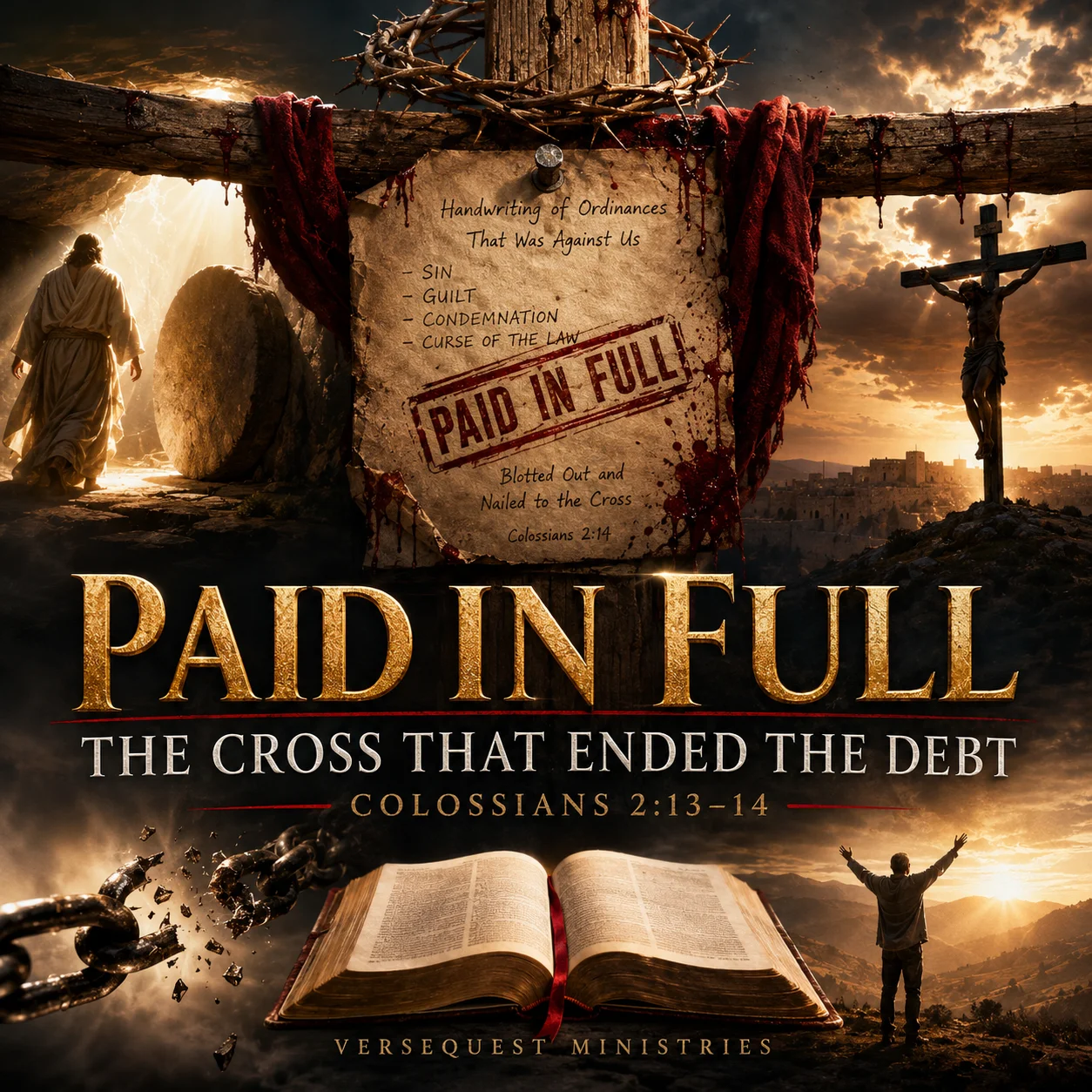
Sermon Title:
Paid in Full: The Cross That Ended the Debt
Key Passage:
Colossians 2:13–14 — “And you, being dead in your sins and the uncircumcision of your flesh, hath he quickened together with him, having forgiven you all trespasses; Blotting out the handwriting of ordinances that was against us, which was contrary to us, and took it out of the way, nailing it to his cross.”
Series:
Foundations of the Gospel of Grace
Topic:
The Finished Cross, Forgiveness of All Trespasses, and the Debt Removed in Christ
Book:
Colossians, Romans, Ephesians, Galatians, 2 Corinthians, Hebrews, 1 Corinthians
Speaker:
Paul Tackett
Suggested Sermon Text:
Colossians 2:8–15; Romans 3:19–28; Romans 4:4–8; Romans 5:1–11; Romans 6:14; Romans 7:4–6; 2 Corinthians 5:19–21; Galatians 2:16–21; Galatians 3:10–14; Ephesians 1:7; Ephesians 2:8–16; Hebrews 10:10–14; 1 Corinthians 15:1–4
Short Sermon Description:
This detailed VerseQuest Ministries sermon outline explains the powerful gospel truth of Colossians 2:13–14: the sinner was dead in sins, guilty before God, and under a handwriting of ordinances that stood against him, but Jesus Christ quickened the believer, forgave all trespasses, blotted out the debt, and nailed it to His cross. This sermon shows that the cross did not merely reduce man’s debt, postpone judgment, or create a religious payment plan; it removed the accusing record through the finished work of Jesus Christ. It explains the believer’s death in sins, quickening together with Christ, complete forgiveness, the handwriting that was against us, the ordinances taken out of the way, the end of law as a condemning system for the believer, and the triumph of Christ over every accusation. Designed for pastors, preachers, teachers, Bible students, and believers, this outline defends salvation by grace, exposes religious systems that try to revive the debt Christ cancelled, and magnifies the blood-bought victory of the Lord Jesus Christ.
Paid in Full
The Cross That Ended the Debt
Introduction
Colossians 2:13–14 is one of the strongest declarations in Paul’s epistles concerning the finished work of Jesus Christ. The sinner begins the passage dead, guilty, uncircumcised in the flesh, and buried beneath trespasses he cannot erase. He does not need religious cosmetics. He does not need an ecclesiastical payment plan. He does not need a priestly clerk to rearrange the bills on heaven’s desk. He needs life, forgiveness, and the removal of the record against him. Paul says God has quickened the believer together with Christ, forgiven him all trespasses, blotted out the handwriting of ordinances that was against him, taken it out of the way, and nailed it to Christ’s cross. That is not partial relief. That is not probation. That is not “try harder and hope for the best.” That is divine cancellation through Calvary.
Religion cannot stand a cancelled debt because religious systems make their living collecting on what Christ already paid. They keep sinners nervous, saints uncertain, consciences chained, and ordinances polished. They tell people Christ paid something, but not everything. They say the cross started the work, but the church must finish it. They say grace opens the door, but law, rituals, sacraments, penance, confession, endurance, and personal merit must keep it from slamming shut. But Colossians 2 does not speak like a priest behind a curtain. It speaks like God from the judgment bench. The handwriting was against us. Christ took it out of the way. He nailed it to His cross. A debt nailed to the cross is not still sitting in Rome’s treasury, a preacher’s baptistry, a legalist’s rulebook, or a sinner’s trembling conscience.
This passage is especially important because it sits in a context warning believers against being spoiled through philosophy, vain deceit, tradition of men, rudiments of the world, and religious ordinances. Paul is not merely giving comfort; he is defending the completeness of Christ against religious robbery. Colossians 2:10 says the believer is “complete in him.” Then verses 13–14 explain why. The believer is alive in Christ, forgiven in Christ, free from the accusing handwriting in Christ, and secure because the cross settled the account. The Church needs this doctrine nailed into its thinking as firmly as the handwriting was nailed to the cross. The debt is gone, the record is blotted out, the ordinances have been removed as a condemning system, and the believer stands in Christ with no religious collector authorized to reopen the account.
I. The Sinner Was Dead in Sins
Key Text: Colossians 2:13
Supporting Texts: Ephesians 2:1–3; Romans 5:12; Romans 6:23
Paul begins with the sinner’s condition: “And you, being dead in your sins.” He does not say the sinner was sick, weak, misinformed, underdeveloped, or merely lacking religious training. He says dead. Dead men do not need decoration; they need life. Dead men do not need ceremonies; they need resurrection. Dead men do not need to be told how to improve their posture in the coffin; they need someone with power over death to call them out. That is why salvation must be of God. A spiritually dead sinner cannot manufacture spiritual life by religious exertion.
Ephesians 2:1 says the same thing: “And you hath he quickened, who were dead in trespasses and sins.” The lost man may be physically alive, emotionally active, intellectually sharp, morally respectable, and religiously devoted, but before God he is dead in sins. Religion often mistakes movement for life. A corpse can be carried, dressed, perfumed, and placed in a beautiful room, but it remains dead. Likewise, a sinner can attend church, receive water baptism, memorize prayers, give money, practice morality, and still remain spiritually dead outside Jesus Christ.
Romans 6:23 says, “For the wages of sin is death.” Sin always pays wages, and the final wage is death. The sinner owes what he cannot pay and receives what he cannot survive. That is the dark background of Colossians 2. Before the debt is cancelled, before forgiveness is declared, before the handwriting is blotted out, the sinner is dead. Grace does not come to improve a living man; grace comes to quicken a dead one.
Main Truth:
The cross ended the debt because the sinner was spiritually dead in sins and utterly unable to give himself life.
II. The Flesh Could Not Repair the Condition
Key Text: Colossians 2:13
Supporting Texts: Romans 7:18; Philippians 3:3–9; Galatians 6:15
Paul adds, “and the uncircumcision of your flesh.” This is important because the Colossians were being pressured by religious systems that leaned on ordinances, physical marks, and outward observances. The flesh always wants something it can do, display, count, compare, and boast in. It wants a cut, a ceremony, a calendar, a rule, a diet, a day, a ritual, or a religious badge. But Paul says the problem is deeper than outward religion can touch. The flesh is not merely uncultivated; it is corrupt.
Romans 7:18 says, “For I know that in me (that is, in my flesh,) dwelleth no good thing.” That verse ought to end every flesh-confidence scheme in Christianity. The flesh cannot justify itself, sanctify itself, redeem itself, or resurrect itself. It may become religious flesh, educated flesh, disciplined flesh, separated flesh, or ceremonial flesh, but it is still flesh. A religious sinner trusting his flesh is like a bankrupt man writing checks from a closed account and calling it finance.
Philippians 3 shows Paul throwing away every ground of fleshly confidence. Circumcised the eighth day, of the stock of Israel, a Hebrew of the Hebrews, touching the law a Pharisee, touching zeal persecuting the church, touching righteousness in the law blameless—yet he counted it all loss for Christ. The flesh had a religious résumé, but it could not produce righteousness before God. The cross that ended the debt also ended every boast of the flesh.
Main Truth:
No outward religious act or fleshly distinction can repair the sinner’s dead condition or pay the debt before God.
III. God Quickened the Believer Together With Christ
Key Text: Colossians 2:13
Supporting Texts: Ephesians 2:4–6; Romans 6:4–11; Galatians 2:20
The verse turns with divine power: “hath he quickened together with him.” The same God who raised Jesus Christ from the dead gives life to the believer in union with Christ. Salvation is not merely a legal adjustment on paper, though it includes a legal declaration of righteousness. It is life from the dead. The believer is quickened together with Christ because his new life is bound to the risen Lord.
Ephesians 2 says, “But God, who is rich in mercy,” quickened us together with Christ, raised us up together, and made us sit together in heavenly places in Christ Jesus. The believer was dead, but God made him alive. He was down in trespasses, but God raised him. He was outside hope, but God placed him in Christ. This quickening is not earned by obedience to ordinances; it is given according to mercy and grace.
Romans 6 teaches that believers are identified with Christ’s death and resurrection. The old man is crucified with Him, and the believer is to reckon himself dead indeed unto sin but alive unto God through Jesus Christ our Lord. Grace does not simply cancel a debt and leave the sinner in the graveyard. Grace gives life in the risen Christ. The cross ended the debt, and the resurrection gives the believer a new standing, new life, and new walk.
Main Truth:
God quickens the believer together with Christ, giving life where sin had brought death.
IV. God Forgave All Trespasses
Key Text: Colossians 2:13
Supporting Texts: Ephesians 1:7; Romans 4:6–8; Acts 13:38–39
Paul says, “having forgiven you all trespasses.” Not some. Not most. Not the respectable ones. Not merely the sins committed before conversion while leaving the believer to pay for the rest. “All trespasses” means all. The blood of Jesus Christ is not a partial cleanser. God does not forgive with a pencil and keep an eraser nearby in case the believer fails too many times. Forgiveness in Christ is complete because redemption in Christ is complete.
Ephesians 1:7 says, “In whom we have redemption through his blood, the forgiveness of sins, according to the riches of his grace.” Forgiveness is in Christ and through His blood. It is not according to the poverty of human merit but according to the riches of grace. Romans 4 speaks of the blessed man whose iniquities are forgiven and whose sins are covered, the man to whom the Lord will not impute sin. That blessedness belongs to the believer justified by faith apart from works.
Acts 13:38–39 says that through Christ is preached the forgiveness of sins, and by Him all that believe are justified from all things. That is strong doctrine. Forgiven all trespasses. Justified from all things. Religion hates “all” because “all” shuts down the payment counter. If all trespasses are forgiven in Christ, then no priest, sacrament, penance, law system, or religious ordinance can claim a remaining balance. The gospel does not say, “Mostly forgiven if you keep up.” It says forgiven all trespasses.
Main Truth:
The believer’s forgiveness is complete because God has forgiven all trespasses through the blood and finished work of Christ.
V. The Handwriting Was Against Us
Key Text: Colossians 2:14
Supporting Texts: Romans 3:19–20; Galatians 3:10; Deuteronomy 27:26
Colossians 2:14 says there was a “handwriting of ordinances that was against us.” That handwriting functioned like an official record, a written charge, an accusing document that testified against the sinner. The law did not stand beside fallen man as a friendly coach cheering him toward self-improvement. It stood against him as a righteous witness. It pointed to his guilt, named his failure, and declared his debt.
Romans 3:19–20 says the law speaks so “that every mouth may be stopped, and all the world may become guilty before God.” By the law is the knowledge of sin. The law exposes the sinner; it does not justify him. Galatians 3:10 says those under the works of the law are under the curse, for it is written, “Cursed is every one that continueth not in all things.” Not some things. Not most things. All things. The law demands perfect obedience and condemns every failure.
This handwriting was “against us” and “contrary to us.” That means it did not help the guilty man escape condemnation; it confirmed his condemnation. Every ordinance he failed, every command he broke, every duty he neglected, every holy demand he violated became another line in the accusing record. The sinner did not need that handwriting edited. He needed it blotted out. He did not need a smaller debt. He needed the record removed.
Main Truth:
The handwriting of ordinances stood against guilty sinners as an accusing record they could never answer or satisfy.
VI. Christ Blotted Out the Handwriting
Key Text: Colossians 2:14
Supporting Texts: Isaiah 43:25; Psalm 51:1; Acts 3:19
Paul says Christ blotted out the handwriting. To blot out is to remove the record, cancel the charge, wipe away what stood written against the guilty. The debt was not renegotiated. It was not transferred to a religious institution. It was not reduced to monthly payments. It was blotted out. God did not leave the believer with a faded copy of condemnation to be restored every time he stumbles. The record against him was dealt with at the cross.
Isaiah 43:25 says, “I, even I, am he that blotteth out thy transgressions for mine own sake.” David prayed in Psalm 51, “blot out my transgressions.” In Colossians 2, Paul shows the cross as the place where the accusing handwriting was blotted out for the believer. The old record has no authority to condemn the man who is in Christ. Romans 8:1 says, “There is therefore now no condemnation to them which are in Christ Jesus.”
This is why the believer must refuse religious systems that keep rewriting what God erased. Legalism tries to restore the handwriting. Rome tries to keep the ledger open. Ritualism tells the sinner there are still ordinances to satisfy. False teachers act like debt collectors knocking on the door after the bill has been nailed to the cross. The believer’s answer is not arrogance but Scripture: God blotted it out.
Main Truth:
Christ blotted out the accusing record that stood against the believer, removing its power to condemn.
VII. Christ Took It Out of the Way
Key Text: Colossians 2:14
Supporting Texts: Romans 6:14; Romans 7:4–6; Galatians 2:19–21
Paul says Christ “took it out of the way.” The handwriting was not merely crossed out and left in the road to trip the believer later. It was removed. This is powerful Church-age doctrine. The believer is not under the law as a condemning covenant system. Romans 6:14 says, “ye are not under the law, but under grace.” That is not an invitation to sin; it is the declaration of a changed standing.
Romans 7 says believers are become dead to the law by the body of Christ, that they should be married to another, even to Him who is raised from the dead. The believer is not married to Moses and Christ at the same time. He belongs to the risen Christ. The law had a rightful ministry of condemnation, but Christ’s death has ended the believer’s relationship to that condemning system. He now serves in newness of spirit, not in the oldness of the letter.
Galatians 2:19 says, “For I through the law am dead to the law, that I might live unto God.” Paul does not say he is lawless, careless, or free to walk after the flesh. He says he is crucified with Christ. Christ lives in him. The removal of the handwriting does not create a rebel with a religious excuse. It creates a saint who lives unto God through union with Christ. Grace does what law never could: it gives life, standing, and power in the risen Saviour.
Main Truth:
Christ took the handwriting out of the way so the believer stands under grace, not under the law as a condemning system.
VIII. Christ Nailed the Debt to His Cross
Key Text: Colossians 2:14
Supporting Texts: John 19:30; Galatians 3:13; 1 Peter 2:24
Paul gives the final picture: “nailing it to his cross.” The cross is where the debt was publicly dealt with. The handwriting that accused us was not nailed to a church door, a priest’s robe, a baptistry wall, or a denominational constitution. It was nailed to Christ’s cross. That means Calvary is the place where the debt ended. The sinner’s account was settled by the suffering Substitute.
John 19:30 records Christ’s victorious words: “It is finished.” Finished means finished. Religion reads that and says, “Yes, but…” The Bible reads it and says, “Amen.” Galatians 3:13 says Christ redeemed us from the curse of the law, being made a curse for us. First Peter 2:24 says He bare our sins in His own body on the tree. The debt was not waved away sentimentally. It was nailed there judicially, righteously, and completely.
A debt nailed to the cross cannot be demanded again without insulting the One who paid it. If Christ bore the curse, the believer is not under it. If Christ bore the sins, the believer is not carrying them before God. If Christ took the handwriting out of the way, no religious system has divine authority to put it back in the way. The cross did not establish a partnership between Christ and religion. It ended the account by Christ alone.
Main Truth:
The sinner’s debt was nailed to Christ’s cross and settled completely by His finished work.
IX. The Cross Triumphs Over Every Accusation
Key Text: Colossians 2:15
Supporting Texts: Romans 8:31–34; Revelation 12:10–11; Hebrews 10:10–14
The next verse says Christ spoiled principalities and powers, made a shew of them openly, and triumphed over them in it. The cross looked like defeat to the blind world, but it was the battlefield where Christ triumphed. Satan’s accusations depend upon guilt. The law’s condemnation depends upon transgression. Death’s claim depends upon sin. At the cross, Christ dealt with sin, satisfied justice, removed the handwriting, and robbed every accuser of final authority over the believer.
Romans 8 asks, “Who shall lay any thing to the charge of God’s elect? It is God that justifieth.” That is courtroom thunder. If God has justified the believer, no devil, priest, preacher, conscience, memory, failure, or religious system can overturn the verdict. Christ died, rose again, and makes intercession. The believer’s standing is defended by the finished work and present ministry of Jesus Christ.
Hebrews 10 says that by one offering Christ hath perfected forever them that are sanctified. Not by repeated offerings. Not by continuous religious payments. Not by ceremonies stacked on top of Calvary. One offering. Perfected forever. The cross ended the debt, and the risen Christ guarantees the result. The believer may still face accusation, but he faces it from inside Christ, with the handwriting blotted out and the debt nailed to the cross.
Main Truth:
Because Christ removed the debt and triumphed at the cross, no accusation can overturn the believer’s standing in Him.
Conclusion
Colossians 2:13–14 gives the believer a gospel foundation that religion cannot honestly improve. The sinner was dead in sins, helpless in the flesh, and condemned by the handwriting of ordinances that stood against him. But God quickened him together with Christ, forgave all trespasses, blotted out the handwriting, took it out of the way, and nailed it to Christ’s cross. That is not religious therapy. That is divine rescue.
The cross did not reduce the debt; it ended it. It did not create a new installment plan; it cancelled the record. It did not leave the believer halfway forgiven and half condemned. It did not say, “Christ will do His part if you keep doing yours.” It says the handwriting was blotted out and nailed to the cross. The believer is complete in Christ, forgiven in Christ, alive in Christ, and free from condemnation in Christ. When religion tries to collect payment on a cancelled debt, show it the nail holes.
The Church must preach the finished cross with clarity and courage. A cloudy gospel leaves sinners uncertain and saints chained. A works gospel rebuilds the handwriting Christ removed. A ritual gospel points men away from the cross and toward ceremonies that cannot quicken the dead. The gospel of grace points straight to Jesus Christ, crucified, buried, risen, and sufficient. The debt is not hiding in a church account somewhere. The debt was nailed to the cross, and the blood of Jesus Christ settled it forever.
Final Call
The sinner outside Christ is dead in sins and guilty before God. No religious effort can give life. No ordinance can erase the record. No ceremony can pay the debt. No law-keeping can remove the curse. No good work can cancel what sin has written against you.
Jesus Christ died for our sins according to the Scriptures. He was buried. He rose again the third day according to the Scriptures. At the cross, He paid the debt, bore the curse, shed the blood, and provided complete forgiveness for every sinner who believes. Believe on the Lord Jesus Christ, and thou shalt be saved.
Believer, stop letting religion, memory, fear, or the Devil collect on a debt Christ cancelled. Stand in the finished work. Walk in grace. Serve from gratitude. Preach the cross plainly. Tell sinners that Christ does not offer a payment plan; He offers full forgiveness through His blood and resurrection.
Closing Verse:
Colossians 2:14 — “Blotting out the handwriting of ordinances that was against us, which was contrary to us, and took it out of the way, nailing it to his cross.”
Closing Statement:
The cross did not leave the sinner with a smaller bill; it nailed the whole debt to Calvary and stamped eternity with the words, Paid in full.