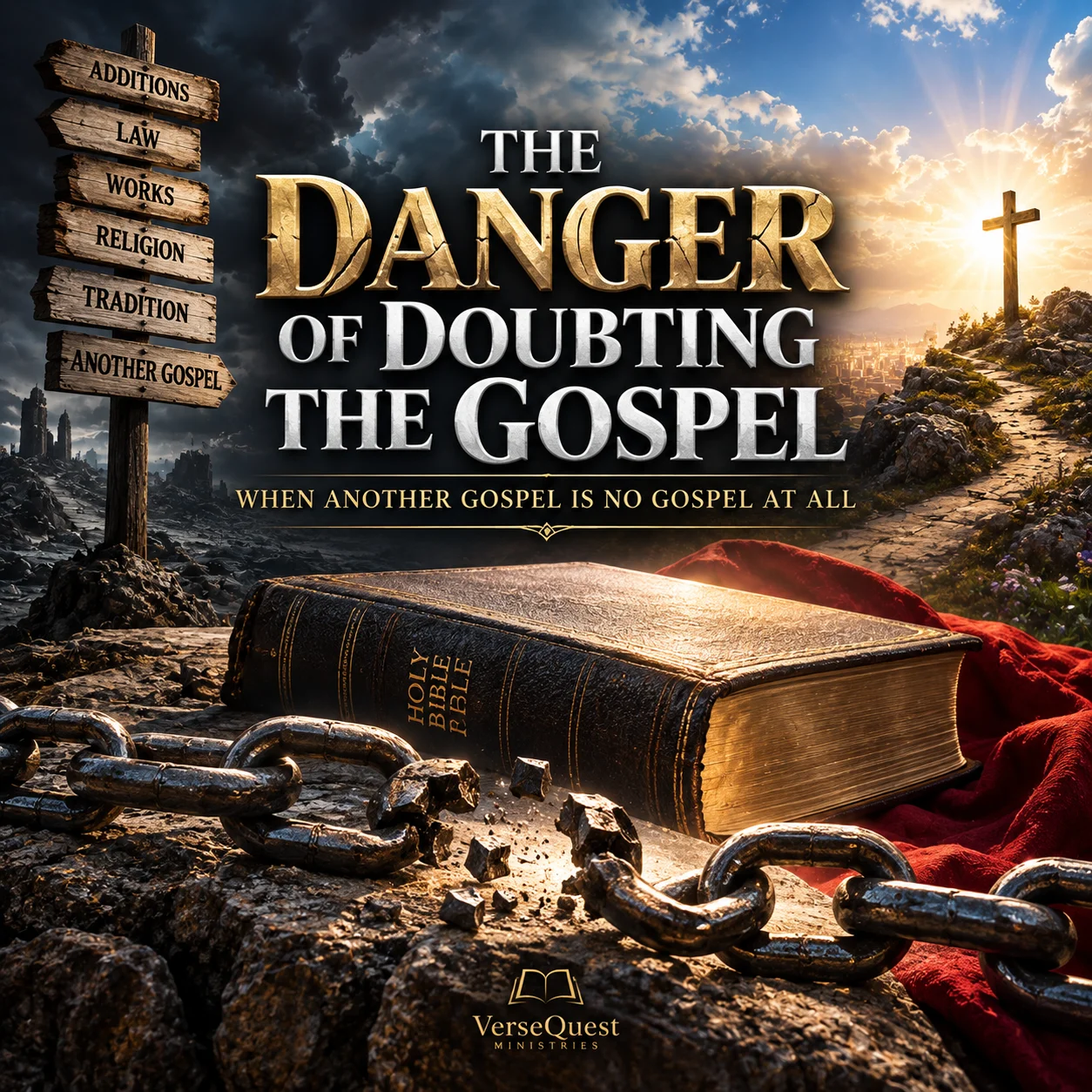
The Danger of Doubting the Gospel
Sermon Title:
The Danger of Doubting the Gospel: When Another Gospel Is No Gospel at All
Key Passage:
Galatians 1:6–9
Galatians 1:8 — “But though we, or an angel from heaven, preach any other gospel unto you than that which we have preached unto you, let him be accursed.”
Series:
Foundations of the Gospel of Grace
Topic:
The Danger of Departing From, Adding To, Subtracting From, or Doubting the Saving Gospel of Jesus Christ
Book:
Galatians, 1 Corinthians, Romans, Ephesians, Acts, Colossians, 2 Corinthians
Speaker:
Paul Tackett
Suggested Sermon Text:
Galatians 1:6–12; Galatians 2:4–21; Galatians 3:1–14; Galatians 5:1–13; 1 Corinthians 15:1–4; Romans 1:16–17; Romans 3:21–28; Romans 4:4–5; Romans 11:6; Ephesians 1:13–14; Ephesians 2:8–9; Acts 15:1–11; Colossians 2:8–17; 2 Corinthians 11:3–4
Short Sermon Description:
This detailed VerseQuest Ministries sermon outline examines Galatians 1:6–9 and Paul’s astonishment that believers in Galatia were being “so soon removed” from the grace of Christ unto another gospel. The danger was not that they had suddenly abandoned religion; it was that religious teachers were corrupting the gospel by adding circumcision, law, works, and human performance to the grace of God. Paul does not treat gospel corruption as a minor theological disagreement. He declares that another gospel is “not another,” identifies false teachers as troublers who “pervert the gospel of Christ,” and pronounces an anathema even upon an apostle or angel who preaches a different message. This sermon explains the gospel that saves today, why grace and works cannot be mixed, how right division protects the believer from importing Israel’s covenant and kingdom requirements into the Church’s gospel, why doubting the sufficiency of Christ destroys assurance and liberty, and why every preacher and believer must guard the gospel exactly as God revealed it.
The Danger of Doubting the Gospel
When Another Gospel Is No Gospel at All
Introduction
Galatians 1:6 opens with one of Paul’s most startling rebukes: “I marvel that ye are so soon removed from him that called you into the grace of Christ unto another gospel.” Paul does not marvel because the Galatians had become atheists, burned their Bibles, and joined a pagan temple. They were being pulled into more religion, not less. Men were coming behind Paul with circumcision, law, religious requirements, human performance, and enough Old Testament vocabulary to make the poison look biblical. That is what makes a false gospel dangerous. The devil does not always replace Jesus Christ with a golden calf. Sometimes he leaves Christ’s name on the sign, puts a Bible under his arm, adds one little requirement to grace, and lets religion do the rest.
The danger of doubting the gospel begins when a man stops believing that what Jesus Christ accomplished is sufficient. Once you doubt that His blood was enough, you need another payment. Once you doubt that His righteousness is enough, you need some righteousness of your own. Once you doubt that His finished work is enough, you need a sacrament, ceremony, law, priest, ordinance, moral record, church membership, baptismal requirement, religious perseverance, or human merit to finish what Christ supposedly left undone. Paul does not call that deeper Christianity. He calls it a perversion. Galatians is God’s answer to every religious mechanic who lifts the hood on the finished work of Christ and announces that Jesus forgot to install something.
This issue must also be rightly divided. The Bible contains law, kingdom truth, promises to Israel, circumcision, ordinances, sacrifices, baptismal commands, Sabbath regulations, and messages preached in settings different from the present dispensation of grace. All Scripture is given by inspiration of God, but all Scripture is not addressed doctrinally to the same people under the same stewardship. The gospel for salvation today is not assembled by grabbing one requirement from Moses, another from John the Baptist, another from the kingdom commission, another from Pentecost, and another from Paul. Paul declares the gospel by which sinners are saved: Christ died for our sins, was buried, and rose again the third day according to the Scriptures. Doubt that gospel, corrupt that gospel, or add to that gospel, and you have moved away from the only ground on which a sinner can stand.
I. The Gospel Must Be Known Before It Can Be Guarded
Key Text: 1 Corinthians 15:1–4
Supporting Texts: Romans 1:16; Ephesians 1:13; Galatians 1:11–12
Before a believer can recognize another gospel, he must know the true one. Paul writes in 1 Corinthians 15:1, “Moreover, brethren, I declare unto you the gospel which I preached unto you.” Then he tells us what he preached: “how that Christ died for our sins according to the scriptures; And that he was buried, and that he rose again the third day according to the scriptures.” There is the saving message in black ink. The death is substitutionary—“for our sins.” The burial proves the death. The resurrection declares the victory. The gospel is not what Jesus might help you accomplish. It is the good news of what Jesus Christ has already accomplished.
Romans 1:16 calls this gospel “the power of God unto salvation to every one that believeth.” Ephesians 1:13 calls it “the word of truth, the gospel of your salvation.” Salvation is not hidden in religious fog. God has given a message to be heard, believed, and trusted. Paul says in Galatians 1 that the gospel he preached was not received of man nor taught by man, “but by the revelation of Jesus Christ.” That gives the message divine authority. Paul did not conduct a religious focus group and create a gospel that tested well with Gentiles.
A church that does not define the gospel clearly cannot defend it. A preacher who spends forty-five minutes talking about relationships, success, culture, politics, feelings, and personal improvement and never tells sinners what Christ did for their sins has not preached the gospel merely because the word “Jesus” appeared in the sermon. The gospel has content. Christ died. Christ was buried. Christ rose again. The sinner believes. Lose that center and everything else starts drifting.
Main Truth:
The gospel that saves today is the revealed message of Christ’s death for our sins, burial, and resurrection, received by faith.
II. Doubting the Gospel Moves a Man Away From Grace
Key Text: Galatians 1:6
Supporting Texts: Galatians 5:4; Romans 11:6; Ephesians 2:8–9
Paul says the Galatians were “removed from him that called you into the grace of Christ.” Notice the movement. Gospel corruption does not merely move a man from one theological opinion to another. It moves his thinking away from grace. Grace says God provides what the sinner cannot provide. Religious flesh says, “Surely I must contribute something.” Grace says Christ finished the payment. Flesh asks for a receipt with its own name on it.
Romans 11:6 makes the distinction mathematically impossible to escape: “And if by grace, then is it no more of works: otherwise grace is no more grace.” Grace plus works is not stronger grace. It is ruined grace. If the sinner must add personal merit to Christ’s work in order to be justified, then salvation is no longer by grace. Ephesians 2 says salvation is “not of works, lest any man should boast.” God designed salvation so thoroughly around Christ that Adam has no trophy to hold when he gets to heaven.
Galatians 5:4 warns those seeking justification by law that “ye are fallen from grace.” That passage is not teaching that a saved believer accidentally falls out of Christ every time he stumbles; its immediate issue is seeking justification on a law principle instead of a grace principle. Paul is attacking the system. The moment you make law the ground of justification, grace has been abandoned as the ground. You cannot stand with one foot on Sinai and one foot on Calvary and call the wobble sound doctrine.
Main Truth:
To doubt the sufficiency of the gospel is to move away from grace and back toward the impossible ground of human merit.
III. Another Gospel Is Not Another Gospel at All
Key Text: Galatians 1:6–7
Supporting Texts: 2 Corinthians 11:3–4; Galatians 2:4–5; Acts 15:1
Paul says the Galatians were being removed “unto another gospel: Which is not another.” There is inspired sarcasm in the wording. Men were advertising an alternative gospel, but heaven refused to recognize the product. It was called a gospel by its salesmen, but God says it was not another gospel at all. There is only one saving message for this dispensation. A counterfeit hundred-dollar bill does not become legal currency because the printing is attractive.
Acts 15 records the issue plainly: “Except ye be circumcised after the manner of Moses, ye cannot be saved.” That is exactly how gospel corruption operates. Notice that those men did not necessarily deny Jesus existed. They simply added a requirement after Him. Christ plus circumcision. Christ plus Moses. Christ plus law. Paul understood that adding anything as a requirement for justification changes the message. A little leaven leaveneth the whole lump. One human requirement attached to the finished work turns grace into wages.
Second Corinthians 11 warns of “another Jesus,” “another spirit,” and “another gospel.” False religion often uses familiar vocabulary while quietly changing definitions. It can say Jesus while preaching another Jesus. It can say grace while teaching merit. It can say faith while requiring works to finish justification. It can say gospel while preaching no gospel at all. Bible believers must judge messages by Scripture, not by religious labels.
Main Truth:
A message that changes the saving terms of Christ’s gospel is not an alternative gospel but a counterfeit gospel.
IV. Adding the Law to Grace Perverts the Gospel of Christ
Key Text: Galatians 1:7
Supporting Texts: Galatians 2:16; Galatians 3:10–13; Romans 3:20; Romans 6:14
Paul identifies the false teachers as those who “would pervert the gospel of Christ.” To pervert something is to twist it from its proper form. The Judaizers did not need to erase Christ completely to pervert His gospel. They only needed to add law to grace. Galatians 2:16 says three times in one verse that justification is not by the works of the law. Paul evidently thought repetition was necessary because religious flesh has a skull like reinforced concrete when its own merit is threatened.
Galatians 3 goes further. “As many as are of the works of the law are under the curse.” Why? Because the law does not demand sincere effort; it demands continuance “in all things which are written in the book of the law to do them.” One broken point identifies the man as a lawbreaker. The law is holy, just, and good, but sinful flesh is not. The law can reveal the disease but cannot become the cure. Christ “hath redeemed us from the curse of the law, being made a curse for us.”
Romans 6:14 says believers are “not under the law, but under grace.” That does not mean holiness is abolished. It means law is not the covenantal system governing the believer’s standing before God. The Christian has stronger motives for holiness than fear of Sinai: union with Christ, the indwelling Spirit, gratitude for grace, sonship, the judgment seat of Christ, and love for the Saviour. Putting the believer back under law for justification does not improve the gospel. It takes him backward from the substance to the shadow.
Main Truth:
Adding law-keeping to grace as a requirement for justification perverts the gospel because Christ has already redeemed the believer from the law’s curse.
V. Even an Angel Has No Authority to Change the Gospel
Key Text: Galatians 1:8–9
Supporting Texts: 2 Corinthians 11:13–15; Colossians 2:18; Deuteronomy 13:1–3
Paul raises the standard as high as language will permit: “But though we, or an angel from heaven, preach any other gospel unto you…let him be accursed.” Paul includes himself. Apostolic reputation does not outrank revealed truth. Personal charisma does not outrank revealed truth. Miracles do not outrank revealed truth. Angels do not outrank revealed truth. If an angel comes wrapped in light, wings spread across the room, and tells you Christ’s finished work needs one additional saving requirement, you do not need another vision. You need Galatians 1:8.
Second Corinthians 11 warns that Satan himself “is transformed into an angel of light.” That should cure the childish notion that every supernatural experience must come from God. Truth judges experience; experience does not rewrite truth. The devil has no objection to supernatural religion if supernatural religion can pull a sinner away from the gospel. Hell is perfectly willing to give a man goose bumps on the way to damnation.
Paul repeats the anathema in verse 9 so nobody can pretend verse 8 was rhetorical exaggeration. “If any man preach any other gospel unto you than that ye have received, let him be accursed.” God protects the gospel with severe language because eternity hangs on the message. Modern religion may prefer dialogue, synthesis, and polite ambiguity, but Paul does not invite the false gospel onto a discussion panel. He pronounces judgment upon it.
Main Truth:
No preacher, apostle, religious institution, supernatural sign, or angel has authority to alter the gospel God revealed.
VI. Right Division Protects the Gospel From Doctrinal Confusion
Key Text: 2 Timothy 2:15
Supporting Texts: Matthew 4:17; Matthew 10:5–7; 1 Corinthians 15:1–4; Ephesians 3:1–9
A major source of gospel confusion is failure to rightly divide the word of truth. During Christ’s earthly ministry, Israel was being offered and prepared for her promised kingdom. John the Baptist and Jesus preached, “Repent: for the kingdom of heaven is at hand.” Matthew 10 sends the apostles to “the lost sheep of the house of Israel” and specifically forbids them to go to the Gentiles or Samaritans in that commission. Those passages are inspired Scripture, but they are not descriptions of Paul’s later ministry to the Body of Christ.
After Calvary, the resurrection, Israel’s continued rejection, and the unfolding of Pauline revelation, the gospel preached among the Gentiles centers upon the finished work: Christ died for our sins, was buried, and rose again. Ephesians 3 speaks of the dispensation of the grace of God given to Paul and the revelation of the mystery that had been hid in God. Right division does not mean there are multiple saviours. There has never been salvation apart from what God provides. But God has revealed different stewardships, commands, peoples, promises, and dispensational settings through Scripture.
Trouble begins when a preacher reaches backward indiscriminately and drags every command given to Israel into the Church’s doctrine of justification. Sabbath keeping, circumcision, Mosaic dietary regulations, kingdom requirements, ceremonial ordinances, temple practices, and covenant signs cannot be dumped into Paul’s gospel and called “the whole Bible.” The whole Bible commands us to divide the Bible correctly. Scripture becomes clearer, not weaker, when God’s distinctions are honoured.
Main Truth:
Right division protects the gospel by keeping Israel’s law and kingdom requirements from being confused with the Church’s salvation by grace through faith.
VII. Doubting the Gospel Destroys Assurance and Produces Bondage
Key Text: Galatians 5:1
Supporting Texts: Romans 5:1–2; Romans 8:1; Galatians 4:9–11; Colossians 2:20–23
Paul tells the Galatians, “Stand fast therefore in the liberty wherewith Christ hath made us free.” False gospels inevitably produce bondage because human performance can never give final assurance. If salvation depends upon Christ plus your ability to maintain an acceptable religious record, then you can never know when the account is sufficient. How obedient is obedient enough? How many works are enough? How much repentance is enough? How many sacraments are enough? The system requires uncertainty because uncertainty keeps the customer paying.
Romans 5 says, “being justified by faith, we have peace with God.” Romans 8 says there is “now no condemnation to them which are in Christ Jesus.” Those are assurance statements. The gospel produces peace because the work is finished. Legalism produces anxiety because man’s work never is. Colossians 2 warns against being subjected to ordinances such as “Touch not; taste not; handle not” as though man-made religious regulations can perfect the believer spiritually.
Doubting the gospel eventually turns the believer’s eyes away from Christ and onto himself. Instead of asking, “What did Christ accomplish?” he asks, “Have I done enough?” Instead of looking at the blood, he studies his performance chart. Instead of resting in Christ’s righteousness, he audits his own. That road produces either pride in the hypocrite or despair in the honest man. Grace gives neither man room to boast. It points both of them to Christ.
Main Truth:
When the sufficiency of the gospel is doubted, assurance gives way to religious bondage because human performance can never provide the certainty Christ’s finished work provides.
VIII. The Gospel Must Be Received and Preserved Exactly as God Gave It
Key Text: 1 Corinthians 15:1–4
Supporting Texts: Galatians 1:9; 1 Corinthians 11:23; 2 Timothy 1:13–14
Paul repeatedly uses the language of receiving, delivering, and keeping truth. In 1 Corinthians 15 he says, “I delivered unto you first of all that which I also received.” The gospel is not Paul’s private invention to be updated by each generation. He received truth from God and delivered it faithfully. The Church is a steward of revelation, not an editing committee authorized to modernize the saving message whenever culture changes.
Second Timothy 1 tells Timothy to “Hold fast the form of sound words” and to keep the good thing committed unto him. Gospel preservation therefore requires doctrinal backbone. Every generation faces pressure to make the gospel more acceptable. One generation wants to add law. Another wants to remove sin. Another removes blood. Another removes hell. Another replaces repentance and faith with vague spirituality. Another turns Christ into a life coach. The wrappers change; the perversion remains.
The Church does not improve the gospel by sanding off its offensive edges. Christ died for our sins because men are sinners. He was buried because He really died. He rose bodily because death was really defeated. Salvation is by grace because man cannot save himself. Faith is necessary because the sinner must receive God’s testimony. Remove one of those pillars and you are no longer preserving the message—you are manufacturing another one.
Main Truth:
The Church must receive, preserve, and preach the gospel exactly as God revealed it rather than adapting its saving content to religious fashion.
IX. The Believer Must Stand Fast Against Those Who Trouble the Gospel
Key Text: Galatians 1:7
Supporting Texts: Galatians 2:4–5; Galatians 5:1; Titus 1:9–11; Romans 16:17–18
Paul says certain men “trouble you.” False doctrine is not harmless intellectual variety. It troubles churches, unsettles believers, destroys assurance, divides saints, corrupts preaching, and eventually affects souls. Galatians 2 says false brethren came in “privily” to spy out liberty and bring believers into bondage. Paul says, “To whom we gave place by subjection, no, not for an hour.” There is a time for patience with confused believers, but there is also a time to refuse doctrinal surrender.
Titus 1 commands a bishop to hold fast the faithful word so he may exhort and convince gainsayers. Paul says there are vain talkers and deceivers “whose mouths must be stopped.” Romans 16 tells believers to mark those who cause divisions and offences contrary to the doctrine learned and avoid them. Biblical love does not require providing a microphone to every gospel corrupter. A shepherd who invites wolves into the sheepfold in the name of dialogue is not loving the sheep.
The believer therefore needs doctrinal courage. Stand fast in liberty. Know the gospel. Test every message. Refuse additions. Refuse subtractions. Refuse religious intimidation. Do not let a collar, degree, title, miracle story, angel story, church tradition, famous personality, or denominational history overrule the King James Bible. Eternity is too long to gamble the gospel on somebody’s religious résumé.
Main Truth:
Believers must stand fast in the gospel of grace and refuse to surrender its truth to teachers who would corrupt it or bring saints into bondage.
Conclusion
Galatians 1:6–9 treats gospel corruption with a seriousness largely missing from modern religion. Paul marvels that the Galatians are so soon removed from the grace of Christ. He says the alternative message is not another gospel at all. He identifies its promoters as troublers and perverters. Then he says that even if Paul himself or an angel from heaven preached a different gospel, let him be accursed. God is not casual about the message by which sinners are saved, and neither should the Church be.
The danger begins with doubt. Doubt whether grace is sufficient and you will add works. Doubt whether the blood is sufficient and you will add payments. Doubt whether Christ’s righteousness is sufficient and you will start sewing together fig leaves of your own. Doubt whether His one offering was sufficient and you will create repeated offerings. Doubt whether His promise is sufficient and you will replace assurance with bondage. Every counterfeit gospel eventually says the same thing in a hundred religious dialects: Jesus Christ did much, but you must finish the job. The gospel says exactly the opposite. Jesus Christ finished the work, and the sinner receives salvation by faith.
The King James Bible gives the believer solid ground. Christ died for our sins according to the Scriptures. He was buried. He rose again the third day according to the Scriptures. The sinner who believes is justified by faith, stands in grace, has peace with God, possesses redemption through Christ’s blood, and is sealed with the Holy Spirit of promise. Do not trade that gospel for Moses plus Christ, sacraments plus Christ, works plus Christ, religion plus Christ, or anything else plus Christ. A gospel that needs Adam’s contribution is a gospel that has already doubted Calvary.
Final Call
Sinner, your greatest danger is not that you have failed to become religious enough. Your greatest danger is that you are guilty before God and cannot save yourself. Your law-keeping cannot justify you. Your morality cannot justify you. Your baptism cannot justify you. Your church membership cannot justify you. Your sacraments, good works, charitable giving, religious discipline, and sincerity cannot erase one sin.
Jesus Christ died for your sins according to the Scriptures. He was buried. He rose again the third day according to the Scriptures. That is the gospel. Believe on the Lord Jesus Christ. Stop trying to add your name beside His on the receipt. The blood was His. The cross was His. The death was His. The resurrection was His. Salvation is His gift.
Believer, do not doubt the gospel after trusting it. Do not let religious men move you away from grace. Study the word. Rightly divide it. Stand fast in liberty. Test every gospel by Scripture. Reject every addition and every subtraction. You do not honour Christ by saying His work was almost enough. You honour Him by believing that when He cried, “It is finished,” He knew exactly what He was talking about.
Closing Verse:
Galatians 1:9 — “If any man preach any other gospel unto you than that ye have received, let him be accursed.”
Closing Statement:
The moment you add something to the finished gospel as a requirement for salvation, you have not improved the good news—you have doubted Christ and manufactured another gospel that cannot save.