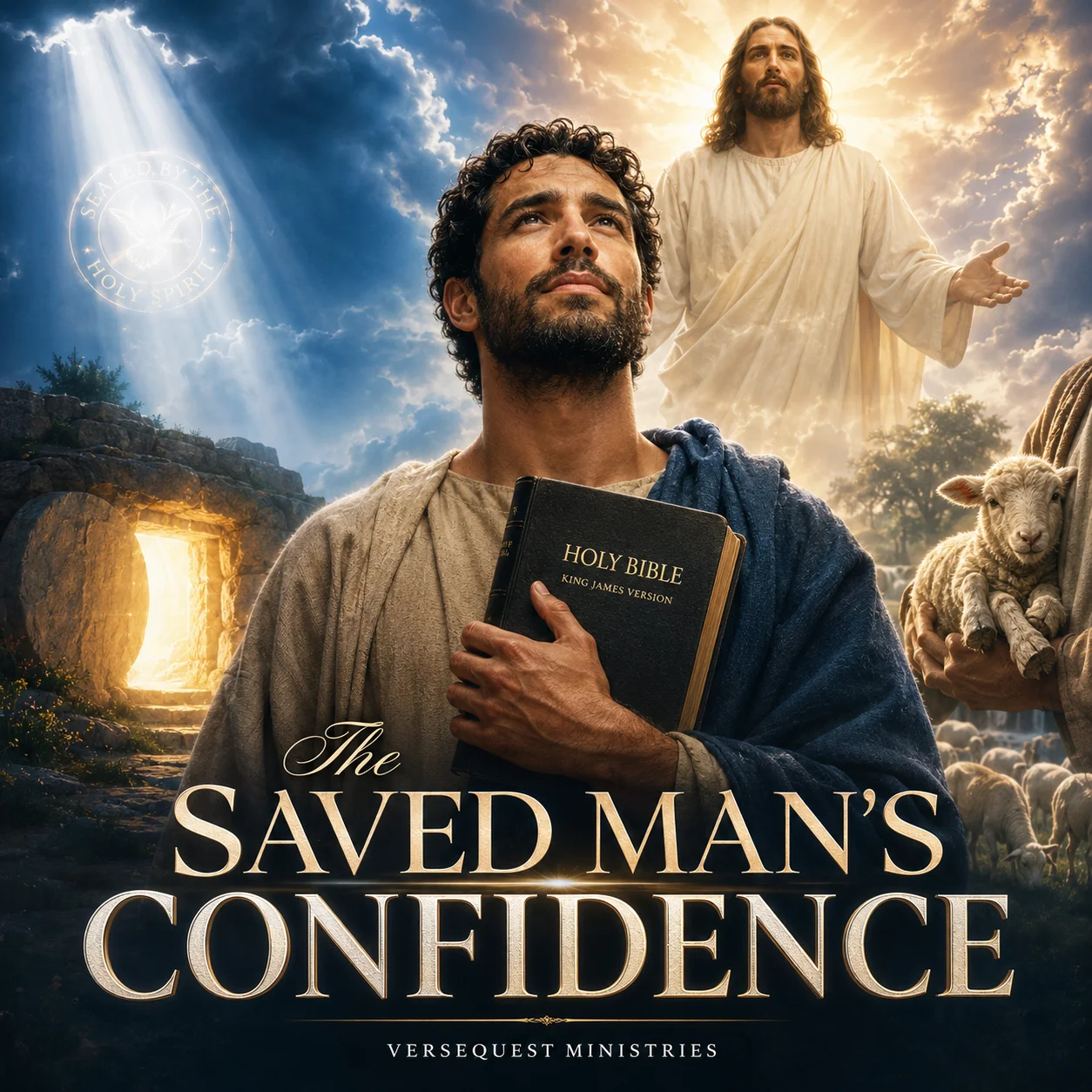
Sermon Title:
The Saved Man’s Confidence: These Things Have I Written That Ye May Know
Key Passage:
1 John 5:13 — “These things have I written unto you that believe on the name of the Son of God; that ye may know that ye have eternal life, and that ye may believe on the name of the Son of God.”
Series:
Foundations of the Gospel of Grace
Topic:
Biblical Assurance of Salvation, Eternal Life, and the Believer’s Confidence in Jesus Christ
Book:
1 John, John, Romans, Ephesians, Colossians, 1 Corinthians, 2 Timothy, Hebrews
Speaker:
Paul Tackett
Suggested Sermon Text:
1 John 5:9–13; John 3:16, 36; John 5:24; John 6:47; John 10:27–30; Romans 5:1–2; Romans 8:1, 31–39; Ephesians 1:13–14; Ephesians 4:30; Colossians 2:10–14; 1 Corinthians 15:1–4; 2 Timothy 1:12; Hebrews 10:14
Short Sermon Description:
This detailed VerseQuest Ministries sermon outline explains 1 John 5:13 and the Bible doctrine that a saved man may know that he has eternal life. Biblical assurance is not spiritual arrogance, emotional optimism, confidence in a prayer, dependence upon church membership, or trust in personal performance; it rests upon the written testimony of God concerning His Son. This sermon shows that eternal life is a present possession, that the witness of God is greater than the witness of men, that life is found in Jesus Christ, and that the believer’s confidence rests upon Christ’s finished work rather than the changing condition of the flesh. It also distinguishes assurance from presumption, salvation from fellowship, standing from state, chastening from condemnation, and eternal life from Christian reward. Designed for pastors, preachers, teachers, Bible students, and believers, this outline gives a strong KJV framework for answering the question, “Can I really know that I am saved?” with the plain testimony of Scripture.
The Saved Man’s Confidence
These Things Have I Written That Ye May Know
Introduction
First John 5:13 is one of the clearest verses in the King James Bible on assurance of salvation: “These things have I written unto you that believe on the name of the Son of God; that ye may know that ye have eternal life.” God did not inspire John to tell believers that they may guess, hope, wonder, speculate, cross their fingers, wait for a priest’s verdict, or spend their entire Christian lives wondering whether salvation is still attached. He says they may know. That word is the wrecking ball against every religious system that thrives by keeping people spiritually uncertain. A man who never knows where he stands is easier to control, easier to frighten, easier to keep on a sacramental treadmill, and easier to sell another religious payment plan. But God did not write the Bible to keep His children guessing.
The verse is not telling every religious professor to manufacture confidence regardless of whether he has believed the gospel. John is writing “unto you that believe on the name of the Son of God.” Assurance belongs to those who possess Christ, not to those who merely possess religion. There is a difference between biblical assurance and fleshly presumption. Presumption says, “I am safe because I said something once, joined something once, felt something once, or belong to the right crowd.” Biblical assurance says, “God has testified concerning His Son, I have believed Him, and His written word says I have eternal life.” The confidence rests not in the strength of the believer’s memory, emotion, or performance, but in the truthfulness of God.
This sermon is especially necessary because believers often confuse their state with their standing. A saved man can feel discouraged, cold, convicted, chastened, spiritually weak, emotionally flat, or painfully aware of his flesh. None of those conditions redefine the promises of God. The believer’s practical walk matters greatly; sin can grieve the Spirit, damage fellowship, rob joy, invite chastening, and burn rewards. But a bad state does not make God’s written testimony false. The saved man’s confidence is not, “I know I am saved because I always feel saved.” His confidence is, “I know whom I have believed, I know what Christ accomplished, and I know what God has written.”
I. Assurance Begins With the Written Word of God
Key Text: 1 John 5:13
Supporting Texts: Romans 10:17; John 20:30–31; 2 Timothy 3:15–17
John says, “These things have I written unto you.” Assurance is therefore grounded in revelation, not emotion. God does not tell the believer to stare inward until he feels sufficiently convinced. He tells him to look at what has been written. Feelings move like weather. Scripture stands like granite. A man may wake up spiritually encouraged on Monday and discouraged on Tuesday, but 1 John 5:13 did not change overnight.
Romans 10:17 says, “So then faith cometh by hearing, and hearing by the word of God.” John 20 says the signs in John’s Gospel were written “that ye might believe that Jesus is the Christ, the Son of God; and that believing ye might have life through his name.” Second Timothy 3 says the Scriptures are able to make wise unto salvation and are profitable for doctrine, reproof, correction, and instruction. God has deliberately attached faith and assurance to His word.
This keeps the believer from becoming a slave to subjective experience. Experiences can be genuine, emotional, memorable, and spiritually important, but they are not the final authority. A believer may remember the exact day he trusted Christ, or he may only know that there came a point when he truly believed the gospel. Assurance is not built on how dramatic the conversion story sounds. It is built on what God says concerning those who believe on His Son.
Main Truth:
Biblical assurance rests on the written word of God, not on fluctuating feelings, religious experiences, or human opinion.
II. The Testimony of God Is Greater Than the Testimony of Men
Key Text: 1 John 5:9
Supporting Texts: 1 John 5:10–12; Romans 3:4; Titus 1:2
First John 5:9 says, “If we receive the witness of men, the witness of God is greater.” That statement ought to settle a thousand arguments. Men can lie. Men can misunderstand. Men can contradict one another. Churches can change positions. Religious authorities can pronounce judgments one century and reverse them the next. But God’s witness is greater because God cannot lie.
John says the believer has the witness in himself and that the one who does not believe God “hath made him a liar.” That is strong language. The assurance issue is therefore not finally about whether the believer feels humble enough to claim salvation. It is whether he believes God’s testimony concerning His Son. False humility says, “I know God says eternal life is in His Son, but I would never presume to know whether I have it.” Bible faith says, “Let God be true, but every man a liar.”
Titus 1:2 speaks of “God, that cannot lie.” Romans 3:4 says, “let God be true, but every man a liar.” The believer’s assurance is as strong as the character of the One who made the promise. If salvation depended on the believer never being mistaken about himself, confidence would be fragile. But assurance ultimately depends on whether God tells the truth. He does.
Main Truth:
The saved man’s confidence rests upon the testimony of the God who cannot lie, not upon the opinions or verdicts of men.
III. Eternal Life Is Found in the Son
Key Text: 1 John 5:11–12
Supporting Texts: John 14:6; Colossians 3:3–4; Galatians 2:20
First John 5:11 says, “God hath given to us eternal life, and this life is in his Son.” Verse 12 follows: “He that hath the Son hath life; and he that hath not the Son of God hath not life.” That is wonderfully simple. Eternal life is not in a denomination, ritual, sacrament, system, or religious pedigree. Life is in the Son.
Jesus said, “I am the way, the truth, and the life.” Colossians 3 says the believer’s life is “hid with Christ in God” and that Christ “is our life.” Galatians 2 says, “Christ liveth in me.” Eternal life is therefore inseparable from Jesus Christ Himself. The believer does not possess some independent spiritual commodity that God may later repossess. He possesses life because he possesses the Son.
This gives assurance its proper center. The question is not, “Am I strong enough to keep eternal life?” The question is, “Is Christ sufficient?” The answer is yes. The believer’s confidence is not self-confidence. It is Christ-confidence. A man who boasts in himself has misunderstood security. A man who rests in Christ has understood it.
Main Truth:
Eternal life is in Jesus Christ, and the believer has life because he has the Son.
IV. The Believer Has Eternal Life as a Present Possession
Key Text: 1 John 5:13
Supporting Texts: John 3:36; John 5:24; John 6:47
John says, “that ye may know that ye have eternal life.” Not may eventually have. Not may inherit if performance remains acceptable. Have. Present possession. John 3:36 says, “He that believeth on the Son hath everlasting life.” John 6:47 says, “He that believeth on me hath everlasting life.” John 5:24 says the believer “hath everlasting life.”
John 5:24 gives the promise in three directions. The believer hath everlasting life in the present, shall not come into condemnation in the future, and is passed from death unto life as a completed transfer. There is present possession, future security, and past transition in one verse. That is stronger than religious uncertainty.
The believer still awaits the redemption of the body, resurrection, glorification, and the full manifestation of his inheritance. But waiting for future glorification does not mean he lacks eternal life now. Salvation has present and future aspects, but eternal life is already possessed. The future is the unveiling of what grace has secured.
Main Truth:
The believer possesses eternal life now and does not merely hope to receive it after successfully completing a religious probation.
V. Assurance Rests on Christ’s Finished Gospel Work
Key Text: 1 Corinthians 15:1–4
Supporting Texts: Romans 4:25; John 19:30; Hebrews 10:14
The Church-age believer’s assurance must be grounded in the gospel Paul declares: Christ died for our sins according to the Scriptures, was buried, and rose again the third day according to the Scriptures. Assurance does not rest on vague belief that Jesus existed or admiration for His teaching. It rests upon the finished saving work of the crucified and risen Christ.
Romans 4:25 says Christ “was delivered for our offences, and was raised again for our justification.” John 19 records the Lord’s words, “It is finished.” Hebrews 10:14 says, “For by one offering he hath perfected for ever them that are sanctified.” The cross did not begin a payment plan. It accomplished redemption. The empty tomb proves the Saviour lives and the sacrifice was accepted.
This is why assurance should never be centered on the believer’s works. If works become the final reason the believer knows he is saved, the finished work of Christ has been displaced. Good works matter as fruit, service, testimony, and evidence of spiritual growth, but they are not the foundation of justification. The saved man’s confidence begins at Calvary and the empty tomb.
Main Truth:
The believer’s assurance rests on Christ’s completed death, burial, and resurrection rather than on the unfinished record of human performance.
VI. The Believer Is Sealed by the Holy Spirit
Key Text: Ephesians 1:13–14
Supporting Texts: Ephesians 4:30; 2 Corinthians 1:21–22; Romans 8:9
Paul says that after hearing the word of truth and believing the gospel of salvation, believers “were sealed with that holy Spirit of promise.” That seal is not an emotional feeling. It is not a church stamp. It is not a temporary sticker. The Holy Spirit Himself is God’s seal upon the believer.
Ephesians 4:30 says believers are “sealed unto the day of redemption.” Second Corinthians 1 says God “hath also sealed us, and given the earnest of the Spirit in our hearts.” The Spirit is both seal and earnest—God’s mark of ownership and pledge of future completion. The believer is not left spiritually unsecured after conversion.
Romans 8 says, “if any man have not the Spirit of Christ, he is none of his.” The presence of the Spirit belongs to those who are Christ’s. That same Spirit may be grieved by sin, which is why Ephesians 4:30 contains both security and warning. Grieving the Spirit is serious, but the verse does not say the seal evaporates. It says the believer is sealed unto redemption day.
Main Truth:
The Holy Spirit seals the believer after faith in the gospel and guarantees God’s ownership and future redemption.
VII. Assurance Must Be Distinguished From Presumption
Key Text: 1 John 5:13
Supporting Texts: 2 Corinthians 13:5; Matthew 7:21–23; 1 Corinthians 15:1–2
Biblical assurance does not mean every person who says, “I am saved,” is automatically saved. Scripture warns against empty profession. Jesus spoke of people who called Him “Lord, Lord” while never truly belonging to Him. Paul tells the Corinthians to examine themselves whether they be in the faith. Assurance belongs to believers, not merely professors.
This is where careful preaching matters. We should never tell a man he is saved simply because he remembers walking an aisle, repeating a prayer, joining a church, being baptized, or having an emotional experience. None of those things is Jesus Christ. A man may have religious memories without gospel faith. First John 5:13 is written to those “that believe on the name of the Son of God.”
But neither should the existence of false professors be weaponized against true believers until nobody can know anything. John’s answer to false profession is not perpetual uncertainty. It is faith in the true Son and confidence in God’s testimony. The cure for presumption is not doubt; it is biblical examination and correct faith.
Main Truth:
Biblical assurance belongs to those who truly believe on Jesus Christ and must not be confused with confidence in empty religious profession.
VIII. A Believer’s State Can Change Without His Standing Being Destroyed
Key Text: Romans 5:1–2
Supporting Texts: 1 Corinthians 3:1–3; Ephesians 4:30; 1 John 1:9
Romans 5 says believers are justified by faith, have peace with God, and stand in grace. That is standing. Yet First Corinthians 3 shows saved people who were carnal, immature, and behaving badly. That is state. The Christian’s practical condition can fluctuate while his position in Christ remains grounded in grace.
Ephesians 4:30 says a believer can grieve the Holy Spirit while remaining sealed unto the day of redemption. First John 1:9 tells believers to confess sins for forgiveness and cleansing in practical fellowship. A believer who sins should not conclude, “I must never have been saved because I failed.” Nor should he conclude, “My standing is secure, therefore my sin is irrelevant.” Both conclusions are wrong.
State affects joy, fellowship, spiritual power, testimony, usefulness, and reward. Standing concerns acceptance in Christ. A poor state requires correction, confession, repentance in practice, and renewed obedience—not another crucifixion of Christ or another new birth.
Main Truth:
The believer’s practical state may rise or fall, but his standing before God remains grounded in justification and grace in Christ.
IX. Assurance Produces Gratitude, Holiness, and Bold Service
Key Text: 1 John 5:13
Supporting Texts: Romans 12:1–2; Titus 2:11–14; 2 Corinthians 5:14–15
The purpose of assurance is not to create lazy Christians. A man who knows he is saved should have more reason to serve Christ, not less. Romans 12 says believers present their bodies as living sacrifices “by the mercies of God.” Mercy comes first; consecration follows. Titus 2 says grace teaches believers to deny ungodliness and worldly lusts.
Second Corinthians 5 says “the love of Christ constraineth us.” The highest Christian motive is not terror that God may revoke eternal life. It is gratitude toward the Saviour who loved us, died for us, rose again, and secured us. A believer who understands grace should not ask, “How much sin can I get away with?” He should ask, “How can I glorify the One who saved me?”
Assurance also produces bold witness. A man who does not know whether the gospel actually saved him will have difficulty preaching it confidently to others. But the believer who knows what Christ has done can point sinners to Christ without stammering religious uncertainty. He does not preach himself. He preaches the Saviour whose promises he has learned to trust.
Main Truth:
Biblical assurance should produce gratitude, holiness, worship, confidence, and faithful service to Jesus Christ.
Conclusion
First John 5:13 says God wants believers to know they have eternal life. That knowledge is not built on feelings, human authority, religious experience, personal worthiness, or flawless performance. It rests on the written word of God, the testimony of God concerning His Son, the finished gospel work of Christ, and the fact that eternal life is in Jesus Christ.
The believer therefore has strong grounds for confidence. He has eternal life as a present possession. He has passed from death unto life. He shall not come into condemnation. Christ gives His sheep eternal life and says they shall never perish. The believer is sealed with the Holy Spirit unto the day of redemption. His life is hidden with Christ in God. God has not built salvation on the weak foundation of Adam’s ability to keep himself.
Yet assurance must never become presumption or carelessness. The believer must examine whether he has truly believed the gospel, walk in the light, confess sin, submit to chastening, grow in grace, and serve Christ faithfully. Assurance does not eliminate responsibility. It gives responsibility a proper foundation. The saved man serves not to make God save him, but because God has saved him in Jesus Christ.
Final Call
Sinner, you cannot know you have eternal life because you are religious, baptized, moral, charitable, churched, sincere, or emotionally moved. Eternal life is in the Son. If you do not have the Son, you do not have life.
Jesus Christ died for your sins according to the Scriptures. He was buried. He rose again the third day according to the Scriptures. Believe on the Lord Jesus Christ. Stop trusting yourself, your works, your church, your sacraments, your morality, or your religious history. Trust Christ.
Believer, stop making your assurance bow before every changing feeling. Read what God wrote. Believe His testimony. Walk holy, confess sin, serve faithfully, and remain humble—but stand confidently upon the word of God. The Bible does not say you may hope that you might possibly have eternal life. It says these things were written that ye may know.
Closing Verse:
1 John 5:13 — “These things have I written unto you that believe on the name of the Son of God; that ye may know that ye have eternal life.”
Closing Statement:
The saved man’s confidence is not that he never changes, but that the written word, finished work, and faithful Son of God never do.