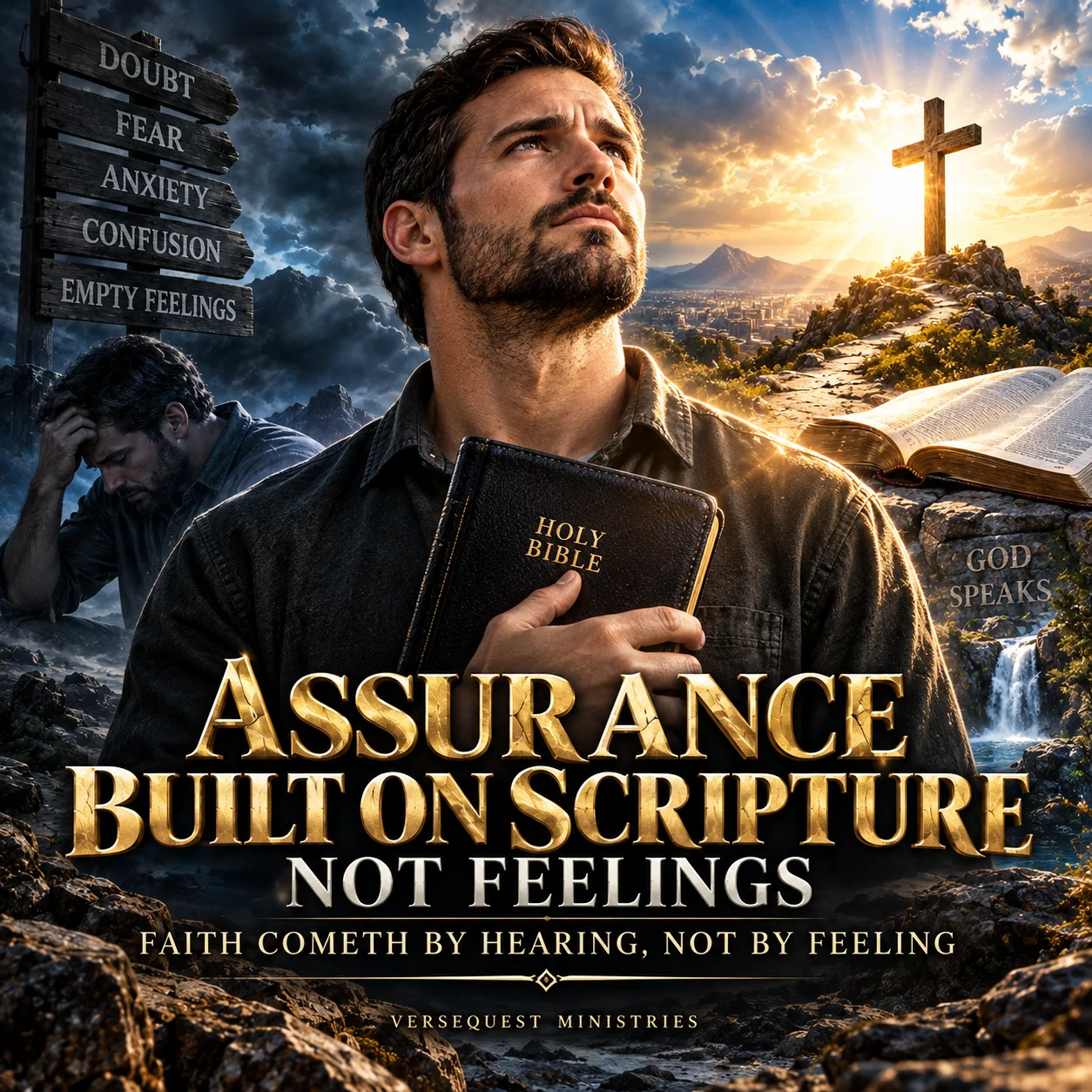
Assurance Built on Scripture, Not Feelings
Faith Cometh by Hearing, Not by Feeling
Sermon Title:
Assurance Built on Scripture, Not Feelings: Faith Cometh by Hearing
Key Passage:
Romans 10:17 — “So then faith cometh by hearing, and hearing by the word of God.”
Series:
Foundations of the Gospel of Grace
Topic:
Biblical Assurance Based on the Written Word of God Rather Than Changing Feelings, Emotions, Experiences, or Human Opinion
Book:
Romans, 1 Corinthians, Ephesians, John, 1 John, Colossians, 2 Timothy, Hebrews, Philippians
Speaker:
Paul Tackett
Suggested Sermon Text:
Romans 10:8–17; Romans 3:21–28; Romans 5:1–2; Romans 8:1, 31–39; 1 Corinthians 15:1–4; Ephesians 1:13–14; Ephesians 2:8–9; Ephesians 4:30; John 3:16, 36; John 5:24; John 6:47; John 10:27–30; 1 John 5:9–13; Colossians 2:10; 2 Timothy 1:12; 2 Timothy 3:15–17; Hebrews 10:14; Philippians 1:6
Short Sermon Description:
This detailed VerseQuest Ministries sermon outline explains Romans 10:17 and the vital truth that saving faith and biblical assurance are built upon the word of God rather than the instability of human feelings. Emotions can rise and fall, circumstances can change, conscience can become troubled, spiritual enjoyment can weaken, and a believer can pass through seasons of doubt, chastening, temptation, or discouragement, but none of those things rewrite what God has said. This sermon places Romans 10 within Paul’s discussion of Israel while drawing out the abiding principle that faith comes by hearing the word of God. It connects that principle to the gospel of Christ’s death, burial, and resurrection, justification by faith, eternal life as a present possession, the Holy Spirit’s seal, and the believer’s standing in Christ. It also distinguishes assurance from presumption, standing from state, conviction from condemnation, and biblical faith from emotional experience. Designed for pastors, teachers, Bible students, and believers, this outline shows why the safest place for a trembling soul is not inside his feelings but inside the written promises of God.
Assurance Built on Scripture, Not Feelings
Faith Cometh by Hearing, Not by Feeling
Introduction
Romans 10:17 gives us one of the simplest explanations in Scripture of where faith comes from: “So then faith cometh by hearing, and hearing by the word of God.” Faith does not come by staring at your feelings until they become sufficiently religious. It does not come by waiting for a chill, a tear, a warm sensation, a dramatic dream, a supernatural sign, a memory of an altar call, or a preacher telling you that you ought to feel something you do not presently feel. Faith comes by hearing, and hearing by the word of God. God deliberately anchored faith outside the nervous system of fallen man and inside the objective testimony of His own word.
That distinction becomes critical when discussing assurance. A saved man can feel strong one day and weak the next. He can feel close to God in the morning and discouraged by evening. He can sing with confidence on Sunday and wake up under a cloud on Monday. His emotions may respond to sleep, health, pressure, temptation, grief, disappointment, guilt, loneliness, circumstances, memories, and spiritual warfare. If assurance rises and falls with the emotions, then the believer’s confidence will be about as stable as a weather vane in a hurricane. God never intended feelings to carry the weight of eternal truth.
Romans 10 itself must be rightly divided. Romans 9–11 deals especially with Israel, her unbelief, God’s dealings with the nation, and the righteousness that comes by faith rather than through establishing one’s own righteousness. Paul is showing that Israel stumbled over Christ while seeking righteousness through the wrong principle. Yet the statement of Romans 10:17 reveals an abiding truth: God produces faith through His revealed word. For the Church today, that word brings us to the gospel Paul declares—that Christ died for our sins, was buried, and rose again. Assurance therefore begins not with “How do I feel?” but with “What hath God said?”
I. Faith Comes by Hearing the Word of God
Key Text: Romans 10:17
Supporting Texts: Romans 10:8–10; 1 Corinthians 1:21; 2 Timothy 3:15
Paul says, “faith cometh by hearing.” That immediately places faith in relationship to revelation. God speaks; man hears; faith receives what God has said. Romans 10:8 calls it “the word of faith, which we preach.” Faith is not man inventing a hopeful interpretation of life. Biblical faith is response to divine testimony. Without a word from God, faith becomes imagination. With the word of God, faith has solid ground.
Second Timothy 3 says the holy Scriptures are able to make a man “wise unto salvation through faith which is in Christ Jesus.” Notice again that Scripture and faith are connected. The Bible does not merely decorate salvation. It tells the sinner who Christ is, what sin is, what Christ accomplished, why man cannot save himself, and what God requires of the sinner. The Spirit uses that truth to bring men to faith.
First Corinthians 1 says it pleased God “by the foolishness of preaching to save them that believe.” The world may mock preaching, but God has chosen to use proclaimed truth. A preacher cannot produce saving faith by manipulating emotions. He can shout, whisper, dim lights, play music, extend invitations, tell stories, and create atmosphere, but only the word of God gives faith its proper object. Faith comes by hearing God.
Main Truth:
Faith is produced through hearing and receiving the word of God, not through emotional manipulation or religious atmosphere.
II. The Gospel Gives Faith Something Definite to Believe
Key Text: 1 Corinthians 15:1–4
Supporting Texts: Romans 1:16; Ephesians 1:13; Galatians 1:11–12
Faith must have content. Paul says, “I declare unto you the gospel which I preached unto you.” He then identifies that gospel: Christ died for our sins according to the Scriptures, He was buried, and He rose again the third day according to the Scriptures. A sinner is not saved by vaguely feeling positive about God. He believes a definite message concerning a definite Saviour and a definite finished work.
Romans 1:16 calls the gospel “the power of God unto salvation to every one that believeth.” Ephesians 1:13 calls it “the word of truth, the gospel of your salvation.” There is nothing foggy about that language. God has given the sinner something objective to hear and believe. The gospel is not, “Feel forgiven.” It is, “Christ died for your sins.” It is not, “Try to sense God’s acceptance.” It is, “Christ was raised again for our justification.”
That difference becomes vital when feelings fail. A believer may not feel forgiven, but Christ still died for sins. He may not feel secure, but Christ is still risen. He may not feel justified, but God’s promise has not changed. Feelings respond to truth properly when they are healthy, but truth does not depend upon feelings for existence. Calvary happened whether you feel it or not. The tomb is empty whether you feel it or not. God’s gospel stands whether your emotions applaud or sulk.
Main Truth:
Biblical faith rests upon the definite gospel facts of Christ’s death, burial, and resurrection rather than upon subjective emotional experience.
III. God’s Written Word Is More Reliable Than Man’s Feelings
Key Text: 2 Timothy 3:16
Supporting Texts: Psalm 119:89; John 17:17; Romans 3:4
Second Timothy 3:16 says, “All scripture is given by inspiration of God.” Jesus says in John 17:17, “thy word is truth.” Psalm 119 says, “For ever, O LORD, thy word is settled in heaven.” Those statements give Scripture a stability that human emotions simply do not possess. God’s word is inspired, true, and settled. Your feelings are none of those things.
Romans 3:4 says, “let God be true, but every man a liar.” Sometimes the “man” who must be contradicted is the man in the mirror. Your heart may say, “God cannot forgive you.” Scripture says redemption is through Christ’s blood. Your feelings may say, “You must have lost everything.” Scripture says believers are sealed unto the day of redemption. Your fear may say, “Christ has let go of you.” Christ says His sheep shall never perish. At that point somebody is wrong, and it is not God.
The Christian must learn to make his feelings bow to Scripture rather than making Scripture bow to feelings. That does not mean emotions are evil or irrelevant. God created man with emotion. Joy, grief, sorrow, love, fear, hope, and peace all have proper places. But feelings make terrible theologians. They report our experience; they do not legislate truth.
Main Truth:
God’s inspired and settled word is an objective authority that outranks every changing feeling of the human heart.
IV. Assurance Comes From What God Has Written
Key Text: 1 John 5:13
Supporting Texts: John 20:30–31; John 5:24; John 6:47
First John 5:13 says, “These things have I written unto you…that ye may know that ye have eternal life.” God connects knowledge of salvation with written revelation. John does not say, “These emotional experiences have I given you that ye may know.” He says, “These things have I written.” Written truth gives assurance a foundation outside the believer.
John 5:24 gives a threefold certainty. The believer “hath everlasting life,” “shall not come into condemnation,” and “is passed from death unto life.” Present possession. Future security. Completed transfer. None of those statements contains the phrase “provided you always feel like it.” John 6:47 says, “He that believeth on me hath everlasting life.” The verse stands whether the believer is emotionally soaring or sitting in the ashes wondering why he feels nothing.
This is why opening the Bible is often more useful to a doubting believer than conducting another autopsy on his feelings. If you continually ask, “Do I feel saved enough?” the question will reproduce itself. Ask instead, “What does God say about the man who believes on Christ?” Scripture gives an answer that feelings cannot manufacture.
Main Truth:
The believer’s assurance comes from God’s written promises concerning those who believe on Jesus Christ.
V. Feelings Cannot Change the Believer’s Standing in Christ
Key Text: Romans 5:1–2
Supporting Texts: Colossians 2:10; Ephesians 1:6–7; Romans 8:1
Romans 5 says, “Therefore being justified by faith, we have peace with God through our Lord Jesus Christ.” Verse 2 says we stand in grace. That is the believer’s standing. Colossians says believers are “complete in him.” Ephesians says believers are accepted in the Beloved and redeemed through His blood. Romans 8 says there is no condemnation to those in Christ Jesus.
None of those truths describes an emotion. “Justified” is not a feeling. “Redeemed” is not a feeling. “Accepted” is not a feeling. “Complete in him” is not a feeling. “No condemnation” is not a feeling. Those are positional statements grounded in the work of God. A believer may feel condemned while remaining judicially free from condemnation. He may feel incomplete while remaining complete in Christ.
This is the distinction between standing and state. Standing is what God has made the believer in Christ. State is the believer’s practical experience and walk. State can fluctuate tremendously. Standing is anchored in Christ. The devil loves to take a bad state and persuade a believer that his standing disappeared. The Bible teaches the believer to correct the state without denying the standing.
Main Truth:
The believer’s standing in Christ rests upon God’s saving work and cannot be redefined by changing emotional states.
VI. Conviction and Chastening Can Disturb Feelings Without Destroying Salvation
Key Text: Hebrews 12:6
Supporting Texts: Ephesians 4:30; 1 Corinthians 11:31–32; 1 John 1:9
Not every bad feeling should be ignored. Sometimes a believer feels miserable because he is walking badly. Ephesians 4:30 says believers can grieve the Holy Spirit. Hebrews 12 says the Father chastens the sons He loves. First Corinthians 11 says believers may be chastened severely for sinful conduct. Assurance does not mean telling a rebellious Christian that every troubled feeling is Satan and nothing needs correction.
But notice First Corinthians 11:32: “when we are judged, we are chastened of the Lord, that we should not be condemned with the world.” Chastening and condemnation are explicitly distinguished. The Father may make a believer uncomfortable because He loves him. Conviction can sting. Chastening can hurt. Broken fellowship can drain joy. None of those things means justification has been reversed.
First John 1:9 gives the answer to practical sin: confession and cleansing. The believer does not need to get saved again every time the Spirit puts His finger on sin. He needs to agree with God, confess it, forsake it, receive cleansing in fellowship, and walk in the light. Proper assurance does not silence conviction; it allows the believer to respond to conviction without mistaking the Father’s rod for the Judge’s condemnation.
Main Truth:
Conviction and chastening may deeply affect the believer’s emotional state, but they are fatherly correction rather than loss of salvation.
VII. The Holy Spirit’s Seal Is Stronger Than Emotional Instability
Key Text: Ephesians 1:13–14
Supporting Texts: Ephesians 4:30; 2 Corinthians 1:21–22; Romans 8:23
Ephesians 1 says that after believers hear the word of truth, the gospel of salvation, and believe, they are “sealed with that holy Spirit of promise.” The Spirit is also called “the earnest of our inheritance until the redemption of the purchased possession.” God does not give the believer a feeling as the earnest. He gives the Holy Spirit.
Ephesians 4:30 says believers are “sealed unto the day of redemption.” That gives the seal a destination. The believer’s emotions may fluctuate hourly, but the Holy Spirit does not reseal and unseal him hourly according to mood. The seal rests upon God’s act and promise. Second Corinthians says God “hath also sealed us, and given the earnest of the Spirit in our hearts.”
Romans 8 points toward “the redemption of our body.” God’s work is headed toward completion. The Spirit’s seal assures the believer that God has not forgotten the purchased possession. A man may wake up feeling spiritually flat, but the Spirit’s seal did not evaporate overnight. Assurance rests in God’s action, not emotional chemistry.
Main Truth:
The Holy Spirit’s seal guarantees the believer’s security until redemption day regardless of emotional fluctuation.
VIII. Doubt Must Be Answered With Scripture, Not Fed With Endless Introspection
Key Text: Psalm 42:5
Supporting Texts: Philippians 4:8; 2 Timothy 1:12; Romans 8:33–39
Psalm 42 records a man speaking to his own soul: “Why art thou cast down, O my soul? and why art thou disquieted in me? hope thou in God.” There are times when the believer must stop listening to himself and start preaching to himself. The soul says, “You are finished.” Scripture says, “Hope thou in God.” Fear says, “You are alone.” Scripture says nothing can separate you from the love of God in Christ Jesus.
Paul says in 2 Timothy 1:12, “I know whom I have believed.” Notice the object. Paul does not say, “I know exactly how strong my emotions are.” He says, “I know whom.” Assurance matures when the believer becomes increasingly Christ-conscious rather than endlessly self-conscious. Excessive introspection turns the Christian life into staring at spiritual belly-button lint while Christ stands outside the frame.
Romans 8 answers accusation with objective truths: God justifies, Christ died, Christ rose, Christ intercedes, nothing separates. That is how doubt must be fought. Open the Book. Read the promises. Rehearse the gospel. Take God’s side against your fears. Feelings often follow truth eventually, but even when they lag behind, truth still leads.
Main Truth:
Doubt is defeated by returning repeatedly to the objective promises of Scripture rather than feeding uncertainty through endless self-examination.
IX. Assurance Built on Scripture Produces a Steady Christian Walk
Key Text: Colossians 2:6–7
Supporting Texts: Romans 12:1–2; Titus 2:11–14; Philippians 1:6
Colossians says, “As ye have therefore received Christ Jesus the Lord, so walk ye in him: Rooted and built up in him, and stablished in the faith.” God wants believers established, not blown around by every emotional wind. A Christian rooted in Scripture can pass through sorrow without surrendering doctrine, conviction without surrendering assurance, and trial without concluding that God abandoned him.
This kind of assurance does not produce laziness. Romans 12 says the mercies of God become the ground for presenting the body as a living sacrifice. Titus 2 says grace teaches believers to deny ungodliness and live soberly, righteously, and godly. Security gives obedience a solid foundation. A believer who knows where he stands can concentrate on walking worthy instead of repeatedly trying to rebuild the foundation of salvation.
Philippians 1:6 says He which began a good work will perform it until the day of Jesus Christ. That is where mature assurance finally rests. The believer studies, prays, obeys, serves, grows, confesses, and perseveres, but underneath all of that is the faithful God who began the work. Feelings may accompany that confidence beautifully, but they are passengers—not the driver.
Main Truth:
Assurance grounded in Scripture establishes the believer in faith and produces a steadier, holier, more fruitful Christian walk.
Conclusion
Romans 10:17 tells us where faith comes from: “faith cometh by hearing, and hearing by the word of God.” That principle should govern assurance as surely as it governs conversion. The sinner hears the gospel and believes. The believer continues to stand on the same trustworthy word. God never intended salvation to begin with Scripture and then be maintained by emotional weather reports. The written word remains the believer’s authority from beginning to end.
Feelings have their place. Joy in the Lord is real. Peace is real. Comfort is real. Conviction is real. God created human beings with emotion, and a healthy Christian life should include the affections. But feelings must follow truth rather than govern truth. The believer may feel condemned while Romans 8 says no condemnation. He may feel abandoned while Hebrews says God will never leave nor forsake. He may feel insecure while Ephesians says he is sealed unto redemption day. When feelings contradict Scripture, Scripture wins.
The Church should therefore teach believers to know their Bible better than they know their moods. Know the gospel. Know your standing. Know Christ’s promises. Know the Spirit’s seal. Know the difference between chastening and condemnation, standing and state, fellowship and sonship. A trembling heart does not need another emotional experiment. It needs a sure word from a God who cannot lie.
Final Call
Sinner, your feelings cannot save you. You may feel religious, sincere, guilty, peaceful, spiritual, emotional, convicted, or even confident and still be lost if you have never believed the gospel. Salvation does not come by feeling something about Jesus. It comes by believing what God has declared concerning His Son.
Jesus Christ died for your sins according to the Scriptures. He was buried. He rose again the third day according to the Scriptures. Believe on the Lord Jesus Christ, and thou shalt be saved. Faith comes by hearing, and hearing by the word of God.
Believer, stop putting your feelings on the throne where God placed His word. When feelings agree with Scripture, thank God for them. When they disagree, believe the Book. Confess real sin. Submit to real chastening. Walk in the Spirit. But do not call God a liar because your emotions had a bad morning. Build assurance on Scripture, and let your feelings learn where they belong.
Closing Verse:
1 John 5:13 — “These things have I written unto you that believe on the name of the Son of God; that ye may know that ye have eternal life.”
Closing Statement:
Feelings may tell you how the journey feels today, but only the word of God can tell you where you eternally stand.