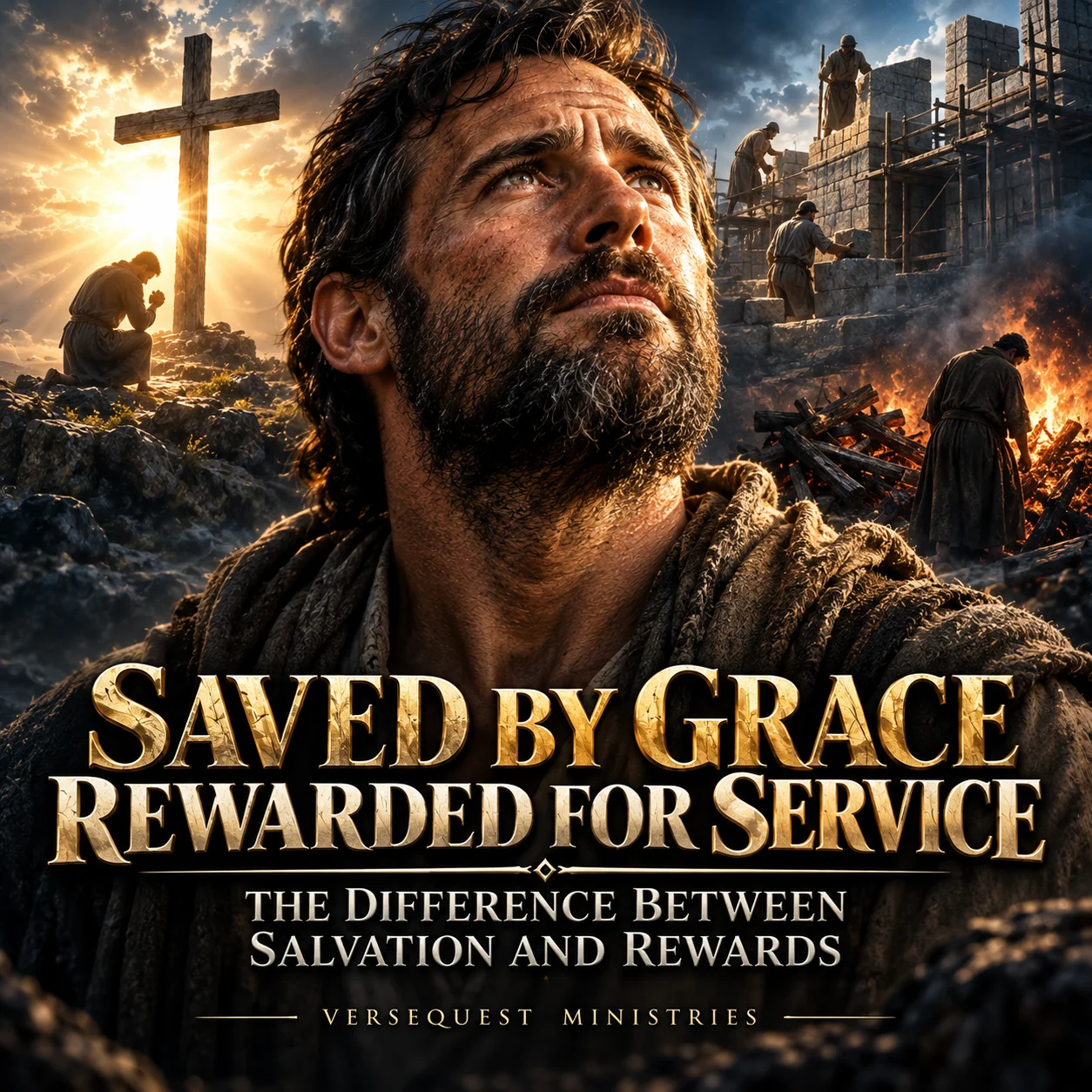
Saved by Grace, Rewarded for Service
The Difference Between Salvation and Rewards
Sermon Title:
Saved by Grace, Rewarded for Service: The Difference Between Salvation and Rewards
Key Passage:
1 Corinthians 3:11–15 — “For other foundation can no man lay than that is laid, which is Jesus Christ. Now if any man build upon this foundation gold, silver, precious stones, wood, hay, stubble; Every man’s work shall be made manifest: for the day shall declare it, because it shall be revealed by fire; and the fire shall try every man’s work of what sort it is. If any man’s work abide which he hath built thereupon, he shall receive a reward. If any man’s work shall be burned, he shall suffer loss: but he himself shall be saved; yet so as by fire.”
Series:
Foundations of the Gospel of Grace
Topic:
The Biblical Difference Between the Free Gift of Salvation and the Rewards Earned Through Faithful Christian Service
Book:
1 Corinthians, Romans, Ephesians, 2 Corinthians, Colossians, 2 Timothy, Philippians, 1 Thessalonians
Speaker:
Paul Tackett
Suggested Sermon Text:
1 Corinthians 3:5–15; 1 Corinthians 4:1–5; 1 Corinthians 9:24–27; 1 Corinthians 15:1–4; Romans 4:4–5; Romans 6:23; Romans 14:10–12; Ephesians 2:8–10; 2 Corinthians 5:9–10; Colossians 3:23–25; 2 Timothy 4:6–8; Philippians 3:13–14; 1 Thessalonians 2:19–20
Short Sermon Description:
This detailed VerseQuest Ministries sermon outline explains 1 Corinthians 3:11–15 and the essential Bible distinction between salvation and rewards. Salvation is the free gift of God received by grace through faith in Jesus Christ, while rewards concern the quality, motive, faithfulness, and spiritual value of the believer’s service after salvation. Paul says Jesus Christ is the only foundation, but believers may build upon that foundation with gold, silver, precious stones, wood, hay, or stubble. At the Judgment Seat of Christ, the believer’s works will be tested by fire; faithful work will receive reward, while worthless work will burn and result in loss. Yet Paul makes the distinction unmistakable: “he himself shall be saved; yet so as by fire.” This sermon separates justification from service, eternal life from wages, sonship from stewardship, salvation from crowns, and the Judgment Seat of Christ from the Great White Throne. It gives pastors, teachers, and Bible students a strong KJV framework for preaching eternal security without encouraging laziness and Christian accountability without turning rewards into a works-based plan of salvation.
Saved by Grace, Rewarded for Service
The Difference Between Salvation and Rewards
Introduction
One of the simplest ways to corrupt the gospel is to confuse salvation with rewards. When the Bible says eternal life is the gift of God, religion turns it into wages. When the Bible says a believer will receive reward according to his labour, religion turns that reward into heaven itself. Then everything gets thrown into one doctrinal stew where nobody knows whether he is working because he is saved, working to stay saved, working to earn heaven, or working to avoid hell. First Corinthians 3:11–15 clears the table. Jesus Christ is the foundation. The man building upon that foundation is already standing on Christ. His work is examined. His work may abide or burn. He may receive reward or suffer loss. But Paul closes the matter with language no honest Bible reader ought to miss: “he himself shall be saved; yet so as by fire.”
Salvation and reward are therefore connected, but they are not identical. Salvation concerns the sinner’s relationship to God through Jesus Christ. Reward concerns the saved believer’s service after salvation. Salvation rests on Christ’s work for us. Reward concerns our work for Christ. Salvation is received by faith apart from works. Reward is connected directly to labour, faithfulness, motive, stewardship, sacrifice, and obedience. Salvation gives a man the foundation. Reward concerns what he builds upon it. Confusing these categories either produces legalism, where a believer spends his life trying to earn what God calls a gift, or careless Christianity, where a saved man assumes that because heaven is secure, nothing he does afterward matters. Paul destroys both errors.
This doctrine must also be rightly divided. First Corinthians is written to the Church, and Paul repeatedly addresses saved people as brethren, saints, those sanctified in Christ Jesus, and those who belong to God. The Judgment Seat passages in Paul’s epistles concern the Body of Christ and Christian service; they are not the Great White Throne judgment of Revelation 20. The Great White Throne deals with the dead and the lake of fire. The Judgment Seat deals with the believer’s works and reward. The sinner needs Christ for salvation. The believer needs faithfulness for reward. Once those lines are drawn correctly, assurance and accountability can stand side by side without fighting each other.
I. Jesus Christ Is the Only Foundation of Salvation
Key Text: 1 Corinthians 3:11
Supporting Texts: 1 Corinthians 15:1–4; Acts 4:12; Romans 3:24–26
Paul begins with the foundation: “For other foundation can no man lay than that is laid, which is Jesus Christ.” Before Paul talks about gold, silver, wood, fire, reward, or loss, he settles where the man stands. The foundation is not baptism, denominational membership, morality, church attendance, sacraments, law-keeping, perseverance, or personal merit. The foundation is Jesus Christ. A man without Christ is not a poorly rewarded Christian. He is a lost sinner without the foundation.
First Corinthians 15 tells us the gospel upon which salvation rests: Christ died for our sins according to the Scriptures, He was buried, and He rose again the third day according to the Scriptures. Acts 4:12 says, “Neither is there salvation in any other.” Romans 3 says believers are “justified freely by his grace through the redemption that is in Christ Jesus.” The foundation was laid by God through the finished work of His Son. The sinner does not bring concrete to Calvary. He receives what Christ accomplished.
That matters because rewards only make sense after the foundation has been laid. A lost man cannot earn Christian rewards by doing religious works. He may give money, feed the poor, build churches, preach sermons, sing hymns, and die with a Bible in his hand, but if he has never trusted Christ, he has never gotten onto the foundation. The Christian life begins with Christ, not with labour.
Main Truth:
Jesus Christ and His finished gospel work are the only foundation of salvation, and no amount of Christian-looking service can replace that foundation.
II. Salvation Is a Gift, but Reward Is Earned
Key Text: Romans 6:23
Supporting Texts: Ephesians 2:8–9; Romans 4:4–5; 1 Corinthians 3:8
Romans 6:23 says, “the gift of God is eternal life through Jesus Christ our Lord.” A gift is not a wage. Romans 4:4 makes the distinction explicit: “Now to him that worketh is the reward not reckoned of grace, but of debt.” When a man works and is paid, the employer is not giving him grace; he is paying what is owed. Salvation cannot simultaneously be a free gift and wages earned through religious labour.
Ephesians 2:8–9 says, “For by grace are ye saved through faith…Not of works, lest any man should boast.” Then First Corinthians 3:8 says, “every man shall receive his own reward according to his own labour.” Notice the difference. Salvation is not according to works. Reward is according to labour. If those statements are blended together, the gospel disappears. If they are rightly divided, the Bible becomes wonderfully clear.
A believer does not serve Christ to purchase eternal life. Eternal life has already been received as God’s gift. He serves because he belongs to Christ, loves Christ, will answer to Christ, and desires Christ’s approval. That changes the entire motive of Christian service. We are not employees trying to earn adoption. We are sons entrusted with stewardship.
Main Truth:
Salvation is the free gift of God received by faith, while reward is given according to the believer’s faithful labour after salvation.
III. Every Believer Builds Something Upon the Foundation
Key Text: 1 Corinthians 3:12
Supporting Texts: Ephesians 2:10; Colossians 3:17; Romans 12:1–2
Paul says, “Now if any man build upon this foundation.” Once Christ is the foundation, the Christian life becomes a building project. Every saved person is constructing something with the time, opportunities, gifts, knowledge, money, influence, relationships, ministry, witness, prayer, study, suffering, sacrifice, and service God has entrusted to him. There is no such thing as a believer who builds absolutely nothing. Even neglect builds a record of wasted opportunity.
Ephesians 2:10 says believers are “created in Christ Jesus unto good works, which God hath before ordained that we should walk in them.” Verse 8 tells us works do not save. Verse 10 tells us the saved man was created unto good works. That order is everything. Grace saves the sinner and then puts the saved man to work. The Christian is not saved by good works, but he is certainly saved unto good works.
Colossians 3:17 says whatsoever the believer does in word or deed should be done in the name of the Lord Jesus. Romans 12 calls the body a living sacrifice. Christian service therefore extends beyond pulpits and missionary fields. Parenting, work, giving, prayer, witness, faithfulness, hospitality, suffering, church service, Bible teaching, encouragement, and private obedience can all become materials in the building. The Lord sees more construction than men do.
Main Truth:
Every believer is building upon Jesus Christ through the daily choices, service, stewardship, and opportunities of the Christian life.
IV. Not All Christian Work Has the Same Eternal Value
Key Text: 1 Corinthians 3:12
Supporting Texts: 1 Corinthians 4:5; 2 Timothy 2:20–21; Colossians 3:23
Paul lists six building materials: “gold, silver, precious stones, wood, hay, stubble.” Three endure fire; three do not. That is the picture. Not everything done by a Christian will possess eternal value merely because a Christian did it. Religious activity and spiritual value are not synonyms. A man can be busy for God while building a haystack.
Gold, silver, and precious stones suggest work with lasting value—service shaped by truth, faithfulness, sacrifice, obedience, right motive, and dependence upon God. Wood, hay, and stubble suggest what may look impressive for a season but cannot stand divine evaluation. Men evaluate size, attendance, applause, budgets, visibility, platforms, followers, titles, degrees, and popularity. Fire has a different grading system.
First Corinthians 4:5 says Christ will “make manifest the counsels of the hearts.” That means motives matter. Two men may preach the same sermon, and God may evaluate the works differently because one sought Christ’s glory while the other sought his own name. A widow may perform an unnoticed act of faithfulness that outweighs a public ministry built on vanity. Heaven’s accounting department does not use social-media analytics.
Main Truth:
Not everything done in the name of Christian service carries equal eternal value, because God evaluates both the quality of the work and the motive behind it.
V. The Fire Tests the Work, Not Christ’s Foundation
Key Text: 1 Corinthians 3:13
Supporting Texts: 2 Corinthians 5:10; Romans 14:10–12; 1 Corinthians 4:5
“Every man’s work shall be made manifest,” Paul says. “The fire shall try every man’s work of what sort it is.” Notice exactly what the fire tests: the work. The foundation is not placed back on trial. Jesus Christ is not examined to see whether His blood was sufficient. Justification is not reopened. Eternal life is not put into a furnace to see whether it survives. The believer’s work is tested.
Second Corinthians 5:10 says, “we must all appear before the judgment seat of Christ.” Romans 14 says, “every one of us shall give account of himself to God.” These passages should make the Christian serious without making him terrified about hell. He is going to meet the One who saved him, and that meeting will involve honest evaluation. The Lord knows what was done, why it was done, what could have been done, what opportunities were wasted, and what sacrifices nobody else saw.
The fire removes public relations. It removes excuses. It removes inflated ministry reports. It removes reputation. Men may spend an entire lifetime polishing wood until it resembles gold, but fire knows the difference. Christ’s evaluation will finally reveal the true spiritual value of every believer’s service.
Main Truth:
At the Judgment Seat of Christ, the believer’s works and motives are tested while his salvation rests securely upon the already-laid foundation of Jesus Christ.
VI. Faithful Service Receives Reward
Key Text: 1 Corinthians 3:14
Supporting Texts: 2 Timothy 4:7–8; 1 Thessalonians 2:19–20; James 1:12
Paul says, “If any man’s work abide which he hath built thereupon, he shall receive a reward.” God is not unrighteous to forget faithful labour. Men may forget it. Churches may overlook it. People you helped may never thank you. Nobody on earth may ever know the prayers prayed in secret, sacrifices made quietly, temptations resisted, money given privately, souls witnessed to, burdens carried, or truth defended when compromise would have been easier. Christ knows.
Paul looked forward to a “crown of righteousness” after finishing his course and keeping the faith. In 1 Thessalonians 2 he calls converted believers his “hope, or joy, or crown of rejoicing” in the presence of the Lord Jesus Christ at His coming. Scripture speaks in several places of crowns and reward connected with faithful service, endurance, shepherding, and disciplined Christian living. Salvation may be free, but God still chooses to honour faithfulness.
Reward should therefore be a legitimate Christian motive when kept underneath love for Christ and the glory of God. Paul certainly thought about reward. The problem is not wanting Christ’s approval. The problem is serving merely for human applause. There is nothing carnal about wanting to finish well and hear the Lord approve what was done for Him.
Main Truth:
Jesus Christ will faithfully reward service that survives His examination because nothing genuinely done for Him is forgotten.
VII. A Believer Can Suffer Loss Without Losing Salvation
Key Text: 1 Corinthians 3:15
Supporting Texts: 2 John 8; 1 Corinthians 9:24–27; Romans 8:1
Here is the verse that draws the line in permanent ink: “If any man’s work shall be burned, he shall suffer loss: but he himself shall be saved; yet so as by fire.” What burns? His work. What does he suffer? Loss. What remains true of the man himself? “He himself shall be saved.” Paul could hardly have written the distinction more plainly.
Second John 8 warns believers, “Look to yourselves, that we lose not those things which we have wrought, but that we receive a full reward.” Something can be lost. The Bible says so. But that something is not automatically salvation. First Corinthians 3 identifies it as reward associated with work. A Christian can reach heaven with eternal life secure and yet discover that much of his earthly activity had no lasting value.
This verse destroys two errors at once. It destroys works salvation because the man whose works burn is still saved. It also destroys careless eternal-security teaching because the saved man can suffer real loss. Grace does not say nothing matters. Grace says heaven is not earned—but how the citizen of heaven lives absolutely matters.
Main Truth:
A believer can lose reward because of worthless service without losing the salvation secured for him in Jesus Christ.
VIII. The Judgment Seat Is Not the Great White Throne
Key Text: 2 Corinthians 5:10
Supporting Texts: Revelation 20:11–15; Romans 14:10–12; 1 Corinthians 3:15
The Judgment Seat of Christ and the Great White Throne are not two names for the same event. At the Judgment Seat, believers appear before Christ and their service is evaluated. First Corinthians 3 allows for reward or loss while explicitly saying the believer himself is saved. Revelation 20 presents the dead standing before the Great White Throne, books opened, judgment according to works, and those not found written in the book of life cast into the lake of fire.
The timing is different, the people are different, the purpose is different, and the outcome is different. The Great White Throne follows the Millennium in Revelation 20. Pauline passages concerning the Church’s accountability belong to the believer’s future with Christ. Throwing all judgment passages into one doctrinal bucket is not Bible study. It is religious recycling.
This distinction protects both assurance and seriousness. Tell a saved man that the Judgment Seat may send him to hell, and you undermine Christ’s finished work. Tell a Christian the Judgment Seat means nothing because salvation is secure, and you undermine Paul’s warnings about reward and loss. Right division lets both doctrines stand exactly where God placed them.
Main Truth:
The Judgment Seat of Christ evaluates the saved believer’s service for reward or loss, while the Great White Throne is the final judgment of the dead.
IX. Understanding Rewards Should Change How the Believer Lives Now
Key Text: 1 Corinthians 3:13–14
Supporting Texts: 1 Corinthians 15:58; Colossians 3:23–24; 2 Corinthians 5:9
Doctrine should eventually reach the shoes. If the believer knows his work will be examined by Jesus Christ, then his present life should be shaped by eternity. First Corinthians 15:58 says, “be ye stedfast, unmoveable, always abounding in the work of the Lord, forasmuch as ye know that your labour is not in vain in the Lord.” There is the proper balance—security in Christ producing steadfast service for Christ.
Colossians 3 tells believers to serve heartily “as to the Lord, and not unto men,” knowing they will receive the reward of the inheritance. That protects a servant from both pride and discouragement. If men applaud, Christ remains the Judge. If men ignore, Christ remains the Judge. Christian faithfulness should not rise and fall with earthly recognition.
Second Corinthians 5:9 says, “Wherefore we labour, that, whether present or absent, we may be accepted of him.” Paul is not trying to earn justification there; he is talking about being well-pleasing to Christ in the context of the Judgment Seat. The saved man should want his life to please the Saviour. Grace gives him heaven freely and then gives him a lifetime in which to prepare something worth laying at Christ’s feet.
Main Truth:
The certainty of future reward and loss should move the secure believer to live faithfully, sacrificially, and eternally minded today.
Conclusion
First Corinthians 3:11–15 draws a line religion constantly blurs. Jesus Christ is the foundation. The foundation is received through the gospel and salvation by grace. Upon that foundation the believer builds. The building materials differ in quality. The day will reveal the work. Fire will test it. That which remains will receive reward. That which burns will produce loss. Yet even where the work burns, Paul says, “he himself shall be saved.” Salvation and rewards are not the same thing.
That distinction protects the gospel without producing lazy Christianity. Salvation is free because Christ paid the full price. Rewards matter because the believer’s life after salvation is real stewardship. Eternal security does not mean eternal insignificance. A Christian can never improve upon the righteousness of Christ that saves him, but he can certainly waste the time Christ gave him. He can reach glory with a full reward or with smoke rising from a pile of burned opportunities.
The Bible believer should therefore rest completely in Jesus Christ for salvation and labour faithfully for Jesus Christ in service. Never try to purchase heaven with Christian works. Never use free salvation as an excuse to waste Christian works. Keep the categories clear. Christ saves. The believer serves. Grace gives eternal life. Faithfulness receives reward. And one day the fire will reveal whether we spent our earthly lives building with gold or stacking hay on top of the Rock.
Final Call
Sinner, rewards are not your first problem. You need the foundation. You may live morally, give generously, attend church faithfully, teach religion, feed the poor, serve your community, and accumulate a mountain of human works, but without Jesus Christ you have no saving foundation beneath any of it.
Jesus Christ died for your sins according to the Scriptures. He was buried. He rose again the third day according to the Scriptures. Believe on the Lord Jesus Christ. Eternal life is not a reward for good behaviour; it is the gift of God through Jesus Christ our Lord.
Believer, your salvation is not your reward for serving well. It rests in Christ. Now that you are saved, build carefully. Redeem the time. Serve when nobody notices. Keep your motives clean. Preach truth. Witness faithfully. Give sacrificially. Pray secretly. Endure hardship. Do what Christ gave you to do. One day the fire will test the work, and only what was truly worth something to Jesus Christ will remain.
Closing Verse:
1 Corinthians 15:58 — “Therefore, my beloved brethren, be ye stedfast, unmoveable, always abounding in the work of the Lord, forasmuch as ye know that your labour is not in vain in the Lord.”
Closing Statement:
Salvation determines whether you stand on the Foundation; rewards reveal what you built after Jesus Christ put you there.