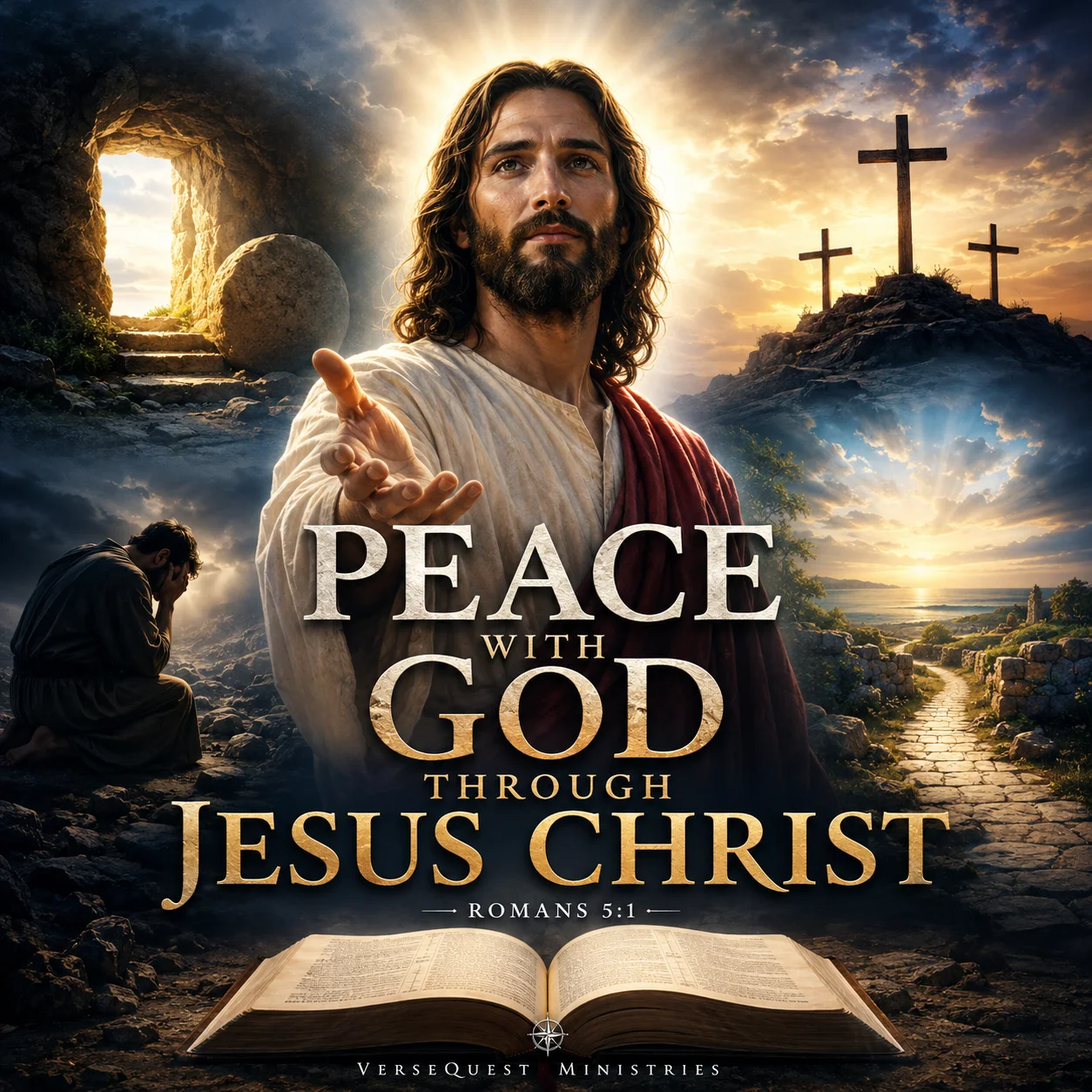
Sermon Title:
The War Is Over: Peace With God Through Jesus Christ
Key Passage:
Romans 5:1 — “Therefore being justified by faith, we have peace with God through our Lord Jesus Christ.”
Series:
Foundations of the Gospel of Grace
Topic:
Peace With God Through Justification by Faith in Jesus Christ
Book:
Romans, Ephesians, Colossians, 2 Corinthians, Galatians, Isaiah, John, Philippians
Speaker:
Paul Tackett
Suggested Sermon Text:
Romans 5:1–11; Romans 3:21–28; Romans 4:20–25; Romans 8:1; Ephesians 2:13–18; Colossians 1:20–22; 2 Corinthians 5:18–21; Galatians 2:16; Isaiah 53:5; John 14:27; Philippians 4:6–7; 1 Corinthians 15:1–4
Short Sermon Description:
This detailed VerseQuest Ministries sermon outline explains the great gospel truth of Romans 5:1: “Therefore being justified by faith, we have peace with God through our Lord Jesus Christ.” The sinner’s greatest problem is not lack of religion, poor self-esteem, bad circumstances, or emotional unrest, but alienation from God because of sin. Peace with God is not a temporary feeling, a religious mood, or inner calm manufactured by human effort; it is the settled legal condition of the justified believer who has been reconciled to God through the blood, death, burial, and resurrection of Jesus Christ. This sermon distinguishes peace with God from the peace of God, shows why justification by faith is the foundation of peace, explains the believer’s access into grace, and exposes false religious systems that offer peace through works, rituals, sacraments, law-keeping, or emotional experience. Designed for pastors, preachers, teachers, Bible students, and believers, this outline presents the finished work of Christ as the only basis for real peace between guilty sinners and a holy God.
The War Is Over
Peace With God Through Jesus Christ
Introduction
Romans 5:1 opens with one of the greatest words in Paul’s epistles: “Therefore.” That word points backward to the doctrine already established in Romans 3 and 4. The sinner has been found guilty. The law has stopped every mouth. No flesh can be justified by the deeds of the law. The righteousness of God has been manifested without the law. Christ has been set forth as a propitiation through faith in His blood. Abraham was justified by faith before circumcision, and David described the blessedness of the man unto whom God imputeth righteousness without works. Then Paul arrives at Romans 5 and says, “Therefore being justified by faith, we have peace with God through our Lord Jesus Christ.” That peace is not built on religious effort. It is built on justification.
The world talks about peace constantly because the world has none. Men sign peace treaties while preparing the next war. Families speak of peace while hiding bitterness behind polite smiles. Churches preach peace while offering sinners a payment plan of guilt, ritual, fear, and uncertainty. The sinner wants peace in his conscience, peace in his home, peace in his mind, and peace in the world, but his first need is peace with God. A man may calm his nerves and still remain condemned. He may quiet his emotions and still remain lost. He may enjoy a happy life and still die without Christ. The first war that must end is not between nations, neighbours, or emotions; it is the war between a holy God and a guilty sinner.
Romans 5:1 declares that this war ends through Jesus Christ. Not through baptism. Not through sacraments. Not through law-keeping. Not through church membership. Not through confessions to a religious officer. Not through personal morality. Not through trying harder, turning over a new leaf, lighting a candle, keeping a feast, saying a prayer by rote, or crawling through a denominational tunnel. Peace with God comes after justification, and justification comes by faith. The sinner is not asked to negotiate terms of surrender; he is commanded to believe the gospel. Christ died for our sins, was buried, and rose again the third day. The peace was not negotiated at a religious altar; it was purchased at Calvary.
I. Peace With God Begins With the Word “Therefore”
Key Text: Romans 5:1
Supporting Texts: Romans 3:21–28; Romans 4:5; Romans 4:24–25
Romans 5:1 does not float in the air by itself. It rests upon the doctrine of justification taught in Romans 3 and 4. “Therefore” means Paul is drawing a conclusion. He has already proven that all are under sin, that all have sinned, that no flesh can be justified by law, and that righteousness is received by faith in Jesus Christ. Peace with God is not the starting point of the gospel presentation; it is the result of God’s saving verdict. Before Romans 5:1 announces peace, Romans 3 has already announced guilt and Romans 4 has already established justification by faith.
This order matters. Modern preaching often tries to give sinners peace before it tells them why they are at war. It comforts before it convicts, soothes before it exposes, and offers a religious pillow to a man sleeping on the edge of hell. Paul does not do that. He first shows the sinner guilty, then shows Christ as the propitiation, then shows faith counted for righteousness, and then announces peace. Biblical peace is not God overlooking guilt. Biblical peace comes after God deals with guilt righteously through the blood of Jesus Christ.
Romans 4:24–25 says righteousness shall be imputed to those who believe on Him that raised up Jesus our Lord from the dead, “Who was delivered for our offences, and was raised again for our justification.” That is the ground beneath Romans 5:1. Christ was delivered because of our offences. Christ was raised because justification had been secured. Therefore, being justified by faith, we have peace with God. The peace is as secure as the resurrection is real.
Main Truth:
Peace with God is the result of justification by faith, grounded in the death and resurrection of Jesus Christ.
II. The Sinner’s Natural Condition Is Not Peace but Enmity
Key Text: Romans 5:10
Supporting Texts: Ephesians 2:1–3; Colossians 1:21; Romans 8:7
Romans 5:10 says, “For if, when we were enemies, we were reconciled to God by the death of his Son.” That word “enemies” is not gentle religious language. It does not say we were misunderstood friends, struggling seekers, sincere worshippers, or basically good people needing a little divine assistance. It says enemies. The lost man is not neutral toward God. His flesh is against God, his mind is darkened by sin, and his natural condition is alienation from the One who made him.
Colossians 1:21 says believers were once “alienated and enemies in your mind by wicked works.” The trouble is not merely outward behaviour, though wicked works reveal the condition. The trouble reaches the mind, the will, the affections, and the heart. Romans 8:7 says “the carnal mind is enmity against God.” The sinner may be religious, polite, educated, charitable, patriotic, and respected in the community, but if he is outside Christ, his carnal mind remains at odds with God. A man may wear a choir robe and still be an enemy if he rejects the righteousness of God in Christ.
This is why peace with God cannot be manufactured by man. Enemies do not write their own peace treaty with the King they offended. Rebels do not decide the terms of pardon. Criminals do not dictate the verdict. God is the offended party, God is the righteous Judge, and God is the One who provided reconciliation through His Son. Peace begins when the sinner stops defending himself and receives God’s provision in Jesus Christ.
Main Truth:
The lost sinner is naturally an enemy of God and can only have peace through the reconciliation provided by Christ.
III. Justification by Faith Is the Foundation of Peace
Key Text: Romans 5:1
Supporting Texts: Galatians 2:16; Romans 3:28; Acts 13:38–39
Romans 5:1 says, “being justified by faith.” That phrase is the foundation. Peace with God does not come through being justified by works, justified by water, justified by sacraments, justified by law, justified by church membership, or justified by sincerity. Galatians 2:16 says a man is not justified by the works of the law, but by the faith of Jesus Christ. Romans 3:28 says a man is justified by faith without the deeds of the law. Acts 13:39 says all who believe are justified from all things from which they could not be justified by the law of Moses.
Justification is God’s legal declaration that the believing sinner is righteous in Christ. It is not a religious feeling. It is not moral improvement. It is not God waiting to see if the sinner will behave well enough until death. It is a settled verdict based upon the finished work of Jesus Christ. The believer’s peace rests upon God’s verdict, not the believer’s mood. Feelings change, but justification stands. Emotions rise and fall, but the blood of Christ does not lose value overnight.
If peace depended on performance, no believer would ever have peace. One bad thought, one foolish word, one sinful motive, one failure in the flesh, and the soul would be thrown back into uncertainty. Religion thrives in that uncertainty. It keeps people working, paying, confessing, fearing, and returning for another installment of temporary comfort. The gospel gives something better: justification by faith and peace with God through Jesus Christ. The justified man is not on probation; he is accepted in the Beloved.
Main Truth:
Peace with God rests on the believer’s justification by faith, not on fluctuating feelings or religious performance.
IV. Peace With God Comes Through Our Lord Jesus Christ
Key Text: Romans 5:1
Supporting Texts: John 14:6; 1 Timothy 2:5–6; Ephesians 2:13–18
Romans 5:1 says peace comes “through our Lord Jesus Christ.” The channel is exclusive. There is no peace with God through Mary, priests, popes, pastors, sacraments, saints, angels, temples, confession booths, rituals, candles, or religious traditions. First Timothy 2:5 says, “For there is one God, and one mediator between God and men, the man Christ Jesus.” If there is one Mediator, there are not two thousand assistant mediators wearing religious costumes.
Jesus Christ is the only sufficient Mediator because He is both God and man. As God, He possesses the divine worth necessary to satisfy eternal righteousness. As man, He could represent men and die in their place. John 14:6 says, “I am the way, the truth, and the life: no man cometh unto the Father, but by me.” That is not narrow-minded bigotry. That is divine reality. There is one door because there is one Saviour.
Ephesians 2 says Christ “is our peace.” He made peace by the blood of His cross and provides access unto the Father. Peace is not an abstract blessing floating around for religious people to claim by sentiment. Peace is a Person. Christ made it. Christ provides it. Christ secures it. A sinner outside Christ has no peace with God, no matter how peaceful he feels. A believer in Christ has peace with God, even when his circumstances are shaking like the Philippian prison.
Main Truth:
Peace with God is found only through the Lord Jesus Christ, the one Mediator and sufficient Saviour.
V. Peace Was Purchased by the Blood of the Cross
Key Text: Colossians 1:20
Supporting Texts: Romans 5:9; Ephesians 1:7; Isaiah 53:5
Colossians 1:20 says Christ made “peace through the blood of his cross.” Peace was not purchased with religious gold, human suffering, moral effort, or ceremonial observance. It was purchased with blood. Romans 5:9 says believers are “justified by his blood.” Ephesians 1:7 says we have redemption through His blood, the forgiveness of sins. The blood of Christ is not decorative doctrine. It is the payment price of peace.
Isaiah 53:5 says, “the chastisement of our peace was upon him.” That means the punishment required to secure our peace fell upon Jesus Christ. Peace did not come because God softened His view of sin. Peace came because sin was judged in the Substitute. God did not call a ceasefire by ignoring justice. He established peace through judgment falling on the Lamb. The sword of divine justice was sheathed only after it struck the One who stood in the sinner’s place.
This destroys every bloodless religion. A gospel without blood is not the gospel. A cross without substitution is not saving truth. A Jesus who merely teaches peace but does not purchase peace cannot reconcile a guilty sinner to God. Christ made peace by His blood because nothing else could answer sin. The price tells you how serious the war was. The blood tells you how complete the peace is.
Main Truth:
Peace with God was purchased by the blood of Jesus Christ, who bore the chastisement required for our reconciliation.
VI. Peace With God Is Different From the Peace of God
Key Text: Romans 5:1
Supporting Texts: Philippians 4:6–7; John 14:27; Colossians 3:15
Romans 5:1 speaks of peace “with God.” Philippians 4:7 speaks of “the peace of God.” These are related, but they are not the same. Peace with God is the believer’s settled position through justification. The peace of God is the believer’s experienced calm through prayer, trust, and fellowship. A man must have peace with God before he can truly enjoy the peace of God.
Many Christians confuse position with experience and then doubt their salvation because their emotions are unsettled. A believer may have peace with God and still experience fear, grief, pressure, temptation, confusion, or sorrow. Paul had peace with God while beaten, imprisoned, shipwrecked, slandered, and hunted. Peace with God does not mean life becomes easy; it means the believer’s legal war with God is over forever. The courtroom has been settled even if the battlefield is still noisy.
Philippians 4 tells believers to pray, give thanks, and let the peace of God keep their hearts and minds through Christ Jesus. That peace guards the believer’s inner life, but it is built on the greater peace already established by justification. The justified believer can come boldly to God because he is no longer an enemy. He does not pray as a rebel begging for a temporary truce. He prays as a reconciled son standing in grace.
Main Truth:
Peace with God is the believer’s permanent standing through justification, while the peace of God is the believer’s experienced rest in fellowship.
VII. Peace Gives the Believer Access Into Grace
Key Text: Romans 5:2
Supporting Texts: Ephesians 2:18; Hebrews 4:16; Ephesians 3:12
Romans 5:2 says, “By whom also we have access by faith into this grace wherein we stand.” Peace with God brings access. The justified believer is not kept outside the gates hoping for an occasional appointment. He stands in grace. He has access through Jesus Christ. Ephesians 2:18 says, “For through him we both have access by one Spirit unto the Father.” This access is not earned by religious rank. It is granted through Christ.
Under the law, access was restricted. The Gentile could not walk into Israel’s sanctuary as he pleased. The ordinary Israelite could not enter the holy of holies. The high priest entered once a year, not without blood. But Christ has opened the way. The veil was rent. The believer now has access, not because he became worthy in himself, but because he stands in the Worthy One. Hebrews 4:16 says we may come boldly unto the throne of grace.
This access should change how a believer lives. He does not stand in terror before an uncertain Judge. He stands in grace before a reconciled Father through a finished Saviour. He may confess sin, seek help, receive mercy, find grace, and pray with confidence. Peace with God is not merely a doctrine to write in a notebook. It is the opened door through which the believer approaches God daily.
Main Truth:
Peace with God gives the justified believer continual access into grace through Jesus Christ.
VIII. Peace Produces Joy, Hope, and Stability in Tribulation
Key Text: Romans 5:2–5
Supporting Texts: Romans 8:31–39; 2 Corinthians 4:17–18; Philippians 1:6
Romans 5 does not say peace with God removes all trouble. Immediately after speaking of peace and access, Paul says believers glory in tribulations also. That sounds insane to the natural man, but it is normal Christianity when doctrine is right. The believer can endure tribulation because his standing with God is settled. Trouble may shake his circumstances, but it cannot shake his justification. Storms may hit the house, but the foundation remains Christ.
Tribulation works patience, patience experience, and experience hope. God uses pressure to develop endurance and deepen confidence. This does not mean suffering saves the believer or pays for sin. Christ did that. It means that suffering in the life of a justified saint is no longer evidence of divine hostility. God is not at war with the believer. He may chasten, train, refine, and strengthen, but He is not condemning. Romans 8:1 already says there is no condemnation to them which are in Christ Jesus.
Peace with God gives stability because the believer knows the greatest issue has been settled. If God justified him, who shall lay anything to his charge? If Christ died, rose, and intercedes, who can condemn? If nothing can separate him from the love of God in Christ Jesus, then tribulation becomes temporary training, not eternal threat. The believer can hurt and still hope. He can weep and still stand. He can be pressed and still know the war is over.
Main Truth:
Peace with God gives the believer hope and stability in tribulation because suffering cannot overturn justification.
IX. Peace With God Must Be Preached Clearly to Sinners
Key Text: 2 Corinthians 5:18–21
Supporting Texts: 1 Corinthians 15:1–4; Acts 16:30–31; Romans 10:13–17
Second Corinthians 5 says God has given believers the ministry of reconciliation. The message is not that sinners should make peace with God by improving themselves. The message is that God was in Christ, reconciling the world unto Himself, not imputing their trespasses unto them, and has committed unto us the word of reconciliation. We preach, “be ye reconciled to God,” because Christ was made sin for us that we might be made the righteousness of God in Him.
The gospel must be clear. Christ died for our sins according to the Scriptures. He was buried. He rose again the third day according to the Scriptures. The sinner receives peace with God by believing on the Lord Jesus Christ, not by entering a religious system. If the message is clouded with works, rituals, sacraments, law, or emotional manipulation, sinners may become religious without being reconciled. A foggy gospel is a cruel thing to preach to dying men.
The Church must not be ashamed of the simplicity of the message. Men love complexity because complexity gives them room to boast. God saves by grace through faith so that the glory belongs to Christ alone. The preacher’s job is not to impress sinners with cleverness, but to declare the terms of peace God has established through the cross. The war can end today for any sinner who believes on Jesus Christ.
Main Truth:
The Church must clearly preach reconciliation through Christ so sinners may have peace with God by faith in the gospel.
Conclusion
Romans 5:1 declares the war is over for the justified believer: “Therefore being justified by faith, we have peace with God through our Lord Jesus Christ.” This peace is not a feeling that comes and goes. It is not a temporary religious mood. It is not produced by human effort. It is the settled condition of a sinner who has been declared righteous in Christ because of the redemption purchased by His blood.
The sinner’s natural condition is enmity. The law exposes guilt. Religion cannot reconcile. Works cannot justify. But Jesus Christ died for our sins, was buried, and rose again. Through Him, God justifies the ungodly who believe. Through Him, the believer has access into grace. Through Him, tribulation cannot destroy hope. Through Him, the courtroom is settled, the condemnation is removed, and the soul stands accepted before God.
The Church must recover the strength of this doctrine. Too many believers live like the war is still undecided, and too many preachers speak as though peace with God is found somewhere in religious effort. But Paul is plain. Being justified by faith, we have peace with God. Do not let Rome, ritualism, legalism, emotionalism, or unbelief drag you back into the war Christ ended. Stand in grace. Glory in Christ. Preach reconciliation. The peace was purchased by blood and secured by resurrection.
Final Call
The sinner outside Christ has no peace with God. He may have money, pleasure, religion, health, friends, and success, but without Christ he remains guilty, condemned, and alienated from God. No ceremony can end that war. No law can erase that guilt. No church can manufacture that peace.
Jesus Christ died for our sins according to the Scriptures. He was buried. He rose again the third day according to the Scriptures. He made peace through the blood of His cross. Believe on the Lord Jesus Christ, and thou shalt be saved. Receive the justification God gives freely by grace through faith.
Believer, rest in the peace Christ purchased. Stop measuring your standing by your mood. Stop letting religion reopen a case God has closed. Serve from peace, pray through peace, endure in peace, and preach the gospel of peace to sinners who are still at war with God.
Closing Verse:
Colossians 1:20 — “And, having made peace through the blood of his cross, by him to reconcile all things unto himself.”
Closing Statement:
The sinner’s war with God ends only where God ended it—at the blood-stained cross of the Lord Jesus Christ.