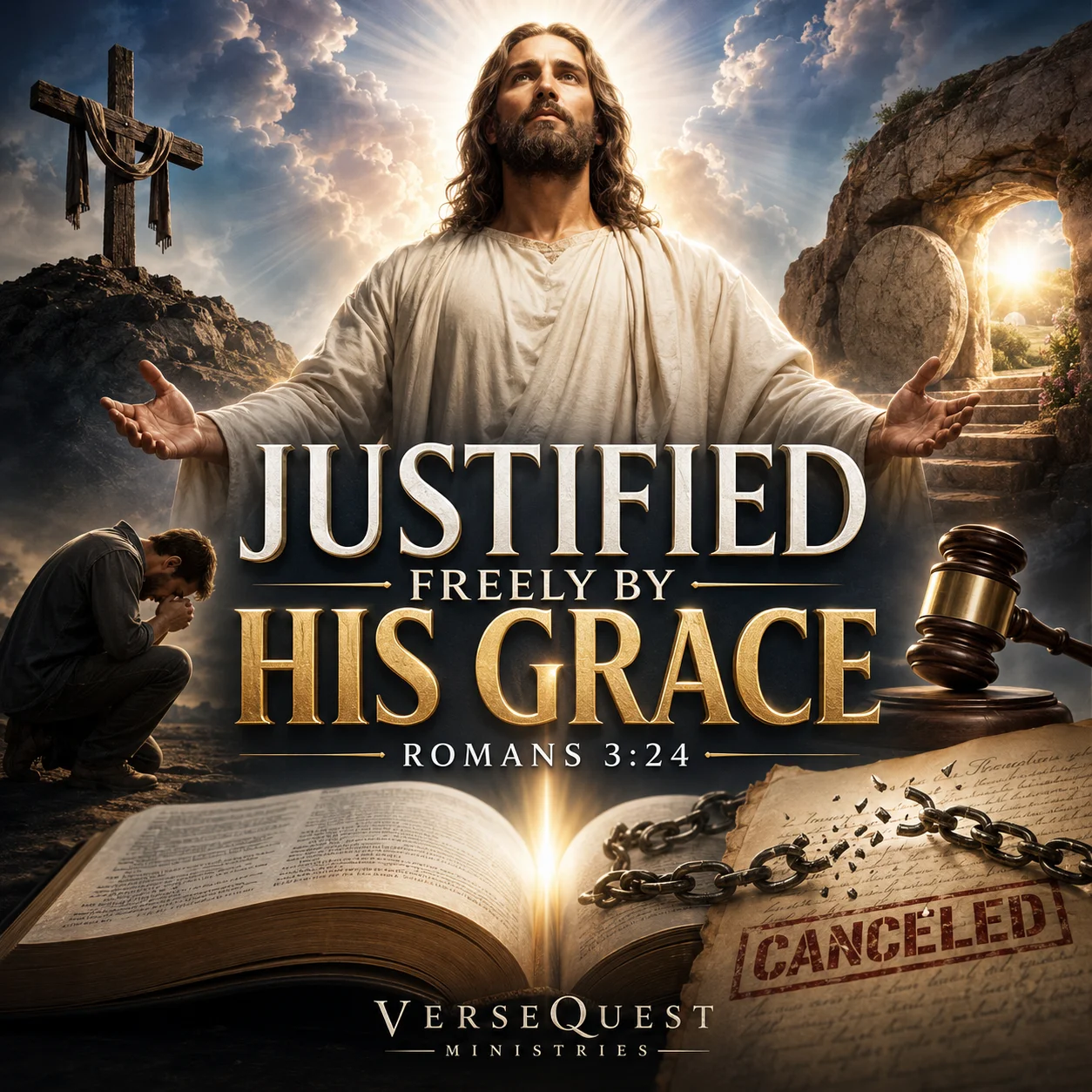
Sermon Title:
The Verdict Grace Gave: Justified Freely by His Grace
Key Passage:
Romans 3:24 — “Being justified freely by his grace through the redemption that is in Christ Jesus.”
Series:
Foundations of the Gospel of Grace
Topic:
Justification by Grace Through the Redemption That Is in Christ Jesus
Book:
Romans, Galatians, Ephesians, Titus, 1 Corinthians, 2 Corinthians, Colossians, Acts
Speaker:
Paul Tackett
Suggested Sermon Text:
Romans 3:19–28; Romans 4:1–8; Romans 5:1–11; Galatians 2:16; Galatians 3:10–14; Ephesians 1:7; Ephesians 2:8–9; Titus 3:5–7; 1 Corinthians 15:1–4; 2 Corinthians 5:19–21; Colossians 1:13–14; Acts 13:38–39
Short Sermon Description:
This detailed VerseQuest Ministries sermon outline explains the doctrine of justification from Romans 3:24: “Being justified freely by his grace through the redemption that is in Christ Jesus.” It shows that every sinner stands guilty before God, that the law stops every mouth, and that no flesh can be justified by deeds, morality, religion, baptism, sacraments, or law-keeping. Justification is God’s legal declaration that the believing sinner is righteous in Christ, not because of human merit, but because Jesus Christ paid the redemption price through His blood, death, burial, and resurrection. This sermon clarifies the difference between forgiveness, justification, redemption, and grace; distinguishes Paul’s gospel of grace from religious mixtures; and shows how the believer receives peace with God, eternal security, and a standing that cannot be improved by works. It equips pastors, teachers, Bible students, and believers to preach justification plainly and defend the finished work of Christ.
The Verdict Grace Gave
Justified Freely by His Grace
Introduction
Romans 3:24 is one of the great courtroom verses of the King James Bible. The sinner stands before God with no defense, no righteousness, no excuse, no plea bargain, and no religious character witness strong enough to survive divine examination. Romans 3 has already swept the whole world into the same courtroom and shut every mouth. The Jew had the law and broke it. The Gentile had conscience and violated it. The moral man condemned others and then committed the same things in principle. The religious man had ordinances and ceremonies but no power to cleanse the heart. By the time Paul reaches Romans 3:24, man is not standing tall with spiritual potential; he is standing guilty before the Judge of all the earth. Then grace speaks.
The verse says, “Being justified freely by his grace.” That is not religious vocabulary to decorate a sermon. That is the divine verdict that turns a condemned sinner into a righteous man in Christ. To justify is not merely to forgive, although forgiveness is included. It is not merely to overlook sin, because God never overlooks sin. It is not God pretending the sinner did not do what he did. Justification is God declaring the believing sinner righteous on the basis of the redemption that is in Christ Jesus. The sinner does not earn the verdict. He does not buy the verdict. He does not deserve the verdict. The verdict is “freely” given because Christ paid the full redemption price.
The religious world hates free justification because it leaves man with nothing to brag about. Religion wants a ladder, a ceremony, a payment plan, a priest, a membership roll, a water tank, a sacrament, a robe, a confession booth, a candle, a rulebook, or some little religious receipt the sinner can hold up and say, “I helped.” But Romans 3:24 removes the sinner’s fingerprints from the cause of salvation. The cause is grace. The channel is redemption. The Redeemer is Christ Jesus. The sinner contributes the guilt; Christ supplies the righteousness. The debtor brings bankruptcy; Christ brings the payment. The criminal brings the sentence; Christ brings the pardon and the righteousness of God.
I. The Whole World Stands Guilty Before God
Key Text: Romans 3:19
Supporting Texts: Romans 3:9–18; Romans 3:23; Galatians 3:22
Romans 3:19 says, “that every mouth may be stopped, and all the world may become guilty before God.” That is the condition that makes justification necessary. God does not justify innocent people. He justifies the ungodly who believe on Jesus Christ. The law does not stand in the courtroom to give man confidence. It stands there to silence him. The sinner may have excuses before other sinners, but he has none before God. The law places its hand over the mouth of human pride and says, “Quiet. The evidence is already in.”
Paul has already shown that there is “none righteous, no, not one.” Their throat is an open sepulchre, their tongues use deceit, their feet are swift to shed blood, and there is no fear of God before their eyes. That is not God being dramatic. That is God giving the autopsy on fallen man. A sinner does not need a motivational speech telling him he is better than he thinks. He needs the truth that he is worse than he admits and that Christ is greater than his guilt.
The gospel begins where human boasting ends. If a man does not know he is guilty, justification sounds unnecessary. If he does not know he is condemned, grace sounds excessive. If he does not know he is lost, redemption sounds optional. Romans 3 shuts the whole world up so Romans 3:24 can open heaven’s answer in Christ.
Main Truth:
Justification is necessary because every sinner stands guilty before God with no righteousness of his own.
II. The Law Cannot Justify the Sinner
Key Text: Romans 3:20
Supporting Texts: Galatians 2:16; Galatians 3:10–11; Acts 13:38–39
Romans 3:20 says, “Therefore by the deeds of the law there shall no flesh be justified in his sight.” That is not difficult English. “No flesh” means no flesh. Not Jewish flesh. Not Gentile flesh. Not religious flesh. Not sincere flesh. Not baptized flesh. Not reformed flesh. The law can reveal sin, define sin, expose sin, and condemn sin, but it cannot remove sin or justify the sinner who committed it.
Galatians 2:16 repeats the same truth three times in one verse: “a man is not justified by the works of the law,” “we might be justified by the faith of Christ,” and “by the works of the law shall no flesh be justified.” God knew religion would keep trying to sneak Moses into the foundation of salvation, so He nailed the door shut three times in one verse. If the law could justify, Christ died in vain. If works could save, Calvary was unnecessary.
Acts 13:39 says that by Christ “all that believe are justified from all things, from which ye could not be justified by the law of Moses.” Moses could point at the stain, but he could not wash it out. Moses could show the debt, but he could not pay it. Moses could demand righteousness, but he could not give it. What the law could not do, Christ did by His death, burial, and resurrection.
Main Truth:
The law exposes guilt but cannot justify the guilty sinner before God.
III. Justification Is God’s Legal Declaration of Righteousness
Key Text: Romans 3:24
Supporting Texts: Romans 4:5; Romans 5:1; 2 Corinthians 5:21
Justification is a legal word. It belongs in the courtroom. It means God declares the believing sinner righteous in His sight. It is not God slowly making the sinner practically sinless before accepting him. That would leave every believer uncertain until death and terrified every time the flesh showed itself. Justification is a divine verdict based on Christ’s righteousness, Christ’s blood, Christ’s redemption, and Christ’s resurrection.
Romans 4:5 says, “But to him that worketh not, but believeth on him that justifieth the ungodly.” That verse is enough to make religion choke on its own incense. God justifies whom? The ungodly. On what condition? Faith. With what works? “Worketh not.” This does not mean the saved man should not serve God after salvation. It means works are excluded from the act of justification. The sinner is declared righteous when he believes God’s testimony concerning Jesus Christ.
Second Corinthians 5:21 gives the ground: Christ was made sin for us, “that we might be made the righteousness of God in him.” The believer is not justified because God discovers righteousness in Adam’s flesh. He is justified because God places him in Christ and imputes righteousness to his account. The sinner’s sin was charged to Christ, and Christ’s righteousness is counted to the believer. That is not bookkeeping fiction. That is blood-bought Bible truth.
Main Truth:
Justification is God declaring the believing sinner righteous in Christ on the basis of Christ’s finished work.
IV. Justification Is Free to the Sinner Because Christ Paid the Price
Key Text: Romans 3:24
Supporting Texts: Ephesians 1:7; Colossians 1:14; 1 Peter 1:18–19
Romans 3:24 says believers are justified “freely.” That word cuts the throat of every pay-for-salvation religion in the world. Freely means without cost to the receiver. The sinner does not make a down payment. He does not bring installments. He does not trade religious deeds for divine acceptance. He receives what grace provides because Christ paid what justice required.
But free does not mean cheap. Ephesians 1:7 says, “In whom we have redemption through his blood.” Colossians 1:14 says the same. First Peter says believers were not redeemed with corruptible things, as silver and gold, but with “the precious blood of Christ.” Salvation is free to the sinner because it was infinitely costly to the Saviour. The gift costs the receiver nothing, but it cost the Giver everything required by holiness.
Religion insults the cross when it tells sinners that Christ paid part and man must pay the rest. That is not humility; that is unbelief wearing church clothes. The debt is not divided between Calvary and human effort. Christ did not hang on the cross to create a coupon. He paid the full price. The sinner is justified freely because the Redeemer did not leave one cent unpaid.
Main Truth:
Justification is free to the believer because Jesus Christ paid the full redemption price with His own blood.
V. Grace Is the Source of Justification
Key Text: Romans 3:24
Supporting Texts: Titus 3:7; Ephesians 2:8–9; Romans 11:6
The verse says “by his grace.” Grace is not man earning less than he should have to earn. Grace is not God grading on a curve. Grace is not God ignoring sin because He is too loving to judge. Grace is God saving guilty sinners righteously through the redemption that is in Christ Jesus. Grace gives what man cannot earn because Christ provided what man could never supply.
Titus 3:7 says, “That being justified by his grace, we should be made heirs according to the hope of eternal life.” The believer is not justified by grace and then kept by law as though God changes systems halfway through the transaction. Grace justifies, grace teaches, grace establishes, and grace keeps the glory where it belongs. If the sinner could contribute merit, grace would no longer be grace.
Romans 11:6 says, “And if by grace, then is it no more of works: otherwise grace is no more grace.” That verse is God’s chemistry lesson for religious mixers. Grace and works cannot be combined as co-causes of salvation. Add works as a ground of justification and you have destroyed grace. Works may follow salvation, but they cannot cause it. Grace is the fountain; faith is the hand; Christ is the Redeemer; justification is the verdict.
Main Truth:
Grace is the source of justification, excluding works as any part of the sinner’s acceptance before God.
VI. Redemption Is the Ground of Justification
Key Text: Romans 3:24
Supporting Texts: Romans 3:25; Galatians 3:13; Hebrews 9:12
Romans 3:24 does not stop with grace. It says justification comes “through the redemption that is in Christ Jesus.” Redemption means deliverance by payment. The sinner was not merely lost in a fog needing better directions. He was under sin, under guilt, under condemnation, and under death. Redemption means Christ paid the price necessary to deliver him.
Romans 3:25 says God set forth Christ “to be a propitiation through faith in his blood.” Propitiation means the righteous demands of God against sin were satisfied. God did not justify sinners by pretending justice no longer mattered. He justified sinners because justice was satisfied at Calvary. The blood of Christ is not decorative language. It is the price of redemption and the basis upon which God can justify the ungodly who believe.
Galatians 3:13 says Christ redeemed us from the curse of the law, being made a curse for us. The curse did not evaporate; it fell upon Christ. The judgment did not disappear; the Substitute bore it. Redemption is not God saying sin was no big deal. Redemption is God saying sin was so serious that only the blood of His Son could pay for it.
Main Truth:
The believer is justified because Jesus Christ paid the redemption price and satisfied God’s righteous judgment against sin.
VII. Faith Receives the Justifying Verdict
Key Text: Romans 3:28
Supporting Texts: Romans 5:1; Acts 16:31; Galatians 3:26
Romans 3:28 says, “Therefore we conclude that a man is justified by faith without the deeds of the law.” Faith is the means by which the sinner receives the verdict of justification. Faith does not purchase salvation. Faith does not impress God as a noble work. Faith simply receives what God freely gives in Christ.
Romans 5:1 says, “Therefore being justified by faith, we have peace with God through our Lord Jesus Christ.” Peace with God is not a mood. It is the end of hostility between the justified sinner and the holy God he offended. The war is over because Christ made peace through the blood of His cross. The believer is not hoping God might accept him someday. He has peace with God now.
Acts 16:31 gives the same simplicity: “Believe on the Lord Jesus Christ, and thou shalt be saved.” The object of faith is not faith itself, not a church, not water, not a feeling, not a ritual, and not personal commitment. The object is the Lord Jesus Christ. Faith rests where redemption is found. A man is not justified by believing he is justified. He is justified by believing on the Redeemer who justifies the ungodly.
Main Truth:
Faith receives justification by resting completely upon the Lord Jesus Christ and His finished redemption.
VIII. Justification Gives the Believer Peace, Security, and Standing
Key Text: Romans 5:1
Supporting Texts: Romans 5:9; Romans 8:1; Ephesians 1:6–7
The justified believer has peace with God. That peace is based on a verdict, not a feeling. Feelings rise and fall like a cheap thermometer in unstable weather. The word of God does not. If God has justified the believer, no religious mood swing can reverse the verdict. Romans 8:1 says, “There is therefore now no condemnation to them which are in Christ Jesus.” No condemnation means no condemnation.
Romans 5:9 says, “Much more then, being now justified by his blood, we shall be saved from wrath through him.” The believer’s future is secure because his justification rests on Christ’s blood, not his own performance. If Christ’s blood justified him, wrath cannot claim him. If God has declared him righteous in Christ, no accusation can overturn the court of heaven.
Ephesians says believers are “accepted in the beloved” and have redemption through His blood. The believer does not stand accepted in himself. He stands accepted in Christ. That standing cannot be improved by religious effort and cannot be destroyed by the weakness of the flesh. Fellowship may be affected by sin, chastening may come, rewards may be lost, but the justified standing in Christ remains secure because it rests upon redemption.
Main Truth:
Justification gives the believer settled peace with God, freedom from condemnation, and secure standing in Christ.
IX. Justification Removes Boasting and Magnifies Christ Alone
Key Text: Romans 3:27
Supporting Texts: 1 Corinthians 1:29–31; Galatians 6:14; Philippians 3:8–9
Romans 3:27 asks, “Where is boasting then? It is excluded.” Justification by grace through redemption slams the door on human pride. No sinner will enter heaven boasting in baptism, sacraments, law-keeping, church attendance, religious office, morality, charity, sincerity, or personal endurance. The justified sinner will glory in the Lord because the Lord did all the saving.
First Corinthians 1 says God arranged salvation so “that no flesh should glory in his presence.” Christ is made unto believers righteousness, sanctification, and redemption. That means the believer does not bring righteousness to Christ; he receives righteousness in Christ. The flesh wants to carry a trophy into heaven. Grace makes the sinner drop it at the door and praise the Lamb.
Paul in Philippians 3 counted his religious gains as loss and dung that he might be found in Christ, “not having mine own righteousness.” That is the heart of justification. Not my righteousness. Not my religion. Not my works. Not my merit. Christ alone. The justified man has found the only safe place for a sinner to stand: in the righteousness of another Man, the Lord Jesus Christ.
Main Truth:
Justification excludes all human boasting and gives all glory to Jesus Christ, the Redeemer and righteousness of the believer.
Conclusion
Romans 3:24 is the verdict grace gave to guilty sinners who believe on Jesus Christ: “Being justified freely by his grace through the redemption that is in Christ Jesus.” The sinner stands guilty. The law cannot justify him. His works cannot rescue him. His religion cannot cleanse him. His ceremonies cannot redeem him. His sincerity cannot satisfy justice. But Christ has provided redemption through His blood, and God justifies the ungodly who believe.
Justification is not God pretending sin did not happen. It is God declaring the believer righteous because sin was dealt with fully at the cross. The blood was shed. The price was paid. The curse was borne. The tomb was emptied. The righteousness of God is received by faith in Jesus Christ. That is why the believer has peace with God, freedom from condemnation, and acceptance in the Beloved.
The Church must preach this doctrine clearly. A vague gospel creates uncertain converts. A mixed gospel creates religious slaves. A works gospel creates proud Pharisees or despairing sinners. But the gospel of grace creates justified saints who know they have nothing to boast in except the Lord Jesus Christ. Grace gave the verdict because redemption paid the price.
Final Call
The sinner does not need a religious improvement plan. He needs justification. He does not need God to ignore his sins. He needs those sins paid for by the blood of Christ. He does not need ceremonies added to Calvary. He needs to believe the gospel.
Jesus Christ died for our sins according to the Scriptures. He was buried. He rose again the third day according to the Scriptures. Redemption is in Him. Forgiveness is in Him. Righteousness is in Him. Eternal life is in Him. Believe on the Lord Jesus Christ, and thou shalt be saved.
Believer, rest in the verdict God has given. Do not let religion drag you back into the courtroom after the Judge has already justified you in Christ. Serve God because you are accepted, not to become accepted. Preach grace without apology. Defend justification by faith. Glory only in the cross of our Lord Jesus Christ.
Closing Verse:
Romans 5:1 — “Therefore being justified by faith, we have peace with God through our Lord Jesus Christ.”
Closing Statement:
The law exposed the sinner’s guilt, but grace gave the verdict of righteousness through the redemption that is in Christ Jesus.