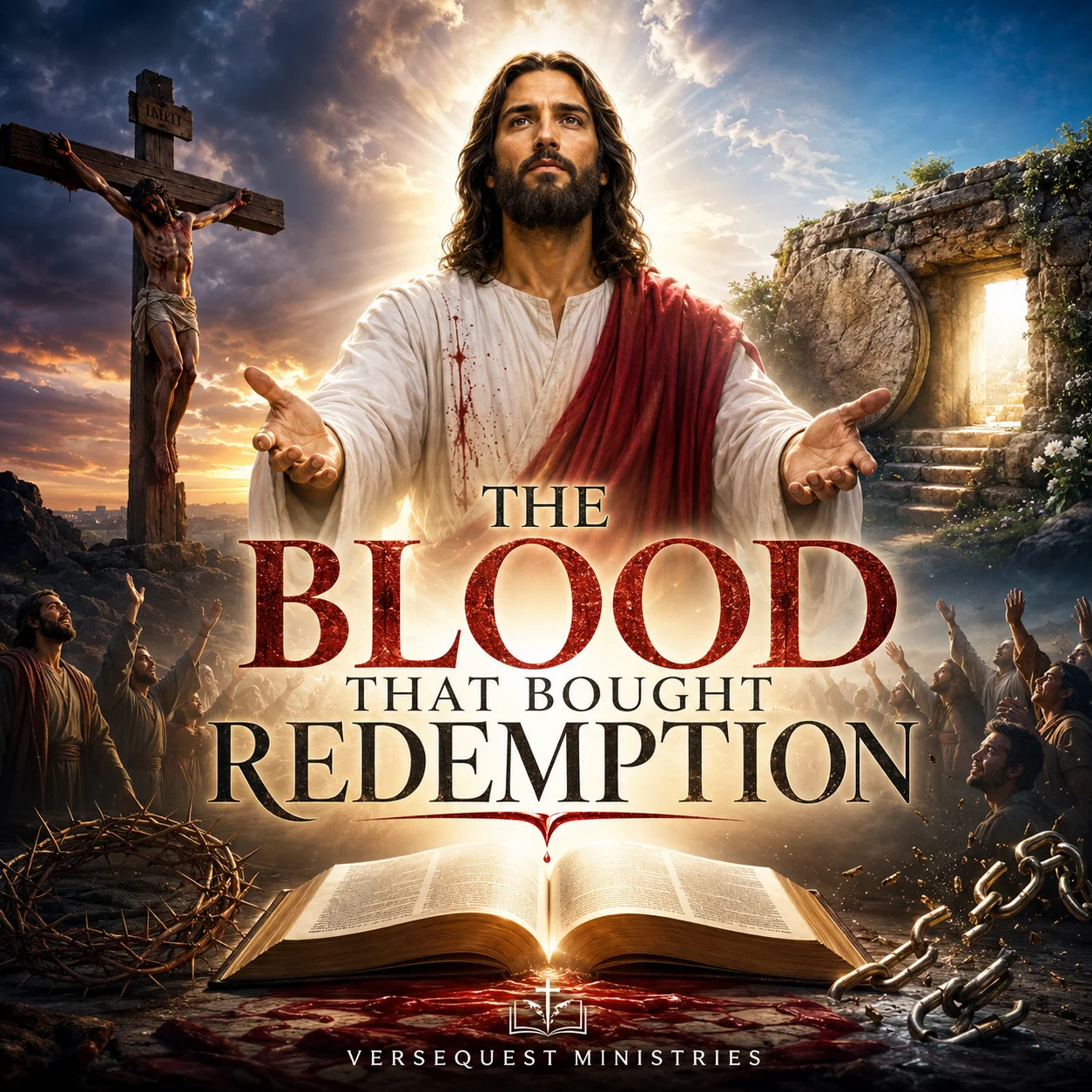
Sermon Title:
The Price Heaven Paid: The Blood That Bought Redemption
Key Passage:
Ephesians 1:7 — “In whom we have redemption through his blood, the forgiveness of sins, according to the riches of his grace.”
Series:
Foundations of the Gospel of Grace
Topic:
Redemption Through the Blood of Jesus Christ
Book:
Ephesians, Romans, Colossians, Hebrews, Galatians, 1 Peter, 1 Corinthians, Revelation
Speaker:
Paul Tackett
Suggested Sermon Text:
Ephesians 1:3–14; Romans 3:23–26; Romans 5:6–11; Colossians 1:12–14; Hebrews 9:11–14; Hebrews 10:10–14; Galatians 3:13; 1 Peter 1:18–19; 1 Corinthians 15:1–4; Revelation 1:5; Revelation 5:9
Short Sermon Description:
This detailed VerseQuest Ministries sermon outline explains the saving doctrine of Ephesians 1:7: “In whom we have redemption through his blood.” Redemption is not religious improvement, moral reform, church membership, baptism, law-keeping, sacraments, or emotional sincerity. It is deliverance by payment, and the payment was the blood of Jesus Christ. This study shows why sinners need redemption, what the blood purchased, how Christ’s death satisfied divine justice, why forgiveness is according to the riches of grace, and why no religious system can add to the finished work of the cross. It also distinguishes the believer’s present redemption in Christ from Israel’s prophetic and national redemptive promises, while keeping the gospel of grace clear for the Church age. Designed for pastors, preachers, teachers, Bible students, and believers, this outline magnifies the blood of Christ as the only sufficient price for forgiveness, justification, peace, and eternal security.
The Price Heaven Paid
The Blood That Bought Redemption
Introduction
Ephesians 1:7 is one of those verses that puts the whole religious world on trial with one clean stroke of the King James Bible: “In whom we have redemption through his blood, the forgiveness of sins, according to the riches of his grace.” Notice where redemption is found: “In whom.” Not in a church system. Not in a sacrament. Not in a confessional booth. Not in a priesthood. Not in a baptistry. Not in a list of works. Not in a stack of religious receipts. Redemption is in Jesus Christ. A sinner outside Christ may have religion, morality, sincerity, family heritage, Bible vocabulary, and a clean public reputation, but he does not have redemption. Redemption is not located in man’s effort; it is located in God’s Son.
The verse also tells us the price: “through his blood.” That is where modern religion begins to cough, blink, adjust its collar, and look for a softer word. The blood is offensive to polite religious flesh. It ruins the sermon for the self-help crowd. It wrecks the interfaith banquet. It offends the moralist who wants salvation by improvement and the ritualist who wants salvation by ceremony. But God did not say we have redemption through Christ’s example, His philosophy, His influence, His social concern, or His religious ideals. The Book says “through his blood.” Sin did not require a lecture; it required a sacrifice. Guilt did not require a committee; it required blood. The sinner did not need a life coach; he needed a Redeemer.
Redemption means a price was paid to deliver someone from bondage. The sinner is not merely confused, unlucky, wounded, or spiritually undereducated. He is sold under sin, guilty before God, condemned by the law, held under death, and unable to buy himself out. Religion may polish the chains, decorate the prison, and teach the prisoner songs about self-worth, but it cannot open the door. Jesus Christ bought redemption with His own blood. That blood did not make salvation merely possible if the sinner could finish the paperwork. It purchased redemption. It secured forgiveness. It satisfied justice. It magnified grace. It brought the believer out of bondage and placed him in Christ. The blood is not heaven’s suggestion box; it is redemption’s purchase price.
I. Redemption Begins With Man’s Bondage to Sin
Key Text: Romans 3:23
Supporting Texts: Romans 3:9–19; Romans 6:17–23; Ephesians 2:1–3
Before a man can understand redemption, he must understand bondage. Romans 3:23 says, “For all have sinned, and come short of the glory of God.” That verse does not leave one proud sinner standing outside the verdict. The polished sinner, the religious sinner, the educated sinner, the poor sinner, the wealthy sinner, the preacher’s kid, the criminal, the moral neighbour, and the church member all stand under the same universal sentence: “all have sinned.” Redemption is necessary because man is not free by nature. He is enslaved to sin, death, corruption, and condemnation.
Romans 6 speaks of sinners as servants of sin before they are made free from sin. Sin is not merely an occasional mistake on an otherwise clean record. Sin is a master. It commands, corrupts, deceives, hardens, and pays wages. Romans 6:23 says, “For the wages of sin is death.” Sin always pays, but it never pays what the sinner hoped to receive. It promises liberty and pays bondage. It promises pleasure and pays shame. It promises life and pays death. The Devil has never missed a payday, and every envelope is marked with death.
Ephesians 2 says the lost man is dead in trespasses and sins, walking according to the course of this world, according to the prince of the power of the air, fulfilling the desires of the flesh and of the mind, and by nature a child of wrath. That is not religious inconvenience. That is spiritual captivity. The sinner does not need a mild renovation; he needs deliverance. The first truth of redemption is this: man is in a prison he cannot unlock, under a debt he cannot pay, and beneath a sentence he cannot survive.
Main Truth:
Redemption is necessary because every sinner is in bondage to sin, guilty before God, and unable to deliver himself.
II. Redemption Means Deliverance by Payment
Key Text: Ephesians 1:7
Supporting Texts: Colossians 1:14; Romans 3:24; 1 Corinthians 6:20
Ephesians 1:7 says, “In whom we have redemption.” Redemption is not a vague religious feeling. It is a transaction of deliverance secured by price. Colossians 1:14 says, “In whom we have redemption through his blood, even the forgiveness of sins.” Romans 3:24 says believers are justified freely by God’s grace “through the redemption that is in Christ Jesus.” The Bible connects redemption, blood, forgiveness, grace, and justification. These are not separate religious slogans; they are joined in the finished work of Christ.
First Corinthians 6:20 says, “For ye are bought with a price.” The believer does not belong to himself. He was purchased. The price was not gold, silver, church membership, baptismal water, human suffering, or religious service. First Peter 1:18–19 tells us plainly that we were not redeemed with corruptible things, but “with the precious blood of Christ.” Religion keeps offering coupons after Christ paid the whole account. That is not humility; that is unbelief wearing a clean shirt.
The price of redemption reveals the seriousness of sin. God did not send an angel with a message saying, “Try harder.” He did not send a prophet with a payment plan. He sent His Son to shed His blood. If sin could have been handled by good intentions, Calvary was excessive. If sin could have been removed by baptism, the blood was unnecessary. If sin could have been erased by sacraments, the cross was overkill. But the blood was required because sin’s bondage was real, sin’s debt was deadly, and only Christ could pay the price.
Main Truth:
Redemption is deliverance by payment, and the payment was the precious blood of Jesus Christ.
III. The Blood of Christ Is the Only Sufficient Price
Key Text: 1 Peter 1:18–19
Supporting Texts: Hebrews 9:12; Hebrews 9:22; Acts 20:28
First Peter 1:18–19 says believers were not redeemed with corruptible things, as silver and gold, but “with the precious blood of Christ, as of a lamb without blemish and without spot.” Silver and gold can buy property, influence, comfort, and human applause, but they cannot buy a soul out of sin. The richest man on earth cannot purchase one drop of forgiveness with all his wealth. Redemption required blood, and not just any blood. It required the blood of the sinless Lamb of God.
Hebrews 9:22 says, “without shedding of blood is no remission.” That is God’s rule, not man’s preference. Sin brings death, and blood represents life poured out. The Old Testament sacrifices pointed forward, but they could not provide final redemption. Hebrews 9:12 says Christ entered in once into the holy place, “having obtained eternal redemption for us.” Notice the strength of the words: once, obtained, eternal redemption. Not temporary redemption. Not partial redemption. Not probationary redemption. Eternal redemption.
Acts 20:28 says God purchased the church “with his own blood.” That one phrase ought to flatten every low view of Christ. The blood that bought redemption is not the blood of a mere martyr. It is not the blood of a religious reformer. It is not the blood of a failed political revolutionary. It is the blood of the Lord from glory, God manifest in the flesh, the sinless Substitute. That blood is sufficient because the Person who shed it is sufficient.
Main Truth:
Only the precious blood of the sinless Lord Jesus Christ could purchase eternal redemption for sinners.
IV. Redemption Through Blood Brings Forgiveness of Sins
Key Text: Ephesians 1:7
Supporting Texts: Colossians 1:14; Hebrews 10:17–18; Psalm 103:12
Ephesians 1:7 says redemption through His blood brings “the forgiveness of sins.” Forgiveness is not God pretending sin did not happen. Forgiveness is God removing the believer’s guilt because Christ paid for that guilt. God does not forgive by lowering His holiness. He forgives because the blood of Christ satisfied His justice. Every sin forgiven in Christ was judged at Calvary. Grace is free to the sinner because it was bought by the Saviour.
Colossians 1:14 repeats the truth: “In whom we have redemption through his blood, even the forgiveness of sins.” The believer does not hope one day to have forgiveness if his religious account balances out. He has it in Christ. “We have redemption.” “We have forgiveness.” That is present possession. Religion loves to keep sinners and saints uncertain, because uncertainty fills altars, confession lines, offering plates, and institutional control systems. The gospel gives a redeemed believer settled forgiveness in Jesus Christ.
Hebrews 10:17 says, “And their sins and iniquities will I remember no more.” Verse 18 adds, “Now where remission of these is, there is no more offering for sin.” That destroys every system that keeps offering, repeating, renewing, or extending what Christ finished. Once sins are forgiven by the blood of Christ, no further sin offering remains. The believer does not need another sacrifice. He needs to believe the one sacrifice God accepted forever.
Main Truth:
Redemption through Christ’s blood gives the believer real, present, complete forgiveness of sins.
V. Redemption Is According to the Riches of Grace
Key Text: Ephesians 1:7
Supporting Texts: Ephesians 2:7–9; Romans 3:24; Titus 3:5–7
Ephesians 1:7 says forgiveness is “according to the riches of his grace.” God does not forgive according to the poverty of human merit but according to the riches of divine grace. That means the measure of forgiveness is not the sinner’s worthiness, but God’s grace in Christ. If forgiveness depended on man’s performance, nobody would have enough. But grace is not a small coin in God’s pocket. It is the overflowing treasury of His goodness toward sinners through Jesus Christ.
Ephesians 2 says salvation is “by grace…through faith,” and “not of works, lest any man should boast.” Romans 3:24 says believers are justified freely by His grace. Titus 3:5 says salvation is “not by works of righteousness which we have done, but according to his mercy.” The Bible keeps saying it because religion keeps denying it. Grace does not mean God helps those who help themselves. Grace means God saves those who cannot save themselves.
The riches of grace do not make sin small; they make Christ great. Grace is not God shrugging at evil. Grace is God providing redemption through blood, then giving forgiveness freely to the believer. The sinner brings bankruptcy. Grace brings wealth. The sinner brings guilt. Grace brings forgiveness. The sinner brings death. Grace brings eternal life. The sinner brings nothing worth boasting in. Grace gives him everything worth praising God for.
Main Truth:
Forgiveness is given according to the riches of God’s grace, not according to the sinner’s works, merit, or religious effort.
VI. Redemption Is Found “In Christ,” Not in Religion
Key Text: Ephesians 1:7
Supporting Texts: Ephesians 1:3–6; Colossians 2:10; Acts 4:12
The verse begins, “In whom.” That phrase matters. Redemption is in Christ. Ephesians 1 says believers are blessed “in Christ,” chosen “in him,” accepted “in the beloved,” and redeemed “in whom.” God has placed every spiritual blessing for the Church in Jesus Christ. The sinner outside Christ has no redemption, no forgiveness, no acceptance, no righteousness, and no hope, no matter how religious he appears.
Colossians 2:10 says believers are “complete in him.” That one phrase is enough to wreck every religious system that teaches Christ must be supplemented. Complete in Him means not completed by Rome, not completed by sacraments, not completed by law, not completed by church membership, not completed by water, not completed by human effort. A man who is complete in Christ does not need a religious institution selling missing pieces.
Acts 4:12 says, “Neither is there salvation in any other.” That excludes every other name, mediator, ritual, and religious path. Redemption is not distributed through ecclesiastical machinery. It is found in the Redeemer. Churches may preach it, believers may testify of it, pastors may explain it, and teachers may defend it, but none of them possess redemption as their private merchandise. The blood bought it. Christ holds it. Faith receives it.
Main Truth:
Redemption is found only in Jesus Christ, not in religious systems, ceremonies, institutions, or human mediators.
VII. Redemption Delivers the Believer From the Curse
Key Text: Galatians 3:13
Supporting Texts: Romans 8:1–4; Colossians 2:13–14; Hebrews 2:14–15
Galatians 3:13 says, “Christ hath redeemed us from the curse of the law, being made a curse for us.” The law did not flatter man. It pronounced a curse upon every one that continued not in all things written in the book of the law to do them. One violation brings guilt. One failure exposes the sinner. The law is holy, but fallen man is not. Therefore, under law, man does not find life; he finds condemnation.
Christ redeemed us from the curse by being made a curse for us. That is substitution. The curse did not disappear into thin air. It fell upon the Son of God at Calvary. He bore the judgment attached to our guilt. Colossians 2 says He blotted out the handwriting of ordinances that was against us and nailed it to His cross. The debt was not negotiated down; it was cancelled by payment.
Romans 8:1 says, “There is therefore now no condemnation to them which are in Christ Jesus.” Redemption delivers the believer from condemnation because Christ already bore the judgment. Religion keeps trying to drag the redeemed man back beneath the curse as though Christ’s blood only made a temporary arrangement. But the Bible says Christ redeemed us. The believer is not under the curse Christ bore, not under the debt Christ paid, and not under the condemnation Christ removed.
Main Truth:
Christ’s blood redeemed believers from the curse and condemnation by bearing the judgment in their place.
VIII. Redemption Gives the Believer a New Master and a New Life
Key Text: 1 Corinthians 6:20
Supporting Texts: Titus 2:14; Romans 6:11–14; 2 Corinthians 5:14–15
First Corinthians 6:20 says, “For ye are bought with a price: therefore glorify God in your body, and in your spirit, which are God’s.” Redemption changes ownership. The believer is no longer his own. That truth cuts both ways. It gives security because the redeemed belong to Christ. It gives responsibility because the redeemed are to glorify God. The blood that freed us from sin also purchased us for the Saviour.
Titus 2:14 says Christ “gave himself for us, that he might redeem us from all iniquity, and purify unto himself a peculiar people, zealous of good works.” Works do not redeem, but redemption produces works. Christ did not shed His blood so the believer could stay comfortably chained to the filth that once enslaved him. Grace saves freely, but it does not save carelessly. The same grace that justifies also teaches, purifies, and directs.
Romans 6 says sin shall not have dominion over the believer because he is not under the law, but under grace. Redemption does not mean the flesh disappears or the believer never struggles. It means sin is no longer the rightful master. The redeemed man should reckon himself dead indeed unto sin and alive unto God through Jesus Christ our Lord. The blood bought liberty, and that liberty is not permission to return to Egypt and call the chains jewelry.
Main Truth:
Redemption changes the believer’s ownership, delivering him from sin’s dominion and calling him to glorify God.
IX. Redemption Will Be Fully Displayed in Glory
Key Text: Ephesians 1:13–14
Supporting Texts: Romans 8:23; Ephesians 4:30; Philippians 3:20–21
Ephesians 1:13–14 says believers are sealed with the Holy Spirit of promise, “which is the earnest of our inheritance until the redemption of the purchased possession.” The believer already has redemption through Christ’s blood, yet he still awaits the full redemption of the body. His soul is saved, his standing is settled, his forgiveness is complete, but his body still lives in a fallen world and awaits glorification.
Romans 8:23 speaks of “the redemption of our body.” That is the future completion of what Christ’s blood has already secured. The believer is not waiting to find out whether redemption will succeed. He is waiting for redemption’s full display. Philippians 3 says the Saviour shall change our vile body, that it may be fashioned like unto His glorious body. The blood that bought the soul will not abandon the body to the grave forever.
Ephesians 4:30 says believers are sealed “unto the day of redemption.” That seal is not fragile tape on a religious package. It is the Holy Spirit’s guarantee. The redeemed believer is kept until the day Christ completes the application of His purchase. The world may bury the body, but it cannot cancel the receipt. The grave may hold dust for a season, but it cannot keep what Jesus Christ bought with blood.
Main Truth:
The believer’s redemption is presently possessed in Christ and will be fully displayed when the body is glorified at His coming.
Conclusion
Ephesians 1:7 gives the believer a treasury of gospel truth in one verse: “In whom we have redemption through his blood, the forgiveness of sins, according to the riches of his grace.” Redemption is in Christ. The price is His blood. The result is forgiveness. The measure is grace. A sinner does not need a religious broker to improve that arrangement. He needs to believe it.
The blood of Christ is the answer to sin’s bondage, guilt’s debt, law’s curse, death’s claim, and religion’s failure. It bought redemption. It secured forgiveness. It satisfied justice. It removed condemnation. It changed ownership. It sealed the believer’s future. It will be praised in glory by those who sing, “thou wast slain, and hast redeemed us to God by thy blood.” Heaven does not sing about religious effort. Heaven sings about the Lamb.
The Church must preach the blood without apology. Bloodless preaching produces powerless religion. Crossless Christianity produces moral philosophy with hymns. Redemption without blood is a lie, and salvation by works is an insult to the Redeemer. The message is not that sinners can improve themselves into favour with God. The message is that Jesus Christ paid the price they could never pay, and in Him there is redemption through His blood.
Final Call
You cannot redeem yourself. Your works cannot pay the price. Your baptism cannot shed blood for sin. Your church cannot cancel your guilt. Your sincerity cannot satisfy divine justice. Your morality cannot buy forgiveness. You need the Redeemer.
Jesus Christ died for your sins according to the Scriptures. He was buried. He rose again the third day according to the Scriptures. His blood is the price of redemption. His grace is rich enough for guilty sinners. His forgiveness is real, present, and complete for those who believe.
Believe on the Lord Jesus Christ, and thou shalt be saved. Trust the blood. Trust the cross. Trust the empty tomb. Trust Christ alone. Believer, live like a purchased man. Glorify God in your body and spirit, preach redemption clearly, and never let religion cheapen the blood that bought you.
Closing Verse:
Revelation 5:9 — “Thou art worthy…for thou wast slain, and hast redeemed us to God by thy blood.”
Closing Statement:
The sinner’s freedom was not bought with religious effort, but with the precious blood of the Lamb who paid redemption’s price in full.