Sermon Title:
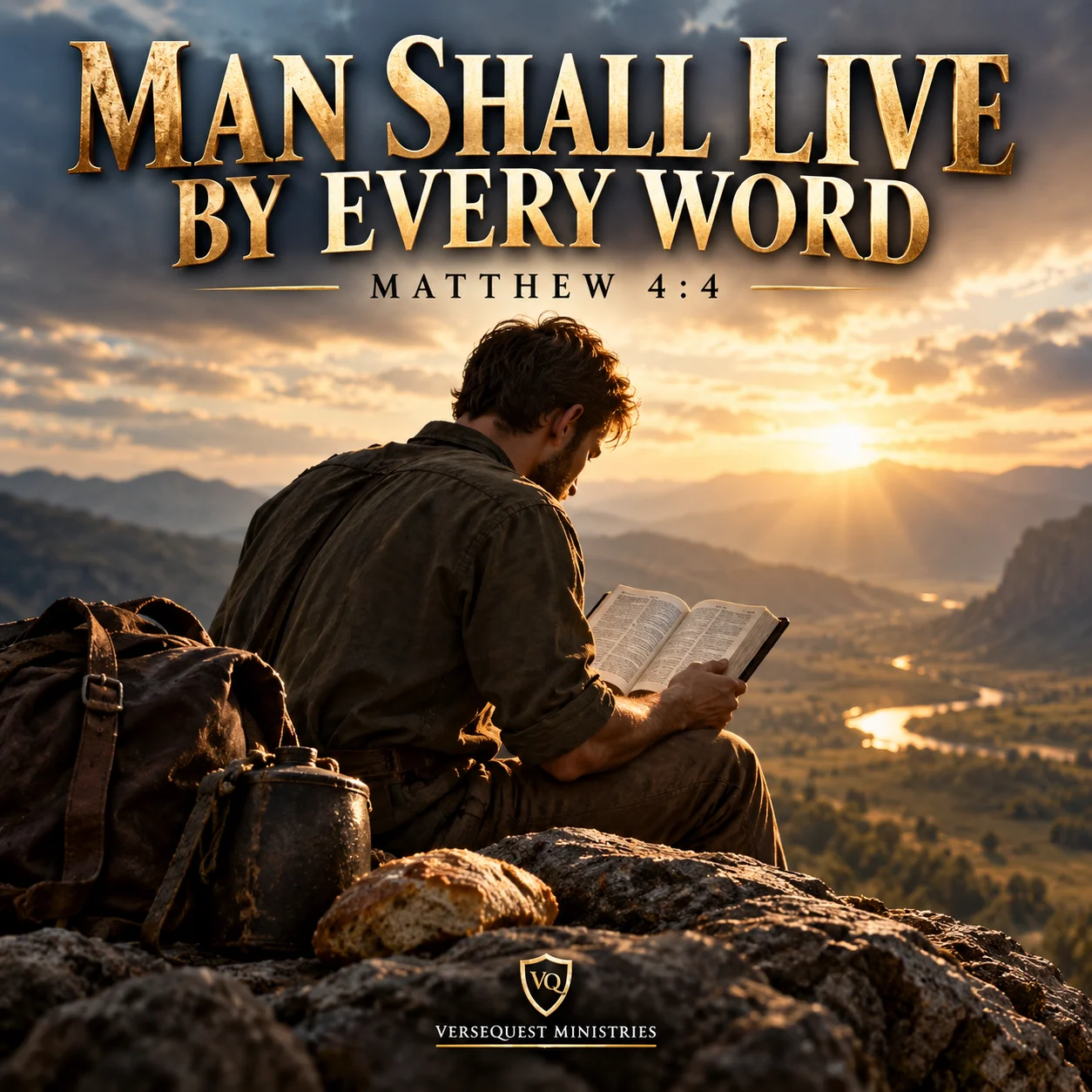
Man Shall Live by Every Word
Key Passage:
Matthew 4:4
“But he answered and said, It is written, Man shall not live by bread alone, but by every word that proceedeth out of the mouth of God.” (Matthew 4:4)
Series:
The Book God Gave
Topic:
Living by Every Word of God
Book:
Matthew
Speaker:
Paul Tackett
Suggested Sermon Text:
Matthew 4:1–11; Deuteronomy 8:1–3; Psalm 12:6–7; Psalm 119:9–16, 89, 105, 130, 140, 160; Proverbs 30:5–6; Isaiah 40:8; Jeremiah 15:16; John 6:63; John 17:17; 2 Timothy 2:15; 2 Timothy 3:15–17; Hebrews 4:12
Short Sermon Description:
Matthew 4:4 records Jesus Christ answering Satan with one of the strongest declarations in Scripture concerning the necessity and authority of the words of God: “Man shall not live by bread alone, but by every word that proceedeth out of the mouth of God.” This sermon examines why Christ emphasized every word, how the written Scriptures sustain the believer spiritually, why Satan attacks God’s words by questioning, twisting, and misapplying them, and how rightly dividing Scripture protects the Christian from doctrinal confusion. It also distinguishes possessing a Bible from actually living by it, shows why obedience must follow hearing, and calls believers to feed continually upon the preserved written word of God rather than attempting to survive spiritually on sermons, feelings, traditions, or religious experiences. The VerseQuest standard requires the treatment to remain KJV-only, rightly divided, detailed, practical, and sermon-ready. Sermon Outline Prompt – VerseQu…
MAN SHALL LIVE BY EVERY WORD
Introduction
A man can live for weeks without certain comforts, days without food, hours without water under severe conditions, and only minutes without air, but Jesus Christ identifies another necessity most men never consider. When Satan tempted Him in the wilderness after forty days of fasting, Christ answered, “Man shall not live by bread alone.” The Lord did not deny that physical bread matters. He denied that physical bread is enough. Man is more than flesh. He possesses a soul, stands accountable before God, and requires something this world cannot produce: the words that proceed from the mouth of God.
The statement becomes even stronger because Christ does not say man shall live by the general message of God, the broad ideas of God, the themes of God, or whatever spiritual meaning a religious expert can reconstruct. He says, “by every word.” That language destroys casual attitudes toward Scripture. If every word matters to Christ, every word ought to matter to the Christian. If every word is necessary for life, then the believer cannot afford to treat half the Bible as expendable, inconvenient, obsolete, embarrassing, or optional simply because modern religion prefers selected portions.
The setting also matters. Jesus is not making this declaration in a classroom. He is in the wilderness facing the tempter. Satan has challenged the Son of God, and Christ answers with Scripture. He does not defeat temptation by emotional experience, personal intuition, religious tradition, philosophical reasoning, or miraculous spectacle. He says, “It is written.” The Christian who wants to stand against deception, temptation, doctrinal error, and spiritual starvation must learn the same lesson: life and victory are tied to believing what God actually said.
I. MAN CANNOT LIVE BY PHYSICAL PROVISION ALONE
Key Text: Matthew 4:4
Supporting Texts: Deuteronomy 8:3; John 6:27; Ecclesiastes 5:10–12; Luke 12:15–21
Jesus says, “Man shall not live by bread alone.” Bread represents legitimate physical necessity. Christ had fasted forty days. His hunger was real. Satan’s temptation was not built around an imaginary need but a genuine one: “If thou be the Son of God, command that these stones be made bread” (Matthew 4:3). Yet Christ refused to let a legitimate physical need take priority over obedience to God.
That exposes the basic philosophy of the world. The world assumes man’s greatest needs are material: food, shelter, money, health, comfort, employment, security, education, entertainment, and physical prosperity. Those things have their place, but man can possess all of them and still be spiritually dead. A full refrigerator cannot feed the soul. A larger house cannot reconcile a sinner to God. A retirement account cannot purchase eternal life. A healthy body still dies eventually.
Deuteronomy 8:3 explains why God allowed Israel to hunger before feeding them with manna: “that he might make thee know that man doth not live by bread only.” God was teaching dependence. Physical provision comes from God, but physical provision cannot replace God. The creature who receives bread while rejecting the words of the Bread-giver has mistaken the gift for the Giver.
Main Truth: Physical provision can sustain the body temporarily, but only the truth of God can direct and sustain the whole man.
II. CHRIST SAID MAN LIVES BY EVERY WORD OF GOD
Key Text: Matthew 4:4
Supporting Texts: Deuteronomy 8:3; Proverbs 30:5; Psalm 119:140; 2 Timothy 3:16
The phrase “every word” deserves careful attention. Jesus could have said, “Man shall live by the message of God.” He did not. He could have said, “by the truth of God.” He chose something more exact: “by every word that proceedeth out of the mouth of God.” Christ’s statement assumes verbal revelation.
Proverbs 30:5 says, “Every word of God is pure.” Second Timothy 3:16 says, “All scripture is given by inspiration of God.” The pattern is consistent: every word, all Scripture. God has never encouraged men to divide His Book into portions worthy of confidence and portions requiring correction. The believer receives the whole counsel of God because God’s authority extends to all the words He inspired.
That does not mean every verse is addressed doctrinally to every person in exactly the same way. Right division remains essential. Noah’s command to build an ark is inspired, but it is not your construction assignment. Israel’s sacrificial laws are inspired, but the Church is not under the Levitical priesthood. Every word is true; every word is profitable; every word belongs in the Bible; but every word must be understood according to its proper doctrinal setting.
Main Truth: Every word of God is true and authoritative, though every word must also be understood and applied according to its proper biblical context.
III. JESUS CHRIST ANSWERED SATAN WITH “IT IS WRITTEN”
Key Text: Matthew 4:4
Supporting Texts: Matthew 4:7, 10; Ephesians 6:17; Psalm 119:11; James 4:7
Three times in Matthew 4 Jesus answers the devil with the written word: “It is written” (Matthew 4:4, 7, 10). That ought to settle the Christian’s attitude toward Scripture in spiritual warfare. Christ did not need to invent a new revelation for the occasion. He used what God had already written.
The sword of the Spirit is “the word of God” (Ephesians 6:17). A sword hanging on a wall looks impressive but is useless in battle if the soldier cannot wield it. Likewise, a Bible sitting unopened on a shelf may be beautifully bound and doctrinally sound, but it does little for the believer who never reads, memorizes, studies, or applies it. Christ knew the Book well enough to answer temptation immediately and precisely.
Notice also that Satan himself later quotes Scripture in Matthew 4:6. The devil can quote verses. The issue is not whether somebody uses Bible words but whether he uses them correctly. Satan ripped Psalm 91 from its proper purpose and tried to turn divine promise into justification for presumption. Christ answered him with another Scripture rightly applied. A Bible verse in the mouth of a deceiver does not become truth merely because it came from the Bible.
Main Truth: Victory over deception requires not merely possessing Scripture but knowing it well enough to use it correctly.
IV. SATAN ATTACKS GOD’S WORDS BY QUESTIONING AND TWISTING THEM
Key Text: Genesis 3:1
Supporting Texts: Genesis 3:1–5; Matthew 4:5–7; 2 Corinthians 11:3–4; 2 Peter 3:16
The first recorded satanic question is, “Yea, hath God said?” That question reveals the enemy’s method. Before he can lead Eve into disobedience, he first has to loosen her confidence in God’s words. Doubt prepares the ground for contradiction. After questioning God, the serpent says directly, “Ye shall not surely die” (Genesis 3:4).
In Matthew 4 the strategy develops. Satan now uses Scripture rather than merely questioning it. That teaches an important lesson: the devil is comfortable with Bible verses when they are detached from biblical truth. He does not care whether a preacher quotes thirty verses if every one of them is mishandled.
Religious deception therefore comes in several forms. Sometimes it denies Scripture. Sometimes it alters Scripture. Sometimes it ignores Scripture. Sometimes it quotes Scripture selectively. Sometimes it mixes Scripture with tradition until tradition controls the meaning. The believer must know more than isolated verses. He must know how the Book fits together.
Main Truth: Satan attacks God’s words both by creating doubt about them and by twisting them into meanings God never intended.
V. EVERY WORD MUST BE RIGHTLY DIVIDED
Key Text: 2 Timothy 2:15
Supporting Texts: 1 Corinthians 10:32; Ephesians 2:11–16; Romans 11:25–29; Hebrews 1:1–2
Paul commands, “Study to shew thyself approved unto God…rightly dividing the word of truth” (2 Timothy 2:15). The word is truth, but truth can be wrongly divided. The Bible contains law and grace, Israel and the Church, prophecy and mystery, earthly promises and heavenly promises, Old Testament ordinances and New Testament revelation.
Failure to distinguish these things creates religious confusion. A preacher can quote a genuine Bible verse and still put his congregation under a command never addressed doctrinally to them. That is why Bible study requires more than finding verses with matching words. Who is speaking? To whom? Under what covenant? At what point in God’s revelation? What is the doctrinal application? What is the spiritual application?
Right division does not remove verses from the Christian’s Bible. It allows him to receive every word without stealing another group’s doctrinal instructions. All Scripture is profitable, but not all Scripture is written directly to the same people. The mature student learns to appreciate every verse while refusing to confuse its address.
Main Truth: Living by every word requires rightly dividing every word so that Scripture is believed without being doctrinally misapplied.
VI. THE WORD OF GOD IS SPIRITUAL FOOD FOR THE INNER MAN
Key Text: Jeremiah 15:16
Supporting Texts: Job 23:12; Psalm 119:103; 1 Peter 2:2; John 6:63
Jeremiah said, “Thy words were found, and I did eat them” (Jeremiah 15:16). Job said he esteemed the words of God’s mouth “more than my necessary food” (Job 23:12). Peter tells believers to desire “the sincere milk of the word” (1 Peter 2:2). Scripture repeatedly uses food imagery because God’s words nourish spiritual life.
A Christian cannot expect strength while starving himself spiritually. Nobody skips meals for six months and then wonders why his body feels weak. Yet believers may go days without opening the Bible and then wonder why temptation overcomes them, doctrine confuses them, worldly thinking dominates them, and spiritual appetite disappears.
Regular Bible intake reshapes spiritual appetite. At first, disciplined reading may feel like duty. Over time, the word becomes necessary. The believer begins noticing when his thinking has gone too long without correction from Scripture. He learns that sermons, books, podcasts, and teachers may help, but none of them can replace direct feeding upon the word itself.
Main Truth: The believer requires continual nourishment from Scripture just as the body requires continual physical food.
VII. LIVING BY EVERY WORD MEANS OBEYING WHAT GOD SAID
Key Text: James 1:22
Supporting Texts: Matthew 7:24–27; Psalm 119:9–11; John 14:21; 2 Timothy 3:16–17
It is possible to read every day, memorize hundreds of verses, understand dispensational distinctions, recognize doctrinal error, and still refuse to obey what the Book says. James warns, “But be ye doers of the word, and not hearers only, deceiving your own selves” (James 1:22).
Jesus compares the man who hears His sayings and does them to a wise man building on rock. The storm hits both houses. The difference is not whether each man heard the truth but whether one acted upon it. Knowledge without obedience can increase accountability without producing maturity.
Living by every word therefore means letting Scripture govern actual decisions. When the Book corrects your temper, change it. When it exposes bitterness, deal with it. When it condemns dishonesty, stop it. When it commands forgiveness, forgive. When it corrects doctrine, abandon the tradition. When it reveals Christ, believe Him. A Bible that never contradicts you is either unread or ignored.
Main Truth: Man truly lives by the word of God when he not only hears and studies it but submits his life to what God said.
Conclusion
Matthew 4:4 gives the believer a complete philosophy of spiritual life in one sentence: “Man shall not live by bread alone, but by every word that proceedeth out of the mouth of God.” Bread matters, but bread is not enough. Physical existence is not the whole of life. Man needs revelation from the God who created him.
Christ also shows us how that word must be treated. He trusted it. He quoted it. He applied it accurately. He resisted Satan with it. He never apologized for it or treated it as uncertain. When the devil twisted Scripture, Christ answered Scripture with Scripture. That is the pattern for the Bible believer: know the Book, rightly divide the Book, compare the Book with itself, and never let experience, tradition, scholarship, or emotion sit above it.
The King James Bible should therefore occupy more than a symbolic place in the Christian’s life. Read it until its language becomes familiar. Memorize it until temptation encounters resistance. Study it until false doctrine sounds strange. Believe it when the world mocks it. Obey it when the flesh dislikes it. Preach it when religion softens it. You cannot live spiritually on yesterday’s meal forever. Open the Book and feed again.
Final Call
If you are lost, the word of God tells you plainly what you need. You need more than morality, religion, baptism, church membership, improvement, or sincerity. You need Jesus Christ. The gospel declares that “Christ died for our sins according to the scriptures; And that he was buried, and that he rose again the third day according to the scriptures” (1 Corinthians 15:3–4). Believe on the Lord Jesus Christ. Salvation is by grace through faith, not by works.
If you are saved, stop trying to live a spiritual life on scraps. Read the whole Book. Study it rightly divided. Feed upon every word. Do not live on quotations pulled from calendars, sermons remembered from childhood, or somebody else’s Bible study. God put His words in your hands so that those words could get into your heart, renew your mind, strengthen your faith, correct your doctrine, expose your sin, and govern your walk.
Closing Verse:
“Thy word have I hid in mine heart, that I might not sin against thee.” (Psalm 119:11)
Closing Statement:
The Christian who tries to live without the words of God is attempting spiritual survival without the food God said was necessary for life.