Sermon Title:
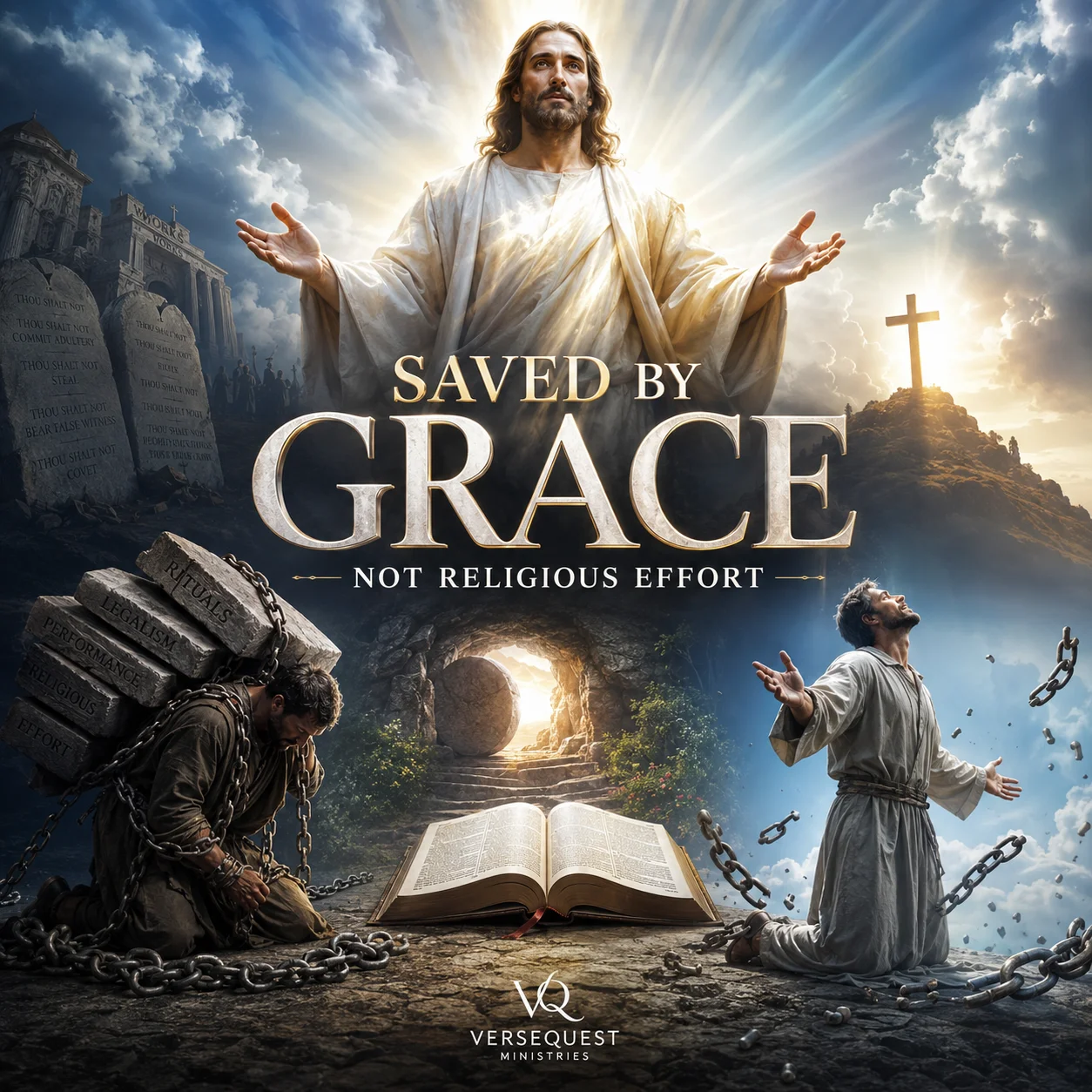
Grace Did What Religion Never Could: Saved by Grace, Not Religious Effort
Key Passage:
Ephesians 2:8–9 — “For by grace are ye saved through faith; and that not of yourselves: it is the gift of God: Not of works, lest any man should boast.”
Series:
Foundations of the Gospel of Grace
Topic:
Salvation by Grace Through Faith Apart From Religious Works, Law, Rituals, or Human Merit
Book:
Ephesians, Romans, Galatians, Titus, 1 Corinthians, Colossians, Acts, Philippians
Speaker:
Paul Tackett
Suggested Sermon Text:
Ephesians 2:1–10; Romans 3:19–28; Romans 4:1–8; Romans 5:1–11; Romans 6:23; Romans 11:6; Galatians 2:16–21; Galatians 3:10–14; Philippians 3:4–9; Titus 3:3–7; Colossians 2:10–14; Acts 16:30–31; 1 Corinthians 15:1–4; 2 Timothy 1:9
Short Sermon Description:
This detailed VerseQuest Ministries sermon outline explains the saving truth of Ephesians 2:8–9: sinners are saved by grace through faith, not by religious effort, human merit, law-keeping, baptism, sacraments, church membership, moral reform, or personal endurance. The passage leaves no room for boasting because salvation is “not of yourselves” and “not of works,” but is the gift of God through Jesus Christ. This study examines man’s spiritual death, the riches of divine mercy, the meaning of grace, the proper place of faith, the difference between justification and Christian service, and the danger of mixing works with the finished gospel. It also shows how right division protects the present gospel of grace from Israel’s law, kingdom requirements, and transitional passages. Designed for pastors, preachers, teachers, Bible students, and believers, this outline presents the death, burial, and resurrection of Jesus Christ as the complete basis of salvation and calls sinners to trust Christ alone.
Grace Did What Religion Never Could
Saved by Grace, Not Religious Effort
Introduction
Ephesians 2:8–9 is one of the clearest declarations of salvation in the entire King James Bible: “For by grace are ye saved through faith.” A sinner does not have to crawl through a maze of church traditions to discover how God saves. He does not need a priest to translate the verse, a council to improve it, or a religious institution to finish it. The Holy Ghost put the answer in plain language. Salvation is by grace, received through faith, and explicitly declared to be “not of yourselves” and “not of works.” Every phrase removes another brick from man’s tower of pride. Grace removes merit. Faith removes boasting. “Not of yourselves” removes self-salvation. “The gift of God” removes purchase. “Not of works” removes religious achievement. God did not leave one loose thread for human pride to pull.
Religion has spent centuries trying to sew works back into a garment God made entirely of grace. One system adds baptism. Another adds sacraments. Another adds law-keeping. Another adds church membership, confession, penance, Sabbath observance, emotional experiences, social reform, or endurance until death. Many will say salvation begins by grace but must be completed by human performance. That is like saying Christ paid the entire debt except for the part the sinner must pay. If one penny of the sinner’s redemption depends upon the sinner, salvation is no longer entirely of grace. Romans 11:6 says, “And if by grace, then is it no more of works: otherwise grace is no more grace.” Grace and works cannot be mixed as co-saviours. Add one drop of human merit to grace, and the mixture is no longer the gospel of grace.
This does not mean works are unimportant. It means works must remain in their proper place. Ephesians 2:10 follows verses 8–9 and teaches that saved believers are created in Christ Jesus “unto good works.” Good works come after salvation as the fruit of new life; they do not come before salvation as the price of eternal life. A tree produces fruit because it is alive. Fruit does not make a dead tree alive. The sinner is saved without works, but he is saved unto a life that should produce works. Confusing those two truths either creates legalism or encourages carelessness. Right doctrine keeps salvation free and service faithful.
I. The Sinner Is Spiritually Dead, Not Merely Religiously Untrained
Key Text: Ephesians 2:1
Supporting Texts: Romans 3:10–18; Romans 5:12; Colossians 2:13
Ephesians 2 begins by declaring that sinners are “dead in trespasses and sins.” That diagnosis must be understood before the cure of verses 8–9 can be appreciated. A spiritually dead man does not need a religious improvement program. He needs life. He cannot educate himself into resurrection, reform himself into regeneration, or ceremonially wash himself into spiritual life. Religion often treats the sinner like a weak man who needs assistance, but Scripture treats him as a dead man who needs divine intervention.
The unsaved man may be physically active, intellectually brilliant, morally respectable, and religiously devoted, yet remain spiritually dead toward God. Saul of Tarsus had education, zeal, circumcision, Hebrew ancestry, Pharisaical discipline, and outward righteousness, but none of those things reconciled him to Christ. In fact, his religion made him confident while he persecuted the Lord’s people. A corpse dressed in religious clothing remains a corpse. Polishing the coffin does not raise the dead.
Spiritual death explains why salvation must be entirely of grace. A dead man cannot boast that he helped perform his resurrection. Lazarus did not contribute to the voice that called him from the tomb. Likewise, sinners do not cooperate with God by supplying a portion of the saving power. God makes alive those who were dead. The sinner receives salvation through faith, but the life, righteousness, forgiveness, and security are all supplied by God in Christ.
Main Truth:
Because the sinner is spiritually dead, salvation must come entirely from the life-giving grace of God rather than human religious effort.
II. Salvation Begins With God’s Mercy, Not Man’s Merit
Key Text: Ephesians 2:4–5
Supporting Texts: Titus 3:5; Romans 9:16; 1 Peter 1:3
Ephesians 2 turns from man’s hopeless condition with two magnificent words: “But God.” Man was dead, disobedient, deceived, walking according to this world, serving the lusts of the flesh, and by nature a child of wrath. “But God, who is rich in mercy, for his great love wherewith he loved us,” intervened. Salvation begins not with man reaching upward but with God acting downward in mercy.
Mercy is God withholding the judgment the sinner deserves. Grace is God giving the sinner what he could never deserve. Titus 3:5 says, “Not by works of righteousness which we have done, but according to his mercy he saved us.” Even the sinner’s supposed works of righteousness cannot become the cause of salvation. Compared with God’s holiness, man’s righteousness is not currency; it is evidence of how poorly he understands the standard.
God did not save believers because He discovered hidden goodness within them. He saved them because He is rich in mercy and great in love. Divine mercy is not sentimental weakness. God did not ignore sin; He judged it at the cross. Mercy could flow to the sinner because justice fell upon the Substitute. The foundation of salvation is not that God lowered His standards but that Jesus Christ met them completely.
Main Truth:
Salvation originates in God’s rich mercy and great love, never in the sinner’s merit, worthiness, or religious achievements.
III. Grace Means God Provides What the Sinner Cannot Earn
Key Text: Ephesians 2:8
Supporting Texts: Romans 3:24; Romans 5:15–21; 2 Timothy 1:9
Grace is God’s unmerited favour toward the guilty, made righteous through the finished work of Jesus Christ. Romans 3:24 says believers are “justified freely by his grace through the redemption that is in Christ Jesus.” The word “freely” means the sinner pays nothing. The gift is free to the receiver because the full price was paid by the Redeemer.
Grace is not God overlooking sin. It is God dealing with sin so completely that He can save the ungodly without compromising His righteousness. Christ bore the guilt, shed the blood, endured the curse, and rose again. Grace does not deny the debt. Grace announces that Another paid it. The cross is where grace became available righteously, not cheaply. Salvation costs the believer nothing, but it cost Jesus Christ His blood.
Second Timothy 1:9 says God “hath saved us, and called us with an holy calling, not according to our works, but according to his own purpose and grace.” God’s saving purpose existed before our religious performance and does not depend upon it. Grace gives the sinner a righteousness he did not produce, a life he did not create, a position he did not earn, and an inheritance he could never purchase.
Main Truth:
Grace is God freely giving guilty sinners everything necessary for salvation because Jesus Christ paid the entire price.
IV. Faith Receives Salvation but Does Not Earn It
Key Text: Ephesians 2:8
Supporting Texts: Romans 4:4–5; Acts 16:31; Galatians 3:26
Ephesians 2 says salvation is “through faith.” Faith is not another religious work secretly inserted into grace. It is the empty hand that receives the gift. Romans 4 contrasts working with believing: “But to him that worketh not, but believeth on him that justifieth the ungodly, his faith is counted for righteousness.” The man who believes is specifically described as one who “worketh not” for justification.
Faith does not save because faith itself is powerful. Jesus Christ saves, and faith rests upon Him. A weak hand can receive a valuable gift just as surely as a strong hand. The value lies in the gift and the Giver, not in the strength of the receiver’s fingers. The sinner does not need faith in faith, confidence in confidence, or sincerity in sincerity. He must believe on the Lord Jesus Christ.
Saving faith accepts God’s testimony that Christ died for our sins, was buried, and rose again the third day. It abandons every competing confidence. The sinner stops trusting baptism, church membership, morality, religious heritage, good intentions, emotional experiences, or personal perseverance. Faith says, “Christ is enough.” The moment faith adds human merit as a co-foundation, it has stopped resting entirely upon Christ.
Main Truth:
Faith is not the price of salvation but the means by which the sinner receives the salvation Jesus Christ purchased.
V. Salvation Is the Gift of God, Not a Religious Wage
Key Text: Ephesians 2:8
Supporting Texts: Romans 6:23; Romans 4:4; John 4:10
Ephesians calls salvation “the gift of God.” Romans 6:23 contrasts wages and gifts: “For the wages of sin is death; but the gift of God is eternal life through Jesus Christ our Lord.” Wages are earned. Gifts are received. The sinner has earned death through sin, but he cannot earn eternal life through religion. Eternal life is God’s gift through Christ.
If a man must perform works to receive, maintain, or complete salvation, then salvation has become wages. Religion may call it a gift, but attaching a payment plan changes the transaction. A gift that must be purchased is not a gift. A salvation that must be earned is not grace. A life called eternal that may expire when the believer fails is not eternal life.
The gift is found “through Jesus Christ our Lord.” God does not hand eternal life to sinners apart from Christ. The gift is bound up in the Son. First John 5 says, “he that hath the Son hath life.” Eternal life is not merely endless existence; it is life in union with the risen Christ. The believer possesses it because he possesses Christ by faith.
Main Truth:
Eternal life is God’s gift through Jesus Christ and cannot be purchased, deserved, or maintained as a religious wage.
VI. “Not of Yourselves” Destroys Every Form of Self-Salvation
Key Text: Ephesians 2:8
Supporting Texts: Jonah 2:9; Philippians 3:7–9; Romans 10:3–4
The phrase “not of yourselves” is broad enough to exclude everything originating in fallen man. Salvation is not of your character, intelligence, baptism, generosity, church, denomination, ancestry, willpower, suffering, promise-keeping, or moral improvement. Man’s contribution to salvation is the sin that made the cross necessary.
Philippians 3 records Paul’s impressive religious credentials. He had circumcision, heritage, zeal, law, and Pharisaical righteousness. Yet when he met Christ, he counted those gains as loss and dung so that he might “be found in him, not having mine own righteousness.” Religious effort becomes dangerous when it persuades a sinner to trust his own righteousness instead of Christ’s.
Romans 10 describes Israel attempting to establish its own righteousness rather than submitting to the righteousness of God. Self-righteousness does not have to appear proud or cruel. It may look disciplined, sincere, charitable, and deeply religious. Yet if it competes with Christ as the ground of acceptance, it is rebellion dressed for church. God does not renovate the sinner’s righteousness; He gives the believer Christ’s righteousness.
Main Truth:
“Not of yourselves” excludes every human quality, ritual, achievement, and personal righteousness as a cause of salvation.
VII. “Not of Works” Excludes Religious Rituals and Law-Keeping
Key Text: Ephesians 2:9
Supporting Texts: Galatians 2:16; Romans 3:28; Colossians 2:13–17
Ephesians 2:9 says plainly, “Not of works.” Galatians 2:16 says three times that a man is not justified by the works of the law. Romans 3:28 concludes that a man is justified by faith “without the deeds of the law.” The Holy Ghost repeats the truth because religious men continually attempt to reverse it.
Works include more than moral deeds. Religious ceremonies are works. Water baptism is something performed upon the body by human hands. Circumcision is a work. Sabbath observance is a work. Taking a sacrament is a work. Church membership is a work. Confession to a religious official is a work. None of these can become part of the saving foundation without contradicting “not of works.”
Colossians 2 says Christ blotted out the handwriting of ordinances that was against us and nailed it to His cross. The believer is complete in Christ, not completed by ordinances. Rituals may symbolize truth when used properly, but symbols cannot produce the reality they portray. Water can wash dirt from flesh; it cannot wash guilt from the conscience. Bread and a cup can memorialize Christ’s death; they cannot repeat or complete it.
Main Truth:
No law, ceremony, ordinance, sacrament, or religious performance can contribute to the justification of a sinner.
VIII. Grace Removes Boasting and Gives All Glory to Christ
Key Text: Ephesians 2:9
Supporting Texts: Romans 3:27; 1 Corinthians 1:29–31; Galatians 6:14
God saves by grace “lest any man should boast.” Heaven will contain no man pointing to himself as the reason he arrived. No one will say, “Christ died, but my baptism completed the transaction,” or “Grace began it, but my law-keeping secured it.” Every saved sinner will praise the Lamb because every part of redemption belongs to Him.
Romans 3 asks, “Where is boasting then? It is excluded.” By what law? “Of works? Nay: but by the law of faith.” Faith excludes boasting because it confesses dependence. The believer does not congratulate himself for receiving mercy any more than a drowning man boasts that he accepted the rescuer’s hand. He praises the One who entered the water.
First Corinthians 1 says God arranged salvation so “that no flesh should glory in his presence.” Christ is made unto believers wisdom, righteousness, sanctification, and redemption. Therefore, “He that glorieth, let him glory in the Lord.” Grace does not merely save the sinner; it places every crown at Christ’s feet before the believer even reaches heaven.
Main Truth:
Salvation by grace excludes all human boasting and reserves every ounce of glory for the Lord Jesus Christ.
IX. Good Works Follow Salvation but Never Form Its Foundation
Key Text: Ephesians 2:10
Supporting Texts: Titus 2:11–14; Titus 3:8; 2 Corinthians 5:14–15
Ephesians 2:10 says, “For we are his workmanship, created in Christ Jesus unto good works.” The same passage that excludes works from salvation establishes works as the intended fruit of salvation. God does not save sinners by good works, but He saves them to produce good works. The order cannot be reversed without corrupting the gospel.
The believer is God’s workmanship. Salvation creates a new man in Christ. Good works flow from new life, gratitude, the indwelling Spirit, sound doctrine, and love for the Saviour. Titus 2 says grace teaches us to deny ungodliness and live soberly, righteously, and godly. Grace is not permission to sin; it is the only foundation upon which true holiness can grow without fear and bondage.
A saved man should serve, give, pray, study, preach, love, forgive, labour, and maintain good works. But he does these things because he is accepted, not to become accepted. He serves from victory, not for justification. The cross is the root; obedience is the fruit. When fruit is made the root, the gospel dies. When the root is sound, fruit should appear.
Main Truth:
Good works are the God-ordained result of salvation in Christ, never the price, cause, or security of that salvation.
Conclusion
Ephesians 2:8–9 leaves no room for religious negotiation. Salvation is by grace, through faith, not of ourselves, the gift of God, and not of works. Every phrase magnifies Christ and humiliates human pride. The sinner is too guilty to earn salvation, too dead to create life, too corrupt to produce righteousness, and too indebted to pay his own account. God supplies everything in Jesus Christ.
Religious effort fails because it begins with the wrong man. It assumes fallen Adam can climb into heaven if given enough rules, ceremonies, encouragement, and time. The gospel declares that Adam must die and the sinner must receive life in Christ. Religion puts paint upon the old man. Grace creates a new man. Religion teaches the corpse to pose. Grace raises the dead.
The Church must guard this gospel without apology. A message that says “grace plus works” is not a stronger gospel; it is another gospel. A preacher who adds law, water, sacraments, or human merit to justification has not helped Christ. He has insulted the sufficiency of the cross. Jesus Christ did not make a partial payment and leave the balance to religion. He said, “It is finished.”
Final Call
You cannot save yourself. Your morality cannot erase your sin. Your baptism cannot purchase righteousness. Your church cannot open heaven. Your works cannot reverse death. Your promises cannot repair your past. You need a Saviour, not a religious program.
Jesus Christ died for your sins according to the Scriptures. He was buried. He rose again the third day according to the Scriptures. He paid the debt, satisfied justice, conquered death, and now offers eternal life as a gift.
Believe on the Lord Jesus Christ, and thou shalt be saved. Stop trusting yourself. Stop trusting ceremonies. Stop trusting religion. Place your complete confidence in Christ’s blood, death, burial, and resurrection. Believer, stand fast in grace, reject legalism, refuse license, and let the grace that saved you produce a life that glorifies your Saviour.
Closing Verse:
Romans 11:6 — “And if by grace, then is it no more of works: otherwise grace is no more grace.”
Closing Statement:
Religion asks the sinner to finish what he could never begin; grace announces that Jesus Christ finished what the sinner could never do.