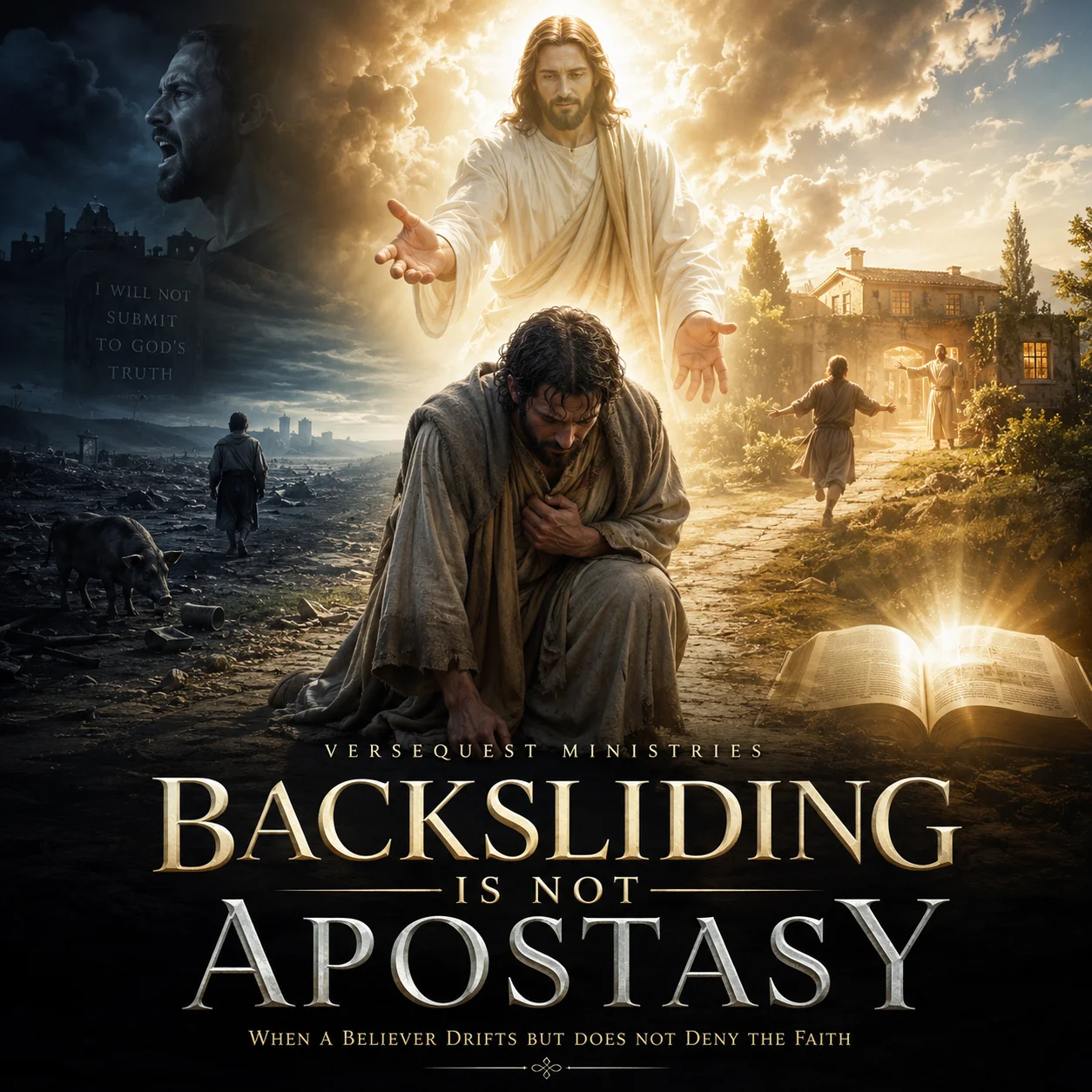
Backsliding Is Not Apostasy
When a Believer Drifts but Does Not Deny the Faith
Sermon Title:
Backsliding Is Not Apostasy: When a Believer Drifts but Does Not Deny the Faith
Key Passage:
Proverbs 14:14 — “The backslider in heart shall be filled with his own ways: and a good man shall be satisfied from himself.”
Series:
Foundations of the Gospel of Grace
Topic:
The Difference Between Backsliding, Broken Fellowship, Chastening, and Apostasy From the Truth
Book:
Proverbs, Jeremiah, Hosea, Luke, 1 John, Galatians, Hebrews, 2 Timothy, Jude, Revelation
Speaker:
Paul Tackett
Suggested Sermon Text:
Proverbs 14:14; Jeremiah 3:6–14; Hosea 14:4; Luke 15:11–24; 1 John 1:7–9; Hebrews 12:5–11; Galatians 6:1; 2 Timothy 4:10; 1 Timothy 4:1; 2 Thessalonians 2:3; Jude 3–4; Revelation 2:4–5; John 10:27–29; Ephesians 4:30
Short Sermon Description:
This detailed VerseQuest Ministries sermon outline explains Proverbs 14:14 and the important Bible distinction between backsliding and apostasy. The backslider in heart is one who turns inward, drifts from fellowship, follows his own ways, loses joy, invites chastening, and must be restored by repentance, confession, and renewed obedience to the word of God. Apostasy, however, is a deeper departure from the truth, a forsaking or corrupting of the faith, often involving doctrinal rebellion, denial of sound doctrine, and departure from the gospel. This sermon rightly divides Old Testament uses of backsliding concerning Israel from practical applications for believers today, showing that a Church-age believer can grieve the Spirit, lose joy, damage testimony, and suffer chastening without losing salvation. It also warns against using eternal security as an excuse for drifting, while rejecting the legalistic error that every season of backsliding proves apostasy or loss of salvation. Designed for pastors, preachers, teachers, Bible students, and believers, this outline magnifies restoration, correction, assurance, holiness, and the faithful Shepherd who restores His wandering sheep.
Backsliding Is Not Apostasy
When a Believer Drifts but Does Not Deny the Faith
Introduction
Proverbs 14:14 gives one of the Bible’s sharpest descriptions of spiritual drift: “The backslider in heart shall be filled with his own ways.” Notice where backsliding begins. It begins “in heart.” Long before the feet wander, the heart turns. Long before the mouth speaks foolishness, the affections have shifted. Long before the believer is seen in the far country, he has already packed his bags inside. Backsliding is not usually a sudden explosion; it is a slow leak. Prayer dries up, the Bible grows quiet, fellowship becomes optional, conviction is brushed off, sin is renamed weakness, and the believer starts feeding on “his own ways.” The backslider does not become empty. He becomes filled, but with the wrong thing.
Backsliding must not be confused with apostasy. A backslider is drifting, cooling, wandering, resisting, or being overtaken in a fault. Apostasy is a departure from the truth itself. Backsliding is the child wandering from the Father’s fellowship. Apostasy is the rebel turning against the Father’s truth. Backsliding may involve serious sin, coldness, worldliness, and spiritual stubbornness, but apostasy involves a settled departure from the faith, a denial or corruption of revealed truth, and in many cases the exposure of a false profession. A backslidden believer needs restoration. An apostate needs rebuke, warning, and in many cases recognition that the man never truly stood in the truth he now denies.
This distinction is needed because two errors are constantly waiting. Legalism looks at every wounded, drifting, struggling believer and screams, “Lost! Apostate! Cast off!” Careless Christianity looks at every drift and says, “Nothing matters. Grace covers it. Leave him alone.” The Bible rejects both. Sin in a believer is serious. Backsliding is dangerous. The backslider in heart shall be filled with his own ways. But a Church-age believer is also sealed unto the day of redemption, held by the Shepherd, and free from condemnation in Christ. He can lose fellowship without losing sonship. He can lose joy without losing salvation. He can be chastened without being damned. Right division keeps assurance from becoming carelessness and keeps correction from becoming condemnation.
I. Backsliding Begins in the Heart
Key Text: Proverbs 14:14
Supporting Texts: Proverbs 4:23; Jeremiah 17:9; Matthew 15:18–19
The verse says, “The backslider in heart.” That is where the matter starts. A man does not usually backslide first in public. He backslides first in the secret place of desire, affection, thought, and will. The outward collapse is often only the visible fruit of an inward departure. Proverbs 4:23 says, “Keep thy heart with all diligence; for out of it are the issues of life.” If the heart is not kept, the life will eventually show the neglect.
Jeremiah 17:9 says, “The heart is deceitful above all things, and desperately wicked: who can know it?” That verse is not written to flatter human nature. The heart can dress rebellion in reasonable language. It can call laziness rest, call compromise balance, call bitterness discernment, call worldliness liberty, and call disobedience “just needing space.” A backsliding heart rarely announces, “I am leaving God.” It usually says, “I am just tired,” “I need a break,” “I am not being fed,” “People hurt me,” or “I can handle this.” Sometimes those words contain real pain, but the heart can use even real pain as an excuse to drift from the Lord.
The Lord Jesus said in Matthew 15 that evil thoughts, murders, adulteries, fornications, thefts, false witness, and blasphemies proceed out of the heart. Backsliding is therefore not fixed by merely changing scenery. A man can change churches, change friends, change routines, change vocabulary, and still carry the same drifting heart with him. The heart must be dealt with before God. The issue is not merely where the feet have gone, but where the heart has turned.
Main Truth:
Backsliding begins in the heart before it is seen in the life, and the heart must be brought honestly before God.
II. Backsliding Fills a Man With His Own Ways
Key Text: Proverbs 14:14
Supporting Texts: Isaiah 53:6; Judges 21:25; Proverbs 3:5–7
Proverbs 14:14 says the backslider “shall be filled with his own ways.” That is a frightening phrase. The backslider is not empty. He is full of self-direction, self-justification, self-pity, self-will, self-confidence, and self-made excuses. He begins to feed on his own reasoning instead of God’s word. He prefers his own counsel to Scripture, his own feelings to obedience, and his own path to the old paths of truth. When a man is filled with his own ways, he may still speak religious language, but self is driving the wagon.
Isaiah 53:6 says, “All we like sheep have gone astray; we have turned every one to his own way.” That is the universal mark of sin. Judges 21:25 says every man did that which was right in his own eyes. The backslider may not become an atheist. He may not deny every doctrine. He may still believe the Bible is true in theory. But practically he starts doing what is right in his own eyes. He lives by personal appetite while still claiming doctrinal loyalty.
Proverbs 3:5–7 gives the cure: “Trust in the LORD with all thine heart; and lean not unto thine own understanding.” The backslider leans hard on his own understanding. He explains away rebuke, avoids counsel, resists correction, and convinces himself that his drift is reasonable. But being filled with your own ways always has consequences. Self is a cruel shepherd. The man who follows himself long enough usually ends up hungry, bitter, dry, and ashamed.
Main Truth:
Backsliding fills a man with self-will and self-deception, replacing the word of God with his own ways.
III. Backsliding Is a Drift From Fellowship, Not Automatically Apostasy
Key Text: Proverbs 14:14
Supporting Texts: 1 John 1:7–9; Luke 15:17–24; Galatians 6:1
Backsliding is serious, but it is not automatically apostasy. The Bible gives room for a believer to drift, stumble, grow cold, be overtaken in a fault, lose joy, and need restoration. First John 1 teaches believers to walk in the light and confess sins. Galatians 6:1 speaks of a man overtaken in a fault and calls spiritual believers to restore such an one in the spirit of meekness. Restoration language belongs to someone who has fallen out of proper fellowship, not someone who is being treated as a doctrinal traitor in every case.
The prodigal son is one of the clearest pictures of broken fellowship without lost sonship. He went into the far country. He wasted his substance. He fed swine. He came to himself. But when he returned, the father did not say, “Become my son again.” He said, “This my son was dead, and is alive again; he was lost, and is found.” His fellowship was broken, his joy was gone, his dignity was ruined, and his consequences were real, but his relationship to the father remained the framework of restoration.
This matters because wounded saints can be destroyed by careless labels. A backslider should not be coddled, but neither should he be falsely called an apostate every time he needs correction. A believer can be in a bad place without having denied the faith. He can be ashamed, cold, worldly, or stubborn and still be the object of restoration. The Bible believer must have enough discernment to rebuke sin seriously and restore repentant saints tenderly.
Main Truth:
Backsliding is a dangerous drift from fellowship and obedience, but it is not automatically the same as apostasy from the faith.
IV. Apostasy Is a Departure From the Truth
Key Text: 1 Timothy 4:1
Supporting Texts: 2 Thessalonians 2:3; Jude 3–4; 2 Peter 2:1–3
Apostasy is not merely a believer having a weak season or needing chastening. First Timothy 4:1 says, “some shall depart from the faith, giving heed to seducing spirits, and doctrines of devils.” That is doctrinal departure. Second Thessalonians 2:3 speaks of a falling away connected with end-time rebellion. Jude warns of certain men crept in unawares, turning the grace of God into lasciviousness and denying the only Lord God, and our Lord Jesus Christ. Apostasy is not just a dirty garment; it is a departure from revealed truth.
Second Peter 2 speaks of false teachers bringing in damnable heresies, even denying the Lord that bought them. Apostasy often shows itself through false doctrine, denial of Christ, corruption of grace, rejection of Scripture, and leading others into error. A backslider may neglect the Bible; an apostate attacks it. A backslider may fall into sin; an apostate justifies false doctrine. A backslider may need restoration; an apostate often becomes a recruiter for rebellion.
This distinction is essential. Demas forsook Paul, having loved this present world, and that was grievous backsliding or worldly desertion. Hymenaeus and Philetus erred concerning the truth, saying the resurrection was past already, and overthrew the faith of some. That is doctrinal corruption. Not all failure is the same. The Bible makes distinctions, and so should the preacher. A man in sin needs rebuke. A man teaching lies needs stronger resistance. A man denying the gospel must not be handled as merely tired.
Main Truth:
Apostasy is a departure from the faith and revealed truth, often marked by false doctrine, denial, and rebellion against Scripture.
V. Backsliding Brings Chastening, Not Condemnation for the Believer in Christ
Key Text: Hebrews 12:6
Supporting Texts: 1 Corinthians 11:31–32; Romans 8:1; Ephesians 4:30; John 10:28–29
When a believer backslides, God does not ignore it. Hebrews 12:6 says, “For whom the Lord loveth he chasteneth, and scourgeth every son whom he receiveth.” Chastening is family discipline. It is not eternal condemnation. The Father does not let His children wander without correction. He may use conviction, Scripture, preaching, consequences, loss, rebuke, or painful providence to turn the backslider from his own ways.
First Corinthians 11:32 makes the distinction plain: “But when we are judged, we are chastened of the Lord, that we should not be condemned with the world.” That verse should settle the matter. Chastening is not condemnation with the world. Romans 8:1 says there is no condemnation to them which are in Christ Jesus. John 10 says Christ’s sheep shall never perish. Ephesians 4:30 says believers are sealed unto the day of redemption. Therefore, chastening must be understood as the Father’s correction of a secure child, not the damnation of a lost enemy.
This does not make backsliding safe. Chastening can be severe. The believer can lose joy, peace, usefulness, testimony, health, opportunities, rewards, and even physical life under divine discipline. Security does not make sin harmless. It makes correction fatherly instead of judicial. The backslider needs to fear the Father’s rod, not because God may break His promise of salvation, but because God is too holy to let His child live comfortably in rebellion.
Main Truth:
The backslidden believer may face serious chastening from the Father, but chastening is not condemnation with the world.
VI. Backsliding Grieves the Spirit and Robs Joy
Key Text: Ephesians 4:30
Supporting Texts: Psalm 51:12; 1 Thessalonians 5:19; Galatians 5:16–25
Ephesians 4:30 says, “And grieve not the holy Spirit of God, whereby ye are sealed unto the day of redemption.” That verse gives both assurance and warning. The believer is sealed unto the day of redemption, but the Spirit can be grieved. Backsliding grieves the Spirit because the believer belongs to God. Sin is not merely a rule violation; it is a personal offense against the God who indwells the believer.
David prayed in Psalm 51:12, “Restore unto me the joy of thy salvation.” He did not ask for salvation itself to be restored, but the joy of it. Backsliding steals the song out of a believer’s mouth. It dries up prayer, dulls Scripture, chills worship, weakens testimony, and makes fellowship with God feel distant. A man filled with his own ways may pretend he is free, but inwardly he is losing the joy that only fellowship with God can give.
First Thessalonians 5:19 says, “Quench not the Spirit.” Galatians 5 commands believers to walk in the Spirit and not fulfil the lust of the flesh. A backslider lives against the ministry of the Spirit and then wonders why he has no spiritual power. The seal remains, but the joy is wounded. The relationship remains, but fellowship is hindered. The Spirit does not leave the Church-age believer every time he stumbles, but the believer can grieve the very One who sealed him.
Main Truth:
Backsliding grieves the Holy Spirit, quenches spiritual life, and robs the believer of the joy of salvation.
VII. Backsliding Requires Confession and Restoration
Key Text: 1 John 1:9
Supporting Texts: Proverbs 28:13; Psalm 51:1–4; Hosea 14:4; Galatians 6:1
First John 1:9 gives the practical path of restoration: “If we confess our sins, he is faithful and just to forgive us our sins, and to cleanse us from all unrighteousness.” The backslider does not need to decorate his drift with excuses. He needs to confess. Confession means agreeing with God about sin. It is not vague regret, emotional fog, public image repair, or religious wording designed to avoid responsibility. It says what God says.
Proverbs 28:13 says, “He that covereth his sins shall not prosper: but whoso confesseth and forsaketh them shall have mercy.” Covering sin is one of the backslider’s favorite hobbies. He covers it with blame, busyness, pain, theology, comparison, privacy, personality, and sometimes ministry itself. But God does not restore fellowship through coverups. He restores through confession and cleansing. David’s Psalm 51 prayer shows a man done defending himself: “my transgressions,” “mine iniquity,” “my sin.”
Hosea 14:4 says, “I will heal their backsliding, I will love them freely.” The immediate context concerns Israel, and that must be noted, but the heart of God toward restoration is clear. Galatians 6:1 calls spiritual believers to restore the overtaken brother. God is not interested in leaving the backslider in the ditch. He rebukes, chastens, convicts, and calls him home. Restoration is not pretending nothing happened. It is dealing with sin God’s way.
Main Truth:
Backsliding is healed through honest confession, forsaking sin, and restoration according to God’s mercy and truth.
VIII. The Backslider Must Return to the Word, Not His Feelings
Key Text: Proverbs 14:14
Supporting Texts: Psalm 119:9–11; Jeremiah 6:16; 2 Timothy 3:16–17
The backslider in heart is filled with his own ways, so the cure is to return to God’s ways. Feelings are often part of the problem. A drifting believer frequently says, “I do not feel close to God,” “I do not feel like reading,” “I do not feel conviction like I used to,” or “I feel like God is far away.” Those feelings may be real, but they are not the authority. The backslider does not recover by obeying his feelings. He recovers by obeying the word of God.
Psalm 119:9 asks, “Wherewithal shall a young man cleanse his way?” The answer is, “by taking heed thereto according to thy word.” Verse 11 says, “Thy word have I hid in mine heart, that I might not sin against thee.” The heart that drifted must be filled again with Scripture. Jeremiah 6:16 says to ask for the old paths and walk therein. The backslider needs the old Book, old truths, old obedience, old prayer, old confession, and old fellowship with God.
Second Timothy 3:16–17 says all Scripture is profitable for doctrine, reproof, correction, and instruction in righteousness. Those are exactly what the backslider needs. Doctrine to show truth. Reproof to expose error. Correction to set him straight. Instruction to teach him how to walk. A man filled with his own ways must be emptied by the word and filled with God’s truth again. No shortcut replaces Scripture.
Main Truth:
The backslider is restored by returning to the authority of God’s word instead of following his own feelings and ways.
IX. Backsliding Warns the Church to Restore Carefully and Contend Firmly
Key Text: Galatians 6:1
Supporting Texts: Jude 3–4; 2 Timothy 2:24–26; Titus 3:10; James 5:19–20
The Church must know how to deal with both backsliders and apostates. Galatians 6:1 tells spiritual believers to restore a man overtaken in a fault in the spirit of meekness, considering themselves lest they also be tempted. That requires tenderness, humility, and truth. A bruised sheep does not need a wolf’s teeth from the pulpit. He needs a shepherd’s hand with a Bible in it. Restoration is not compromise; it is biblical recovery.
But Jude says to earnestly contend for the faith against men who creep in and corrupt the truth. Titus 3 says a heretic after the first and second admonition is to be rejected. Second Timothy speaks of instructing those who oppose themselves, if God peradventure will give them repentance to the acknowledging of the truth. The Church must be patient with the wounded, firm with the rebellious, and uncompromising with false doctrine. Not everyone in error is in the same condition.
James 5:19–20 speaks of converting one who errs from the truth and saving a soul from death, hiding a multitude of sins. There is real rescue work to be done. Some saints need restoration before sin destroys their usefulness. Some teachers need rebuke before their doctrine destroys others. Some apostates need to be marked because they are not merely weak but dangerous. The preacher must keep both grace and discernment loaded.
Main Truth:
The Church must restore backsliders with meekness while firmly contending against apostasy and false doctrine.
Conclusion
Proverbs 14:14 gives a sober warning: “The backslider in heart shall be filled with his own ways.” Backsliding begins in the heart, grows through self-will, robs joy, grieves the Spirit, invites chastening, damages testimony, and requires honest confession. It is not a small thing. It should not be excused, softened, renamed, or treated as normal Christian liberty. The believer who drifts from God is not heading into freedom. He is heading into the bitter harvest of his own ways.
But backsliding is not the same as apostasy. A backslider may be a wandering child who needs restoration. An apostate departs from the faith and corrupts or denies the truth. The backslider needs rebuke, confession, cleansing, and restoration. The apostate must be resisted, marked, and rejected when he refuses correction. Right division and Bible discernment are required. Legalism confuses every stumble with loss of salvation, while lawlessness treats every drift as harmless. The Bible does neither.
The Church-age believer is saved by grace, sealed unto the day of redemption, held by Christ, and free from condemnation. That security does not make backsliding safe. It makes the Father’s correction certain. The answer to backsliding is not despair, denial, or doctrinal confusion. The answer is to come back to God’s word, confess sin, submit to chastening, walk in the Spirit, and be restored. The Shepherd knows how to bring a wandering sheep home.
Final Call
Sinner, if you have never trusted Jesus Christ, your problem is not backsliding from fellowship. Your problem is that you are lost, dead in sins, and under condemnation. Religion cannot save you. Morality cannot save you. Baptism, sacraments, church membership, law-keeping, and good works cannot save you.
Jesus Christ died for your sins according to the Scriptures. He was buried. He rose again the third day according to the Scriptures. Believe on the Lord Jesus Christ, and thou shalt be saved. Do not confuse religious interest with salvation. You must be in Christ.
Believer, if you are backslidden in heart, stop feeding on your own ways. Come clean before God. Confess the sin. Return to the word. Submit to the Father’s correction. Let spiritual believers help restore you. You have not found a ditch deeper than the Shepherd’s reach, but you must stop calling the ditch a pasture.
Closing Verse:
Hosea 14:4 — “I will heal their backsliding, I will love them freely: for mine anger is turned away from him.”
Closing Statement:
Backsliding fills a man with his own ways, but grace calls the wandering heart back to the God who restores without confusing chastening with condemnation.