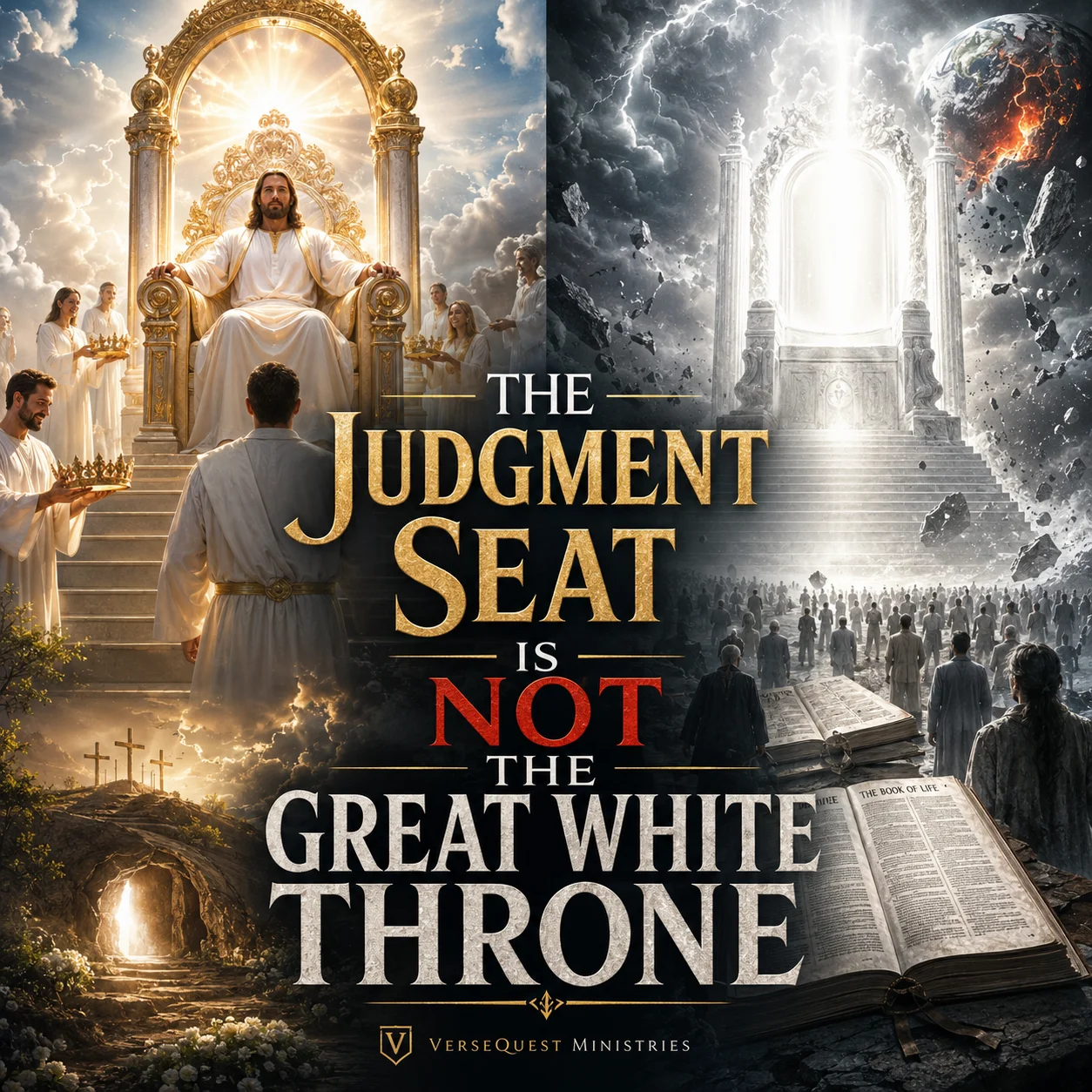
Sermon Title:
Two Thrones, Two Judgments: The Judgment Seat Is Not the Great White Throne
Key Passage:
2 Corinthians 5:10 — “For we must all appear before the judgment seat of Christ; that every one may receive the things done in his body, according to that he hath done, whether it be good or bad.”
Revelation 20:11–12 — “And I saw a great white throne, and him that sat on it, from whose face the earth and the heaven fled away… And I saw the dead, small and great, stand before God; and the books were opened.”
Series:
Foundations of the Gospel of Grace
Topic:
The Difference Between the Judgment Seat of Christ and the Great White Throne Judgment
Book:
2 Corinthians, Revelation, Romans, 1 Corinthians, Ephesians, Colossians, 1 Thessalonians, 2 Timothy
Speaker:
Paul Tackett
Suggested Sermon Text:
2 Corinthians 5:1–10; Revelation 20:4–15; Romans 8:1; Romans 14:10–12; 1 Corinthians 3:8–15; 1 Corinthians 4:1–5; 1 Corinthians 15:51–58; 1 Thessalonians 4:13–18; Ephesians 2:8–10; Colossians 3:23–25; 2 Timothy 4:6–8; John 5:24
Short Sermon Description:
This detailed VerseQuest Ministries sermon outline explains the crucial Bible distinction between the judgment seat of Christ in 2 Corinthians 5:10 and the great white throne in Revelation 20:11–15. These are not two names for the same event. The judgment seat of Christ concerns believers whose salvation is already settled in Jesus Christ and whose service, motives, stewardship, and works are examined for reward or loss. The great white throne is the final judgment of the dead after the Millennium, where the books are opened, the dead are judged according to their works, and those not found written in the book of life are cast into the lake of fire. This sermon distinguishes salvation from service, sonship from reward, chastening from condemnation, the catching away of the Church from the final resurrection of the lost, and the believer’s secure standing from his serious accountability before Christ. Designed for pastors, preachers, teachers, Bible students, and believers, this outline gives a strong KJV framework for rightly dividing two judgments that religion often confuses.
Two Thrones, Two Judgments
The Judgment Seat Is Not the Great White Throne
Introduction
One of the fastest ways to produce unnecessary fear in a saved believer is to take every judgment passage in the Bible, throw it into one religious blender, push the button, and tell the saint he had better hope his good works outweigh his bad when he finally stands before God. That is not rightly dividing the word of truth. Second Corinthians 5:10 says, “For we must all appear before the judgment seat of Christ.” Revelation 20:11 says, “And I saw a great white throne.” Those are not interchangeable phrases. The settings are different. The people appearing are different. The issues examined are different. The results are different. The timing is different. Confuse them, and you will confuse salvation, rewards, resurrection, the Church, prophecy, and the gospel itself.
The judgment seat of Christ is not a second chance for God to decide whether the blood of Jesus Christ was enough. The believer’s eternal standing has already been settled by grace through faith. Romans 8:1 says there is “now no condemnation to them which are in Christ Jesus.” John 5:24 says the believer “shall not come into condemnation.” Ephesians 1 says believers have redemption through Christ’s blood and are sealed with the Holy Spirit of promise. Therefore, when a saved man stands before Christ, the issue is not whether he will be cast into the lake of fire. The issue is what he did with the life, opportunities, gifts, time, truth, and service entrusted to him after salvation.
The great white throne is altogether different. Revelation 20 places it after the thousand-year reign, after Satan’s final rebellion and defeat, and before the new heaven and new earth. The dead, small and great, stand before God. The books are opened. The dead are judged according to their works. Death and hell deliver up the dead in them. Death and hell are cast into the lake of fire. And “whosoever was not found written in the book of life was cast into the lake of fire.” This is not the judgment seat of Christ with a different backdrop. It is the final assize of the lost. One judgment concerns the saved man’s service. The other concerns the final judgment of the dead. Two thrones. Two judgments. Right division matters.
I. The Judgment Seat of Christ Is for Believers
Key Text: 2 Corinthians 5:10
Supporting Texts: Romans 14:10–12; 1 Corinthians 3:11–15; Romans 8:1
Paul says, “For we must all appear before the judgment seat of Christ.” The “we” belongs to the context of believers. Second Corinthians is written to the church of God at Corinth and to saints. Paul is discussing the Christian’s present earthly tabernacle, the desire to be clothed upon with the heavenly, being absent from the body and present with the Lord, and then appearing before Christ. He is not suddenly shifting to the final resurrection of the lost. He is speaking of the accountability of those who belong to Christ.
Romans 14:10 likewise says, “for we shall all stand before the judgment seat of Christ.” Again, Paul is addressing brethren. The context concerns believers judging one another in disputed matters and reminds every Christian that he will give account of himself to God. That should sober the saved man. He does not need to spend his life playing pope over another believer’s conscience when he has his own stewardship to answer for before the Lord.
Yet accountability is not condemnation. Romans 8:1 remains true. The believer’s sins have been dealt with judicially at Calvary. Christ bore the condemnation. The judgment seat does not reopen the question of justification. It examines the believer as a servant and steward. If you turn the judgment seat into a second great white throne, you have quietly made salvation depend on works after all.
Main Truth:
The judgment seat of Christ concerns believers whose salvation is settled but whose Christian service must be examined by the Lord.
II. The Judgment Seat Examines the Believer’s Works
Key Text: 2 Corinthians 5:10
Supporting Texts: 1 Corinthians 3:8–15; Colossians 3:23–25; 1 Corinthians 4:5
Second Corinthians 5:10 says every believer will “receive the things done in his body, according to that he hath done, whether it be good or bad.” The body matters. The Christian life is not abstract theology floating above practical conduct. What the believer does with his body, time, tongue, money, gifts, opportunities, ministry, testimony, and obedience matters. Salvation is free, but service is accountable.
First Corinthians 3 gives the clearest companion passage. Paul says every man shall receive his own reward according to his own labour. He describes building upon the foundation, which is Jesus Christ, with gold, silver, precious stones, wood, hay, and stubble. The fire shall try every man’s work “of what sort it is.” Notice carefully: the examination is of the work. It is not determining whether Christ’s blood was sufficient to save the worker.
Colossians 3 says, “whatsoever ye do, do it heartily, as to the Lord,” because the believer shall receive the reward of the inheritance. First Corinthians 4 says the Lord will bring to light the hidden things of darkness and make manifest the counsels of the hearts. Motive matters. A sermon can sound spiritual and be preached for pride. A ministry can look large and be built on flesh. Christ sees what men cannot see.
Main Truth:
The judgment seat examines the quality, motive, faithfulness, and spiritual value of the believer’s works and service.
III. The Judgment Seat Can Bring Reward or Loss
Key Text: 1 Corinthians 3:14–15
Supporting Texts: 2 John 8; 2 Timothy 4:7–8; 1 Corinthians 9:24–27
First Corinthians 3 says, “If any man’s work abide which he hath built thereupon, he shall receive a reward.” That is positive judgment. The judgment seat is not merely a frightening audit. Faithfulness will be recognized by Christ. Service done according to Scripture, from the right motive, through dependence upon God, will not be forgotten. The world may overlook it. Men may never applaud it. Christ does not miss it.
But verse 15 gives the other side: “If any man’s work shall be burned, he shall suffer loss.” Loss is real. A believer can waste opportunities, live carnally, build with wood, hay, and stubble, and arrive before Christ with less reward than he might have received. Second John warns, “look to yourselves, that we lose not those things which we have wrought, but that we receive a full reward.” Eternal security does not make rewards automatic.
Then comes one of the strongest distinctions in the passage: “but he himself shall be saved; yet so as by fire.” The work may burn. The reward may be lost. The believer remains saved. That one sentence demolishes the idea that the judgment seat is the great white throne. At the great white throne, the issue ends in the lake of fire. At the judgment seat, a believer may suffer loss while he himself remains saved.
Main Truth:
At the judgment seat, a believer may receive reward or suffer loss, but the examination of works does not overturn his salvation in Christ.
IV. Salvation Is Not the Reward Given at the Judgment Seat
Key Text: Ephesians 2:8–10
Supporting Texts: Romans 4:4–5; Titus 3:5; Romans 6:23
Ephesians 2:8–9 says salvation is “by grace…through faith,” “not of works, lest any man should boast.” Then verse 10 says believers are “created in Christ Jesus unto good works.” The order matters. Salvation first. Good works afterward. The works are the fruit of salvation, not the purchase price. The judgment seat evaluates fruit; it does not determine whether grace really saved the believer.
Romans 4 makes the distinction between wage and grace. “Now to him that worketh is the reward not reckoned of grace, but of debt.” Salvation cannot simultaneously be a free gift and wages earned at judgment. Romans 6:23 says “the gift of God is eternal life through Jesus Christ our Lord.” A gift is received. A reward is earned through faithful service. Mix those categories and the gospel becomes religious bookkeeping.
This is why the judgment seat should motivate holiness without destroying assurance. The believer should care deeply how he lives because Christ will examine his service. But he should never imagine he is keeping himself out of hell by accumulating sufficient Christian works. Salvation was settled at the cross and received by faith. Reward concerns what the saved man did afterward.
Main Truth:
Salvation is God’s free gift in Christ, while reward at the judgment seat concerns the believer’s faithful service after salvation.
V. The Great White Throne Occurs After the Millennium
Key Text: Revelation 20:11
Supporting Texts: Revelation 20:4–10; Revelation 19:11–21; Revelation 21:1
Revelation gives an unmistakable prophetic sequence. Revelation 19 shows Christ returning in glory. Revelation 20 describes Satan bound for a thousand years and the reign associated with that period. After the thousand years, Satan is loosed, deceives the nations one final time, is defeated, and is cast into the lake of fire. Then John says, “And I saw a great white throne.”
The timing alone separates this judgment from the judgment seat of Christ in a dispensational framework. The Church’s judgment before Christ belongs with the catching away, heavenly accountability, reward, and preparation for reigning with Him. The great white throne appears after the Millennium, at the closing judgment before Revelation 21 introduces the new heaven and new earth.
God is not randomly rearranging scenes in Revelation. Prophecy has structure. The return of Christ, the thousand years, Satan’s final rebellion, the great white throne, and the eternal state are not one event with several nicknames. When preachers collapse them into one giant judgment day, they may sound traditional, but they are not reading the sequence carefully.
Main Truth:
The great white throne is a distinct final judgment occurring after Christ’s millennial reign and Satan’s final defeat.
VI. The Great White Throne Is the Judgment of the Dead
Key Text: Revelation 20:12
Supporting Texts: Revelation 20:5; Revelation 20:13; John 5:28–29
John says, “And I saw the dead, small and great, stand before God.” That language is solemn. Social rank has vanished. Kings do not have private entrances. Billionaires cannot buy counsel. Scholars cannot debate jurisdiction. Religious titles carry no weight. Small and great stand before God. Death has reduced all earthly distinction to silence.
Revelation 20:13 says, “And the sea gave up the dead which were in it; and death and hell delivered up the dead which were in them.” Nobody escapes by burial method, lost body, forgotten grave, cremation, ocean, battlefield, or centuries of decay. God knows where every particle is. When He calls the dead to stand, death cannot hide one prisoner.
John 5 speaks of a resurrection “unto the resurrection of damnation.” Revelation 20 shows the final scene of judgment. This is not the Church appearing for reward. These are the dead brought before the great white throne after the thousand years. The difference between 2 Corinthians 5 and Revelation 20 is not cosmetic. It is fundamental.
Main Truth:
The great white throne summons the dead to final judgment before God, not the saved Church to an examination of Christian service.
VII. The Books Are Opened at the Great White Throne
Key Text: Revelation 20:12
Supporting Texts: Daniel 7:9–10; Ecclesiastes 12:14; Romans 2:16
Revelation 20 says, “and the books were opened.” Then another book is opened, “which is the book of life.” The dead are judged out of those things written in the books, according to their works. God keeps perfect records. No hidden thought, secret deed, buried crime, self-righteous boast, hypocritical prayer, religious performance, or private wickedness disappears from divine knowledge.
The works here do not save anyone. They demonstrate the righteousness of God’s judgment. Every man will be judged without error. There will be no false evidence, corrupt witness, biased jury, missing transcript, or legal loophole. The omniscient Judge knows the whole story. Men who spent their lives telling God how righteous they were will discover that the books contain more information than their autobiographies did.
This is also why works salvation is hopeless. If a sinner wants to stand on his works, Revelation 20 shows where that road ends. The standard is not whether you did more good than your neighbour. The issue is righteousness before a holy God. The books expose the works. The book of life settles the final question. Human merit does not survive the great white throne.
Main Truth:
The books at the great white throne reveal the perfect record of works and demonstrate the absolute righteousness of God’s final judgment.
VIII. The Great White Throne Ends in the Second Death
Key Text: Revelation 20:14–15
Supporting Texts: Revelation 21:8; Matthew 25:41; Romans 6:23
Revelation 20:14 says, “And death and hell were cast into the lake of fire. This is the second death.” Then verse 15 says, “And whosoever was not found written in the book of life was cast into the lake of fire.” There is no reward ceremony here. No crowns. No gold, silver, and precious stones. No believer suffering loss yet being saved. The destination is the lake of fire.
That is what makes confusing the two judgments so destructive. If you tell a saved believer that 2 Corinthians 5:10 may end with him being cast into the lake of fire, you have denied Romans 8:1, John 5:24, Ephesians 1:13–14, and the finished work of Christ. If you tell the lost that the great white throne is merely an evaluation for rewards, you have emptied Revelation 20 of its warning. Confusion harms both saved and lost.
Romans 6:23 says, “the wages of sin is death; but the gift of God is eternal life through Jesus Christ our Lord.” The sinner must receive the gift before he dies. The great white throne is not where men negotiate salvation after examining the books. It is final judgment. Today is the day to believe the gospel.
Main Truth:
The great white throne culminates in the second death and the lake of fire for those not found written in the book of life.
IX. Right Division Gives the Believer Assurance and Accountability
Key Text: 2 Timothy 2:15
Supporting Texts: Romans 8:1; 2 Corinthians 5:10; Revelation 20:15; 1 Corinthians 4:5
Right division does not erase judgment; it puts each judgment where God put it. The believer needs both assurance and accountability. Romans 8:1 gives assurance: “There is therefore now no condemnation to them which are in Christ Jesus.” Second Corinthians 5:10 gives accountability: “we must all appear before the judgment seat of Christ.” Those verses are not enemies. Salvation is secure, and service is serious.
The lost sinner also needs clarity. Revelation 20 is not a passage to soften into generic symbolism about facing your mistakes. It is the final judgment before the lake of fire. The books open. The dead stand before God. The book of life is consulted. The second death follows. The preacher who loves souls should not blur that warning.
First Corinthians 4:5 tells believers to wait until the Lord comes, who will bring to light the hidden things and make manifest the counsels of the hearts, “and then shall every man have praise of God.” The saved man should therefore live with eternity in view. Not to earn heaven, but because he is going to meet Christ. Assurance should not make him lazy. It should make him grateful, sober, and faithful.
Main Truth:
Right division preserves both truths: the believer is secure from condemnation yet accountable for service, while the lost face final judgment at the great white throne.
Conclusion
The judgment seat of Christ and the great white throne are not the same judgment. The judgment seat concerns believers and their works, service, motives, stewardship, reward, and loss. The great white throne concerns the dead standing before God after the Millennium, where the books are opened and final judgment leads to the second death for those not found in the book of life. One deals with reward after salvation. The other deals with final judgment apart from salvation.
This distinction protects the gospel. The believer is not saved by accumulating enough gold, silver, and precious stones to survive the judgment seat. He is saved by grace through faith in Jesus Christ. His works come afterward and will be examined. Likewise, the lost sinner cannot approach the great white throne expecting his works to save him. If works could have justified him, Christ need not have died. The books will not vindicate Adam. They will demonstrate the justice of God.
The Church should preach both judgments plainly. Saints need to know that their service matters. Sinners need to know that final judgment is real. But no preacher should terrorize blood-bought believers with another man’s throne, another resurrection, another time, and another judgment. Read the words. Watch the context. Follow the timeline. Believe the King James Bible. The judgment seat is not the great white throne.
Final Call
Sinner, if you have never trusted Jesus Christ, do not imagine you can wait until the great white throne and plead your good works. Revelation 20 gives no such hope. The books will be opened. Your works will be known. The wages of sin is death. You need salvation before judgment, not an argument during judgment.
Jesus Christ died for your sins according to the Scriptures. He was buried. He rose again the third day according to the Scriptures. Believe on the Lord Jesus Christ, and thou shalt be saved. Trust His blood, His righteousness, His finished work, and His resurrection.
Believer, you are not headed to the great white throne to find out whether Christ saved you. But you are headed for accountability before Jesus Christ. Live like it. Redeem the time. Serve faithfully. Keep your motives clean. Build with gold, silver, and precious stones. You are saved by grace, but your life still matters before the Lord who saved you.
Closing Verse:
Romans 14:12 — “So then every one of us shall give account of himself to God.”
Closing Statement:
The judgment seat asks what the saved man did with the life Christ gave him; the great white throne reveals what becomes of the man who faces God without Christ.