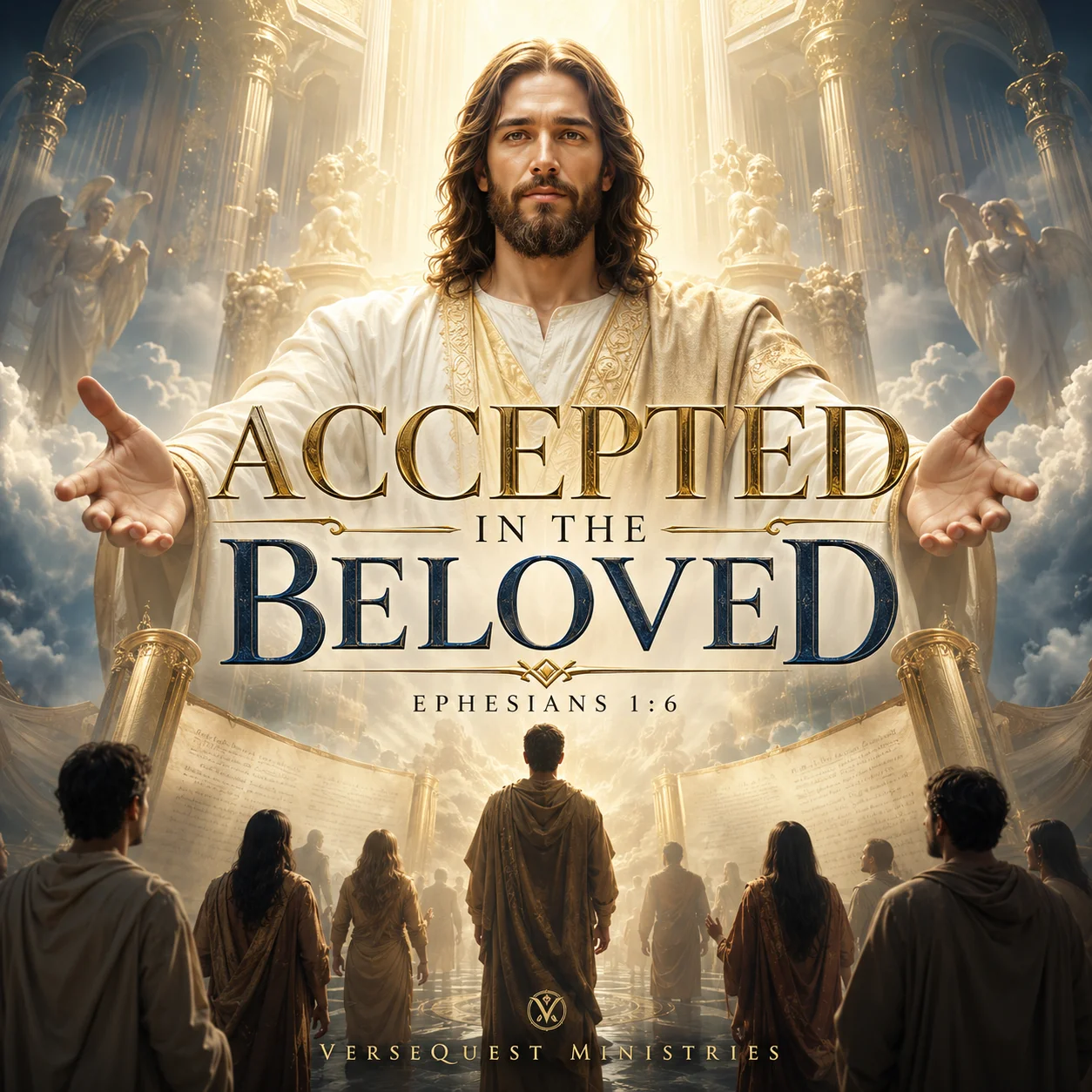
Accepted in the Beloved
The Standing Religion Can Never Give
Sermon Title:
Accepted in the Beloved: The Standing Religion Can Never Give
Key Passage:
Ephesians 1:6 — “To the praise of the glory of his grace, wherein he hath made us accepted in the beloved.”
Series:
Foundations of the Gospel of Grace
Topic:
The Believer’s Acceptance Before God in Jesus Christ by Grace
Book:
Ephesians, Romans, Colossians, Galatians, 2 Corinthians, John, Hebrews, 1 Corinthians
Speaker:
Paul Tackett
Suggested Sermon Text:
Ephesians 1:3–14; Romans 3:21–28; Romans 4:5–8; Romans 5:1–11; Romans 8:1, 31–39; Colossians 1:12–14; Colossians 2:10–14; Galatians 2:16–21; 2 Corinthians 5:17–21; John 17:20–26; Hebrews 10:10–14; 1 Corinthians 15:1–4
Short Sermon Description:
This detailed VerseQuest Ministries sermon outline explains Ephesians 1:6 and the believer’s glorious standing before God: “accepted in the beloved.” This sermon shows that Christian acceptance is not earned by religion, law-keeping, sacraments, baptism, church membership, human merit, emotional performance, personal worthiness, or moral reform. The believer is accepted because he is in the Beloved Son, the Lord Jesus Christ. The outline explains the riches of grace in Ephesians 1, the believer’s position in Christ, the difference between acceptance and approval of sin, the security of being accepted in the One whom the Father loves, and the practical fruit of serving from acceptance rather than striving for it. It also exposes legalistic fear, religious insecurity, and every false system that makes saints live as though God’s favor must be purchased after Christ already obtained it by His blood. Designed for pastors, preachers, teachers, Bible students, and believers, this outline magnifies grace, union with Christ, justification, redemption, eternal security, and the believer’s settled standing in Jesus Christ.
Accepted in the Beloved
The Standing Religion Can Never Give
Introduction
Ephesians 1:6 is one of the richest standing verses in Paul’s epistles: “To the praise of the glory of his grace, wherein he hath made us accepted in the beloved.” That is not religious sentiment. That is not emotional encouragement for a tired saint having a bad week. That is a divine statement about the believer’s position before God. The saved man is not merely tolerated, barely admitted, reluctantly forgiven, or nervously watched from the edge of heaven’s porch. He is accepted. But the verse does not say he is accepted in himself, in his performance, in his religious record, in his denomination, in his baptism, in his morality, or in his consistency. He is accepted “in the beloved.”
That phrase destroys the pride of self-righteousness and the misery of religious insecurity at the same time. Self-righteousness wants acceptance to be earned so man can boast. Religious insecurity wants acceptance to be fragile so systems can control the conscience. But the King James Bible puts acceptance where God put it: in the Beloved. The Father’s love for the Son is the atmosphere of the believer’s acceptance. The believer is not standing before God in Adam trying to impress the throne with good intentions. He is in Christ, blessed with all spiritual blessings, chosen in Him, redeemed through His blood, forgiven according to the riches of His grace, sealed with the Holy Spirit of promise, and made accepted in the Beloved.
This doctrine must be preached because multitudes of saved people live like spiritual beggars outside a palace they already inhabit. They think God accepts them more on good days and less on bad days. They confuse fellowship with standing, chastening with rejection, growth with acceptance, and service with the ground of favor. A believer should absolutely walk holy, confess sin, obey Scripture, and serve faithfully. But he does not do those things to become accepted. He does them because he has been made accepted in Christ. Religion says, “Work so God might accept you.” Grace says, “God has accepted you in Christ; now walk worthy of that calling.”
I. Acceptance Begins With the Glory of God’s Grace
Key Text: Ephesians 1:6
Supporting Texts: Ephesians 1:3–7; Romans 3:24; Titus 3:5–7
Paul says this acceptance is “to the praise of the glory of his grace.” That means the believer’s acceptance is designed to glorify God’s grace, not man’s merit. God did not build salvation in such a way that the sinner could receive applause for helping. Grace receives the praise because grace provided the plan, grace gave the Son, grace applied the redemption, grace forgave the sins, and grace made the believer accepted in Christ. If a man’s acceptance depends on his works, then man gets room to boast. If acceptance is in the Beloved, God gets all the glory.
Ephesians 1 begins with God blessing believers “with all spiritual blessings in heavenly places in Christ.” Every major blessing in the passage is tied to Christ. Chosen in Him. Accepted in the Beloved. Redemption through His blood. Forgiveness in Him. Sealed after trusting in Him. The passage is not a celebration of human religious achievement. It is a treasure house of grace. The believer enters it empty-handed and finds everything already supplied in Jesus Christ.
Romans 3:24 says believers are “justified freely by his grace through the redemption that is in Christ Jesus.” Titus 3:5 says salvation is “not by works of righteousness which we have done, but according to his mercy.” Grace does not mean God found something admirable in Adam and decided to reward it. Grace means God did for guilty sinners what guilty sinners could never do for themselves. Acceptance in the Beloved is not God applauding our improvement. It is God glorifying His grace through His Son.
Main Truth:
The believer’s acceptance is rooted in the glory of God’s grace, not in human merit, religious effort, or personal worthiness.
II. The Believer Is Accepted in a Person, Not a Performance
Key Text: Ephesians 1:6
Supporting Texts: Colossians 2:10; 1 Corinthians 1:30; 2 Corinthians 5:17
The verse says “accepted in the beloved.” That locates acceptance. The believer is not accepted in his emotions, his church attendance, his prayer record, his giving, his Bible reading, his ministry activity, or his personal progress. Those things have their place in the Christian life, but they are not the ground of acceptance. The ground of acceptance is a Person: the Lord Jesus Christ. The believer stands before God in the Beloved Son.
Colossians 2:10 says, “And ye are complete in him.” First Corinthians 1:30 says Christ is made unto us wisdom, righteousness, sanctification, and redemption. Second Corinthians 5:17 says if any man be in Christ, he is a new creature. These verses are position verses. They tell the believer where God has placed him and what God has made him in Christ. The believer’s standing is not “in self-improvement.” It is not “in religious sincerity.” It is “in Christ.”
This is why the Christian life must never be preached as though God accepts the believer only when his performance reaches a certain level. That produces either pride in the disciplined or despair in the honest. The believer’s performance affects fellowship, fruit, testimony, usefulness, rewards, and chastening, but it does not create his standing in Christ. The saved man is accepted in the Beloved before he ever performs one act of service, and every act of true service should flow from that acceptance.
Main Truth:
The believer is accepted in Jesus Christ Himself, not in the changing record of his own performance.
III. The Beloved Is the Son in Whom the Father Is Well Pleased
Key Text: Ephesians 1:6
Supporting Texts: Matthew 3:17; Matthew 17:5; John 17:23–26
The word “beloved” points to the Father’s delight in the Son. At the baptism of Christ, the voice from heaven said, “This is my beloved Son, in whom I am well pleased.” On the mount of transfiguration, the Father again said, “This is my beloved Son, in whom I am well pleased; hear ye him.” The Lord Jesus Christ is not merely accepted by the Father. He is the Beloved One, the eternal object of the Father’s pleasure, the Son in whom heaven has perfect delight.
This makes the believer’s acceptance staggering. God has not accepted the believer in a weak representative. He has accepted him in the Son whom He loves perfectly. The believer is not standing before God in Adam, hoping God overlooks enough failure to let him through. He stands in the Beloved. The Father’s acceptance of the Son is the sphere in which the believer’s acceptance is secured. That is not fragile. That is not temporary. That is not probationary.
John 17 shows the Lord praying concerning those who would believe on Him, and He speaks of the love wherewith the Father loved Him. The believer’s union with Christ brings him into blessings no religious system could invent. Religion can give a man titles, certificates, rituals, and rules, but it cannot place him in the Beloved Son. Only God can do that by grace. And what God has done in Christ, no religious accuser has authority to undo.
Main Truth:
The believer is accepted in the Son whom the Father loves perfectly and in whom He is eternally well pleased.
IV. Acceptance Is Purchased Through Redemption by Blood
Key Text: Ephesians 1:7
Supporting Texts: Colossians 1:14; 1 Peter 1:18–19; Hebrews 9:12
Ephesians 1:6 is followed immediately by Ephesians 1:7: “In whom we have redemption through his blood, the forgiveness of sins, according to the riches of his grace.” The believer is accepted in the Beloved because redemption has been purchased by blood. Grace is free to the sinner, but it was not cheap. The price was not silver, gold, candles, beads, church dues, sacraments, or human effort. The price was the blood of Jesus Christ.
First Peter 1:18–19 says believers were not redeemed with corruptible things, as silver and gold, but with the precious blood of Christ. Hebrews 9:12 says Christ obtained eternal redemption by His own blood. Colossians 1:14 says, “In whom we have redemption through his blood, even the forgiveness of sins.” The Bible ties acceptance, redemption, forgiveness, and blood together. Any gospel that offers acceptance without blood is a false gospel with a clean shirt and a rotten heart.
The believer’s acceptance is not God pretending sin does not matter. Calvary proves sin matters. The Father did not accept sinners by lowering His holiness. He accepted believers in the Beloved because the Beloved shed His blood, bore sin, satisfied justice, and rose again. The cross is the righteous basis of grace. The sinner’s acceptance is not charity at the expense of holiness; it is grace reigning through righteousness by Jesus Christ our Lord.
Main Truth:
The believer’s acceptance is blood-bought, grounded in redemption and forgiveness through Jesus Christ.
V. Acceptance in Christ Silences the Accuser
Key Text: Romans 8:33–34
Supporting Texts: Revelation 12:10–11; Colossians 2:13–14; Zechariah 3:1–5
Romans 8 asks, “Who shall lay any thing to the charge of God’s elect? It is God that justifieth.” That is courtroom thunder. If God has justified the believer and made him accepted in the Beloved, then no accuser has authority to overturn the verdict. The devil may accuse. Conscience may remember. Legalists may point. Religion may threaten. But the believer’s standing does not rest on the silence of accusers. It rests on the finished work of Christ and the verdict of God.
Colossians 2 says God forgave all trespasses, blotted out the handwriting of ordinances that was against us, took it out of the way, and nailed it to Christ’s cross. That means the record that could condemn the believer has been dealt with. The accuser can wave old charges, but heaven has already nailed the handwriting to the cross. You cannot collect on a debt God says Christ paid.
Zechariah 3 gives a picture of Joshua the high priest clothed with filthy garments while Satan stands to resist him. The Lord rebukes Satan and changes Joshua’s garments. That is a strong picture of what God does by grace. The answer to accusation is not self-defense but divine provision. The believer is accepted in the Beloved, clothed in Christ’s righteousness, and beyond the condemning reach of every accusation that Christ’s blood has answered.
Main Truth:
Acceptance in Christ silences every accusation because God has justified the believer and dealt with the record against him.
VI. Acceptance Is Not Permission to Walk After the Flesh
Key Text: Romans 6:1–2
Supporting Texts: Titus 2:11–14; Ephesians 4:1; Romans 12:1–2
Every time grace is preached clearly, someone crawls out of the bushes with the same old question: “So you are saying people can just sin?” Paul already answered that in Romans 6: “God forbid.” Acceptance in the Beloved is not permission to live like the devil. It is the foundation for living unto God. Grace does not make sin harmless. Calvary proves sin was so deadly that only the blood of Christ could answer it.
Titus 2 says the grace of God that brings salvation teaches believers to deny ungodliness and worldly lusts. Grace is not a lazy teacher. It trains. It rebukes. It instructs. It points the believer away from the flesh and toward sober, righteous, and godly living. The believer does not obey to become accepted; he obeys because he has been accepted in the Beloved. That difference is not small. It is the difference between bondage and gratitude.
Ephesians 4:1 says believers should “walk worthy of the vocation wherewith ye are called.” Paul does not say walk worthy so you can earn the calling. He says walk worthy because you have it. Romans 12 says present your body a living sacrifice “by the mercies of God.” Mercy comes first. Consecration follows. The saved man serves from acceptance, not for acceptance. That produces stronger holiness than fear ever could.
Main Truth:
Acceptance in the Beloved does not excuse sin; it gives the believer the grace-grounded motive to walk worthy of Christ.
VII. Acceptance Must Be Distinguished From Fellowship and Chastening
Key Text: Hebrews 12:6
Supporting Texts: 1 John 1:7–9; 1 Corinthians 11:31–32; 2 Corinthians 5:10
A believer can be accepted in Christ and still need correction from the Father. Hebrews 12 says the Lord chastens those He loves and scourges every son whom He receives. Chastening does not mean the believer has been rejected. It means he is a son. A father correcting a child is not the same as a judge condemning a criminal. The believer’s standing is acceptance in Christ; his daily fellowship can be affected by sin.
First John 1 speaks of walking in the light and confessing sins. Confession restores practical fellowship; it does not re-create union with Christ. First Corinthians 11 shows that believers can be chastened severely in this life, even to weakness, sickness, and death, but Paul says this chastening happens so “we should not be condemned with the world.” That distinction is vital. Chastening is not condemnation. Correction is not rejection. Discipline is not damnation.
The judgment seat of Christ also must be distinguished from acceptance in the Beloved. Believers will give account for service, motives, and works. Rewards can be gained or lost. But the judgment seat is not where God decides whether the believer is accepted. That was settled in Christ. A believer may suffer loss and yet be saved. The accepted child can lose reward, feel conviction, receive chastening, and still remain accepted in the Beloved.
Main Truth:
The believer’s acceptance in Christ is settled, though fellowship, chastening, and rewards are affected by his walk.
VIII. Acceptance Frees the Believer From Religious Insecurity
Key Text: Galatians 5:1
Supporting Texts: Colossians 2:16–23; Romans 8:15; 2 Timothy 1:7
Galatians 5:1 says, “Stand fast therefore in the liberty wherewith Christ hath made us free.” A believer accepted in the Beloved does not need to crawl back under religious bondage to prove he belongs to God. Colossians 2 warns against being judged in meat, drink, holy days, new moons, sabbath days, ordinances, and touch-not-taste-not-handle-not religion. Those things may look humble, disciplined, and spiritual to men, but they cannot improve the believer’s acceptance in Christ.
Romans 8 says believers have not received the spirit of bondage again to fear, but the Spirit of adoption, whereby we cry, “Abba, Father.” Religious insecurity keeps saints acting like frightened servants outside the house. Grace teaches them they are sons. That does not produce arrogance. It produces confidence in the Father and reverence for the One who made them accepted in His Son.
Second Timothy 1:7 says God has not given us the spirit of fear. Many religious systems operate on fear because fear fills pews, controls giving, and keeps people dependent on the system. But the believer’s acceptance is not held hostage by religious machinery. In Christ, he has access, sonship, assurance, and liberty. He does not need to buy from religion what God already gave him in the Beloved.
Main Truth:
Acceptance in the Beloved frees the believer from religious insecurity, fear-based bondage, and man-made spiritual control.
IX. Acceptance Produces Praise to the Glory of Grace
Key Text: Ephesians 1:6
Supporting Texts: Ephesians 1:12–14; Romans 11:36; Revelation 5:9–12
The verse begins with praise and ends with acceptance: “To the praise of the glory of his grace.” God’s purpose in making believers accepted in the Beloved is that His grace would be glorified. Salvation is not arranged so man can brag about his contribution. It is arranged so God receives praise for grace. The believer’s acceptance should produce worship, not pride; gratitude, not laziness; assurance, not arrogance.
Ephesians 1 repeatedly points to praise: “to the praise of the glory of his grace,” “that we should be to the praise of his glory,” and “unto the praise of his glory.” The believer’s standing in Christ is meant to turn him into a worshipper. The more he understands grace, the less room he has for boasting in the flesh. He is accepted because of the Beloved, redeemed by the Beloved, sealed in the Beloved, and destined to the praise of God’s glory.
Revelation 5 shows heaven praising the Lamb who was slain and redeemed sinners to God by His blood. Heaven will not sing about human merit, denominational superiority, sacramental systems, or religious achievements. Heaven will praise the Lamb. The believer who understands Ephesians 1:6 starts practicing now. He says, “All glory to God. I am accepted in the Beloved.”
Main Truth:
Acceptance in the Beloved produces praise, worship, gratitude, and glory to the grace of God.
Conclusion
Ephesians 1:6 gives the believer a standing religion can never manufacture: “accepted in the beloved.” The believer is not accepted in Adam, self, flesh, works, law, ritual, baptism, sacraments, church membership, or personal consistency. He is accepted in Jesus Christ, the beloved Son of God. That acceptance begins with grace, rests in Christ’s person, is purchased by blood, and glorifies God.
This truth does not lower holiness; it establishes the only foundation on which true holiness can stand. The believer accepted in Christ does not need to serve from terror. He serves from gratitude. He does not obey to bribe God into loving him. He obeys because God has loved him in Christ. He does not confess sin to get saved again. He confesses because fellowship with the Father matters. He does not walk worthy to become accepted. He walks worthy because he is accepted.
The Church needs this doctrine preached loudly in a day of religious uncertainty and performance-driven Christianity. Saints do not need another spiritual treadmill with Bible verses taped to the handles. They need to know where God has placed them. Accepted in the Beloved. Redeemed through His blood. Forgiven according to the riches of grace. Sealed with the Holy Spirit. Blessed in Christ. The believer’s standing is not a fragile contract with religious fine print. It is a grace verdict written in the blood of the Son God loves.
Final Call
Sinner, outside Jesus Christ you are not accepted before God. Your religion cannot make you accepted. Your morality cannot make you accepted. Your baptism cannot make you accepted. Your church membership, sacraments, law-keeping, sincerity, and works of righteousness cannot place you in the Beloved.
Jesus Christ died for your sins according to the Scriptures. He was buried. He rose again the third day according to the Scriptures. Believe on the Lord Jesus Christ, and thou shalt be saved. God accepts sinners only in His Son, and the door is open through the blood of Christ.
Believer, stop living like an orphan outside the Father’s house. You are accepted in the Beloved. Walk holy, serve faithfully, confess sin quickly, endure chastening humbly, and worship deeply. But never forget the ground under your feet: God has made you accepted in Jesus Christ.
Closing Verse:
Ephesians 1:6 — “To the praise of the glory of his grace, wherein he hath made us accepted in the beloved.”
Closing Statement:
The believer does not stand before God begging for acceptance; he stands in the Beloved Son, accepted by grace and covered by blood.