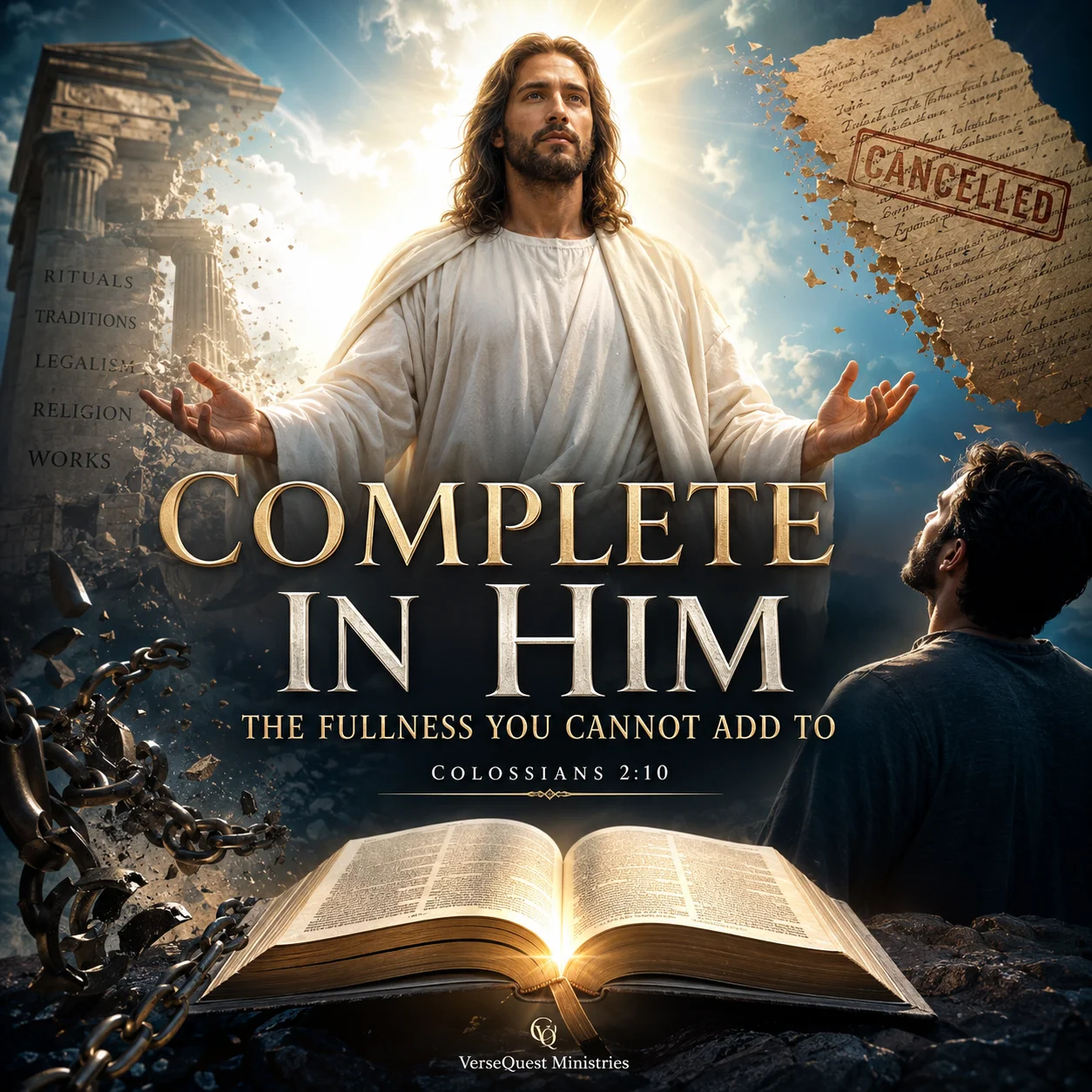
Complete in Him
The Fullness You Cannot Add To
Sermon Title:
Complete in Him: The Fullness You Cannot Add To
Key Passage:
Colossians 2:10 — “And ye are complete in him, which is the head of all principality and power.”
Series:
Foundations of the Gospel of Grace
Topic:
The Believer’s Completeness in Jesus Christ and the Sufficiency of His Finished Work
Book:
Colossians, Ephesians, Romans, Galatians, Hebrews, 1 Corinthians, 2 Corinthians, John
Speaker:
Paul Tackett
Suggested Sermon Text:
Colossians 2:6–15; Colossians 1:12–20; Ephesians 1:3–14; Ephesians 2:8–18; Romans 3:21–28; Romans 5:1–11; Romans 8:1; Galatians 2:16–21; Galatians 3:13; Hebrews 10:10–14; 1 Corinthians 15:1–4; 2 Corinthians 5:21; John 19:30
Short Sermon Description:
This detailed VerseQuest Ministries sermon outline explains Colossians 2:10 and the believer’s complete standing in Jesus Christ: “And ye are complete in him.” Paul writes this truth in a context warning believers against philosophy, vain deceit, tradition of men, rudiments of the world, religious ordinances, legalistic shadows, and man-made spiritual substitutes. This sermon shows that the believer is not made complete by religion, baptism, sacraments, law-keeping, church membership, mystical experiences, self-reform, human merit, or religious systems, but by union with the Lord Jesus Christ. It explains Christ’s fullness as the bodily dwelling of the Godhead, His headship over all principality and power, the believer’s spiritual circumcision, identification with Christ’s death and resurrection, forgiveness of all trespasses, the handwriting blotted out, and the triumph of Christ over every accuser. Designed for pastors, teachers, preachers, Bible students, and believers, this outline magnifies the sufficiency of Christ and exposes every doctrine that tries to add to what God says is already complete in Him.
Complete in Him
The Fullness You Cannot Add To
Introduction
Colossians 2:10 is one of the strongest verses in the Bible on the believer’s standing in Jesus Christ: “And ye are complete in him, which is the head of all principality and power.” That verse is a spiritual death blow to every religious system that tells the saved man Christ is not enough. Paul does not say the believer is improving toward completeness if he submits to ordinances. He does not say the believer is partially complete until a priest, sacrament, ceremony, church, law, mystical experience, or religious hierarchy finishes the job. He says, “ye are complete in him.” That is present tense, settled standing, Pauline doctrine, and blood-bought sufficiency.
The context matters. Colossians 2 is not written in a vacuum. Paul warns believers not to be spoiled through philosophy and vain deceit, after the tradition of men, after the rudiments of the world, and not after Christ. Then he says, “For in him dwelleth all the fulness of the Godhead bodily. And ye are complete in him.” The issue is Christ versus substitutes. Christ versus philosophy. Christ versus tradition. Christ versus religious ordinances. Christ versus worldly principles. Christ versus angelic powers. Christ versus legalistic shadows. Christ versus men who want to judge you in meat, drink, holy days, new moons, and sabbath days. Paul’s answer is not “add more religion.” His answer is “Christ is enough.”
This doctrine must be preached because the flesh hates completeness in Christ. Flesh wants something to add, perform, boast in, display, and control. Religion wants a saved man to feel unfinished so it can sell him missing pieces. Philosophy tells him he needs higher wisdom. Legalism tells him he needs Moses. Sacramentalism tells him he needs a ritual system. Mysticism tells him he needs an experience. Asceticism tells him he needs self-punishment. But God tells the believer he is complete in Christ. The man who has Christ does not need a religious add-on package. He needs to know what God says he already has in the risen Saviour.
I. The Warning Comes Before the Declaration
Key Text: Colossians 2:8
Supporting Texts: Galatians 1:6–9; 2 Corinthians 11:3–4; 1 Timothy 4:1
Before Paul says the believer is complete in Christ, he warns, “Beware lest any man spoil you.” That word “spoil” carries the idea of being robbed, carried off, or taken captive. False doctrine does not merely confuse people; it plunders them. It steals assurance, liberty, joy, doctrinal clarity, and confidence in the finished work of Christ. The thief may wear a robe, carry a degree, quote Greek, talk humility, light candles, or speak in soft religious tones, but if he moves you away from Christ’s sufficiency, he is robbing you.
Paul names the tools: “philosophy and vain deceit,” “tradition of men,” and “rudiments of the world.” Philosophy without Christ becomes proud speculation. Tradition without Christ becomes embalmed error. Rudiments of the world become religious kindergarten rules masquerading as spiritual maturity. Colossians does not attack true wisdom, order, or reverence; it attacks anything “not after Christ.” That is the measuring line. If it does not bring you under Christ’s headship, magnify Christ’s work, and submit to Christ’s word, it is not spiritual food. It is doctrinal bait.
The Church needs this warning because many believers are not defeated by open atheism but by religious additions. The devil knows how to wrap bondage in Bible language. He can preach “Jesus plus law,” “Jesus plus ritual,” “Jesus plus experience,” “Jesus plus tradition,” “Jesus plus the institution,” and “Jesus plus your performance.” Paul says, “Beware.” The man who is complete in Christ can still be spoiled in his mind if he forgets what he has in Christ.
Main Truth:
False doctrine spoils believers by moving them away from the sufficiency, authority, and completeness found in Jesus Christ.
II. Christ Contains All the Fulness of the Godhead Bodily
Key Text: Colossians 2:9
Supporting Texts: Colossians 1:15–19; John 1:1–14; 1 Timothy 3:16; Hebrews 1:3
Paul grounds the believer’s completeness in Christ’s fullness: “For in him dwelleth all the fulness of the Godhead bodily.” The believer is complete in Christ because Christ Himself is not lacking anything. He is not a partial revelation of God, a religious messenger only, an exalted creature, a moral teacher, or a heavenly assistant. In Him dwells all the fullness of the Godhead bodily. That is a King James Bible statement with doctrinal iron in it.
Colossians 1 says Christ is the image of the invisible God, the Creator of all things, before all things, and by Him all things consist. John 1 says the Word was God, and the Word was made flesh. First Timothy 3:16 says, “God was manifest in the flesh.” Hebrews 1 says He is the brightness of God’s glory and the express image of His person. The Christ in whom the believer is complete is not small, borrowed, limited, or dependent. He is God manifest in the flesh.
This matters because every attack on Christ’s deity becomes an attack on the believer’s completeness. If Christ is not fully God, He cannot fully save. If Christ is not sufficient in His person, His work cannot be sufficient in redemption. The cults lower Christ and then sell you a religious program to make up the difference. The Bible exalts Christ and then tells the believer, “ye are complete in him.” The fullness of the Godhead bodily leaves no vacancy for religious improvement.
Main Truth:
The believer is complete in Christ because all the fullness of the Godhead dwells bodily in the Lord Jesus Christ.
III. The Believer Is Complete in Christ, Not in Religion
Key Text: Colossians 2:10
Supporting Texts: Ephesians 1:3–7; John 14:6; Acts 4:12; 1 Corinthians 1:30
Paul says, “And ye are complete in him.” That phrase locates completeness. It is “in him.” Not in a church system. Not in a sacrament. Not in a baptismal pool. Not in Moses. Not in the traditions of men. Not in a religious institution. Not in mystical experience. Not in self-improvement. In Him. The believer’s completeness is not self-generated or church-administered. It is found in union with Jesus Christ.
Ephesians 1 says the believer is blessed with all spiritual blessings in heavenly places in Christ. He is accepted in the beloved. He has redemption through His blood. First Corinthians 1:30 says Christ is made unto us wisdom, righteousness, sanctification, and redemption. That is completeness. If Christ is your righteousness, what righteousness is missing? If Christ is your redemption, what payment remains? If Christ is your sanctification positionally, what religious ceremony must be added to make God accept you?
Religion survives by convincing sinners and saints that Christ is not enough. It says you need Christ plus the priest, Christ plus the wafer, Christ plus the law, Christ plus the tradition, Christ plus the church office, Christ plus your merit. The Bible says “complete in him.” Any doctrine that tells a saved man he is incomplete without the religious system has contradicted Colossians 2:10. The believer does not need to be completed by what Christ died to deliver him from.
Main Truth:
The believer’s completeness is in Jesus Christ alone, not in religion, rituals, law, sacraments, or human merit.
IV. Christ Is Head Over All Principality and Power
Key Text: Colossians 2:10
Supporting Texts: Ephesians 1:20–23; Colossians 1:16; 1 Peter 3:22; Hebrews 2:14
Paul adds that Christ is “the head of all principality and power.” The believer’s completeness is attached to the One who outranks every spiritual authority in creation. Principalities and powers are not above Christ, beside Christ, or independent of Christ. They are under Him. This matters because Colossians 2 warns about voluntary humility and worshipping of angels. Men are always tempted to chase spiritual intermediaries when God has given them the Head.
Ephesians 1 says God raised Christ and set Him far above all principality, power, might, dominion, and every name that is named. Colossians 1 says thrones, dominions, principalities, and powers were created by Him and for Him. First Peter 3 says angels and authorities and powers are made subject unto Him. The risen Christ is not negotiating for authority. He has it.
The believer complete in Christ does not need to fear spiritual powers as though Christ is insufficient to secure him. He does not need angel worship, mystical hierarchies, religious mediators, occult ladders, or spiritual middlemen. Christ is the Head. The Body needs the Head, not a committee of spiritual substitutes. When believers forget Christ’s headship, they become vulnerable to superstition, fear, and religious manipulation.
Main Truth:
Christ’s headship over all principality and power means the believer’s completeness rests in the supreme authority of the risen Lord.
V. The Believer Has a Spiritual Circumcision Without Hands
Key Text: Colossians 2:11
Supporting Texts: Romans 2:28–29; Philippians 3:3; Galatians 6:15
Paul says believers are circumcised “with the circumcision made without hands, in putting off the body of the sins of the flesh by the circumcision of Christ.” This is not physical circumcision under Abraham or Moses. This is spiritual operation by God. It is “without hands.” The believer’s standing is not produced by a human ritual, a religious blade, or a fleshly mark. God has dealt with the believer in Christ.
Philippians 3:3 says, “For we are the circumcision, which worship God in the spirit, and rejoice in Christ Jesus, and have no confidence in the flesh.” That last phrase is the key: no confidence in the flesh. The flesh wants religious marks it can point to. Grace points to Christ. Galatians 6:15 says in Christ Jesus neither circumcision availeth any thing, nor uncircumcision, but a new creature. The issue in the Church age is not fleshly distinction but new life in Christ.
This destroys every attempt to drag the believer back under physical religion as the basis of spiritual standing. The believer is complete in Christ because God has performed a spiritual operation that man’s hands could never accomplish. Fleshly ordinances can touch the body, but they cannot put off the body of the sins of the flesh. God did that in Christ. The saved man is not waiting for religion to operate. God already has.
Main Truth:
The believer’s spiritual standing comes from God’s operation in Christ, not from fleshly rites, physical marks, or human hands.
VI. The Believer Is Identified With Christ’s Death and Resurrection
Key Text: Colossians 2:12
Supporting Texts: Romans 6:3–11; Galatians 2:20; Ephesians 2:5–6
Paul says believers are “buried with him in baptism” and “risen with him through the faith of the operation of God.” The emphasis in the passage is God’s operation, not religious performance. The believer is identified with Christ’s death, burial, and resurrection. He is not merely following religious instruction from a distance. He is spiritually joined to the crucified and risen Christ.
Romans 6 explains that believers are planted together in the likeness of Christ’s death and shall be also in the likeness of His resurrection. The old man is crucified with Him. The believer is to reckon himself dead indeed unto sin but alive unto God through Jesus Christ our Lord. This is not the flesh improving itself. This is identification with Christ. God does not train Adam into glory; He places the believer in the last Adam.
Ephesians 2 says believers have been quickened together with Christ, raised up together, and made to sit together in heavenly places in Christ Jesus. That is completion language. The saved man’s standing is tied to Christ’s finished death and victorious resurrection. Religion says, “Do this to become complete.” Scripture says, “God has identified you with Christ; now walk in light of what is true.”
Main Truth:
The believer is complete in Christ because he is identified with Christ’s death, burial, resurrection, and heavenly life.
VII. The Believer Is Forgiven All Trespasses
Key Text: Colossians 2:13
Supporting Texts: Ephesians 1:7; Acts 13:38–39; Romans 4:6–8; Hebrews 10:17–18
Colossians 2:13 says God has quickened believers together with Christ, “having forgiven you all trespasses.” Not some. Not most. Not only the sins before conversion. Not the respectable ones. All trespasses. That is not careless language. That is the Holy Ghost telling the believer the scope of forgiveness in Christ. A man cannot be complete in Christ if unforgiven trespasses remain on God’s legal ledger.
Ephesians 1:7 says believers have redemption through Christ’s blood, the forgiveness of sins. Acts 13 says by Christ all that believe are justified from all things. Romans 4 describes the blessed man to whom the Lord will not impute sin. Hebrews 10 says where remission of sins is, there is no more offering for sin. These verses agree with Colossians 2:13. Forgiveness in Christ is not partial religious relief. It is complete.
This destroys fear-based systems that keep believers chained to uncertainty. If all trespasses are forgiven, then no priestly system can keep a believer half-pardoned. If all trespasses are forgiven, then no sacramental treadmill is needed to keep the account active. If all trespasses are forgiven, then the believer is not complete because he keeps paying, but because Christ already paid. The blood did not buy an installment plan. It bought forgiveness.
Main Truth:
The believer is complete in Christ because God has forgiven all trespasses through the blood and finished work of Jesus Christ.
VIII. The Handwriting Against Us Was Blotted Out
Key Text: Colossians 2:14
Supporting Texts: Galatians 3:13; Romans 7:4–6; Romans 8:1; Hebrews 10:14
Paul says Christ blotted out “the handwriting of ordinances that was against us,” took it out of the way, and nailed it to His cross. The record against the sinner was not edited, reduced, postponed, or transferred to a religious collection agency. It was blotted out. The ordinances that stood contrary to us were taken out of the way. The debt was nailed to the cross. That is why the believer is complete in Christ.
Galatians 3:13 says Christ redeemed us from the curse of the law, being made a curse for us. Romans 7 says believers are become dead to the law by the body of Christ, that they should be married to another, even to Him who is raised from the dead. Romans 8:1 says there is no condemnation to them which are in Christ Jesus. The handwriting cannot condemn the man for whom Christ bore the curse and removed the record.
Legalism spends its time trying to pull the handwriting off the cross and hang it back over the believer’s head. Sacramental religion wants the ledger reopened. Works-based religion insists there is still a balance due. But Colossians says Christ took it out of the way. A believer complete in Christ does not owe God a righteousness payment to secure salvation. Christ paid, Christ removed, Christ nailed, and Christ triumphed.
Main Truth:
The believer is complete in Christ because the condemning handwriting was blotted out, taken away, and nailed to His cross.
IX. Completeness in Christ Frees the Believer From Shadows and Man-Made Judgments
Key Text: Colossians 2:16–17
Supporting Texts: Galatians 4:9–11; Hebrews 10:1; Romans 14:5–6; Ephesians 2:15
After declaring the believer complete in Christ, Paul says, “Let no man therefore judge you” in meat, drink, holy days, new moons, or sabbath days, “which are a shadow of things to come; but the body is of Christ.” Shadows had their place before the substance arrived. But a man who has Christ does not need to live under the tyranny of shadows. The law’s ceremonial system pointed forward. Christ is the fulfillment.
Galatians 4 rebukes believers for turning again to weak and beggarly elements, observing days, months, times, and years. Hebrews 10 says the law had a shadow of good things to come, and not the very image of the things. Shadows are not evil when God gives them their place, but they become bondage when men use them to replace or supplement Christ. The believer’s completeness is in the Body, not the shadow.
This does not mean a believer cannot esteem a day unto the Lord or make practical choices of conscience. Romans 14 allows liberty in doubtful matters. But no man has authority to judge the believer’s standing by Old Testament shadows, dietary rules, ceremonial calendars, or sabbath bondage. Christ is enough. If a man is complete in Christ, he is not incomplete because he refuses to live under another man’s religious calendar.
Main Truth:
Completeness in Christ frees believers from legalistic judgment by shadows, ordinances, and man-made measures of spirituality.
Conclusion
Colossians 2:10 gives the believer one of the greatest declarations of grace in the Bible: “And ye are complete in him.” The verse stands in direct opposition to every system that tries to spoil believers through philosophy, tradition, worldly rudiments, religious ordinances, mystical intermediaries, legalistic judgments, or fleshly confidence. God does not say the believer is complete in Christ plus religion. He says complete in Him.
The reason is clear. Christ contains all the fullness of the Godhead bodily. Christ is Head of all principality and power. In Christ, the believer has spiritual circumcision without hands, identification with His death and resurrection, forgiveness of all trespasses, the handwriting blotted out, and victory over every accusing power. That is not a partial salvation. That is not a spiritual starter kit. That is completeness in the risen Saviour.
The Church must preach this doctrine with clarity because unfinished religion is always looking for customers. It wants believers nervous, dependent, uncertain, and chained to systems God never made their head. But the Bible says Christ is the Head, and the believer is complete in Him. Good works matter, holiness matters, doctrine matters, church life matters, and obedience matters—but none of them complete what Christ has already completed. They are the walk of the complete man, not the price of completeness.
Final Call
Sinner, you are not complete in yourself. You are not complete in your religion. You are not complete in your morality, baptism, sacraments, church membership, law-keeping, sincerity, or works of righteousness. Outside Christ, you are guilty, dead in sins, and without saving righteousness.
Jesus Christ died for your sins according to the Scriptures. He was buried. He rose again the third day according to the Scriptures. Believe on the Lord Jesus Christ, and thou shalt be saved. Enter into the only One in whom sinners can be forgiven, justified, redeemed, and made complete.
Believer, stop letting religion sell you missing pieces that God says you already have in Christ. Walk worthy. Study the word. Serve faithfully. Reject sin. Preach the gospel. But do it from the settled ground of Colossians 2:10: ye are complete in Him.
Closing Verse:
Colossians 2:10 — “And ye are complete in him, which is the head of all principality and power.”
Closing Statement:
The believer does not need religion to finish what Christ has already made complete; he needs to stand, walk, and rejoice in the fullness he has in Him.