
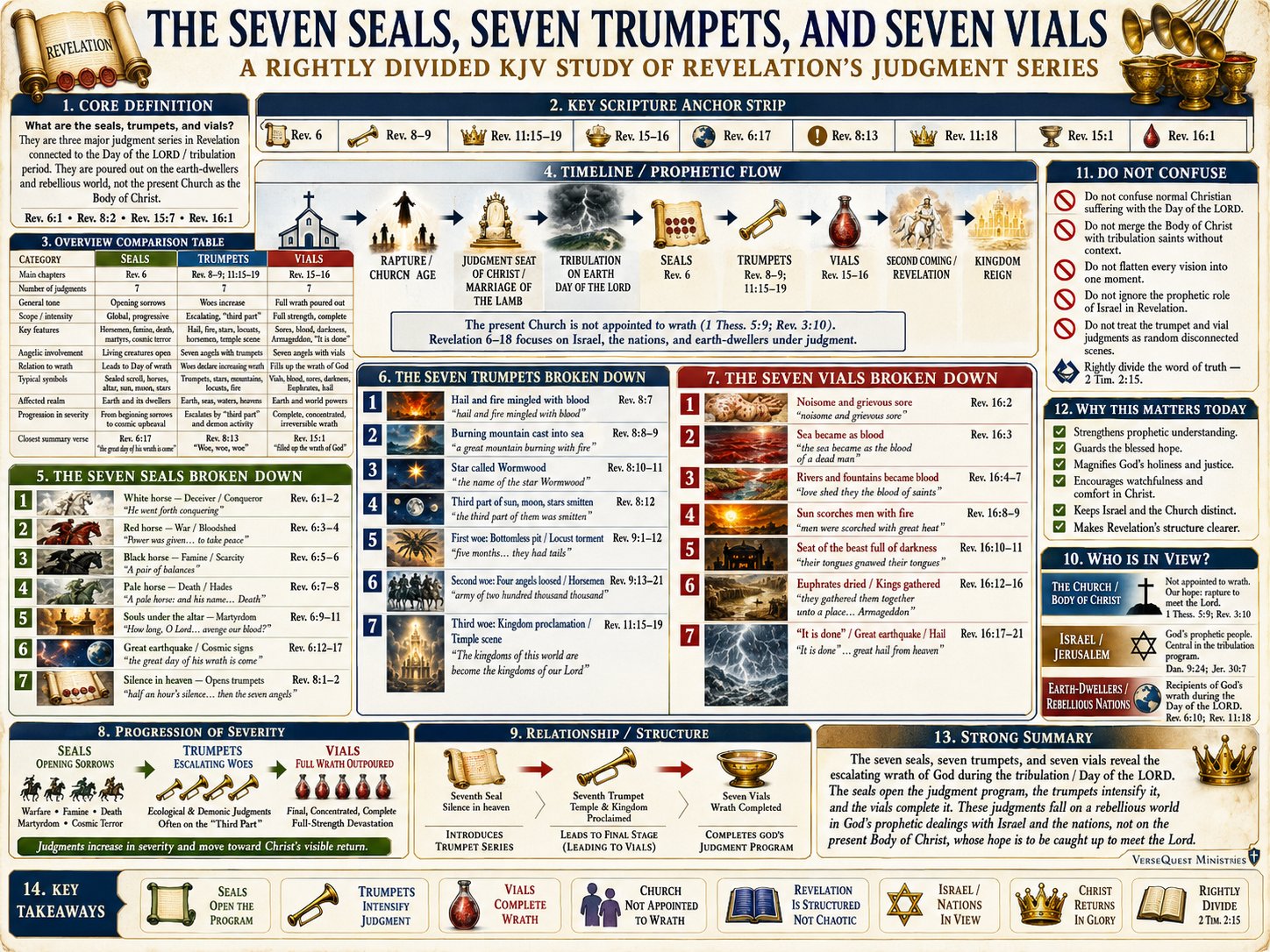
The Seven Seals, Seven Trumpets, and Seven Vials – Revelation’s Tribulation Judgment Series Explained (KJV Bible Study Chart)
Understand Revelation’s seven seals, seven trumpets, and seven vials with this detailed KJV chart covering the Four Horsemen, Tribulation martyrs, cosmic judgments, demonic torment, divine wrath, the beast’s kingdom, Armageddon, Israel, the Church, and Christ’s glorious return.
$3.99
Description
The Seven Seals, Seven Trumpets, and Seven Vials is a comprehensive, rightly divided KJV Bible study chart explaining the three great judgment series revealed in the book of Revelation. Beginning with the opening of the seven-sealed book in Revelation 6, intensifying through the seven trumpet judgments of Revelation 8–9 and 11, and reaching completion in the seven vials of Revelation 15–16, these judgments move the prophetic program toward the visible return and earthly reign of the Lord Jesus Christ.
Built around Revelation 6, Revelation 8–9, Revelation 11:15–19, Revelation 15–16, Revelation 6:17, Revelation 8:13, Revelation 11:18, Revelation 15:1, and Revelation 16:1, this chart presents Revelation as an ordered prophetic book rather than a collection of random disasters, disconnected visions, or symbolic descriptions of ordinary Church history.
The seals, trumpets, and vials belong to the future Tribulation and Day of the Lord. They are directed against rebellious earth-dwellers, the kingdom of the beast, and the nations that reject God’s authority. Israel and Jerusalem also return to the centre of the prophetic program as Daniel’s seventieth week reaches its fulfillment.
These judgments should not be interpreted as the present Church’s ordinary experience. The Body of Christ is not appointed to the coming divine wrath. The Church’s hope is the catching away to meet the Lord Jesus Christ in the air before God’s Tribulation judgments fall upon the earth.
The chart begins by defining the three judgment series. The seven seals open the judgment program and introduce conquest, warfare, famine, death, martyrdom, cosmic terror, and the solemn preparation for the trumpet judgments. The seven trumpets intensify the devastation through judgments upon the earth, sea, rivers, heavenly lights, human bodies, and rebellious nations. The seven vials complete the wrath of God through final, concentrated, and devastating plagues immediately preceding the return of Christ.
The source of these judgments is heaven. The Lamb opens the seals, seven angels sound the trumpets, and seven angels pour out the vials. Human rulers, armies, devils, political systems, and natural elements participate, but the authority governing the entire sequence belongs to God.
Revelation 6:17 declares, “For the great day of his wrath is come; and who shall be able to stand?” This statement identifies the period as divine wrath rather than merely political upheaval, environmental collapse, or the natural consequence of human warfare. The world recognizes that the judgments proceed from the throne and from the Lamb.
The Lord Jesus Christ is not only the suffering Lamb who died for sinners. He is also the risen Heir who possesses the right to open the sealed book, judge the rebellious world, overthrow the usurper, and receive the kingdoms that belong to Him.
The first seal introduces the rider upon the white horse, who goes forth conquering and to conquer. This rider should not be confused with Jesus Christ in Revelation 19. The first-seal rider appears at the beginning of the Tribulation judgment sequence and represents deceptive conquest and counterfeit authority.
The white horse suggests an appearance of righteousness, peace, victory, or legitimate rule. Yet this rider is followed immediately by warfare, famine, and death. The apparent peacemaker becomes the doorway through which the remaining horsemen enter.
The true Jesus Christ appears later in Revelation 19 with many crowns, a vesture dipped in blood, a sharp sword, the armies of heaven, and the name KING OF KINGS, AND LORD OF LORDS. The first rider imitates conquest; Christ possesses the lawful right to rule.
The second seal reveals the red horse of war and bloodshed. Peace is taken from the earth, and men kill one another. The false stability established by the conqueror collapses into violence.
The third seal reveals the black horse of famine, scarcity, rationing, and economic control. A pair of balances pictures food being carefully measured while basic necessities become painfully expensive.
War destroys supply lines, agricultural production, transportation, government stability, and ordinary commerce. The world that trusted centralized human power discovers that its rulers cannot guarantee daily bread.
The fourth seal reveals the pale horse, whose rider is named Death, with Hell following him. Authority is given to kill through the sword, hunger, death, and the beasts of the earth.
The first four seals are commonly known as the Four Horsemen of the Apocalypse. Together they present deceptive conquest, warfare, famine, and mass death sweeping across a world entering the Day of the Lord.
The fifth seal reveals the souls of martyrs beneath the altar. They were slain for the Word of God and for the testimony they maintained. They cry for righteous judgment and the avenging of their blood.
This prayer belongs within the Tribulation judgment setting. God is no longer merely permitting nations to proceed in long-suffering rebellion; He is openly answering the bloodshed of His servants and preparing to judge their persecutors.
The presence of saints during the Tribulation does not prove that the present Body of Christ remains on the earth. God had saints before the Church began and will have saints after the Church has been caught away. The identity and calling of believers must be determined by their scriptural setting.
The sixth seal produces a great earthquake, a darkened sun, a blood-like moon, falling stars, a heaven departing like a rolled scroll, and the movement of mountains and islands. Human rulers, wealthy men, military leaders, servants, and free men attempt to hide from the face of God.
The world does not explain these events away successfully as ordinary climate, geological, or astronomical disturbances. The inhabitants of the earth recognize that the day of divine wrath has arrived.
The sixth seal ends with the question, “Who shall be able to stand?” Political power, wealth, military strength, underground shelters, science, and human pride cannot protect rebels when heaven itself declares judgment.
The seventh seal brings silence in heaven for approximately half an hour. The silence is a solemn pause before the next series begins. It is not the end of judgment but the awful stillness preceding greater devastation.
When the seventh seal is opened, seven angels receive seven trumpets. This establishes an important structural relationship: the seventh seal introduces the trumpet series.
The chart compares the seals, trumpets, and vials by their scope and severity. The seals open the program through conquest, war, famine, martyrdom, death, and cosmic upheaval. The trumpets escalate the judgments, often affecting a third part of creation. The vials bring complete and concentrated wrath.
The first trumpet brings hail and fire mingled with blood. A third part of the trees is burned, and all green grass is affected. Vegetation, agriculture, food production, and the ecological systems upon which human life depends are struck.
The second trumpet brings something resembling a great mountain burning with fire into the sea. A third part of the sea becomes blood, a third part of marine life dies, and a third part of the ships is destroyed.
The judgment reaches the oceans, shipping, food supplies, trade, naval strength, and global transportation. The commercial system that appeared to unite and sustain the world begins to collapse under judgment.
The third trumpet introduces the star called Wormwood. It falls upon a third part of the rivers and fountains of waters, making them bitter and causing many deaths.
Fresh water becomes a vehicle of judgment. The world that rejected the living God and polluted His truth receives bitter waters it cannot safely drink.
The fourth trumpet strikes a third part of the sun, moon, and stars. A third part of the day and night is darkened.
The lights God placed in the firmament no longer provide their ordinary measure of light. The heavenly bodies become instruments in the Day of the Lord rather than silent witnesses ignored by rebellious mankind.
Following the fourth trumpet, a heavenly messenger announces three woes because of the remaining trumpets. Revelation 8:13 declares, “Woe, woe, woe, to the inhabiters of the earth.”
The expression earth-dwellers identifies a recurring class in Revelation. These people have fixed their allegiance, identity, worship, hope, and security upon the world that stands beneath God’s judgment.
The fifth trumpet is the first woe. The bottomless pit is opened, smoke rises, and terrifying locust-like creatures emerge with power to torment men for five months.
These are not ordinary insects. Their supernatural origin, fearful appearance, organized purpose, and ruler connect them with the demonic realm. Their king is identified as Abaddon in Hebrew and Apollyon in Greek.
During this torment, men seek death but cannot find it. Death, which mankind often treats as the final escape from pain and accountability, temporarily refuses those who desire it.
The sixth trumpet is the second woe. Four angels bound at the Euphrates are released, and a vast mounted army advances. A third part of mankind is killed through fire, smoke, and brimstone.
The survivors still refuse to repent of devil worship, idolatry, murder, sorcery, fornication, and theft. Judgment exposes the rebellion of the human heart but does not automatically produce repentance.
The seventh trumpet is the third woe. It includes the great proclamation, “The kingdoms of this world are become the kingdoms of our Lord, and of his Christ.”
The seventh trumpet contains heavenly worship, the opening of the Temple, the announcement of divine wrath, reward for God’s servants, and destruction for those who destroy the earth.
The proclamation anticipates the approaching transfer of world authority to Jesus Christ. The beast’s temporary rule cannot prevent the Kingdom from passing into the hands of its rightful King.
The seventh trumpet of Revelation should not automatically be identified with the “last trump” of 1 Corinthians 15. First Corinthians concerns the mystery transformation of the Body of Christ. Revelation’s trumpet belongs inside the Tribulation judgment program and concerns wrath upon the nations.
Similar terminology does not prove identical events. Audience, purpose, setting, timing, movement, and result must all be considered.
Revelation 15 introduces seven angels having the seven last plagues, “for in them is filled up the wrath of God.” The vial judgments do not begin the wrath; they bring it to completion.
The first vial produces a noisome and grievous sore upon those who possess the mark of the beast and worship his image. The mark that promised economic participation and political security becomes connected with physical judgment.
The second vial turns the sea into blood like the blood of a dead man, and every living soul in the sea dies. The trumpet judgment affected a third part, but the vial judgment is complete and devastating.
The third vial turns rivers and fountains of water into blood. The angel declares God righteous because the persecutors shed the blood of saints and prophets and are given blood to drink.
God’s wrath is not uncontrolled emotion. It is righteous judgment answering murder, persecution, blasphemy, idolatry, deception, and rebellion.
The fourth vial gives the sun power to scorch men with fire and great heat. Instead of repenting, men blaspheme the name of God.
The fifth vial is poured upon the seat of the beast, and his kingdom becomes full of darkness. Men gnaw their tongues because of pain but continue blaspheming God.
The kingdom that claimed enlightenment, progress, reason, unity, and human advancement is covered in darkness by the true God it rejected.
The sixth vial dries the Euphrates and prepares the way for the kings of the east. Unclean spirits gather the rulers of the world to the battle associated with Armageddon.
Earthly leaders believe they are moving according to strategy, diplomacy, national interest, and military necessity. Scripture reveals that demonic spirits are drawing them toward their appointed destruction.
The seventh vial is poured into the air. A great voice from the Temple declares, “It is done.” A tremendous earthquake follows, the cities of the nations fall, islands flee, mountains disappear, and enormous hail descends.
Babylon comes into remembrance before God and receives the cup of His fierce wrath. The world’s religious, political, economic, and commercial rebellion reaches its final collapse.
The declaration “It is done” marks the completion of the vial judgments. The prophetic wrath has reached its climax, and the world stands at the threshold of the visible return of Jesus Christ.
The progression is therefore deliberate. The seals produce opening sorrows. The trumpets bring escalating woes. The vials pour out completed wrath.
The judgments increase in severity and move toward the public overthrow of the beast’s kingdom. What begins with a deceptive conqueror ends with the true King descending from heaven.
The chart’s structural overview shows the seventh seal leading into the trumpets and the seventh trumpet leading toward the final vial stage. Revelation contains both progression and parenthetical sections, but it is not chaotic.
Certain visions pause the chronological movement to explain people, signs, spiritual conflicts, heavenly scenes, prophetic personalities, and the broader significance of earthly events. These explanatory sections should not be mistaken for random interruptions.
The present Church Age appears before this prophetic judgment sequence. During the present dispensation of grace, the gospel is preached, and the Body of Christ is being formed.
The Church is then caught up to meet Jesus Christ in the air. The Judgment Seat of Christ and the marriage of the Lamb belong to the heavenly sequence, while the earth enters Daniel’s seventieth week.
The seals open the Tribulation judgments, the trumpets intensify them, and the vials complete them. Jesus Christ then returns visibly with His saints, defeats His enemies, and establishes His Kingdom.
This prophetic flow keeps the Church distinct from Israel and the nations. The Body of Christ is not appointed to wrath. Israel returns to the centre of the prophetic program, and the rebellious nations become the objects of judgment.
The chart identifies three groups requiring careful distinction. The Church, the Body of Christ, possesses a heavenly calling and a blessed hope. Israel and Jerusalem return to the centre of Daniel’s prophetic program. Earth-dwellers and rebellious nations receive the wrath described throughout Revelation.
The Church should not be inserted into every scene simply because saints, witnesses, or believers appear. God will save people during the Tribulation, but those believers must be understood within the prophetic setting where Scripture places them.
The chart warns against confusing normal Christian suffering with the Day of the Lord. Christians presently endure persecution, sickness, loss, chastening, temptation, and the hostility of the world. These experiences are not identical to seals being opened, trumpets being sounded, and vials being poured from heaven.
The Body of Christ must not be merged with Tribulation saints without regard for context. The Church’s mystery calling and Israel’s prophetic program are not interchangeable.
Every Revelation vision should not be flattened into one simultaneous moment. Some passages advance the sequence, while others explain people, institutions, conflicts, or events in greater detail.
At the same time, the judgments should not be treated as random and disconnected. The progression from seals to trumpets to vials reveals an escalating and purposeful movement toward Christ’s return.
The prophetic role of Israel must not be ignored. Daniel’s seventieth week, Jerusalem, the Temple, the tribes of Israel, the remnant, the two witnesses, and the Messiah’s earthly Kingdom belong to the prophetic framework.
The doctrine matters because it strengthens prophetic understanding. It allows believers to see the structure of Revelation without turning every symbol into speculation or every judgment into a newspaper headline.
It also magnifies God’s holiness and justice. The severity of the judgments reveals the seriousness of sin, idolatry, persecution, deception, and rejection of Jesus Christ.
The chart encourages watchfulness without fear. The believer’s confidence rests in Christ, not in his ability to survive divine wrath.
It preserves the distinction between Israel and the Church. God remains faithful to His earthly promises to Israel while also completing His heavenly purpose for the Body of Christ.
It makes Revelation’s structure easier to understand. The seals open the program, the trumpets intensify it, and the vials complete the wrath.
The strong summary is clear: the seven seals, seven trumpets, and seven vials reveal the escalating wrath of God during the future Tribulation and Day of the Lord.
The seals introduce deceptive conquest, warfare, famine, death, martyrdom, and cosmic terror. The trumpets intensify the judgments through ecological destruction, celestial disturbance, demonic torment, and worldwide death. The vials complete the wrath through sores, blood, heat, darkness, Armageddon, earthquake, and hail.
These judgments fall upon a rebellious world within God’s prophetic dealings with Israel and the nations. They are not the appointed destiny of the present Body of Christ.
The Church’s hope is not to endure the seals, survive the trumpets, and escape during the vials. The Church’s hope is to be caught up to meet Jesus Christ before the Tribulation wrath begins.
Revelation does not end with the beast, Babylon, destruction, or wrath. It moves toward the appearing of the Lord Jesus Christ, the defeat of His enemies, and the establishment of His righteous Kingdom.
The counterfeit conqueror rides first, but the true King rides last—and when Jesus Christ appears, every rebel kingdom falls.
Seven seals of Revelation, seven trumpets of Revelation, seven vials of Revelation, Revelation judgment series, Tribulation wrath, Day of the Lord, wrath of the Lamb, Four Horsemen of the Apocalypse, souls under the altar, cosmic judgments, bottomless pit, demonic locusts, Wormwood, seventh trumpet, seven last plagues, mark of the beast, Armageddon, Babylon judged, Church not appointed to wrath, Israel in prophecy, Second Coming of Jesus Christ
The seven seals, seven trumpets, and seven vials form three major judgment series within the future Tribulation and Day of the Lord.
The seals open the judgment program, the trumpets intensify it, and the vials complete the outpouring of divine wrath.
These judgments are not merely symbolic descriptions of ordinary Church history or normal Christian suffering.
The Lamb opens the seals, angels sound the trumpets, and angels pour out the vials under God’s authority.
The first-seal rider is a deceptive conqueror and should not be confused with Jesus Christ in Revelation 19.
The white horse is followed by the red horse of warfare, the black horse of famine, and the pale horse of death.
The fifth seal reveals Tribulation martyrs crying for righteous judgment.
The presence of saints in the Tribulation does not prove that the present Body of Christ remains on earth.
The sixth seal introduces an earthquake, cosmic disturbances, and open recognition of the wrath of the Lamb.
The seventh seal brings silence in heaven and introduces the seven trumpets.
The first trumpet strikes vegetation with hail and fire mingled with blood.
The second trumpet devastates the sea, marine life, and ships.
The third trumpet introduces Wormwood and strikes fresh water.
The fourth trumpet darkens a third part of the heavenly lights.
The fifth trumpet opens the bottomless pit and releases supernatural torment.
The sixth trumpet releases destructive powers connected with the Euphrates and the death of a third part of mankind.
The seventh trumpet announces the coming transfer of world rule to Jesus Christ.
The seventh trumpet should not automatically be identified with the last trump of 1 Corinthians 15.
First Corinthians 15 concerns the mystery transformation of the Church; Revelation’s trumpet belongs to Tribulation judgment.
The seven vials are called the seven last plagues because they fill up or complete the wrath of God.
The first vial brings grievous sores upon the beast’s worshippers.
The second vial turns the sea to blood and destroys its life.
The third vial turns rivers and fountains into blood.
The fourth vial brings scorching heat from the sun.
The fifth vial covers the beast’s kingdom in darkness.
The sixth vial dries the Euphrates and gathers the kings toward Armageddon.
The seventh vial produces the declaration “It is done,” followed by earthquake, collapsing cities, and hail.
The judgments increase in scope and severity as the Second Coming approaches.
The seventh seal introduces the trumpet sequence, and the seventh trumpet leads toward the vial completion.
Revelation contains chronological progression along with parenthetical and explanatory visions.
Every vision should not be forced into one moment, but the judgments should not be treated as unrelated events.
The Church, Israel, Tribulation saints, earth-dwellers, and the nations must remain distinct.
The Body of Christ is not appointed to divine Tribulation wrath.
The prophetic timeline places the Rapture before the seals, trumpets, and vials.
Israel and Jerusalem return to the centre of Daniel’s prophetic program during the Tribulation.
The judgments reveal God’s holiness, justice, sovereignty, and patience finally giving way to righteous wrath.
The final emphasis belongs to Jesus Christ, who returns visibly, defeats the beast, judges the nations, and establishes His Kingdom.
Revelation Bible studies, seven-seals teaching, seven-trumpets instruction, seven-vials studies, Tribulation prophecy, Day-of-the-Lord lessons, Four Horsemen studies, interpreting Revelation’s structure, Antichrist teaching, mark-of-the-beast instruction, Armageddon studies, Church-and-Israel distinctions, pre-Tribulation Rapture teaching, Second Coming studies, prophecy timelines, Sunday school lessons, homeschool Bible curriculum, Christian school instruction, Bible institute classes, prophecy conferences, sermon preparation
King James Bible, Strong’s Concordance, Thompson Chain-Reference Bible, Treasury of Scripture Knowledge, Nave’s Topical Bible, Revelation 4–19 study notes, Daniel’s seventieth-week charts, Tribulation timelines, Four Horsemen comparison charts, trumpet-judgment worksheets, vial-judgment summaries, Day-of-the-Lord studies, Church-versus-Israel charts, pre-Tribulation Rapture resources, Antichrist and mark-of-the-beast studies, Second Coming timelines, VerseQuest Revelation and right-division charts
Related products
-
KJV Studies
-
-67%
- The Blood of Christ – 66-Study KJV Bible Doctrine PDF
- A 441-page premium VerseQuest PDF featuring 66 detailed KJV Bible studies on the blood of Jesus Christ. This powerful doctrinal resource covers redemption, justification, propitiation, cleansing, access to God, eternal…
- Original price was: $29.99.$9.99Current price is: $9.99.
- Add to cart
-
-67%
-
Jesus Christ / Christology
-
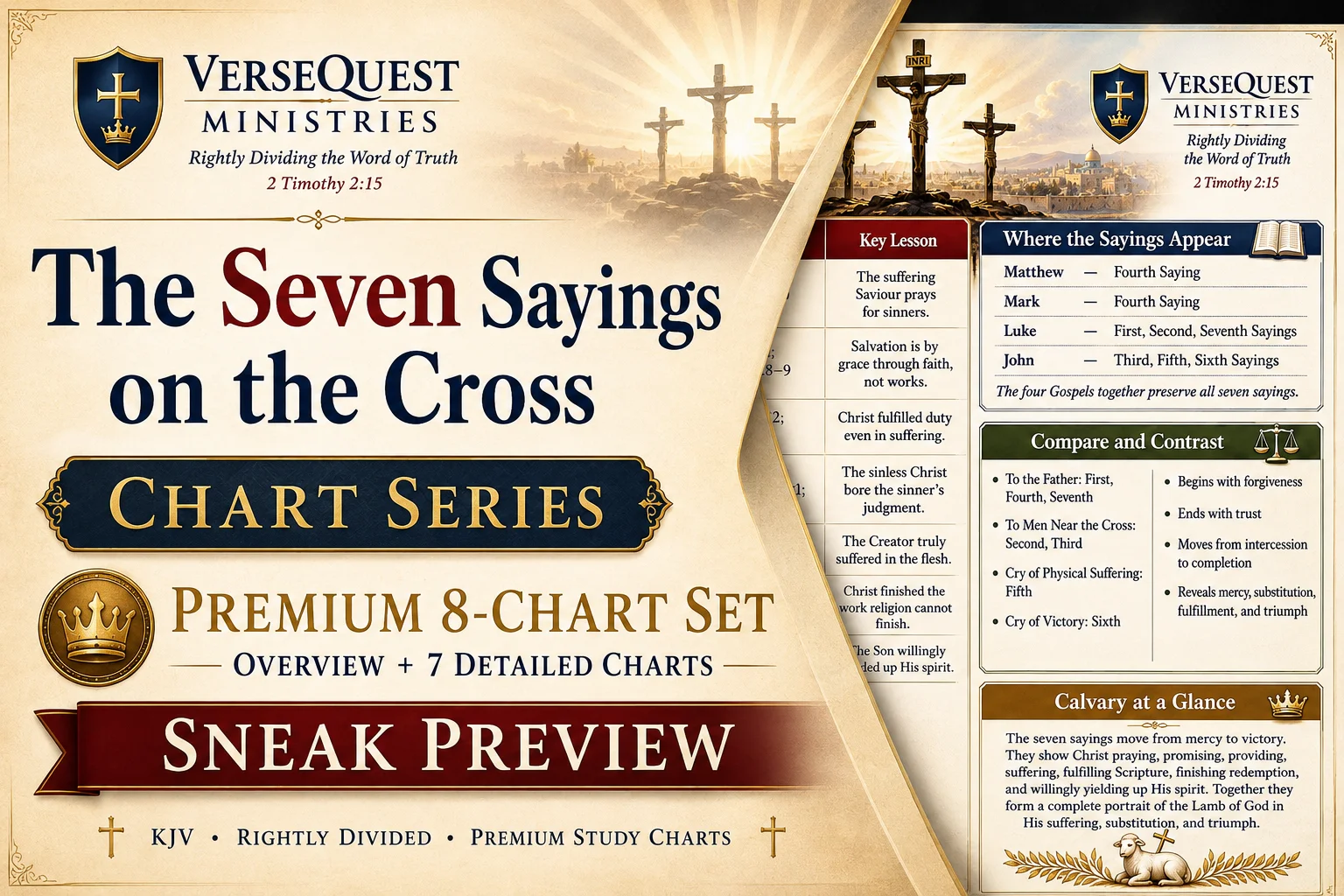
- The Seven Sayings on the Cross – Premium 8-Chart KJV Study Set
- A premium VerseQuest Ministries digital PDF study set on The Seven Sayings on the Cross, featuring an overview chart plus seven detailed KJV Bible study charts. This resource examines Calvary,…
- $12.99
- Add to cart
-
-
Premium VerseQuest Books
-
-75%
- Christ in the Old Testament Made Plain — 100-Essay KJV Study PDF
- A massive 670-page premium KJV Bible study PDF featuring 100 detailed essays showing Jesus Christ throughout the Old Testament in promise, type, sacrifice, Christophany, prophecy, suffering, resurrection, priesthood, and future…
- Original price was: $39.99.$9.99Current price is: $9.99.
- Add to cart
-
-75%
-
The Rapture
-
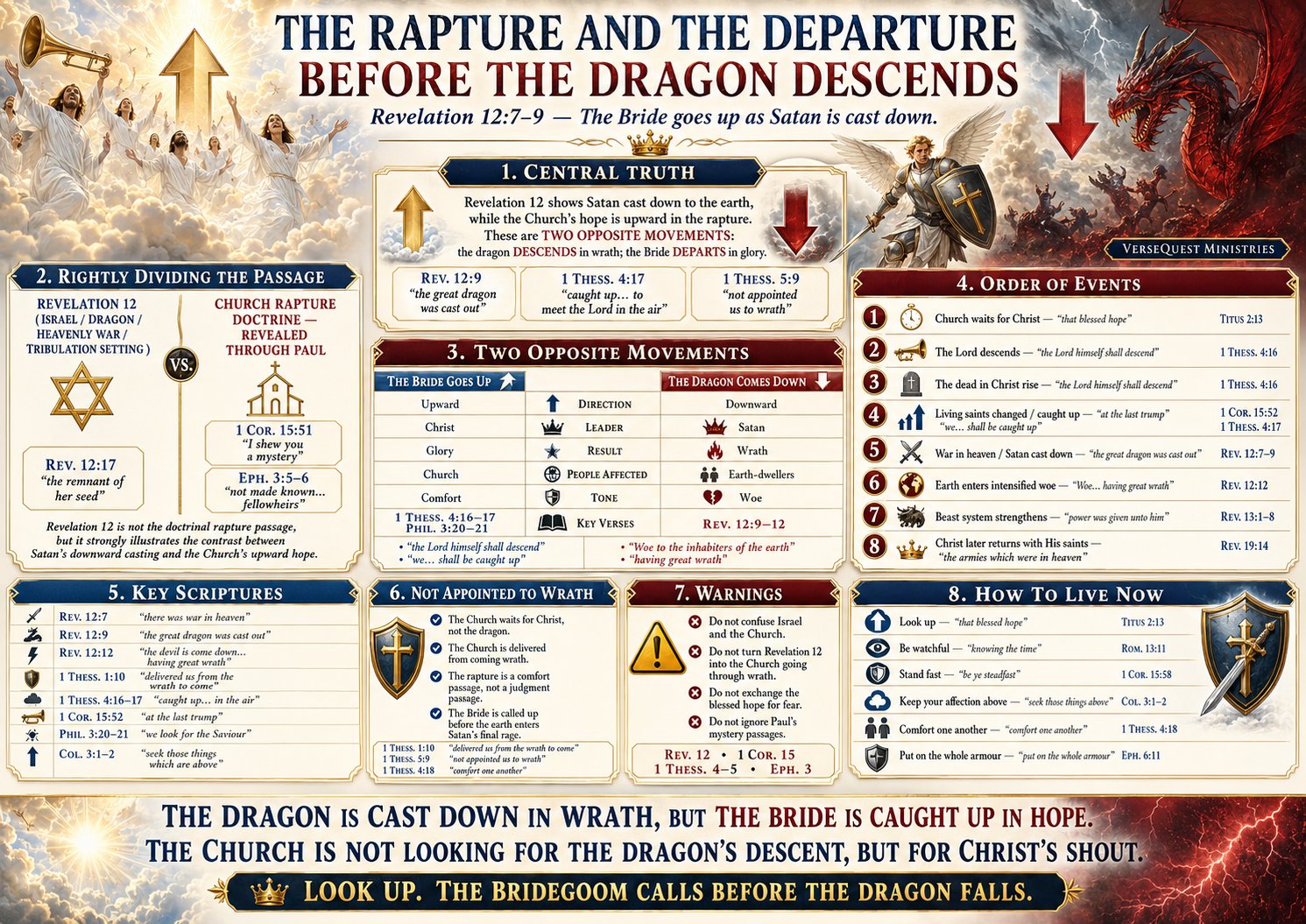
- The Rapture and the Departure Before the Dragon Descends – Printable Bible Study Chart
- Printable KJV Bible study chart on The Rapture and the Departure Before the Dragon Descends, showing the Bride caught up before Satan is cast down in wrath. This premium VerseQuest…
- $4.99
- Add to cart
-
-
VerseQuest Premium Library
-
-67%
- The Book of Psalms Made Plain – 383-Page KJV Psalm Study
- The Book of Psalms Made Plain is a 383-page premium KJV Bible study featuring 54 detailed essays through the major themes, doctrines, prophecies, prayers, laments, and praises of the Psalms.…
- Original price was: $29.99.$9.99Current price is: $9.99.
- Add to cart
-
-67%