
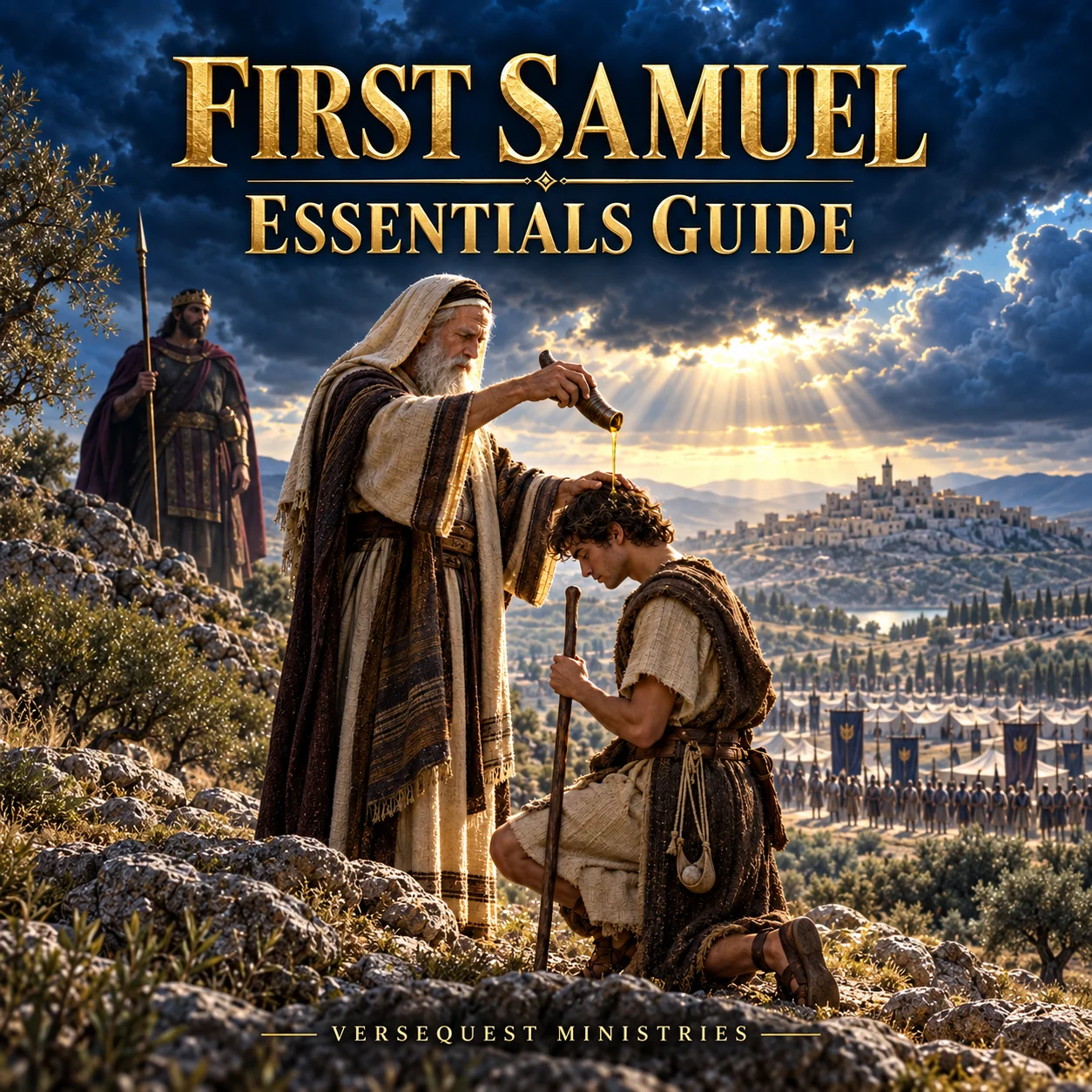
First Samuel Essentials Guide
The First Samuel Essentials Guide is a 120-page downloadable and printable KJV study designed to give you the essential foundation of First Samuel without requiring you to begin with a large commentary. It follows the complete movement of the book from Hannah and Samuel through Saul’s rejection, David’s anointing, Goliath, Jonathan, the wilderness years, Endor, Ziklag, and Saul’s final defeat.
The guide includes printed King James Bible passages, clear explanations, chapter maps, timelines, character profiles, doctrinal distinctions, difficult-passage studies, review questions, teaching points, and note areas. It is ideal for beginners, personal Bible study, discipleship, Sunday school preparation, family study, or quick reference.
Receive the complete 120-page PDF for $14.99 and build a dependable foundation for understanding Samuel, Saul, David, Israel’s monarchy, and the coming King foreshadowed throughout the book.
$14.99
Description
The First Samuel Essentials Guide is a 120-page downloadable and printable PDF designed to give readers a clear, substantial foundation in one of the Bible’s most important historical books. First Samuel records Israel’s transition from the days of the judges to the establishment of the monarchy. It introduces Samuel as prophet, judge, and intercessor; follows the appointment and rejection of Saul; and traces the anointing, testing, and preparation of David before he receives the throne.
This guide presents the major events of First Samuel in their biblical order while showing how they fit together. Readers will study Hannah’s prayer, Samuel’s call, the corruption of Eli’s house, the capture and return of the ark, Israel’s repentance at Mizpeh, the nation’s demand for a king, Saul’s early victories and eventual rejection, David’s anointing, the defeat of Goliath, Jonathan’s covenant with David, Saul’s growing jealousy, David’s wilderness years, Abigail’s intervention, Saul’s visit to the woman at Endor, David’s recovery at Ziklag, and Saul’s death on Mount Gilboa.
The important King James Bible passages used throughout the lessons are printed directly in the guide. Readers can therefore study the text, explanation, major observations, doctrinal distinctions, memorable teaching points, review questions, and personal applications without continually stopping to locate each passage elsewhere. The material is written for beginners, but it is sufficiently detailed to remain useful to experienced Bible students, teachers, pastors, preachers, and Sunday school instructors.
Special attention is given to the contrast between Samuel, Saul, and David. Samuel hears and delivers the word of the LORD. Saul receives tremendous opportunities but loses his dynasty through impatience, partial obedience, fear of the people, and rejection of God’s commandment. David is chosen according to God’s purpose, anointed before his brethren, tested through conflict, persecuted by a rejected ruler, and prepared for the kingdom during years of hardship.
The guide also preserves important dispensational distinctions. Israel is treated as a literal covenant nation under the Mosaic law, and the establishment of the monarchy is explained within that historical setting. Old Testament operations of the Spirit are not confused with the believer’s position in the body of Christ. Difficult passages—including God’s repentance concerning Saul, the evil spirit that troubled Saul, and Samuel’s appearance at Endor—are addressed directly from the King James Bible.
The concluding reference section provides timelines, chapter maps, character profiles, doctrinal summaries, comparisons, difficult-passage notes, a study of Christ in First Samuel, and a final review of the book’s essential truths. The guide presents David as a historical king while also showing how the rejected and later enthroned son of Jesse points forward to the greater Anointed King, the Lord Jesus Christ.
This resource may be used for personal study, discipleship, family Bible reading, Sunday school preparation, sermon development, classroom instruction, small-group discussion, or quick reference. It is especially valuable for readers who want more than a brief summary but are not yet ready to work through a large verse-by-verse commentary.
The First Samuel Essentials Guide is available for $14.99 as a 120-page downloadable PDF that may be read digitally or printed for study.
Prayer and divine intervention — Hannah’s prayer, Samuel’s intercession, and David’s inquiries demonstrate dependence upon the LORD. The authority of God’s word — Samuel rises because he hears and delivers the word, while Saul falls because he rejects it. The judgment of a corrupt priesthood — Eli’s house illustrates the consequences of tolerating sin in spiritual leadership. The holiness of God — The ark narratives show that sacred things cannot be manipulated, commercialized, or approached carelessly. Repentance and national restoration — Israel’s return at Mizpeh demonstrates the necessity of putting away strange gods and returning wholeheartedly to the LORD. The transition from judges to kings — Samuel stands at the historical turning point between tribal judgeship and Israel’s monarchy. The dangers of demanding worldly leadership — Israel wants a king like the nations without adequately considering the cost. Opportunity without obedience — Saul receives anointing, signs, empowerment, victory, and public approval, yet squanders his opportunities. Partial obedience as disobedience — Saul’s failure concerning Amalek exposes the emptiness of religious excuses. The heart versus outward appearance — Saul appears kingly to men, while David is selected according to what the LORD sees. The anointed king in rejection — David is chosen before he is enthroned and must endure opposition during the interval. Faith in the face of overwhelming opposition — David’s victory over Goliath shows that the battle belongs to the LORD. Covenant friendship and loyalty — Jonathan’s relationship with David demonstrates costly faithfulness despite personal loss. Jealousy and spiritual decline — Saul’s envy becomes an obsession that destroys his judgment, relationships, and kingdom. Mercy and restraint — David’s refusal to kill Saul demonstrates his willingness to leave vengeance and timing with God. Wisdom that prevents unnecessary bloodshed — Abigail’s intervention shows how godly discernment can restrain destructive anger. Providence during the wilderness years — God protects and prepares David through caves, betrayal, exile, and uncertainty. The danger of seeking forbidden spiritual counsel — Saul’s visit to Endor displays the final stage of rejecting God’s revealed word. Old Testament Spirit ministry — Saul’s empowerment and loss of royal enablement must be understood within their proper dispensational setting. Christ in First Samuel — David’s anointing, rejection, victory, suffering, followers, and future throne anticipate the greater Son of David.
Central argument: First Samuel demonstrates that position, appearance, religious activity, and human power cannot replace submission to the word of the LORD. Samuel is established because he hears God’s word. Saul loses the kingdom because he rejects it. David is prepared for the throne because he learns to trust God’s timing through opposition and testing.
Major movement: The book begins with a barren woman praying and ends with a fallen king dying. Between these events, God raises Samuel, judges Eli’s house, vindicates His holiness through the ark, restores Israel at Mizpeh, permits the establishment of the monarchy, rejects Saul, and prepares David.
Samuel’s importance: Samuel is more than a childhood Bible character. He is the final great judge, an established prophet, an intercessor, a national leader, and the man commissioned to anoint Israel’s first two kings.
Saul’s tragedy: Saul does not fail because he lacks opportunity. He receives signs, empowerment, victory, public recognition, Samuel’s instruction, and repeated warnings. His ruin develops through impatience, self-will, partial obedience, fear of the people, jealousy, and refusal to submit fully to God’s word.
David’s preparation: David is anointed long before he is enthroned. Goliath is not his final test but an early public victory. Caves, betrayal, false accusation, exile, difficult followers, and repeated opportunities for revenge become part of his preparation for the kingdom.
Essential distinction: David’s refusal to kill Saul does not mean Saul remains spiritually approved. Saul is still the LORD’s anointed in his governmental office, but he is a rejected king moving toward judgment. David refuses to seize the throne by murder and waits for God to remove Saul.
Old Testament Spirit ministry: The Spirit’s coming upon Saul and David concerns empowerment for royal service. The Spirit’s departure from Saul must not be used to deny the Church-age believer’s sealing by the Holy Spirit.
The ark: Israel cannot use the ark as a charm, and the Philistines cannot make it a trophy. The LORD demonstrates His holiness in Israel and His superiority over Dagon in Philistia.
Endor: The text identifies the appearing figure as Samuel. The event does not validate necromancy; it demonstrates God’s sovereign interruption and confirms judgment upon Saul for seeking forbidden counsel after rejecting revealed truth.
Christological pattern: David is the anointed king who is rejected before he reigns. He defeats the enemy’s champion, gathers followers during his rejection, refuses to take the throne unlawfully, and waits for the appointed time. These patterns point beyond David to the Lord Jesus Christ, the greater Son of David and rightful King.
Memorable teaching points: Prayer can shape a nation before political power appears. Religious objects cannot substitute for obedience. A man may look like a king and still lack the heart to obey. Partial obedience is rebellion wearing religious clothing. The giant is never greater than the God whose name he defies. Wilderness preparation often precedes public responsibility. God’s delays are not the cancellation of His promises.
Subjects for further study: Hannah’s prayer and Mary’s praise; Samuel as judge and prophet; the ark in Israel’s history; the biblical doctrine of the monarchy; Saul’s excuses in First Samuel 15; David’s related psalms; Jonathan’s covenant with David; the priesthood after Nob; the Davidic covenant; and the prophetic relationship between David’s rejection and Christ’s future kingdom.
For personal Bible study, the guide provides a structured path through all thirty-one chapters of First Samuel. Readers can begin with the printed KJV passage, study the explanation and observations, examine the doctrinal distinction, answer the review questions, and record their conclusions in the designated note areas.
Pastors and preachers can use the guide to identify sermon subjects involving prayer, spiritual leadership, obedience, jealousy, courage, friendship, mercy, divine providence, and preparation for service. The timelines, character comparisons, chapter maps, and doctrinal summaries can help organize teaching series without losing sight of the book’s overall movement.
Sunday school teachers and small-group leaders can assign one study at a time and use the questions to begin discussion. Because the relevant passages are printed directly in the guide, every participant can follow the lesson even when additional study materials are unavailable.
Families can use shorter sections for regular Bible reading and discussion. Hannah, Samuel, Jonathan, Saul, David, Goliath, Abigail, and other major figures provide meaningful lessons about prayer, responsibility, courage, friendship, anger, obedience, and consequences.
The guide is also suited to discipleship and ministry training. It teaches new believers how to observe a passage, follow a biblical narrative, distinguish Israel’s historical setting from Church-age doctrine, compare characters, recognize consequences, and connect individual events to the Bible’s larger revelation of Jesus Christ.
A King James Bible for reading each lesson within its full chapter and surrounding context.
A KJV concordance for tracing words such as king, anointed, heart, obey, Spirit, fear, word, and LORD throughout First Samuel.
A reliable Bible dictionary for historical information concerning Shiloh, Mizpeh, Gilgal, Ramah, Gath, Nob, Adullam, Engedi, Ziklag, and Mount Gilboa.
Cross-reference tools for following First Samuel’s connections with Deuteronomy, Judges, Psalms, the Gospels, Acts, and Hebrews.
A map of ancient Israel during the united monarchy for tracing Samuel’s circuit, Philistine territory, Saul’s campaigns, and David’s wilderness movements.
A timeline of the judges, Samuel, Saul, and David to clarify how their lives and ministries overlap.
The Psalms associated with David’s wilderness experiences, particularly Psalms 34, 52, 54, 56, 57, and 59.
The VerseQuest Judges Essentials Guide for understanding the spiritual and national conditions that preceded Samuel.
The VerseQuest Ruth Essentials Guide for studying the family line and providential setting leading toward David.
Bible studies on the Davidic covenant, the kingdom of Israel, the Son of David, and the future reign of the Lord Jesus Christ.
Related products
-
UFOs and the Bible
-
- Beneath the Firmament: Pyramids, UFOs, Ancient Rebellion, and the Coming King — 404-Page PDF Book
- Beneath the Firmament is a 404-page downloadable PDF containing 60 substantial KJV-centered studies divided into two books. Pyramids Beneath the Firmament investigates Babel, Nimrod, ancient engineering, worldwide pyramid traditions, sacred…
- $19.99
- Add to cart
-
-
New Believer Training
-

- Milk Stage Discipleship: An 80-Lesson KJV Foundation for New Believers
- Milk Stage Discipleship is a 595-page downloadable KJV Bible-study book containing 80 thorough lessons designed to establish believers in the foundational doctrines of the Christian faith. The studies progress from…
- $29.99
- Add to cart
-
-
guarding your thoughts
-

- The Guarded Mind – 50 KJV Biblical Studies on Fear, Anxiety, Lies, and Spiritual Strongholds
- Guard your heart and mind with fifty thorough, Scripture-filled studies confronting fear, anxiety, accusation, temptation, bitterness, distraction, comparison, false guidance, and spiritual strongholds. This 351-page digital PDF uses the King…
- $9.99
- Add to cart
-
-
Grace for the Wasted Years
-

- Grace for the Wasted Years — 237-Page KJV Bible Study PDF
- Grace for the Wasted Years is a 237-page downloadable KJV Bible study for believers burdened by lingering guilt, painful memories, damaged relationships, lost opportunities, and the fear that too much…
- $19.99
- Add to cart
-
-
Premium Studies
-
-25%
- The Doctrine of Hell — Premium Essay Series PDF
- A 383-page premium VerseQuest PDF study book containing 54 KJV essays on hell, fire, darkness, judgment, the lake of fire, the second death, and Jesus Christ as the only escape.
- Original price was: $39.99.$29.99Current price is: $29.99.
- Add to cart
-
-25%