
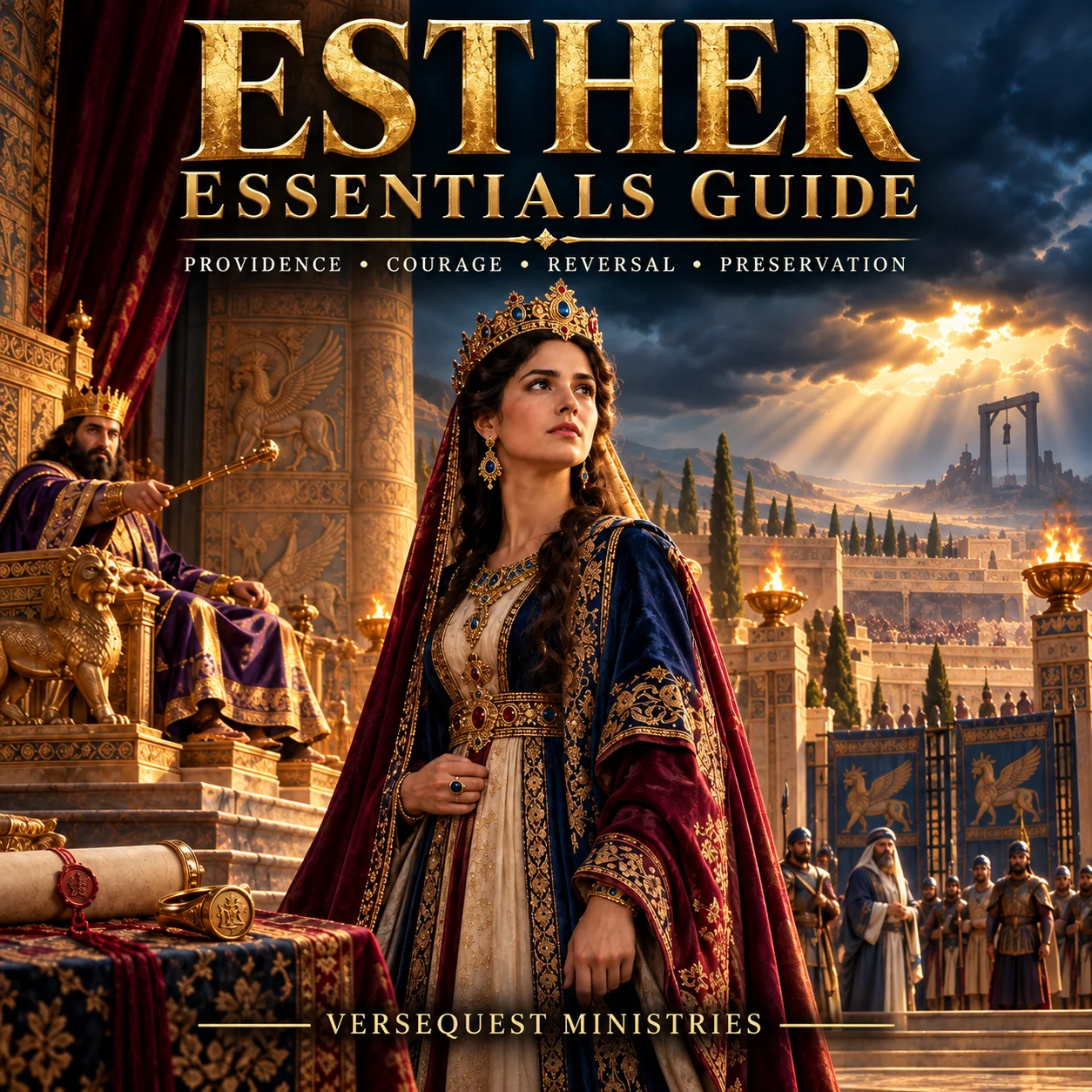
Esther Essentials Guide: Providence, Courage, Reversal & Preservation
The Esther Essentials Guide is a 108-page downloadable KJV Bible study PDF containing 60 core studies through all 167 verses of Esther. Follow the complete story from the Persian court and Esther’s rise to the threat of Haman, the courage of intercession, the great providential reversal, the preservation of the Jews, and the establishment of Purim.
In addition to the verse-by-verse core studies, the guide includes historical background, chronology, character and theme studies, doctrinal distinctions, difficult passages, prophetic connections, narrative maps, unit reviews, teaching plans, sermon starters, a subject index, memory tools, and space for personal notes.
Designed for Bible students, pastors, teachers, preachers, families, and serious readers, this $14.99 digital study guide keeps the King James Bible central while carefully distinguishing history, doctrine, practical application, and responsible typology.
$14.99
Description
The Esther Essentials Guide is a comprehensive, KJV-centered study of one of the most remarkable books of the Old Testament—a book in which God’s name is not openly stated, yet His providential hand can be traced from beginning to end. This 108-page downloadable PDF study guide walks through the complete Book of Esther with 60 core studies covering all 167 verses, helping readers understand the history, structure, people, decisions, decrees, reversals, and doctrinal lessons that make Esther far more than a familiar story about a courageous queen.
The guide begins by establishing the historical setting of Esther under Gentile Persian rule. Readers are introduced to Shushan the palace, the Persian Empire, Ahasuerus, Vashti, Esther, Mordecai, Haman, the royal court, important locations, chronology, and the political realities surrounding the threatened Jewish population. The book then traces Esther’s great narrative movement from royal display to Jewish danger, from concealment to identification, from fasting to intercession, from Haman’s advancement to his destruction, and from a decree of death to lawful defense, deliverance, rest, and remembrance.
At the heart of the guide are 60 detailed core studies through Esther 1–10. Each study keeps the King James Bible at the center, prints the selected KJV passage, identifies the central truth, explains the text, highlights important observations, supplies relevant cross-references, provides review questions, and leaves space for personal notes. Rather than treating Esther as a collection of disconnected moral lessons, the guide shows how banquets, decrees, written records, garments, authority, timing, fasting, pride, courage, and remembrance work together throughout one carefully constructed biblical narrative.
Special attention is given to the doctrine of divine providence, the preservation of the Jewish people, courageous intercession, the destructive nature of pride, the consequences of written authority, the recurring theme of reversal, and the importance of remembering deliverance. The guide also carefully preserves doctrinal distinctions. Esther is first interpreted historically as the account of Jews living under Persian Gentile dominion. Israel, the Church, and the nations are not merged together, and typological or prophetic applications are kept secondary to the actual biblical text.
The reference section greatly expands the usefulness of the book. Readers will find unit reviews, a narrative reversal map, studies of Esther’s banquets, fasts, decrees, chronology, major characters and themes, discussions of Amalek, providence, fasting and leadership, examinations of difficult passages, doctrinal distinctions, prophetic connections involving Israel, and a four-layer approach to history, literary design, doctrine, and typology. The guide also includes teaching plans, sermon and lesson starters, a subject index, a memory framework, and a final review.
The Esther Essentials Guide is designed for repeated use rather than a single reading. It can be read straight through for an overview of Esther, studied alongside an open King James Bible, used as preparation for a sermon or Sunday school lesson, worked through in family Bible study, or consulted as a reference when studying subjects such as providence, Jewish preservation, Purim, Haman, Mordecai, Persian law, intercession, leadership, and prophetic patterns involving Israel.
This digital resource is available as a downloadable PDF for $14.99 and is especially suited for Bible students, pastors, preachers, teachers, families, Sunday school instructors, ministry leaders, and serious readers who want to understand Esther without losing the historical setting or forcing the book into interpretations the text does not support.
Divine Providence — Esther repeatedly demonstrates purposeful timing, prepared circumstances, written records, human decisions, and unexpected reversals working together without requiring a public miracle. Jewish Preservation — The central national crisis concerns an empire-wide decree intended to destroy the Jewish people and the remarkable reversal through which they are preserved. Courageous Intercession — Esther moves from personal safety and concealment to identifying herself with her threatened people and speaking on their behalf. Pride and Self-Destruction — Haman’s demand for honor, wounded pride, hatred, boasting, and plotting ultimately become the instruments of his downfall. Providence Without Moral Approval — God’s ability to overrule human choices does not mean every action recorded in Esther receives divine moral approval. Reversal — Haman rises and falls; Mordecai is overlooked and then honored; the Jews are sentenced to destruction and then authorized to defend themselves; mourning becomes celebration. Written Authority — Letters, decrees, royal records, seals, laws, and written memorials repeatedly shape the direction of the narrative. The Persian Empire — The vast governmental setting of 127 provinces demonstrates the magnitude of both Haman’s decree and the Jewish crisis. Fasting and Dependence — Fasting accompanies crisis, solidarity, resolve, and preparation for Esther’s dangerous approach to the king. Position and Responsibility — Esther’s royal position brings responsibility rather than mere privilege. Delayed Recognition — Mordecai’s faithful service is recorded long before it is rewarded, becoming crucial at precisely the needed moment. Antisemitic Hatred — Haman turns personal hatred of Mordecai into a political plan against an entire people. Purim and Remembrance — Deliverance becomes something future generations are commanded to remember rather than allow to disappear from national memory. Leadership and Service — Mordecai’s final greatness is associated with seeking the good and peace of his people. Israel and the Church — The historical Jews of Esther remain Jews; Christian applications do not erase Israel’s national identity. History Before Typology — Historical meaning governs all later doctrinal, practical, prophetic, and typological applications. Gentile Dominion — Esther occurs while Jews live under the authority of a vast Gentile empire. Prophetic Patterns — Jewish persecution, Gentile authority, threatened destruction, preservation, and reversal can illuminate broader prophetic themes when controlled by explicit prophetic Scripture.
Central Argument: Esther records the preservation of the Jewish people under Persian Gentile rule through a chain of prepared circumstances, courageous decisions, written decrees, precise timing, and extraordinary reversals. God’s name is not openly stated in the narrative, yet the events form one of Scripture’s clearest demonstrations of providential government.
The Book Must Be Read as One Story: Vashti’s removal, Esther’s elevation, Mordecai’s unrewarded service, Haman’s advancement, the extermination decree, Esther’s decision, the sleepless king, the opened records, Haman’s humiliation, the second banquet, the counter-decree, Jewish victory, and Purim are interconnected. Events that appear insignificant when introduced later become essential to deliverance.
The Great Narrative Pattern: The book can be remembered through the progression Display → Placement → Threat → Decision → Hinge → Exposure → Defense → Rest. This framework allows a student to recall the entire movement of Esther without reducing the book to isolated character lessons.
The Hinge Is Esther 6: The king cannot sleep. The chronicles are read. Mordecai’s forgotten service is discovered. Haman arrives intending to request Mordecai’s execution but is instead ordered to honor him publicly. Nothing outwardly miraculous occurs, yet the direction of the entire book turns in one night.
Providence Does Not Mean Approval: The narrative contains pride, drunkenness, political manipulation, anger, hatred, questionable decisions, and violent intentions. God’s ability to govern through human circumstances does not make every human action righteous.
Esther’s Courage Develops: Esther begins under Mordecai’s instruction and with her Jewish identity concealed. When the crisis comes, she must personally identify with her threatened people and accept the danger of approaching the king without being summoned.
Haman Illustrates the Logic of Pride: His honor is insufficient so long as one man refuses to bow. Personal offense expands into genocidal hatred. The gallows constructed for Mordecai becomes the instrument of Haman’s own execution.
Mordecai Demonstrates Delayed Reward: His faithful service in exposing treason is written into the royal records but initially receives no reward. The delay becomes part of the providential timing because the record is remembered when its effect will be greatest.
The Decree Problem Is Important: Haman’s death does not automatically erase the consequences of the first decree. A second decree must address an existing legal danger. This supplies a valuable teaching principle: removing the person who created a problem does not necessarily remove every consequence of the problem.
Purim Preserves Memory: Jewish deliverance is not merely experienced; it is formally remembered. Celebration, generosity, gifts, and concern for the poor become part of the memorial.
Israel Remains Israel: The endangered people in Esther are Jews. Christian readers may draw practical and spiritual lessons, but the historical identity of the passage must not be rewritten.
Prophecy Must Remain Controlled: Esther contains patterns that harmonize with later prophetic passages involving Gentile dominion, hostility toward Israel, preservation, and reversal. Those comparisons must remain subordinate to explicit prophetic Scripture rather than transforming every person or event into a mandatory end-times symbol.
Questions Worth Further Study: Why is written documentation so prominent in Esther? How many decisive events depend upon timing? What distinguishes Esther’s courage from recklessness? Why does Haman’s hatred expand from Mordecai to all Jews? How does Persian law affect the crisis? What role does remembrance play in preserving national identity? How does Mordecai’s final leadership contrast with Haman’s pursuit of power?
Personal Bible Study: Work through the 60 core studies alongside the printed KJV passages, record observations, trace repeated words and themes, and use the review material to retain the flow of all ten chapters.
Sermon Preparation: Use the historical proposition, chapter movement, doctrinal conclusions, cross-references, and included sermon starters to develop text-centered messages without separating application from context.
Sunday School: The guide can be taught chapter by chapter over ten sessions or divided into broader units covering preparation, crisis, turning point, reversal, remembrance, and leadership.
Small Groups: Esther’s clear narrative movement makes the guide useful for group discussion concerning providence, pride, courage, responsibility, intercession, leadership, prejudice, and remembrance.
Family Bible Study: Families can read the selected KJV passages aloud, identify each chapter’s major decision or reversal, and discuss the practical lessons concerning courage, service, pride, providence, and responsibility.
Discipleship: The guide teaches readers how to distinguish historical facts, doctrinal conclusions, practical applications, inferences, and typological observations rather than treating every Bible passage carelessly.
Classroom Instruction: Teachers can use the historical material, chronology, Persian setting, character studies, doctrinal distinctions, narrative maps, and review tools to build a structured study of Esther.
Ministry Training: The resource provides an example of handling narrative Scripture responsibly by establishing history and context before moving to doctrine, application, typology, or prophecy.
A King James Bible with cross-references should remain the primary companion resource so that every doctrine and application can be checked against Scripture.
An exhaustive concordance keyed to the King James Bible is useful for tracing words and subjects such as Jews, decree, king, law, fasting, Purim, Agag, Amalek, remembrance, providence-related passages, and Gentile kingdoms.
A reliable Bible dictionary can help with Persian court terminology, ancient customs, Shushan, Ahasuerus, Mordecai, Esther, Haman, Purim, Amalek, Agag, and the political structure of the Persian Empire.
Bible maps of the Persian Empire are particularly valuable for visualizing Shushan and the enormous geographical reach represented by the 127 provinces stretching from India unto Ethiopia.
A Bible chronology covering Ezra, Nehemiah, Esther, Daniel, and the Persian period can help readers understand where Esther fits within the broader post-exilic history of the Jewish people.
For the subject of Amalek, compare Exodus 17, Deuteronomy 25, 1 Samuel 15, and Esther 3 to trace the biblical history behind the hostility associated with Haman the Agagite.
For Israel’s preservation and prophetic future, study Genesis 12 and 17, Jeremiah 31, Daniel 2 and 7, Zechariah 12–14, Romans 11, and Revelation 12 alongside Esther.
For divine providence and rulers, use a KJV concordance and cross-reference system to examine passages such as Proverbs 21:1 and other texts demonstrating God’s authority over kings, nations, timing, and circumstances.
Related products
-
Study Books (PDF)
-
-25%
- The Mysteries of God Revealed for the Church Age – Premium Essay Series PDF
- A premium 404-page VerseQuest Ministries digital PDF study book featuring 54 detailed KJV-only essays on the mysteries of God revealed for the Church Age. This rightly divided study covers the…
- Original price was: $39.99.$29.99Current price is: $29.99.
- Add to cart
-
-25%
-
Names of Christ
-

- The Names and Titles of Jesus Christ Made Plain
- A complete 100-essay KJV Bible study on the names and titles of the Lord Jesus Christ, showing His deity, humanity, blood atonement, resurrection, priesthood, headship over the Church, shepherd care,…
- $29.99
- Add to cart
-
-
The Rapture
-
-67%
- Caught Up Before the Wrath – 66-Essay KJV Rapture Study
- Caught Up Before the Wrath is a 430-page premium KJV Bible study defending the pre-tribulation Rapture of the Church from a rightly divided, dispensational perspective. This 66-essay VerseQuest Ministries book…
- Original price was: $29.99.$9.99Current price is: $9.99.
- Add to cart
-
-67%
-
KJV Bible Study Resources
-
-60%

- Practical Christianity for Daily Battles – 329-Page KJV Study PDF
- A premium 329-page KJV study PDF with 40 full essays applying sound, rightly divided Bible doctrine to real daily Christian battles. Topics include temptation, anxiety, marriage, parenting, pornography, grief, church…
- Original price was: $24.99.$9.99Current price is: $9.99.
- Add to cart
-
-60%
-
Jesus Christ / Christology
-
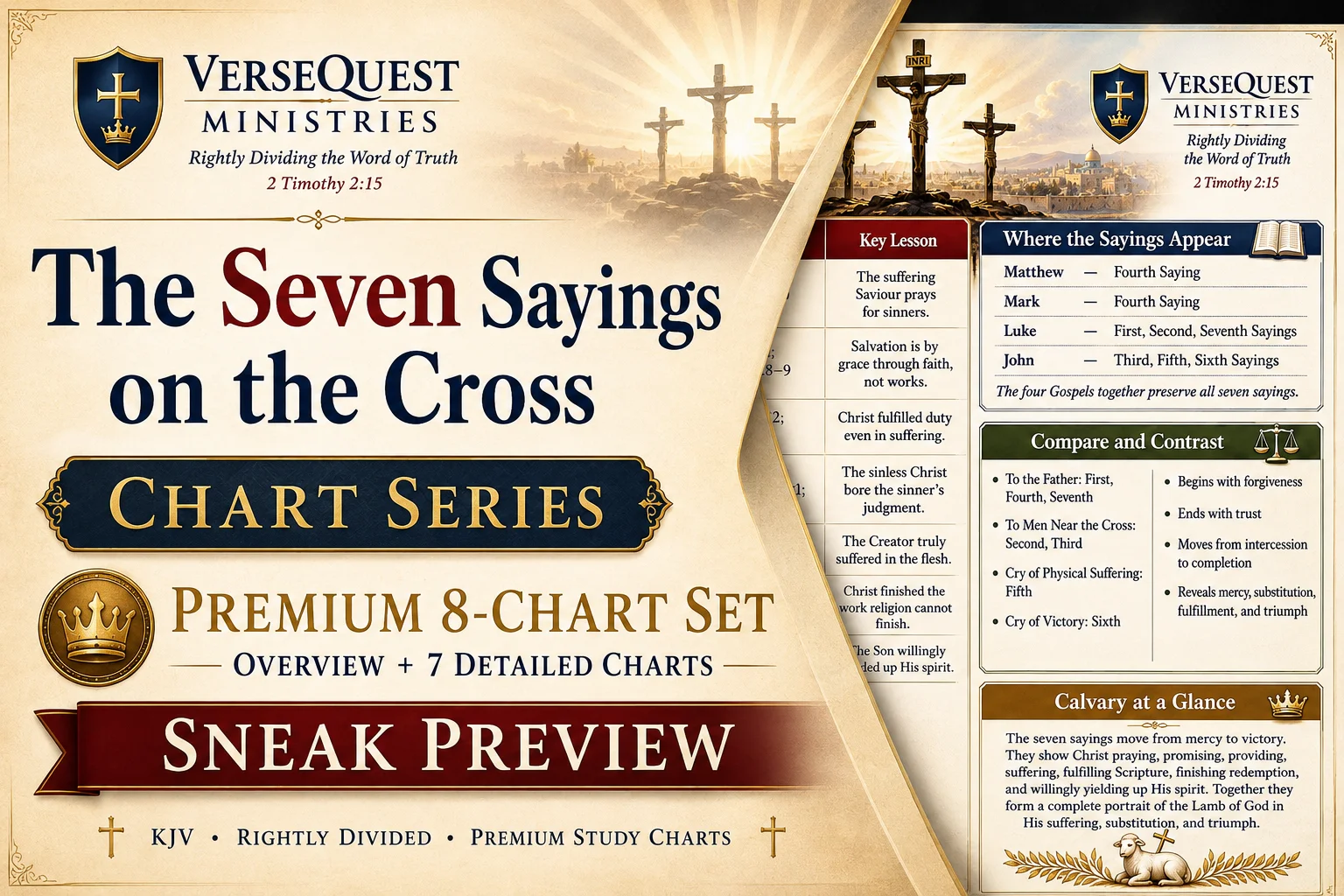
- The Seven Sayings on the Cross – Premium 8-Chart KJV Study Set
- A premium VerseQuest Ministries digital PDF study set on The Seven Sayings on the Cross, featuring an overview chart plus seven detailed KJV Bible study charts. This resource examines Calvary,…
- $12.99
- Add to cart
-