
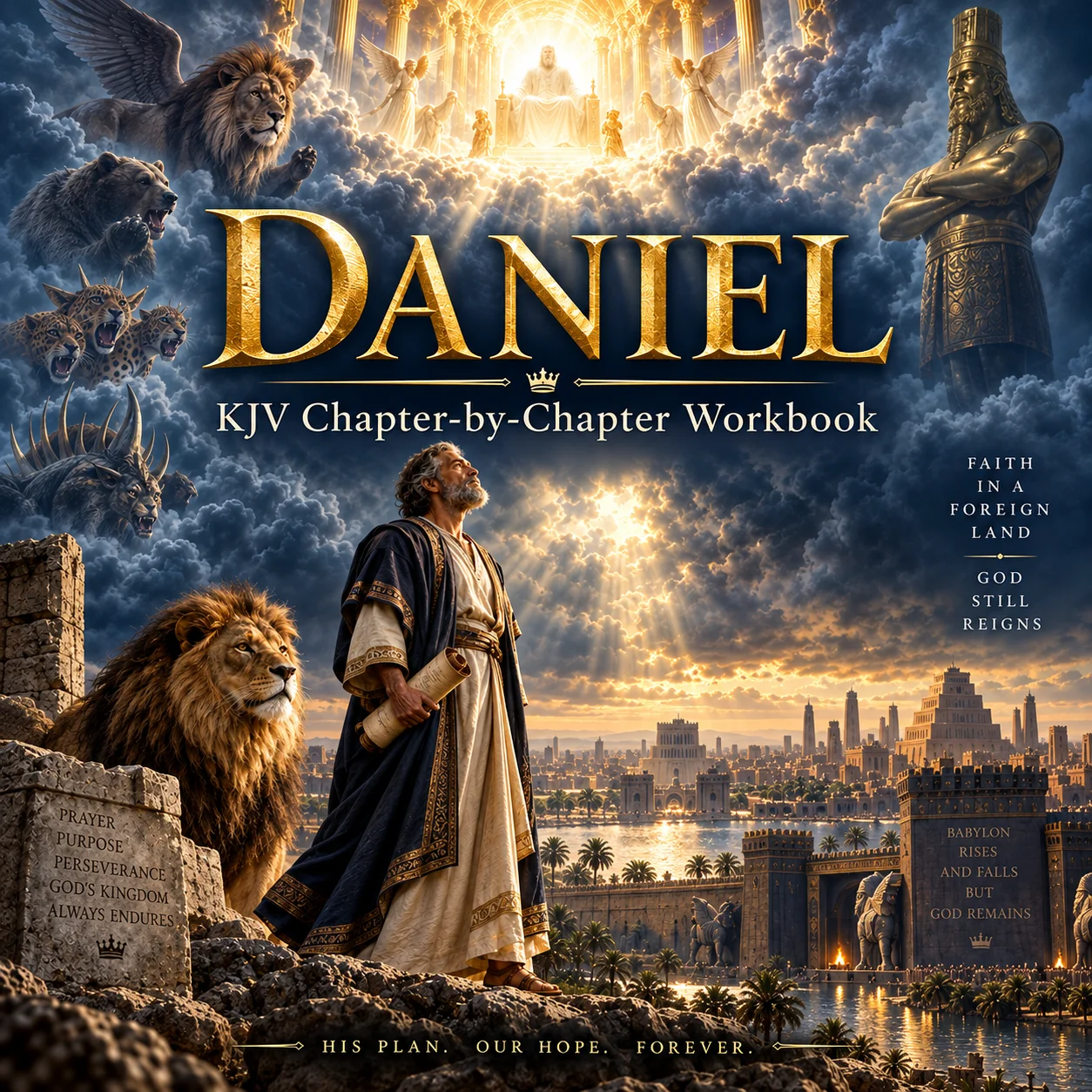
Daniel KJV Chapter-by-Chapter Workbook
The Daniel KJV Chapter-by-Chapter Workbook is a complete 225-page downloadable PDF study covering all 12 chapters of Daniel from a King James Bible, rightly divided perspective.
Study Daniel’s captivity in Babylon, the fiery furnace, lions’ den, Nebuchadnezzar’s great image, four beasts, little horn, ram and he goat, Seventy Weeks, Messiah the Prince, supernatural conflict, kings of the north and south, Antichrist, Tribulation, resurrection, prophetic time periods, and the everlasting kingdom.
This is an interactive workbook rather than a simple commentary. It includes detailed teaching, guided questions, KJV vocabulary, cross-reference work, prophetic charts, doctrinal distinctions, glossary studies, review material, note space, lesson-development exercises, and teaching tools designed to help you work through Daniel for yourself.
225-page downloadable PDF — $21.99.
$21.99
Description
The Daniel KJV Chapter-by-Chapter Workbook is a comprehensive 225-page downloadable PDF Bible-study course designed to lead the student through all 12 chapters of Daniel with an open King James Bible. Daniel is one of the most important books in Scripture for understanding faithfulness under pressure, the rise and fall of Gentile kingdoms, the coming Antichrist, Israel in prophecy, the Tribulation, the Second Advent, the kingdom of God, resurrection, and the supernatural conflict operating behind earthly history.
The workbook begins where Daniel begins: with faithful young Hebrews carried into Babylon. Students examine Daniel’s decision not to defile himself, the Babylonian program of cultural assimilation, the wisdom God gives Daniel and his companions, and the lesson that a believer can live faithfully in a hostile environment without surrendering biblical conviction. The historical chapters move through Nebuchadnezzar’s dreams, the fiery furnace, the king’s humiliation, Belshazzar’s final feast, the handwriting on the wall, Daniel’s prayer life, and the lions’ den.
From there, the course moves deeply into Daniel’s prophetic visions. Daniel 2 receives detailed attention through the great image of gold, silver, brass, iron, and iron mixed with clay, culminating in the stone cut without hands and the establishment of God’s kingdom. Daniel 7 develops the same prophetic landscape through the four beasts, ten horns, little horn, Ancient of days, heavenly judgment, and the Son of man receiving an everlasting dominion.
Daniel 8 examines the ram, he goat, notable horn, four successor horns, sanctuary conflict, and the fierce ruler who emerges within the prophetic picture. Students are trained to distinguish broad prophetic structure from narrower historical and future applications rather than treating every symbol as interchangeable.
Daniel 9 forms one of the major study centers of the workbook. The student first works through Daniel’s prayer of confession and intercession before examining the prophecy of the Seventy Weeks. Special attention is given to Daniel’s people, Daniel’s holy city, Messiah the Prince, Messiah being cut off, the prophetic divisions of the weeks, the final week, covenant, sacrifice, and the abomination connected with the closing prophetic crisis.
Daniel 10 introduces another essential subject: the supernatural conflict behind the kingdoms of men. The workbook examines Daniel’s fasting and mourning, the glorious heavenly messenger, the prince of Persia, Michael, the coming prince of Grecia, the book of truth, and the relationship between visible political history and invisible spiritual conflict.
Daniel 11 receives substantial treatment because of its extraordinary prophetic detail. Students follow the kings of the north and south, political alliances, warfare, treachery, persecution, sanctuary desecration, the people who know their God, and the movement toward the willful king of the time of the end. The workbook encourages careful reading of historical fulfillment while maintaining the prophetic movement toward the latter-day crisis.
Daniel 12 brings the study to its conclusion with Michael standing for Daniel’s people, the unparalleled time of trouble, deliverance, resurrection, everlasting life, everlasting contempt, the sealing of the words, increased knowledge, purification, the 1,290 and 1,335 days, and Daniel’s personal assurance that he will rest and stand in his lot at the end of the days.
This is not merely a commentary placed inside workbook covers. The course is intentionally interactive. Students work through guided observation questions, interpretive exercises, cross-reference trails, KJV vocabulary studies, doctrinal distinctions, prophetic-horizon studies, chart work, review questions, personal summaries, teaching exercises, sermon-development prompts, and dedicated note areas. The goal is to require the student to look repeatedly at the biblical text and develop conclusions from Scripture.
The workbook also includes substantial introductory material, an important-terms glossary, whole-book surveys, doctrinal anchors, cumulative review material, prophecy comparisons, kingdom charts, Daniel 2 and Daniel 7 comparisons, Seventy Weeks material, spiritual-realm studies, prophetic time markers, Daniel/Revelation connections, teaching resources, homeschool and classroom assignments, assessment material, and a final teaching project.
Particular care is taken to preserve important biblical distinctions. Israel remains Israel. Jerusalem remains Jerusalem. Daniel’s people are identified according to the passage rather than automatically transferred to the Church. The Church Age, Tribulation, Second Advent, and Millennial Kingdom are not collapsed into one prophetic event. Historical fulfillment is considered without allowing historical events to erase genuine future prophecy.
The Daniel KJV Chapter-by-Chapter Workbook is suitable for serious individual Bible study, pastors and preachers preparing Daniel series, Sunday school teachers, homeschool families, Bible institutes, discipleship settings, and students who want a structured way to understand one of Scripture’s most important prophetic books.
The buyer receives the complete 225-page downloadable PDF for $21.99.
God’s Sovereignty Over Kingdoms — Daniel repeatedly demonstrates that earthly kings reign only beneath the authority of the Most High. Faithfulness in Exile — Daniel and his companions demonstrate how God’s people can remain faithful in a foreign culture. Biblical Separation — Daniel 1 teaches deliberate refusal of defilement without promoting isolation, incompetence, or disrespect. The Times of the Gentiles — The book provides one of Scripture’s foundational prophetic frameworks for successive Gentile dominion. Nebuchadnezzar’s Great Image — Gold, silver, brass, iron, iron mixed with clay, and the stone form a major prophetic outline. The Stone Cut Without Hands — Human kingdoms ultimately fall before the divinely established kingdom. The Fiery Furnace — Daniel 3 teaches uncompromising worship and faithfulness even when obedience may result in death. The Most High Ruleth — Daniel 4 establishes divine government over rulers, including God’s ability to abase the proud. The Handwriting on the Wall — Daniel 5 illustrates divine measurement, accountability, and sudden judgment. Prayer Under Pressure — Daniel 6 and Daniel 9 show prayer as a settled discipline rather than a crisis-only response. The Four Beasts — Daniel 7 presents world power from heaven’s perspective through beast imagery. The Ancient of Days — God appears as eternal Judge above the unstable kingdoms of men. The Son of Man — Daniel 7 presents Messiah receiving everlasting dominion, glory, and kingdom. The Little Horn — Daniel develops the final blasphemous ruler through multiple prophetic passages. The Ram and He Goat — Daniel 8 narrows the prophetic picture through Medo-Persian and Grecian imagery. Sanctuary Desecration — Attacks upon the sanctuary and holy worship recur as major prophetic warning signs. Daniel’s Seventy Weeks — Daniel 9 provides a crucial Israel- and Jerusalem-centered prophetic timetable. Messiah the Prince — The coming and cutting off of Messiah stand at the center of Daniel 9’s prophetic revelation. Israel and the Church Distinguished — Daniel’s prophetic program concerning his people and holy city is not automatically reassigned to the Church. The Seventieth Week — The final prophetic week includes covenant, sacrifice, desolation, and end-time conflict. Angelic and Spiritual Warfare — Daniel 10 gives a rare biblical glimpse into supernatural powers connected with earthly kingdoms. Michael the Archangel — Michael is repeatedly connected with Daniel’s people and end-time conflict. The Kings of the North and South — Daniel 11 records detailed conflict and succession leading toward the final prophetic crisis. The People Who Know Their God — Faithfulness and spiritual knowledge become especially important under persecution. Antichrist and the Final King — Daniel provides major characteristics of the final world ruler who opposes God and persecutes His people. The Tribulation — Daniel 7–12 contains important chronological and doctrinal foundations for understanding the future time of trouble. The Second Advent — Daniel repeatedly points beyond human kingdoms to divine intervention and Messiah’s kingdom rule. Resurrection — Daniel 12 clearly teaches resurrection to everlasting life and everlasting contempt. Prophetic Time Periods — The seventy weeks, time-times-and-an-half, 2,300 days, 1,290 days, and 1,335 days require careful contextual study. God’s Everlasting Kingdom — The final emphasis of Daniel is not Antichrist, Babylon, Persia, Greece, or Rome, but the kingdom that shall never be destroyed.
Daniel begins with defeat from the human viewpoint but sovereignty from the divine viewpoint. Jerusalem is besieged, temple vessels are removed, and young Hebrews are carried into Babylon. Yet Daniel immediately makes clear that Babylon did not simply overpower Judah independently of God. The LORD gave Jehoiakim into Nebuchadnezzar’s hand. The book therefore begins by teaching the reader how to interpret history.
Daniel 1 establishes a principle that governs the entire book: the world can change a believer’s surroundings without necessarily changing his allegiance. Daniel’s name, education, environment, language, and food are all subjected to Babylonian pressure, but Daniel “purposed in his heart” not to defile himself.
Daniel 2 moves from personal faithfulness to world prophecy. The great image provides an ordered sequence of Gentile dominion. Human kingdoms appear impressive, valuable, and powerful, but the entire image ultimately falls beneath a stone “cut out without hands.”
Daniel 2 and Daniel 7 should always be compared. Daniel 2 shows world empire through the appearance of valuable metals. Daniel 7 shows earthly empire as heaven sees its predatory character: beasts arising from a troubled sea. Both passages move toward the destruction of Gentile dominion and the establishment of God’s kingdom.
Daniel 3 demonstrates the inevitable conflict between true worship and coerced idolatry. Shadrach, Meshach, and Abednego do not know whether God will deliver them before entering the furnace, but they know beforehand that they will not worship the image.
Daniel 4 makes divine sovereignty explicit: “the most High ruleth in the kingdom of men” (Daniel 4:17). Nebuchadnezzar has enormous political power, but God can remove his understanding until the proud king learns heaven’s rule.
Daniel 5 presents the opposite response. Belshazzar possesses the historical warning of Nebuchadnezzar but refuses to humble himself. Greater light therefore produces greater responsibility. Babylon falls the same night its rulers are feasting.
Daniel 6 shows that Daniel’s prayer life is habitual. The crucial phrase is that Daniel prayed “as he did aforetime.” The lions’ den does not create Daniel’s devotion; it reveals devotion that already existed.
Daniel 7 is foundational to end-time prophecy. The fourth beast, ten horns, little horn, persecution of the saints, heavenly judgment, and kingdom given in connection with the Son of man all require close comparison with Revelation.
Daniel 8 narrows the focus through the ram and he goat. The chapter teaches students that biblical prophecy can move between clearly identified historical kingdoms and later prophetic developments without becoming meaningless symbolism.
Daniel 9 demonstrates what prophetic study should produce in a godly student. Daniel reads Jeremiah, understands the prophecy, and prays. Knowledge of prophetic timing does not make him proud; it drives him to confession.
The Seventy Weeks are determined upon Daniel’s people and Daniel’s holy city. That wording must remain controlling. The passage concerns Israel and Jerusalem and therefore should not be casually rewritten as a prophecy about the Church.
Messiah appears directly in the prophecy and is “cut off.” The passage then moves into events involving Jerusalem, destruction, covenant, sacrifice, and the abomination connected with the final week.
Daniel 10 reveals that political history has a supernatural dimension. The prince of Persia and prince of Grecia are not merely earthly political titles within the immediate description. Michael appears as a heavenly prince specially associated with Daniel’s people.
Daniel 11 demonstrates the precision of biblical prophecy through extraordinary historical detail before moving into material concerning the time of the end. Students should resist both extremes: refusing historical fulfillment on one side and forcing all future prophecy into past history on the other.
Daniel 11:32 provides one of the book’s memorable principles: “the people that do know their God shall be strong, and do exploits.” The answer to prophetic darkness is not merely knowing prophecy. It is knowing God.
Daniel 12 completes the sequence with Israel’s time of trouble, Michael, deliverance, resurrection, purification, prophetic time markers, and Daniel’s own promised future.
The final message of Daniel is therefore not that beasts win, Babylon wins, Antichrist wins, or Gentile empires win. Every empire receives an expiration date. God’s dominion does not.
For personal Bible study, the workbook provides a guided route through every chapter so readers can slow down, observe the KJV text, trace repeated words, compare passages, answer questions, and record their own conclusions.
For sermon preparation, pastors and preachers can use chapter outlines, doctrinal themes, prophetic distinctions, cross-references, teaching prompts, charts, and difficult-passage material to develop individual messages or complete Daniel sermon series.
For Sunday school, chapters can be divided into individual lessons or longer units. Historical chapters provide strong narrative teaching, while prophetic chapters can be developed into focused lessons on kingdoms, Antichrist, Israel, Tribulation, Second Advent, and resurrection.
For homeschool families, the workbook can function as a structured Bible curriculum. Students can read assigned chapters, complete questions, define vocabulary, work through charts, write summaries, and complete review material.
For small groups and discipleship, guided questions provide a natural structure for discussion without reducing Daniel to opinion-based conversation.
For Bible institutes and ministry training, the deeper prophecy work, cross-reference studies, chronological distinctions, glossary material, final assessment, and teaching project provide substantial material for formal coursework.
For family Bible study, selected questions, historical narratives, memory passages, and character lessons can be adapted to different ages while adults continue into the advanced prophetic sections.
For topical teaching, the workbook can support studies on prayer, conviction, persecution, prophecy, Antichrist, kingdoms, spiritual warfare, pride, resurrection, Israel, and the Second Advent.
An Authorized King James Bible should remain open throughout the workbook and serve as the controlling text for every study.
A KJV concordance will help trace important Daniel expressions such as “Most High,” “kingdom,” “dominion,” “vision,” “understand,” “time of the end,” “saints,” “prince,” “abomination,” and “latter days.”
A KJV chain-reference Bible is especially useful for connecting Daniel with Isaiah, Jeremiah, Ezekiel, Matthew, 2 Thessalonians, and Revelation.
A Bible atlas can help students locate Babylon, Shushan, Persia, Grecia, Jerusalem, the Mediterranean world, and the geographical areas connected with the kings of the north and south.
A Bible chronology or prophetic timeline can help organize Babylon, Medo-Persia, Greece, Roman dominion, the Church Age, Daniel’s Seventieth Week, the Tribulation, Second Advent, and Millennial Kingdom.
A Bible dictionary can help with terminology involving Babylonian government, ancient court titles, sanctuary vocabulary, empires, historical rulers, weights, measures, and cultural background.
For further Scripture study, compare Isaiah 14, Jeremiah 25 and 29, Ezekiel 28 and 37–39, Matthew 24, 2 Thessalonians 2, and Revelation 11–20.
The Ezekiel KJV Chapter-by-Chapter Workbook can also complement this study because Ezekiel and Daniel minister within overlapping exilic and prophetic settings and contain important material concerning Israel, the nations, supernatural beings, restoration, and latter-day prophecy.
Related products
-
VerseQuest Premium Library
-
-67%
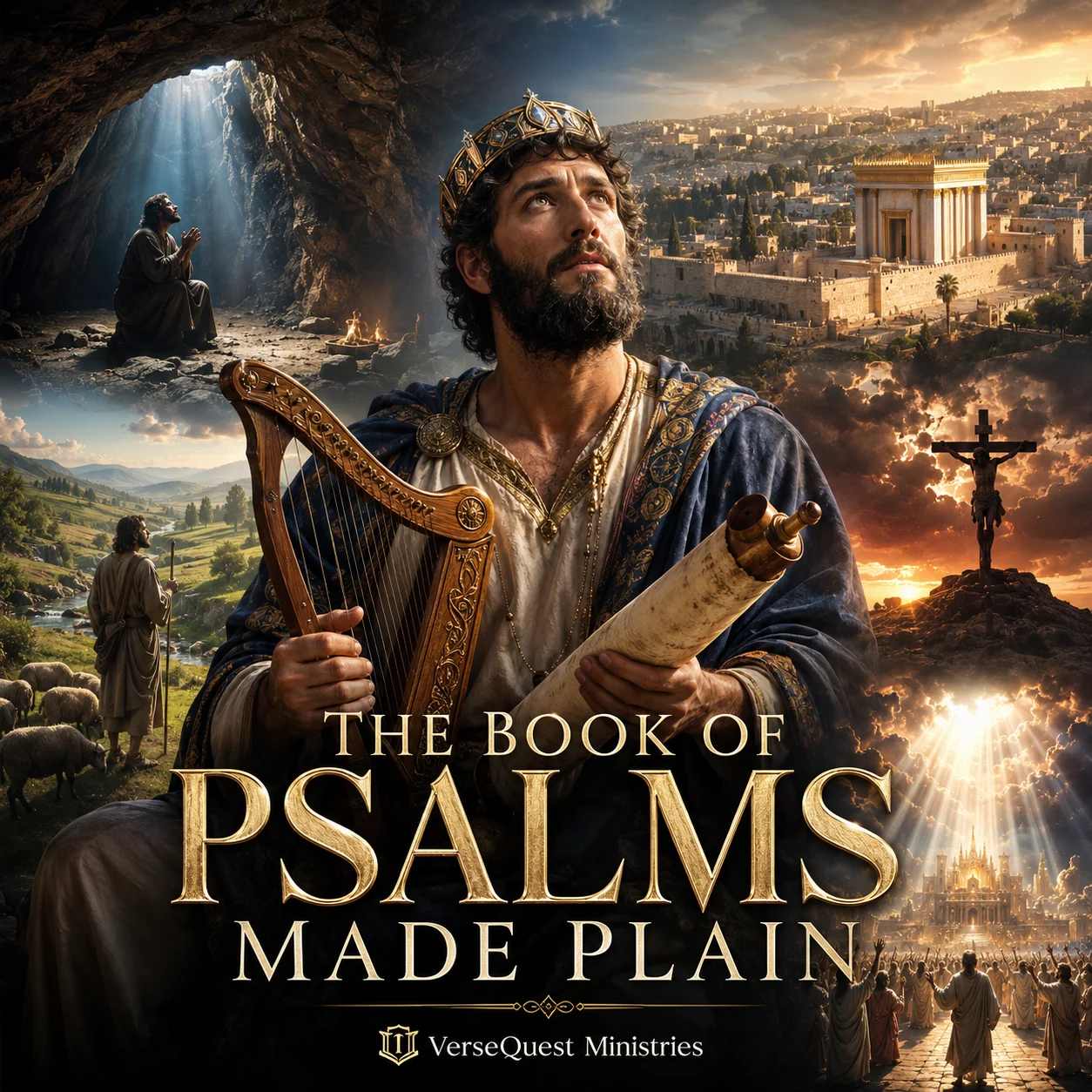
- The Book of Psalms Made Plain – 383-Page KJV Psalm Study
- The Book of Psalms Made Plain is a 383-page premium KJV Bible study featuring 54 detailed essays through the major themes, doctrines, prophecies, prayers, laments, and praises of the Psalms.…
- Original price was: $29.99.$9.99Current price is: $9.99.
- Add to cart
-
-67%
-
Rightly Divided
-
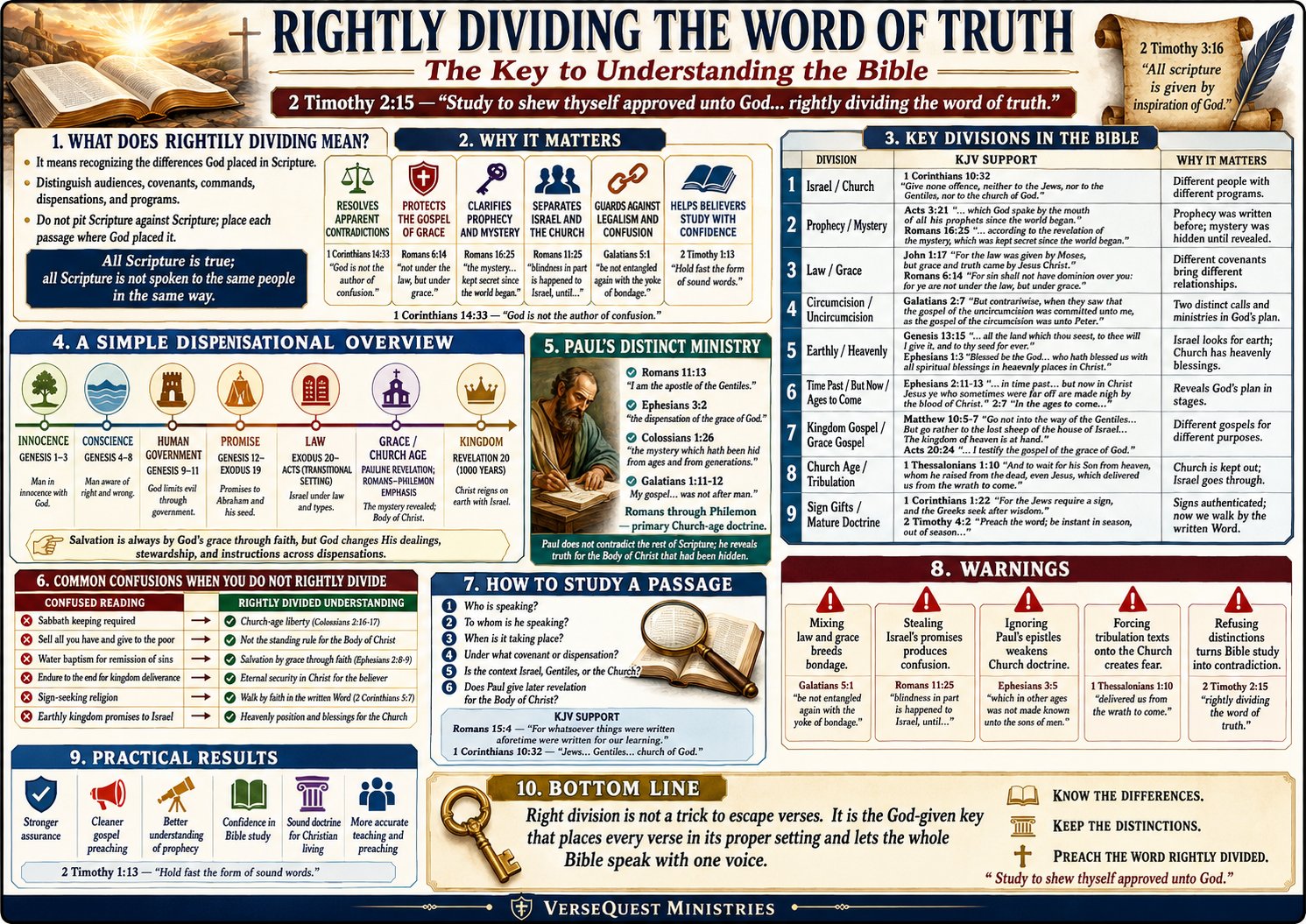
- Rightly Dividing the Word of Truth – KJV Bible Study Chart
- A premium KJV Bible study chart explaining how to rightly divide the word of truth, distinguish key biblical divisions, and study Scripture with clarity and confidence.
- $3.99
- Add to cart
-
-
Bible Study Chart
-
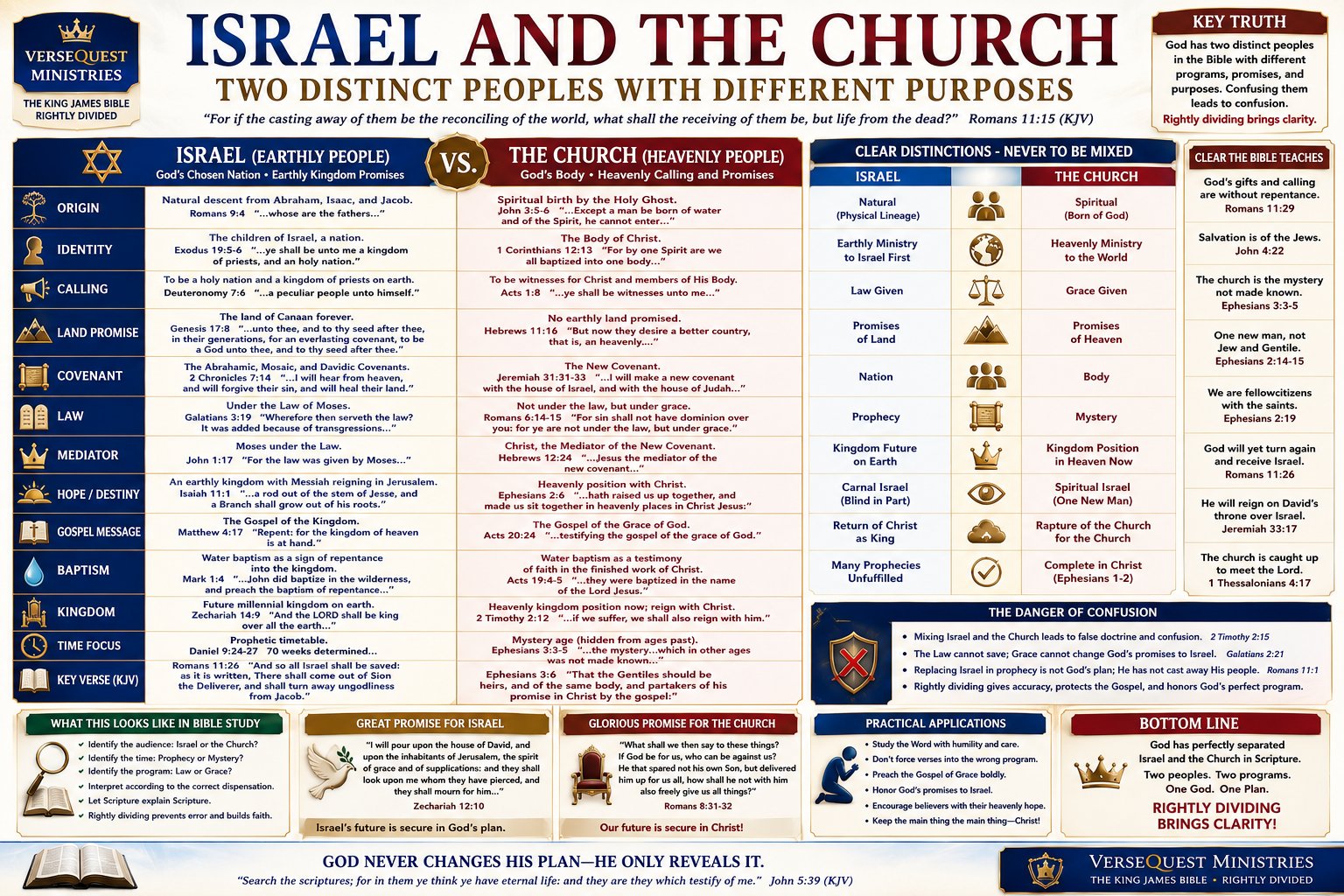
- Israel and the Church Bible Study Chart – Two Distinct Peoples with Different Purposes (KJV)
- Compare Israel and the Church with this detailed KJV Bible study chart covering their distinct origins, identities, covenants, callings, promises, gospel programs, and future destinies.
- $3.99
- Add to cart
-
-
The Gospel of the Kingdom
-
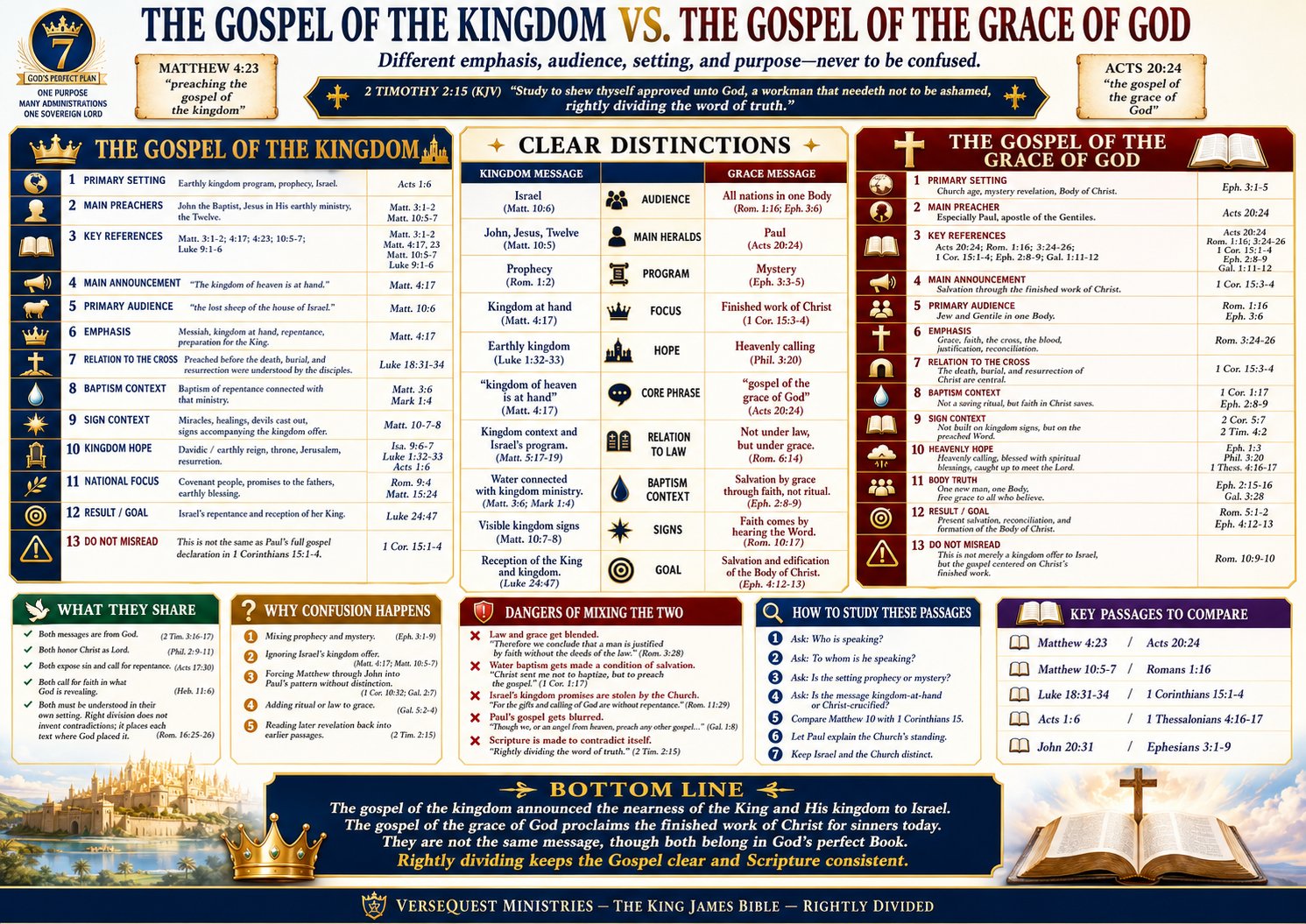
- The Gospel of the Kingdom vs. the Gospel of the Grace of God – KJV Right Division Bible Study Chart
- Compare the gospel of the kingdom and the gospel of the grace of God with this detailed KJV chart covering audience, message, prophecy, mystery, baptism, signs, salvation, and right division.
- $3.99
- Add to cart
-
-
Law vs Grace
-
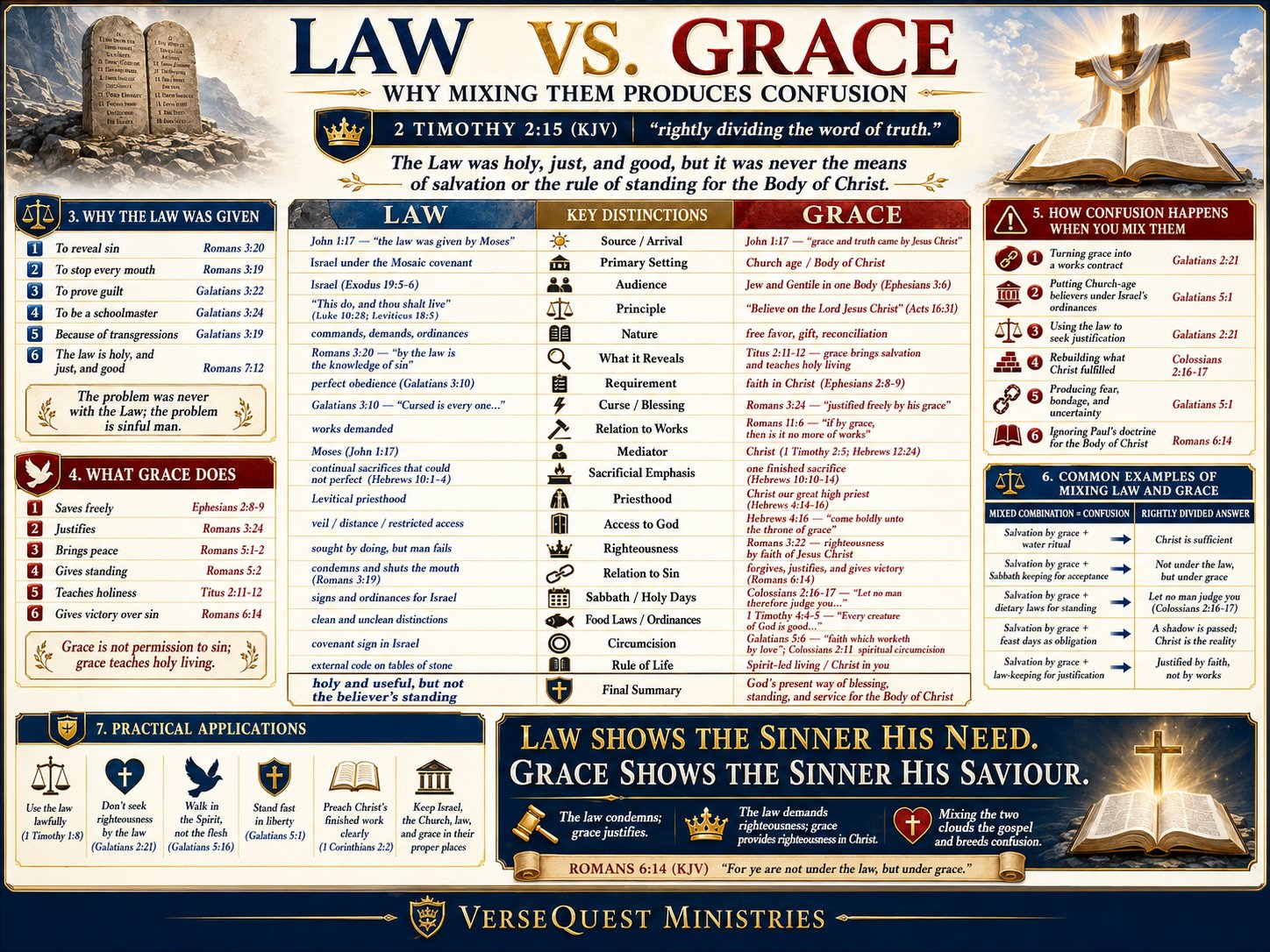
- Law vs. Grace Bible Study Chart – Why Mixing Them Produces Confusion (KJV)
- Compare law and grace with this detailed KJV Bible study chart explaining salvation, justification, holiness, Israel’s Mosaic covenant, Christian liberty, and the danger of mixing law with the gospel.
- $3.99
- Add to cart
-