
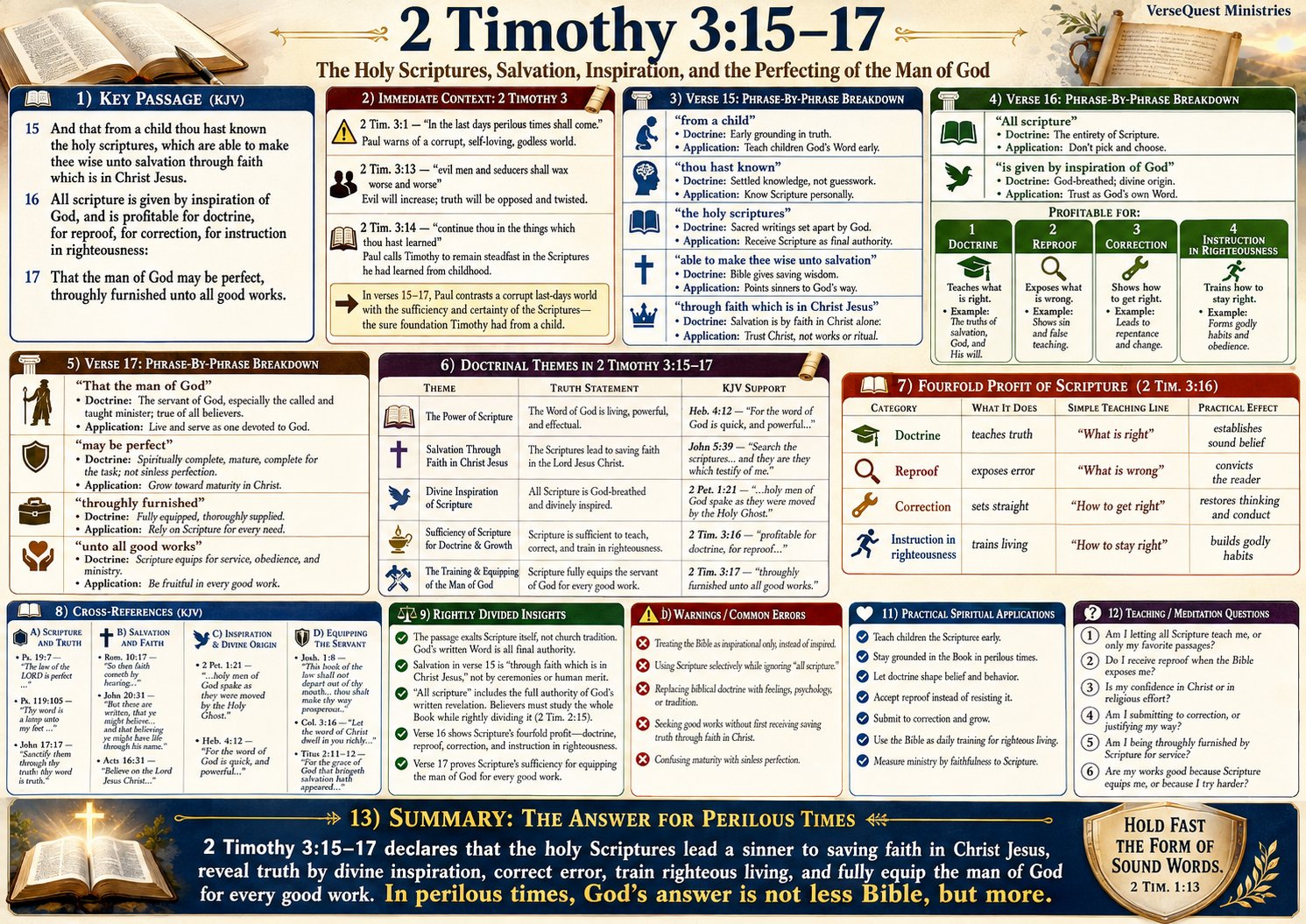
2 Timothy 3:15–17 – The Holy Scriptures, Salvation, Inspiration, and the Perfecting of the Man of God (KJV Bible Study Chart)
Study 2 Timothy 3:15–17 with this detailed KJV chart covering the Holy Scriptures, salvation through faith in Christ, divine inspiration, doctrine, reproof, correction, instruction in righteousness, spiritual maturity, and preparation for every good work.
$3.99
Description
2 Timothy 3:15–17: The Holy Scriptures, Salvation, Inspiration, and the Perfecting of the Man of God is a detailed KJV Bible study chart examining one of Scripture’s clearest declarations concerning the saving wisdom, divine inspiration, complete authority, practical profit, and spiritual sufficiency of the written Word of God.
Built around the complete text of 2 Timothy 3:15–17, this chart explains how the Holy Scriptures direct sinners to saving faith in Jesus Christ, reveal truth by divine inspiration, expose error, correct wrong thinking and conduct, train believers in righteousness, and thoroughly furnish the servant of God for every good work.
The passage appears within Paul’s warning concerning the perilous conditions of the last days. Second Timothy 3 describes self-loving, proud, unthankful, unholy, pleasure-loving people who possess a form of godliness while denying its power. Paul also warns that evil men and seducers will wax worse and worse, deceiving and being deceived.
God’s answer to a worsening world is not less Scripture, softer doctrine, religious entertainment, human philosophy, or dependence upon cultural approval. Paul directs Timothy back to the truths he had learned and to the Holy Scriptures he had known from childhood.
The chart begins with the full King James Bible text of the passage. Verse 15 declares, “And that from a child thou hast known the holy scriptures, which are able to make thee wise unto salvation through faith which is in Christ Jesus.”
The words “from a child” emphasize the importance of early biblical instruction. Timothy’s knowledge of Scripture did not begin after he entered public ministry. The Word had been placed before him from childhood through the influence of his mother Eunice and grandmother Lois.
This truth presents a direct responsibility to Christian parents, grandparents, churches, and teachers. Children should not be left spiritually empty while the world fills their minds with unbelief, confusion, sensuality, pride, and falsehood. They should be taught the Word of God early, consistently, plainly, and faithfully.
Early exposure to Scripture does not save automatically. A child may know Bible stories, attend church, memorize verses, and still need personally to believe on Jesus Christ. Yet biblical training provides the truth through which faith may come and spiritual wisdom may develop.
The phrase “thou hast known” presents settled knowledge rather than vague religious feeling. Timothy had received definite words, identifiable truth, and a reliable scriptural foundation.
Christian faith is not guesswork, superstition, emotional imagination, or confidence in religious tradition. God has spoken in written words that may be known, read, studied, believed, taught, compared, memorized, and obeyed.
The phrase “the holy scriptures” identifies the written Word as sacred, separated, and given by God. Scripture is not merely inspiring literature, ancient religious reflection, or the private opinions of spiritual men.
The Scriptures are holy because their source is holy, their truth is pure, their message is authoritative, and their purpose is connected with the revelation and will of God.
The chart explains that the Scriptures are “able to make thee wise unto salvation.” The Bible exposes the sinner’s condition, reveals God’s holiness, explains the penalty of sin, presents the Person and work of Jesus Christ, and directs the hearer toward the only true Saviour.
Scripture does not save apart from Jesus Christ. The Bible does not call sinners to worship a physical book as an object. It reveals the Christ who saves and gives the inspired testimony upon which saving faith rests.
Salvation comes “through faith which is in Christ Jesus.” The sinner is not saved through biblical knowledge alone, religious effort, church membership, water baptism, law-keeping, ceremonies, moral improvement, or family heritage.
The Scriptures make a person wise concerning salvation by directing him away from self and toward Jesus Christ. Christ died for our sins, was buried, and rose again according to the Scriptures. The sinner receives eternal life by believing on Him.
The chart moves next to verse 16: “All scripture is given by inspiration of God.” The word “all” forbids the believer from treating only selected passages as authoritative while dismissing difficult, unpopular, corrective, prophetic, historical, or doctrinal portions.
All Scripture is true and profitable, though not every passage is addressed directly to the same people, under the same covenant, or within the same dispensation. Right division does not weaken inspiration. It allows every inspired passage to remain in the setting where God placed it.
The phrase “is given by inspiration of God” identifies the divine source of Scripture. The Bible did not originate merely through human genius, religious experience, institutional decree, church tradition, or scholarly reconstruction.
God used human writers without surrendering the authorship and authority of His revelation. The words written are God’s words, communicated through men moved by the Holy Ghost.
Second Peter 1:21 explains that prophecy came not by the will of man, but holy men of God spoke as they were moved by the Holy Ghost. The personalities and circumstances of the writers remained real, but the resulting Scripture possesses divine authority.
Inspiration applies to the words of Scripture, not merely to vague religious ideas. Doctrine depends upon words, grammar, statements, distinctions, names, promises, warnings, and precise revelation.
The chart presents the fourfold profit of Scripture. The Bible is profitable “for doctrine.” Doctrine teaches what is right.
Doctrine identifies the truth concerning God, Jesus Christ, salvation, sin, grace, the Church, Israel, prophecy, the Christian walk, resurrection, judgment, eternity, and every major subject God has revealed.
Sound doctrine stabilizes believers. A Christian who refuses doctrine becomes vulnerable to persuasive personalities, emotional manipulation, popular religious trends, and every new wind of teaching.
Scripture is also profitable “for reproof.” Reproof exposes what is wrong. It reveals false doctrine, sinful conduct, impure motives, unbelief, hypocrisy, rebellion, and self-deception.
The Bible does not exist merely to affirm every feeling or approve every choice. It confronts the reader with God’s standard and identifies areas where belief or conduct contradicts truth.
Reproof is uncomfortable because pride prefers confirmation to exposure. Yet a Bible that never corrects the reader has either been ignored, softened, or placed beneath human opinion.
Scripture is profitable “for correction.” Correction shows how to get right. God’s Word does not merely expose failure and leave the believer in despair.
It straightens what has become crooked, restores truthful thinking, directs repentance, and supplies the biblical path back to obedience and fellowship.
Correction may require confession, forsaking sin, repairing damage, changing doctrine, ending compromise, receiving counsel, or submitting an established habit to Scripture.
Scripture is also profitable “for instruction in righteousness.” Instruction teaches the believer how to remain and grow in what is right.
Christian living requires more than occasional crisis correction. The believer needs continual training in holiness, wisdom, prayer, speech, relationships, service, discernment, stewardship, endurance, and obedience.
Instruction in righteousness forms godly habits. The Word teaches believers not only how to escape a particular failure but how to develop a life increasingly governed by truth.
The fourfold pattern is memorable. Doctrine teaches what is right. Reproof exposes what is wrong. Correction shows how to get right. Instruction in righteousness teaches how to stay right.
These four functions make Scripture personally practical. The Bible addresses belief, error, restoration, and continued growth. It does not merely provide historical information or religious discussion.
Verse 17 explains the purpose of this scriptural profit: “That the man of God may be perfect.” The phrase “the man of God” applies especially to the servant entrusted with teaching and ministry, but the principle of scriptural equipping extends to every believer.
The Christian worker must be formed by Scripture rather than trends, marketing, charisma, psychology, political ideology, or institutional pressure.
The phrase “may be perfect” does not teach sinless perfection in the present body. The word presents the idea of spiritual maturity, completeness, fitness, and readiness for the assigned work.
A believer may be complete for service without becoming incapable of temptation or failure. Scripture develops maturity by shaping doctrine, character, judgment, priorities, and obedience.
The Christian should never use the promise of spiritual equipping to claim that he no longer sins. First John warns believers against claiming sinless perfection, while the epistles repeatedly command confession, growth, correction, and vigilance.
The next phrase is “throughly furnished.” The spelling and wording of the King James Bible communicate complete and thorough equipment.
Scripture does not provide a partial foundation that must be completed by human philosophy, mystical revelation, church tradition, or cultural ideology. It supplies the servant of God with the truth necessary for doctrine, discernment, correction, holy living, and faithful ministry.
The sufficiency of Scripture does not mean the believer should reject teachers, pastors, study tools, or fellowship. God uses these means, but every teacher and resource must remain beneath the final authority of the written Word.
A preacher is useful only as he teaches Scripture faithfully. A commentary helps only when it clarifies rather than corrects the Bible. Tradition is acceptable only where it agrees with God’s Word.
The phrase “unto all good works” places Christian works after salvation and scriptural equipping. Good works do not save the sinner, but they should mark the life of the saved believer.
Ephesians 2:8–10 teaches that salvation is by grace through faith and not of works, while also declaring that believers are created in Christ Jesus unto good works.
Scripture prepares the believer to serve, teach, witness, pray, endure, minister, show mercy, defend truth, resist sin, strengthen others, and glorify God.
The man of God is not furnished merely to collect information. Knowledge should produce faithful service. The Bible enters the mind, settles in the heart, corrects the walk, and equips the hands.
The chart develops several major doctrinal themes found in the passage. The first is the power of Scripture. Hebrews 4:12 declares that the Word of God is quick, powerful, and sharper than any two-edged sword.
Scripture reaches beyond outward appearance and exposes the thoughts and intents of the heart. Human persuasion may influence conduct temporarily, but God’s Word works at the level of conscience, belief, and spiritual judgment.
The second theme is salvation through faith in Jesus Christ. John 5:39 records Christ directing people to search the Scriptures because they testify of Him.
The Bible’s saving wisdom is Christ-centred. Scripture does not teach that merely owning, reading, or admiring a Bible gives eternal life. It directs the sinner to believe the gospel.
The third theme is divine inspiration. God’s words possess authority because God is their source.
The fourth theme is the sufficiency of Scripture for doctrine, reproof, correction, instruction, and ministry preparation.
The fifth theme is the training and equipping of the man of God. Scripture produces servants capable of teaching truth, identifying error, applying correction, living righteously, and completing God-given work.
The chart includes grouped KJV cross-references. Psalm 19 describes the law of the LORD as perfect, converting the soul. Psalm 119 calls God’s Word a lamp unto the feet and a light unto the path.
John 17:17 records Christ praying, “Sanctify them through thy truth: thy word is truth.” The believer’s growth in holiness is inseparable from God’s written truth.
Romans 10:17 teaches that faith comes by hearing and hearing by the Word of God. Acts 16:31 gives the saving message: “Believe on the Lord Jesus Christ, and thou shalt be saved.”
Second Peter 1:21 explains divine inspiration. Hebrews 4:12 describes the living and penetrating power of the Word.
Joshua 1:8 connects meditation upon Scripture with obedient living. Colossians 3:16 commands believers to let the Word of Christ dwell in them richly.
Titus 2 teaches that grace produces godly living, while Scripture provides the truth through which that grace is understood and applied.
The chart includes several rightly divided insights. The passage exalts Scripture rather than church tradition, institutional authority, religious experience, or scholarly opinion.
God’s written Word remains the final authority. Believers should listen respectfully to teachers but test every teaching through Scripture.
Verse 15 teaches salvation through faith in Christ Jesus, not through religious ceremonies, personal righteousness, or human merit.
Verse 16 includes the whole body of inspired Scripture. Believers must study the entire Bible while recognizing the distinctions God placed within it.
Not every command was given directly to the Body of Christ, but every Scripture remains inspired, true, and profitable when interpreted according to its context.
Verse 16’s fourfold profit applies truth to both belief and behaviour. Doctrine without application produces barren knowledge, while application without doctrine becomes unstable religious activity.
Verse 17 establishes Scripture’s sufficiency for equipping the man of God. Ministry does not become spiritually effective by moving away from the Bible.
The chart warns against several common errors. One error is treating the Bible as merely inspirational rather than inspired.
A human speech may inspire emotion. Scripture is inspired in the sense that it has been given by God and carries His authority.
Another error is using Scripture selectively while ignoring the words that confront cherished doctrine, tradition, lifestyle, or institutional practice.
The believer must not pick and choose which verses remain authoritative according to personal comfort.
Another error is replacing biblical doctrine with feelings, philosophy, entertainment, or inherited tradition. Feelings may be sincere and still wrong. Tradition may be old and still unscriptural.
The chart also warns against seeking good works before receiving salvation through faith in Christ. Good works cannot create the new birth or justify the sinner.
A person may become religiously active while remaining spiritually dead. Salvation comes first; biblical service follows.
Another danger is confusing spiritual maturity with sinless perfection. The mature believer is not someone who claims he no longer sins, but someone increasingly governed by Scripture, humility, confession, discernment, and obedience.
The practical applications are direct. Parents and churches should teach children the Scriptures early. Believers should remain grounded in the Bible during perilous times.
Doctrine should shape both belief and behaviour. Christians should accept scriptural reproof rather than resisting it.
They should submit to correction and continue receiving instruction in righteousness. The Bible should function as daily training rather than an emergency object opened only during crisis.
Ministry should be measured by faithfulness to Scripture. A large audience does not prove biblical accuracy, and a polished presentation cannot replace sound doctrine.
The chart also supplies questions for teaching and meditation. Is the believer allowing all Scripture to teach him, or only favourite passages? Does he receive reproof when the Bible exposes error?
Is his confidence resting in Jesus Christ or religious effort? Is he submitting to correction or defending his own way?
Is Scripture furnishing him for service, or is he depending upon personality, experience, and human strength?
Are his good works the fruit of scriptural equipping and salvation by grace, or an attempt to earn acceptance?
The final summary identifies 2 Timothy 3:15–17 as God’s answer for perilous times. The Holy Scriptures lead sinners to saving faith in Christ, reveal truth by divine inspiration, correct error, train righteous living, and fully equip the servant of God.
The answer to increasing deception is not less Bible but more. The answer to false doctrine is Scripture. The answer to spiritual immaturity is Scripture. The answer to confusion, weak preaching, compromised churches, and unprepared believers is a renewed submission to the written Word of God.
This resource is ideal for personal Bible study, KJV defense, inspiration and preservation teaching, new-believer discipleship, Christian education, pastoral training, Scripture-sufficiency studies, Sunday school, homeschool Bible curriculum, Christian schools, Bible institutes, sermon preparation, family devotions, and ministry-leadership instruction.
2 Timothy 3:15–17, Holy Scriptures, inspiration of Scripture, all Scripture is profitable, salvation through faith in Christ, doctrine, reproof, correction, instruction in righteousness, perfect man of God, thoroughly furnished, good works, sufficiency of Scripture, authority of the Bible, Scripture in perilous times, teaching children the Bible, rightly dividing Scripture, KJV Bible study, sound doctrine, biblical equipping
Second Timothy 3:15–17 appears within Paul’s warning about perilous last-days conditions, deception, false religion, and worsening evil.
Paul directs Timothy to continue in the truth he had learned rather than follow the surrounding decline.
Timothy had known the Scriptures from childhood, demonstrating the importance of early biblical instruction.
Knowing Scripture intellectually is not identical to salvation, but Scripture provides the truth that makes a person wise concerning salvation.
Salvation is through faith in Jesus Christ, not through works, ceremonies, family heritage, or biblical knowledge alone.
The Scriptures testify of Christ and reveal the gospel through which sinners believe.
The expression “holy scriptures” identifies the written Word as sacred, authoritative, and separated unto God.
The word “all” includes every inspired portion of Scripture and rejects selective submission.
All Scripture is true and profitable, though every passage must be interpreted according to audience, covenant, setting, and dispensation.
Inspiration means Scripture has been given by God rather than originating through human will alone.
God used human writers while preserving the divine authority and truth of the written revelation.
Inspiration applies to the words of Scripture and not merely to general religious concepts.
Doctrine teaches what is right.
Reproof exposes what is wrong.
Correction shows how to get right.
Instruction in righteousness teaches how to stay right and grow in obedience.
The Bible addresses both belief and conduct.
Reproof should not be rejected merely because it is uncomfortable.
Correction demonstrates that God’s purpose is restoration rather than exposure alone.
Instruction develops stable habits of righteousness.
The phrase “man of God” applies especially to God’s servant but provides a principle of equipping for every believer.
The word “perfect” means mature, complete, properly fitted, and ready for the work rather than sinlessly flawless.
The phrase “throughly furnished” presents complete scriptural equipment for Christian service.
Scripture is sufficient as the final authority for doctrine, correction, righteousness, and ministry.
Teachers, commentaries, pastors, and study resources remain helpful only when subordinate to Scripture.
Good works follow salvation and scriptural equipping; they do not purchase eternal life.
The Bible does not merely provide information. It prepares believers for obedient service.
Right division does not weaken the authority of Scripture. It prevents inspired passages from being misapplied.
Scripture should not be replaced with psychology, philosophy, tradition, religious entertainment, or human opinion.
Believers must not call the Bible merely inspirational while denying that it is divinely inspired.
Maturity should not be confused with sinless perfection.
The believer should permit Scripture to teach, expose, correct, and train him continually.
In perilous times, God’s answer is not less Bible, but more.
Second Timothy Bible studies, inspiration-of-Scripture teaching, Bible-authority classes, Scripture-sufficiency studies, KJV defense, teaching children the Bible, Christian education, doctrine and discipleship, pastoral training, ministry preparation, explaining doctrine and reproof, correction and restoration, righteous-living instruction, new-believer classes, family devotions, Sunday school lessons, homeschool Bible curriculum, Christian school teaching, Bible institute instruction, sermon preparation
King James Bible, Strong’s Concordance, Thompson Chain-Reference Bible, Treasury of Scripture Knowledge, Nave’s Topical Bible, Second Timothy study notes, Bible inspiration and preservation resources, Scripture-memory cards, doctrinal review worksheets, right-division study materials, Bible-reading plans, Christian-education guides, pastoral-training resources, family devotional materials, Pauline epistle outlines, VerseQuest Bible-authority and doctrine charts
Related products
-
Hath God Said
-
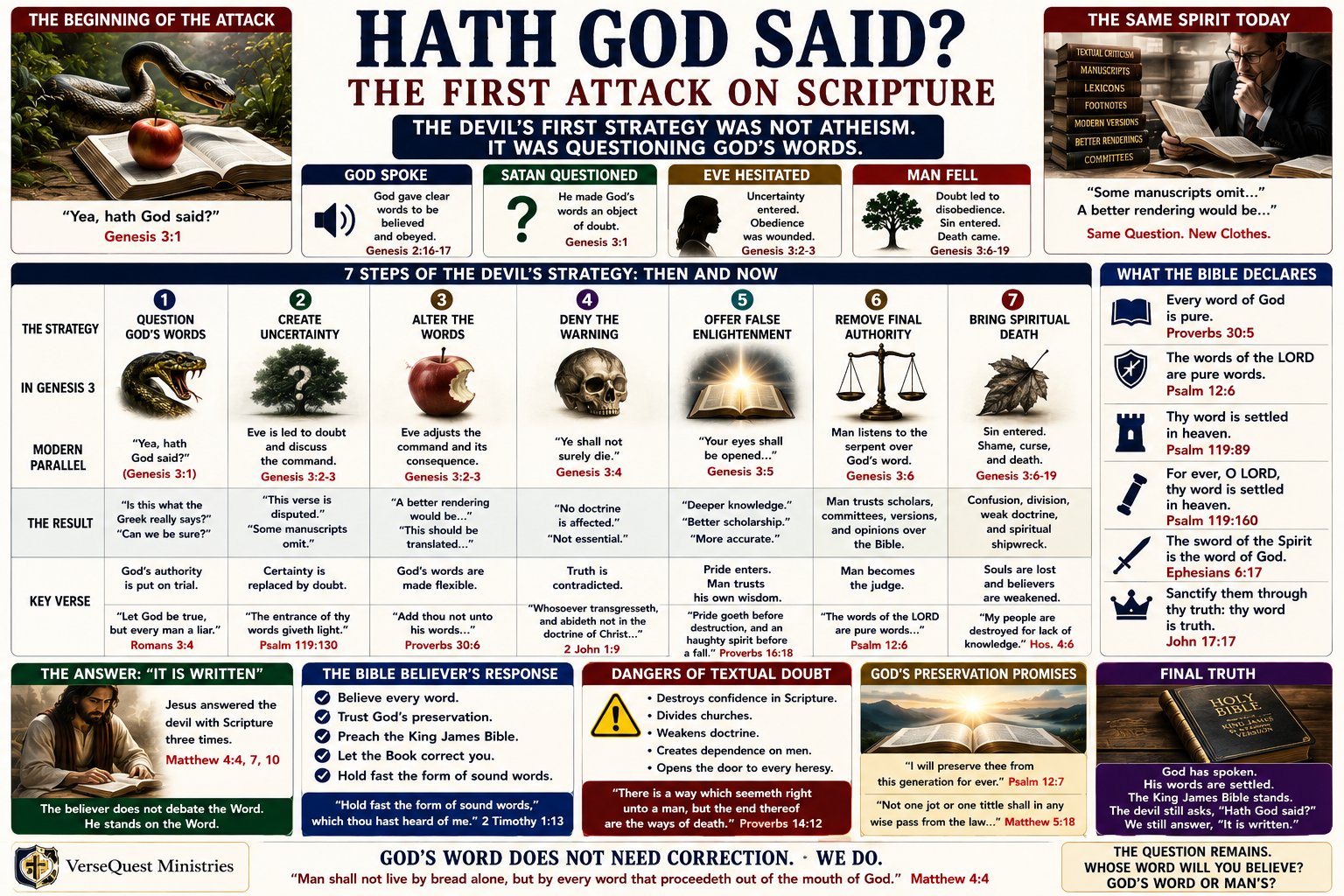
- Hath God Said? Bible Study Chart – The First Attack on Scripture, Textual Doubt, and KJV Preservation
- Trace Satan’s first attack on Scripture with this detailed KJV Bible study chart covering Genesis 3:1, textual doubt, altered words, false enlightenment, Bible preservation, and final authority.
- $3.99
- Add to cart
-
-
True Worship vs False Worship
-
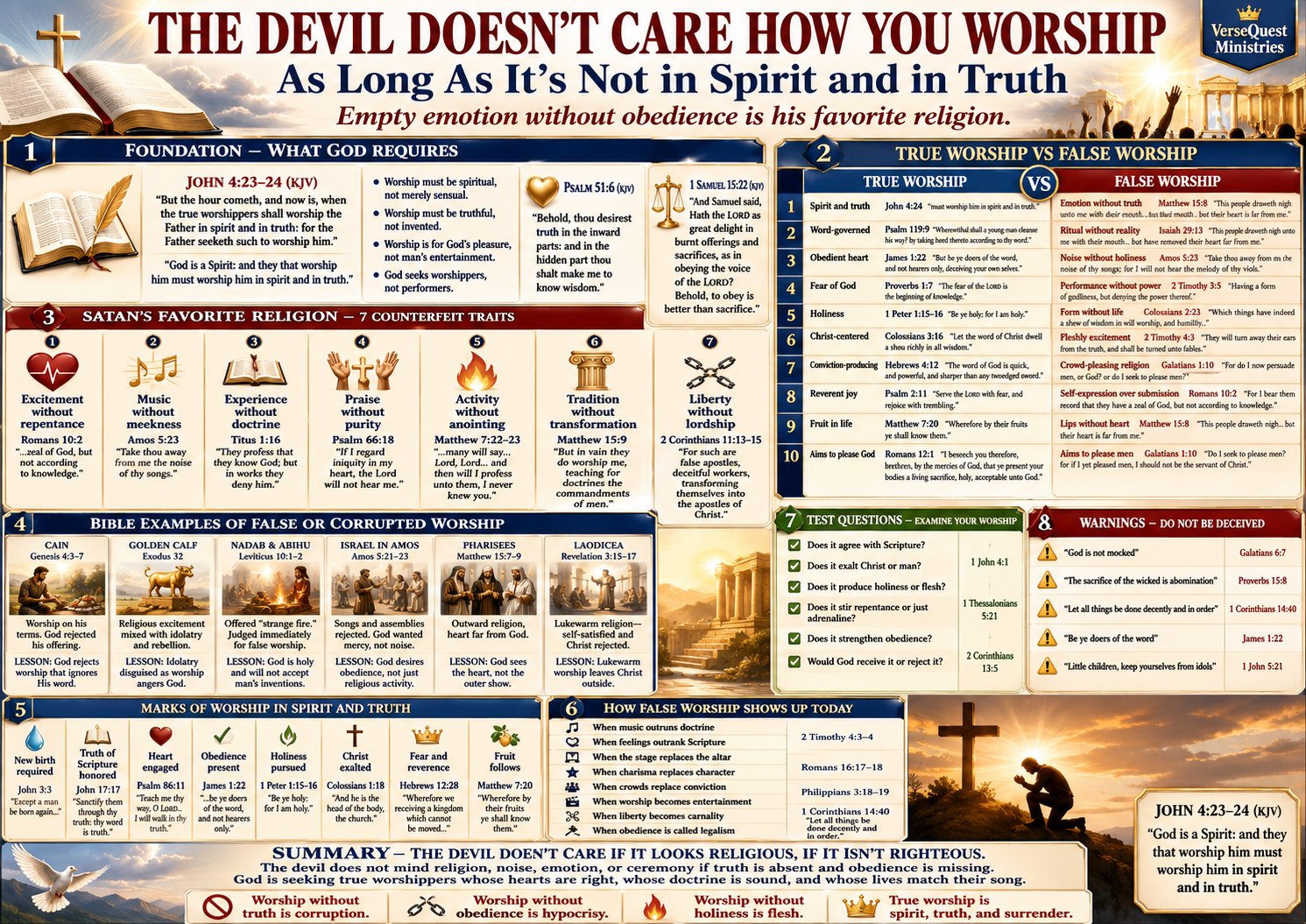
- The Devil Doesn’t Care How You Worship – True Worship in Spirit and in Truth Versus False Religion (KJV Bible Study Chart)
- Examine true and false worship with this detailed KJV Bible study chart covering spirit and truth, counterfeit religion, biblical music, obedience, holiness, discernment, and Christ-centred praise.
- $3.99
- Add to cart
-
-
Prayer
-
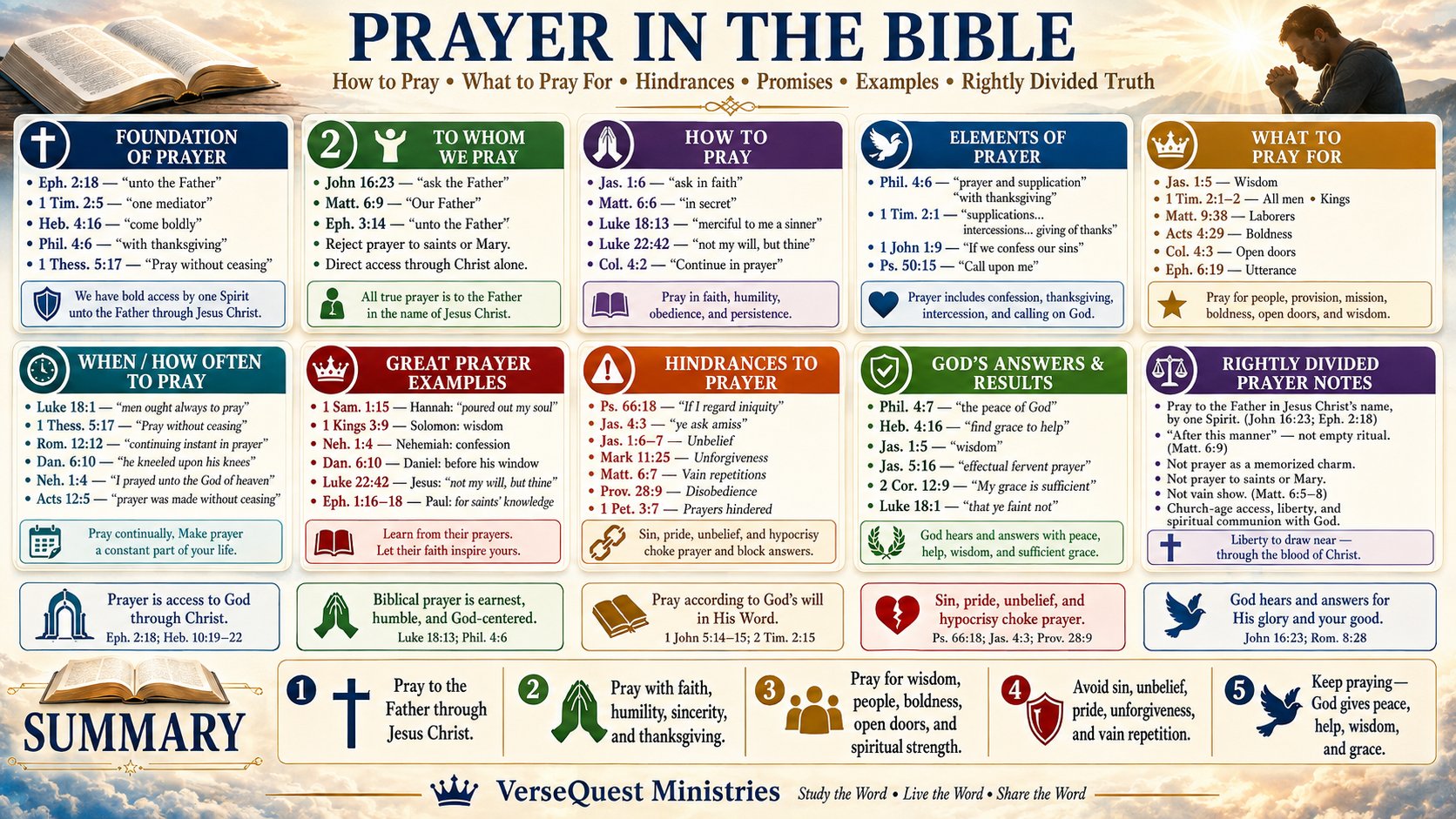
- Prayer in the Bible Chart – How to Pray According to Scripture
- Discover what the Bible teaches about prayer through this easy-to-follow VerseQuest study chart. Learn who to pray to, how to pray, what hinders prayer, what to pray for, and key…
- $4.99
- Add to cart
-
-
Christian Living
-
-50%
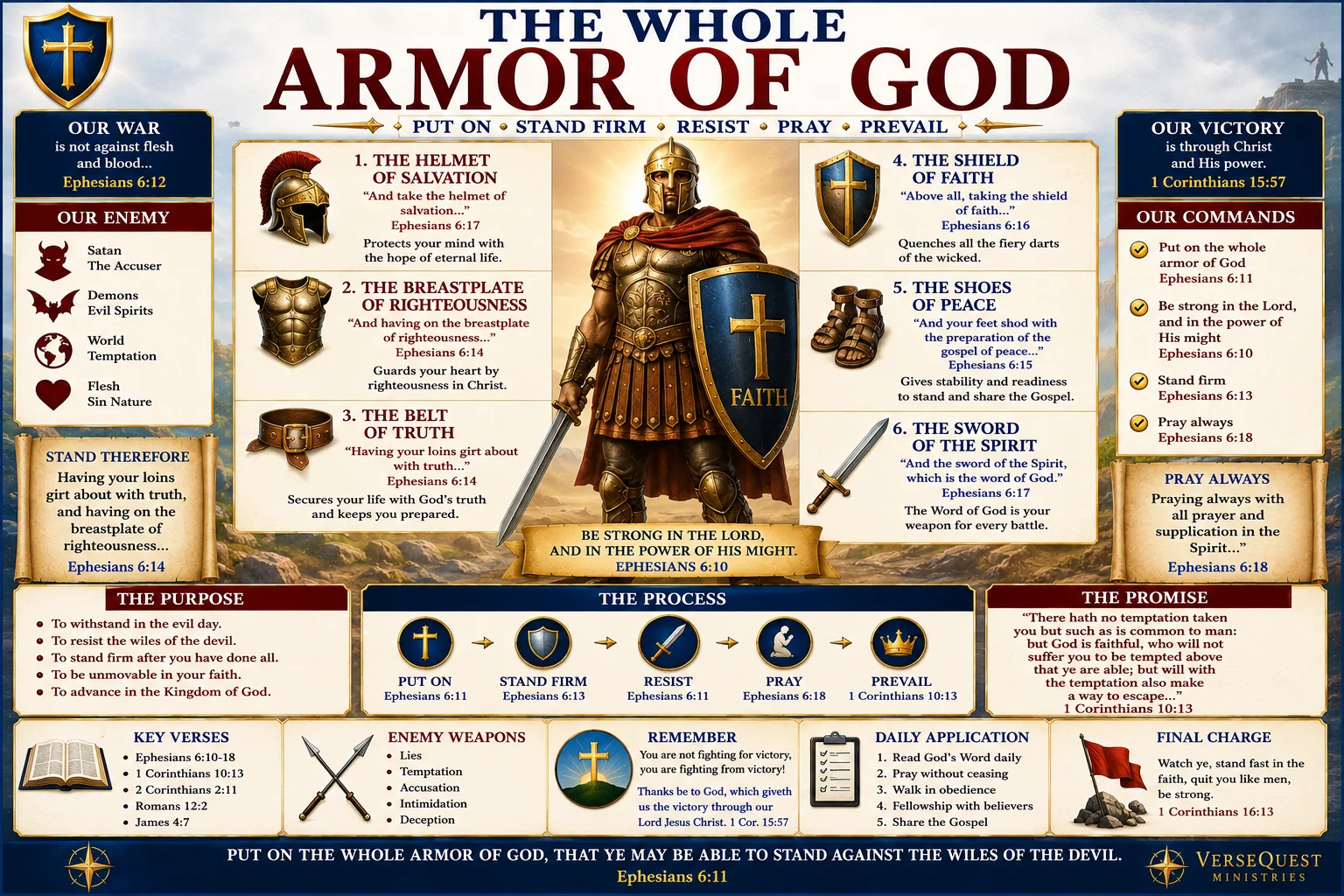
- The Whole Armor of God Chart — KJV Bible Study
- Premium printable KJV Bible study chart explaining the whole armor of God from Ephesians 6, including the helmet, breastplate, belt, shield, shoes, sword, prayer, and spiritual victory in Christ.
- Original price was: $10.00.$4.99Current price is: $4.99.
- Add to cart
-
-50%
-
Biblical Humility
-
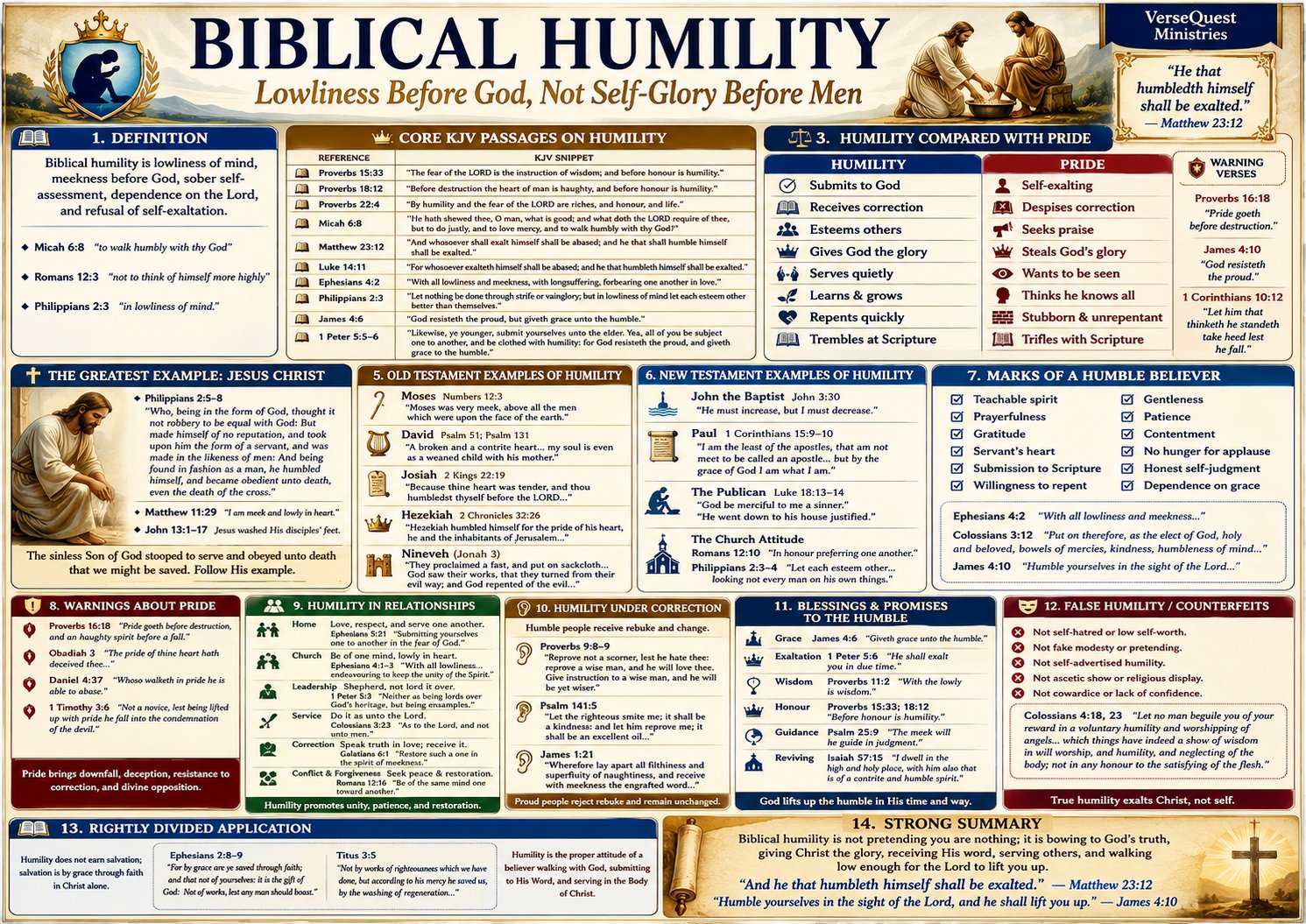
- Biblical Humility Bible Study Chart – Lowliness Before God, Not Self-Glory Before Men (KJV)
- Study biblical humility with this detailed KJV chart comparing humility and pride, Christ’s example, receiving correction, servant leadership, grace, and practical Christian living.
- $3.99
- Add to cart
-