
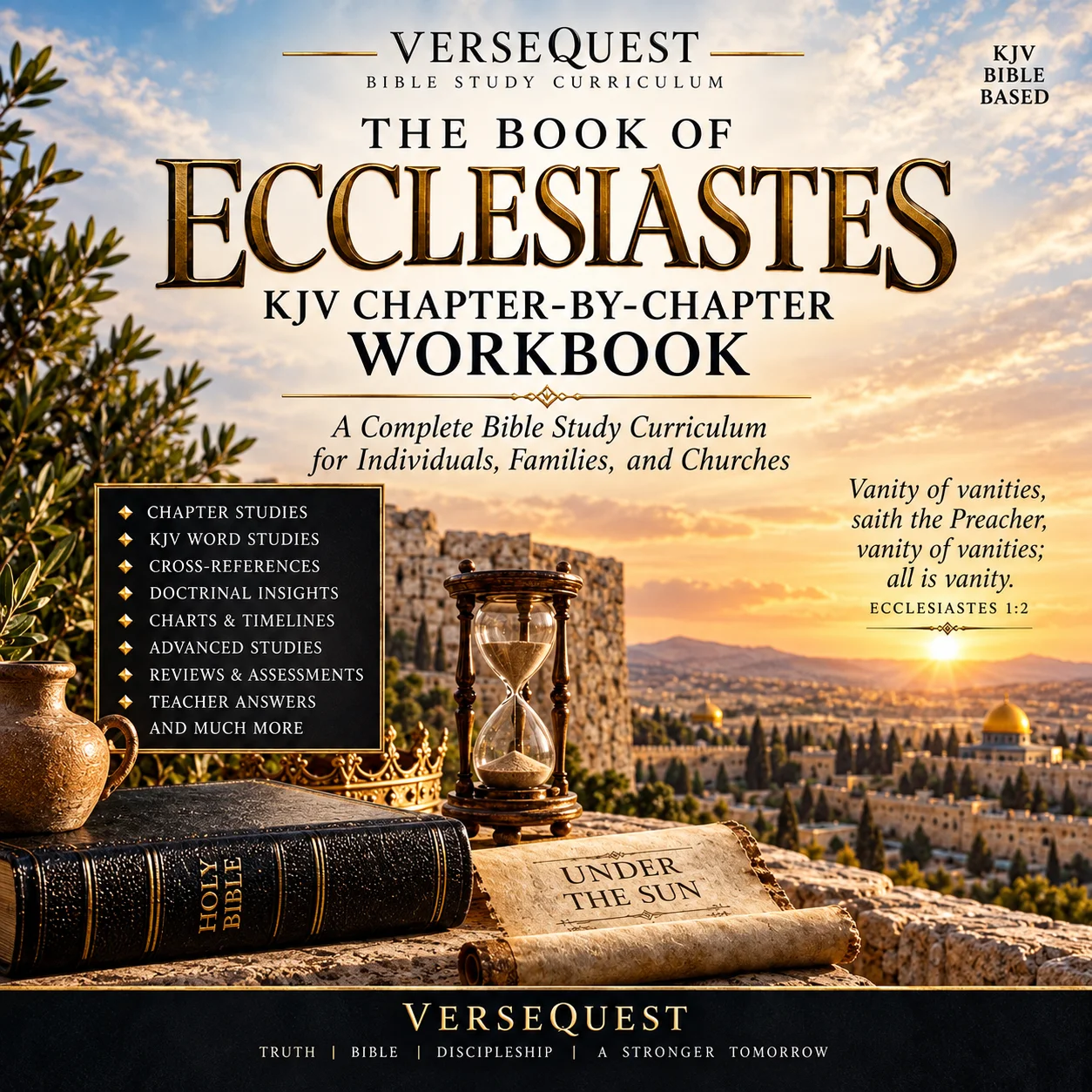
The Book of Ecclesiastes KJV Chapter-by-Chapter Workbook
The Ecclesiastes KJV Chapter-by-Chapter Workbook is a complete 500-page downloadable PDF curriculum covering all 12 chapters of Ecclesiastes. It systematically examines Solomon’s search for meaning through wisdom, pleasure, work, wealth, achievement, time, adversity, mortality, and life “under the sun,” while leading the student toward the book’s final conclusion: fear God and live in view of judgment.
The workbook includes detailed chapter studies, KJV word studies, cross-references, doctrine and right division, difficult-passage studies, personal study areas, 25 advanced studies and worksheets, 24 master charts, reviews, assessments, glossary material, indexes, teaching tools, a final project, and certificate of completion.
Designed for serious Bible students, homeschool families, pastors, teachers, Sunday schools, churches, and independent learners, this $24.99 digital workbook is built to help the student understand not only what Ecclesiastes says, but how its difficult statements fit within the whole counsel of Scripture.
$24.99
Description
The Ecclesiastes KJV Chapter-by-Chapter Workbook is a complete 500-page downloadable PDF Bible-study curriculum designed to lead serious students systematically through all 12 chapters of Ecclesiastes. Rather than treating the book as a collection of gloomy sayings about the meaninglessness of life, this workbook follows Solomon’s great investigation of life “under the sun” and carefully distinguishes his observations, experiments, frustrations, conclusions, and the final truth with which the book closes.
Ecclesiastes records the testimony of a man uniquely qualified to test what the world promises will satisfy the human heart. Solomon possessed wisdom, wealth, authority, possessions, servants, houses, gardens, entertainment, achievement, reputation, and access to nearly every earthly pleasure imaginable. Yet again and again he encounters the same verdict: “Vanity of vanities, saith the Preacher, vanity of vanities; all is vanity” (Ecclesiastes 1:2). The workbook follows that investigation chapter by chapter and asks why wisdom, pleasure, labour, riches, success, reputation, youth, and even long life cannot provide the ultimate answer apart from God.
One of the most important features of this course is its treatment of the repeated expression “under the sun.” Ecclesiastes contains statements concerning life, death, the grave, knowledge, work, chance, prosperity, adversity, and human limitation that can be badly misused when isolated from Solomon’s viewpoint and the rest of Scripture. The workbook therefore trains the student to ask what Solomon is observing, what he is concluding from earthly experience, what the immediate passage actually states, and what the fuller revelation of Scripture establishes.
All 12 chapters receive detailed study covering close KJV observation, chapter structure, key expressions, word studies, doctrine and right division, cross-references, difficult passages, interpretive distinctions, practical applications, review questions, teaching exercises, and substantial space for personal notes. Special attention is given to major passages such as the search for satisfaction in Ecclesiastes 2, the times and seasons of Ecclesiastes 3, worship and vows in Ecclesiastes 5, wisdom and adversity in Ecclesiastes 7, the difficult statements concerning the dead in Ecclesiastes 9, sowing and uncertainty in Ecclesiastes 11, and the remarkable description of aging and death in Ecclesiastes 12.
The workbook also moves beyond the standard chapter studies with 25 advanced studies and worksheets, 24 master charts and analysis tools, cumulative review material, final assessments with answer guidance, an expanded Ecclesiastes KJV glossary, indexes, teaching aids, course-use tools, a final teaching project, and a certificate of completion. Its master-study framework traces major themes such as vanity, “under the sun,” labour, wisdom, pleasure, riches, oppression, time, mortality, judgment, enjoyment as a gift from God, youth, aging, and the fear of God.
The course is intentionally KJV-centered and rightly divided. It teaches the student to compare Scripture with Scripture without allowing a difficult statement in Ecclesiastes to overthrow clearer revelation elsewhere. This is especially important in passages sometimes used to support soul sleep, uncertainty about the afterlife, or other doctrinal conclusions that go beyond Solomon’s immediate “under the sun” observation.
The book finally leads the student where Ecclesiastes itself leads: “Fear God, and keep his commandments: for this is the whole duty of man” (Ecclesiastes 12:13). The following verse adds the sobering reason: every work and every secret thing will be brought into judgment. The apparent pessimism of the book therefore has a purpose. Ecclesiastes dismantles confidence in everything temporary so that the reader can properly evaluate life in view of God and eternity.
This 500-page downloadable PDF can be used for personal Bible study, homeschool Bible curriculum, Sunday school, church Bible classes, discipleship, family study, sermon and lesson preparation, ministry training, or advanced independent study. At $24.99, it is designed to provide a complete working curriculum for anyone who wants to understand Ecclesiastes rather than merely quote its most familiar verses.
Vanity of Vanities — The repeated verdict upon earthly pursuits when treated as the final purpose of life. Life Under the Sun — Solomon’s recurring perspective of human life as observed within earthly experience. The Search for Profit — The question of what lasting gain man receives from labour, achievement, possessions, and earthly striving. Wisdom and Its Limits — Wisdom is better than folly, yet human wisdom cannot answer every question or escape mortality. Pleasure and Satisfaction — Solomon tests laughter, entertainment, possessions, accomplishments, and sensual gratification and discovers their inability to provide ultimate fulfilment. Labour and Toil — Work can be meaningful and productive while still becoming vanity when treated as the final source of identity or permanence. Wealth and the Love of Money — Riches may be possessed without being enjoyed and cannot prevent death or secure lasting satisfaction. Enjoyment as the Gift of God — Ecclesiastes repeatedly distinguishes frantic acquisition from the God-given ability to receive ordinary blessings gratefully. Time and Divine Ordering — Ecclesiastes 3 emphasizes seasons, purposes, limits, and God’s relation to time. Oppression and Injustice — The book honestly records the inequalities, abuses, and frustrations visible in earthly life. Mortality and Death — Death levels earthly distinctions and forces the reader to evaluate life beyond immediate success. The Spirit, Dust, and the Grave — Difficult passages are compared carefully with the rest of Scripture rather than used to construct isolated doctrines. Chance, Uncertainty, and Human Limitation — Man cannot predict or control every earthly event. Authority and Government — Kings, rulers, folly in leadership, obedience, oppression, and political responsibility appear repeatedly. Youth and Aging — The book moves from youthful opportunity to the physical decline of old age and the necessity of remembering the Creator before the evil days come. Judgment — Ecclesiastes ultimately places human conduct under divine accountability. The Fear of God — The conclusion of the book supplies the controlling answer to Solomon’s entire investigation. Observation Versus Final Revelation — The workbook repeatedly distinguishes Solomon’s immediate observation from fuller doctrinal revelation elsewhere in Scripture. Right Division — Statements are interpreted according to setting, audience, literary purpose, and later biblical revelation. Words of Truth — Ecclesiastes closes by emphasizing careful teaching, wisdom, the Shepherd, and the certainty of God’s final judgment.
Ecclesiastes should not be read as though every sentence were an isolated doctrinal statement. The controlling interpretive expression is “under the sun.” Solomon repeatedly describes what he observes within earthly existence: generations come and go, work is inherited by another, wisdom cannot prevent death, wealth cannot guarantee enjoyment, injustice occurs, wicked men sometimes prosper, and earthly outcomes do not always appear proportionate to conduct.
The book begins with the staggering declaration, “Vanity of vanities…all is vanity.” “Vanity” does not mean that nothing whatsoever has value. Ecclesiastes itself identifies wisdom as better than folly, companionship as better than isolation, a good name as valuable, prudent conduct as beneficial, and enjoyment of God’s gifts as legitimate. The book’s argument is that created things cannot bear the weight of becoming man’s final purpose.
Solomon’s experiment in chapter 2 is central. He tries mirth, pleasure, wine, great works, houses, vineyards, gardens, servants, possessions, silver, gold, music, achievement, and unrestricted desire. Few men could conduct such an experiment on Solomon’s scale. His verdict is therefore significant: abundance did not resolve the deeper problem.
Ecclesiastes 3 introduces divine ordering into the discussion. There is “a time to every purpose under the heaven.” Man does not control every season. God’s work exceeds human comprehension, and human beings encounter limitations that neither intelligence nor effort can remove.
The workbook must distinguish carefully between earthly observation and complete biblical revelation. This becomes especially important in Ecclesiastes 9. Statements such as “the dead know not any thing” occur within a discussion of earthly life “under the sun.” They should not be used to cancel clearer revelation concerning conscious existence after death, resurrection, heaven, hell, or future judgment.
Ecclesiastes repeatedly returns to the inability of riches to satisfy. The man who loves silver will not be satisfied with silver. Wealth can increase anxiety, disappear through calamity, pass to heirs, or remain unusable because its owner lacks the God-given ability to enjoy it. Possession and enjoyment are not identical.
The book also presents enjoyment positively when understood correctly. Eating, drinking, work, companionship, marriage, and ordinary earthly blessings may be received as gifts from God. Ecclesiastes does not advocate nihilism. It exposes idolatry of created things while teaching that those same things may be gratefully received in their proper place.
Chapter 7 deepens the argument through adversity. Mourning can teach what feasting cannot. Rebuke can profit where flattery cannot. Patience may be better than pride. Nostalgia is not automatically wisdom. Human righteousness, wisdom, and effort do not place man beyond the reach of a fallen world.
Ecclesiastes 11 joins uncertainty with responsibility. Because man cannot control the wind, rain, future, or mysterious work of God, he should not use uncertainty as an excuse for paralysis. He should sow, labour, act, and remember that rejoicing does not eliminate accountability.
Chapter 12 brings the experiment to its proper conclusion. The command is not merely to remember mortality but to “Remember now thy Creator in the days of thy youth.” The aging imagery progressively portrays bodily decline until the dust returns to the earth and the spirit returns unto God who gave it.
The closing verses interpret the entire book. Solomon’s search does not terminate in pleasure, cynicism, intellectualism, wealth, or despair. It terminates with “Fear God, and keep his commandments.” The reason follows immediately: God will bring every work into judgment, including every secret thing.
The ultimate lesson of Ecclesiastes is therefore not that life is meaningless. It is that life cannot be interpreted correctly when God is removed from the conclusion. Everything under the sun is temporary. God is not.
For personal Bible study, the workbook provides a systematic path through every chapter rather than encouraging isolated reading of familiar verses. Students can mark recurring expressions, examine key words, compare cross-references, work through difficult passages, record observations, and complete chapter reviews before moving forward.
For homeschool Bible curriculum, the 500-page format provides extensive written work, theme tracing, advanced studies, charts, review material, assessment, personal notes, and a final teaching project. Families can use it as an extended Ecclesiastes course rather than a short devotional study.
For Sunday school and church Bible classes, teachers can select chapter-study material, difficult-passage exercises, master charts, and advanced investigations according to the time available. The workbook’s structure makes it possible to teach Ecclesiastes sequentially while keeping each lesson connected to the book’s overall argument.
For sermon and lesson preparation, pastors and teachers can draw from chapter outlines, thematic studies, KJV vocabulary, cross-reference work, doctrinal distinctions, and major interpretive questions. The repeated attention to context helps prevent familiar Ecclesiastes passages from being detached from Solomon’s argument.
For discipleship and small groups, the contrast between temporary earthly pursuits and eternal accountability provides rich material for discussions about money, work, success, pleasure, disappointment, aging, mortality, contentment, priorities, and the fear of God.
For ministry training and advanced Bible study, Ecclesiastes provides an exceptional opportunity to teach interpretation. Students must learn that recording a statement in inspired Scripture does not mean every statement may be removed from its speaker, argument, perspective, and context and turned into a standalone doctrinal proposition.
The primary companion should always be an Authorized King James Bible, since every study is intended to drive the student back into the biblical text itself.
A KJV concordance is valuable for tracing repeated words and expressions such as vanity, labour, wisdom, folly, under the sun, portion, travail, profit, time, judgment, and fear God.
A KJV cross-reference Bible or cross-reference tool can help students extend the Scripture chains begun in the workbook and compare Ecclesiastes with Job, Psalms, Proverbs, the historical books, and the New Testament.
A reliable Bible dictionary may be used after contextual study to investigate historical customs, royal life, agriculture, ancient labour, vows, government, wealth, and difficult KJV vocabulary.
The Book of Proverbs is an essential companion because both books deal heavily with wisdom, folly, conduct, speech, wealth, work, rulers, and the fear of God, while Ecclesiastes repeatedly tests the limitations of wisdom within a fallen world.
The Psalms provide valuable comparisons concerning vanity, mortality, oppression, prosperity of the wicked, the brevity of life, judgment, and confidence in God.
The completed Proverbs KJV Chapter-by-Chapter Workbook and Psalms KJV Chapter-by-Chapter Workbook complement this course by providing additional VerseQuest study of biblical wisdom, worship, human experience, righteousness, and Scripture-to-Scripture interpretation.
Related products
-
Chart Collections
-
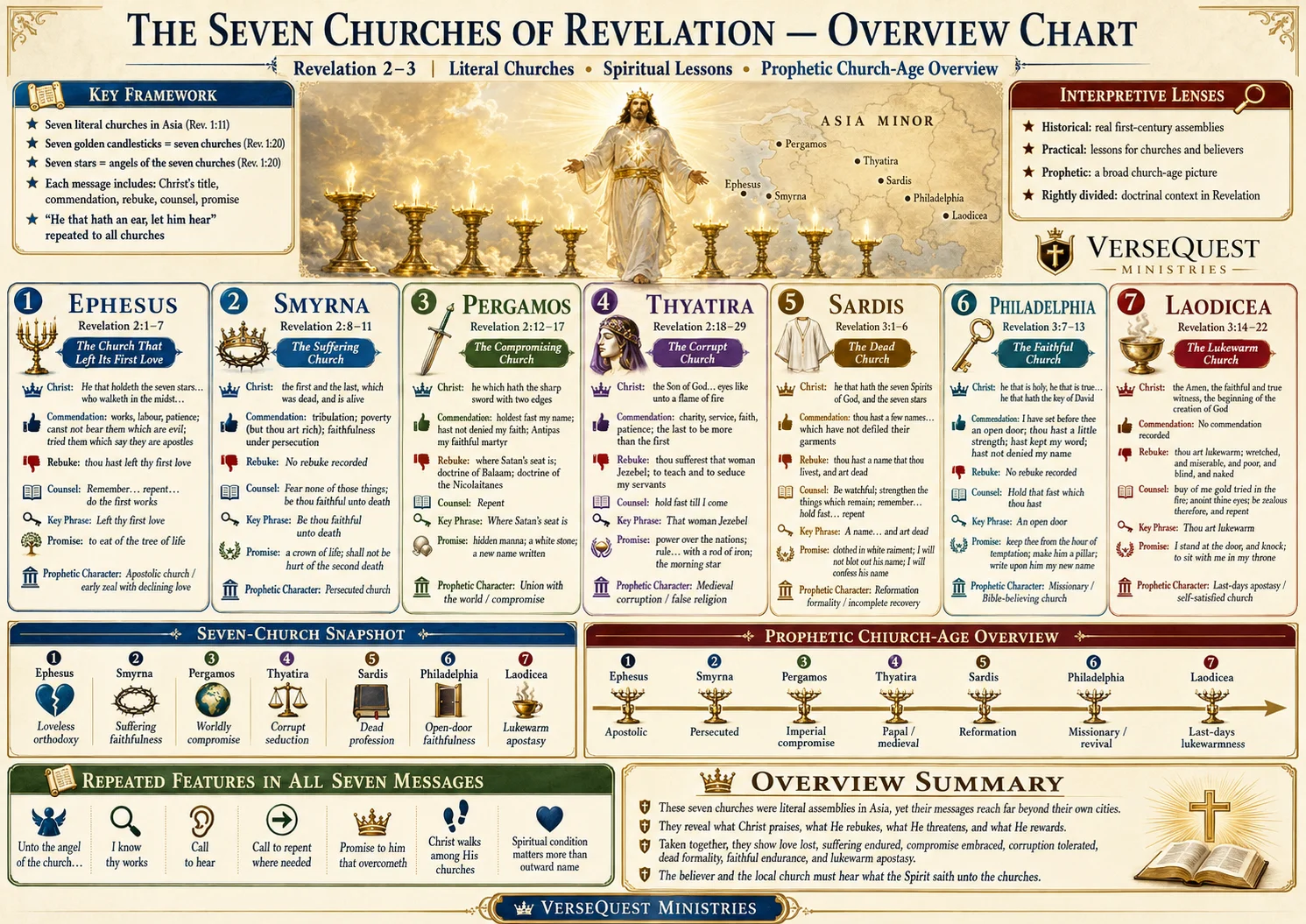
- The Seven Churches of Revelation Chart Collection – Christ Walking Among the Candlesticks
- A premium VerseQuest Ministries™ PDF chart collection covering the Seven Churches of Revelation in Revelation 2–3. Includes one overview chart plus individual KJV Bible study charts for Ephesus, Smyrna, Pergamos,…
- $12.99
- Add to cart
-
-
Doctrine Series
-
-14%
- Judas Iscariot and the Coming Antichrist – Premium KJV Prophecy Study
- A massive 459-page premium KJV prophecy study tracing the biblical connection between Judas Iscariot, the son of perdition, and the coming Antichrist. This detailed VerseQuest Ministries PDF examines Judas’ betrayal,…
- Original price was: $34.99.$29.99Current price is: $29.99.
- Add to cart
-
-14%
-
Doctrine Series
-
- The Lost Tribes Myth Exposed (213-Page Premium Study)
- A 213-page premium KJV study exposing the Lost Tribes myth, tribal identity errors, prophecy abuse, race theories, and false Israel claims through 35 detailed essays.
- $24.99
- Add to cart
-
-
Names of Christ
-
- The Names and Titles of Jesus Christ Made Plain
- A complete 100-essay KJV Bible study on the names and titles of the Lord Jesus Christ, showing His deity, humanity, blood atonement, resurrection, priesthood, headship over the Church, shepherd care,…
- $29.99
- Add to cart
-
-
Heaven
-
- The Doctrine of Heaven Made Plain — 599-Page KJV Bible Study PDF
- A massive 599-page KJV, rightly divided study on heaven, covering the present heaven, resurrection body, Rapture, Millennium, New Jerusalem, eternal state, hard questions, funeral lies, and cult errors.
- $34.99
- Add to cart
-