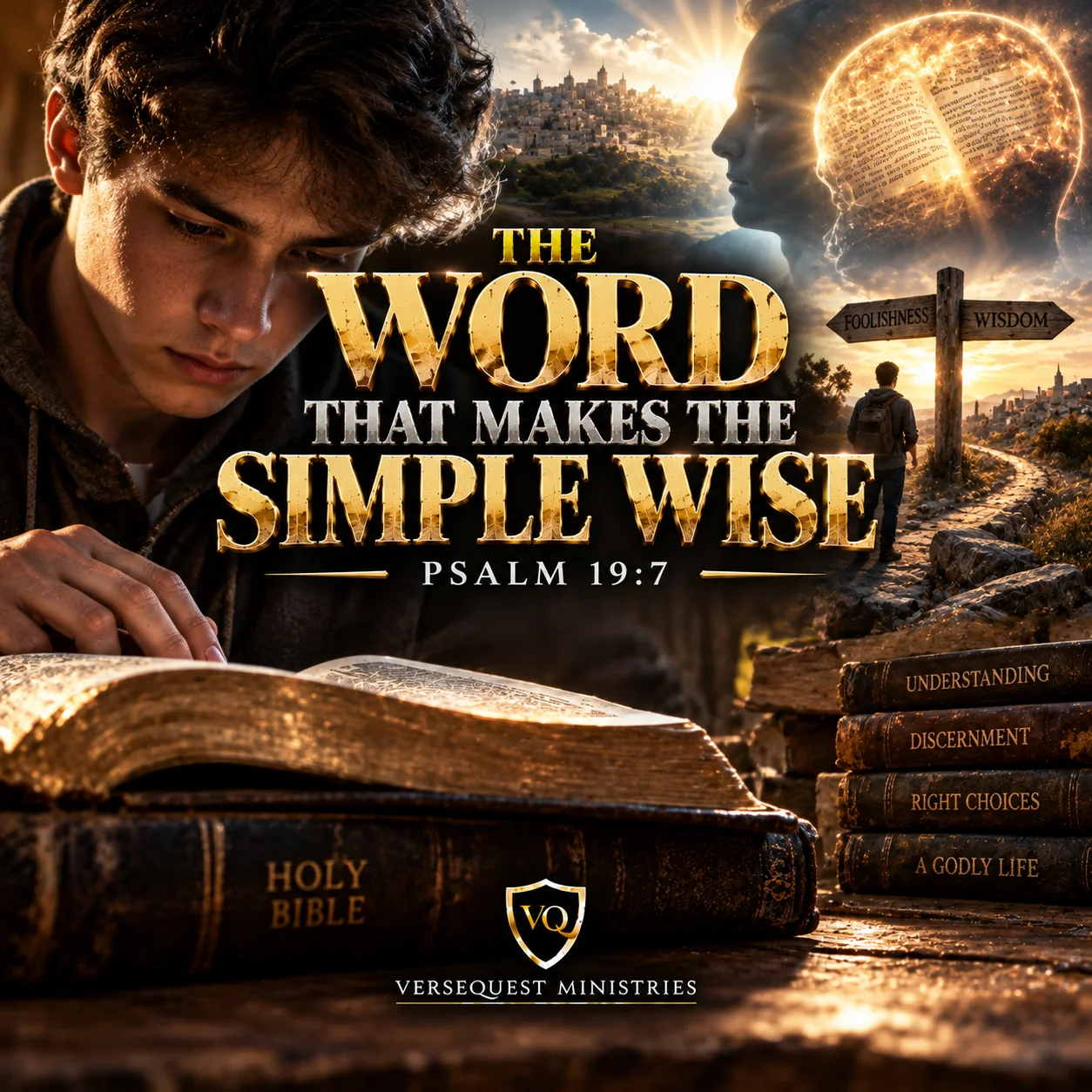
Sermon Title:
The Word That Makes the Simple Wise
Key Passage:
Psalm 19:7
“The law of the LORD is perfect, converting the soul: the testimony of the LORD is sure, making wise the simple.” (Psalm 19:7)
Series:
The Book God Gave
Topic:
How the Sure Word of God Gives Wisdom to Those Who Will Receive It
Book:
Psalms
Speaker:
Paul Tackett
Suggested Sermon Text:
Psalm 19:1–14; Psalm 119:98–105, 129–130; Proverbs 1:1–7; Proverbs 2:1–11; Proverbs 3:5–7; Proverbs 9:10; Isaiah 8:20; Matthew 7:24–27; Matthew 11:25–26; Romans 1:18–22; 1 Corinthians 1:18–31; 1 Corinthians 2:6–16; Ephesians 5:15–17; Colossians 2:8; 2 Timothy 2:15; 2 Timothy 3:15–17; James 1:5
Short Sermon Description:
Psalm 19:7 declares that “the testimony of the LORD is sure, making wise the simple.” This sermon examines the difference between human intelligence and biblical wisdom, showing that God does not reserve spiritual understanding for an intellectual elite but gives wisdom through His sure word to those humble enough to receive, believe, study, and obey it. The message explores what Scripture means by “the simple,” why certainty begins with God’s testimony rather than man’s opinions, how the Bible corrects foolish thinking, why worldly education cannot substitute for revelation, and how right division protects the believer from confusing inspired passages that belong to different doctrinal settings. It also shows that biblical wisdom is practical, producing discernment, sound judgment, holy choices, doctrinal stability, and a life ordered according to truth. Preachers, teachers, and Bible students will gain a sermon-ready treatment of biblical wisdom, spiritual understanding, the sufficiency and certainty of Scripture, humility before God’s word, and the practical transformation that occurs when the simple allow the Book to make them wise.
THE WORD THAT MAKES THE SIMPLE WISE
Introduction
The world has never suffered from a shortage of educated fools. Men can split atoms, map galaxies, perform surgery through tiny incisions, build machines that communicate across continents in seconds, and still be completely confused about God, sin, eternity, morality, salvation, and the purpose of life. Intelligence is real, education is valuable, and learning should never be despised, but none of those things automatically produces wisdom. Psalm 19:7 makes an astonishing statement: “the testimony of the LORD is sure, making wise the simple.” God can take someone without impressive credentials, place His word in that person’s hands, and give him wisdom that no university can manufacture.
The verse also tells us why this is possible. The testimony of the LORD is sure. Human wisdom changes because human knowledge is limited. Textbooks are revised. Experts disagree. Philosophies rise, dominate a generation, and disappear. God does not need revised editions because omniscience does not discover new information. The believer begins his pursuit of wisdom with something solid beneath his feet: God has spoken, and His testimony is sure.
The word “simple” does not mean a person must remain ignorant, lazy, or gullible. Scripture frequently uses simplicity for someone inexperienced, undiscerning, open to influence, or lacking established wisdom. That person stands at a crossroads. He can believe every voice that speaks loudly enough, or he can receive the word of God and become wise. The Bible does not glorify stupidity. It cures it.
I. GOD’S TESTIMONY IS SURE BECAUSE GOD HIMSELF IS TRUE
Key Text: Psalm 19:7
Supporting Texts: Numbers 23:19; Titus 1:2; Psalm 119:160; Romans 3:4
David calls “the testimony of the LORD” sure. Biblical wisdom begins with certainty about the Speaker. If God can lie, forget, misunderstand, exaggerate, or change His mind because new information becomes available, His testimony cannot be a foundation for wisdom.
But Scripture says God “cannot lie” (Titus 1:2). Numbers 23:19 declares, “God is not a man, that he should lie.” Psalm 119:160 says, “Thy word is true from the beginning.” The reliability of Scripture rests upon the reliability of its Author.
Men often reverse the order. They stand above the Bible and ask whether God’s words meet modern standards of credibility. Scripture reverses the courtroom: “Let God be true, but every man a liar” (Romans 3:4). Man does not certify God’s testimony. God’s testimony judges man.
The simple become wise when they stop treating every opinion as equally uncertain and find an authority incapable of falsehood.
Main Truth: Biblical wisdom begins with confidence that God’s testimony is absolutely reliable because the God who gave it cannot lie.
II. THE SIMPLE ARE NOT HOPELESS—THEY ARE TEACHABLE
Key Text: Psalm 19:7
Supporting Texts: Psalm 119:130; Proverbs 1:4; Proverbs 14:15; Matthew 11:25
Psalm 119:130 says, “The entrance of thy words giveth light; it giveth understanding unto the simple.” The simple person’s problem is not that wisdom is permanently beyond his reach. His problem is that he needs light.
Proverbs warns that “the simple believeth every word” (Proverbs 14:15). That is the danger of simplicity. An undiscerning person can be carried by the last confident voice he heard. Advertisers know it. Politicians know it. Cult leaders know it. False teachers know it. Social media algorithms know it.
But simplicity can become wisdom when teachability is placed beneath the right Teacher. Jesus thanked the Father that truth had been revealed unto “babes” while hidden from the self-satisfied wise and prudent (Matthew 11:25). God is not impressed by intellectual pride.
There is a tremendous difference between being simple and being stubborn. The simple man can learn. The proud man has already decided he knows.
Main Truth: Lack of experience does not prevent wisdom when a person humbly receives the light God has supplied in His word.
III. BIBLICAL WISDOM IS NOT THE SAME THING AS HUMAN INTELLIGENCE
Key Text: 1 Corinthians 1:20–21
Supporting Texts: 1 Corinthians 1:18–31; 1 Corinthians 2:6–8; Romans 1:21–22; Colossians 2:8
Paul asks, “Where is the wise? where is the scribe? where is the disputer of this world?” The world has its wisdom, and Scripture never pretends otherwise. The problem is that human intelligence operating independently of God cannot reach divine truth on its own.
Romans 1 describes men who “became vain in their imaginations” and, “professing themselves to be wise, they became fools” (Romans 1:21–22). Their problem was not low intelligence. It was rebellion against revealed truth.
A man can earn multiple degrees and remain completely foolish about eternity. Another man may never enter a university classroom and understand sin, salvation, judgment, resurrection, grace, Israel, the Church, and eternity because he has learned the Bible.
That does not make ignorance virtuous. It makes revelation necessary.
Main Truth: Human intelligence can acquire enormous knowledge, but only God’s revelation can give wisdom concerning spiritual truth.
IV. THE WORD MAKES THE SIMPLE WISE BY CORRECTING FALSE THINKING
Key Text: 2 Timothy 3:16
Supporting Texts: Romans 12:2; Psalm 119:104; Proverbs 2:6; Hebrews 4:12
“All scripture is given by inspiration of God” and is profitable for doctrine, reproof, correction, and instruction in righteousness. Those four functions describe how foolish thinking becomes wise thinking.
Doctrine teaches what is right. Reproof exposes what is wrong. Correction removes error and restores truth. Instruction trains the believer to continue in the right direction.
Romans 12:2 calls for transformation “by the renewing of your mind.” The Christian does not become wise merely by collecting information. His categories must change. His thinking about God, himself, sin, money, sex, marriage, suffering, success, death, eternity, and righteousness must be reshaped by Scripture.
Psalm 119:104 says, “Through thy precepts I get understanding: therefore I hate every false way.” Understanding produces discrimination. Wisdom learns that every path is not equally safe.
Main Truth: Scripture makes the simple wise by replacing false assumptions with God’s truth and training the mind to judge life biblically.
V. WISDOM REQUIRES THE FEAR OF THE LORD
Key Text: Proverbs 9:10
Supporting Texts: Proverbs 1:7; Job 28:28; Ecclesiastes 12:13; Psalm 111:10
“The fear of the LORD is the beginning of wisdom” (Proverbs 9:10). Wisdom begins with a correct relationship to authority.
A man who approaches Scripture determined that God may speak only when God agrees with him has not begun wisely. He has made himself god before opening God’s Book.
The fear of the Lord recognizes that the Creator is not our debating opponent. He is holy. He knows everything. We answer to Him. His judgment is final.
That attitude produces teachability. Psalm 111:10 says, “a good understanding have all they that do his commandments.” Notice how understanding and obedience connect. Scripture does not separate wisdom from submission.
Many people want enough Bible knowledge to win arguments without enough fear of God to let the Bible win the argument with them.
Main Truth: Wisdom begins when man stops treating himself as the highest authority and submits reverently to the God who has spoken.
VI. THE WORD MAKES US WISE BY TEACHING DISCERNMENT
Key Text: Psalm 119:98–100
Supporting Texts: Hebrews 5:13–14; Philippians 1:9–10; 1 Thessalonians 5:21; 1 John 4:1
Psalm 119 contains a remarkable testimony: “Thou through thy commandments hast made me wiser than mine enemies” (Psalm 119:98). The Psalmist even says he had more understanding than his teachers because God’s testimonies were his meditation.
Wisdom is not merely knowing facts. It is knowing how to distinguish. Hebrews speaks of mature believers whose senses are exercised “to discern both good and evil.”
Discernment matters because error rarely arrives wearing a sign that says FALSE DOCTRINE. It arrives with Bible verses, spiritual language, emotional stories, respected names, impressive credentials, and plausible arguments.
The Bible-trained mind begins noticing what others miss. What does this teacher mean by salvation? Which verses were omitted? To whom was that promise given? Does this doctrine agree with the rest of Scripture? Has a kingdom passage been placed upon the Church? Has experience replaced biblical authority?
Main Truth: God’s word produces wisdom by training believers to distinguish truth from error, right from wrong, and sound doctrine from spiritual counterfeit.
VII. THE WORD MUST BE RIGHTLY DIVIDED TO PRODUCE SOUND WISDOM
Key Text: 2 Timothy 2:15
Supporting Texts: 1 Corinthians 10:32; Romans 11:25–29; Ephesians 2:11–16; Ephesians 3:1–10
A man can possess the right Bible and still become doctrinally confused by mishandling it. Paul therefore commands, “rightly dividing the word of truth.”
The entire Bible is true, but the entire Bible is not addressed doctrinally to the same people under identical conditions. Scripture distinguishes Israel, Gentiles, and the Church. It distinguishes law and grace, prophecy and mystery, earthly kingdom promises and the heavenly calling of the body of Christ.
Failure to recognize those distinctions can turn inspired truth into practical confusion. A verse may be perfectly true and perfectly misapplied.
This is especially important when studying salvation, signs, ordinances, covenants, prophecy, tribulation, the kingdom, and Israel. Wisdom does not merely ask, “Is there a verse?” Wisdom asks, “Where is the verse, to whom is it spoken, and what does God intend it to teach?”
Main Truth: Sound biblical wisdom requires rightly dividing Scripture so inspired truths remain in the doctrinal settings God gave them.
VIII. WISDOM FROM THE WORD BECOMES PRACTICAL IN DAILY DECISIONS
Key Text: Ephesians 5:15–17
Supporting Texts: Proverbs 3:5–7; Psalm 119:105; James 1:5; Colossians 4:5
Paul commands believers to “walk circumspectly, not as fools, but as wise” (Ephesians 5:15). Biblical wisdom is meant to walk.
Scripture does not name every job you should accept, every house you should purchase, every city you should live in, or every daily decision you will face. Instead, God develops a Bible-trained mind capable of applying revealed principles.
Proverbs says, “Trust in the LORD with all thine heart; and lean not unto thine own understanding.” Psalm 119:105 says God’s word is a lamp unto the feet and a light unto the path.
The mature believer increasingly asks wise questions. Will this strengthen or weaken my walk? Does this compromise doctrine? What effect will this have upon my family? Is this honest? Is it expedient? Does it feed the flesh? Does it help me serve Christ?
Wisdom is truth applied to life.
Main Truth: The wisdom Scripture produces becomes visible when biblical truth governs practical choices, priorities, relationships, and conduct.
IX. HEARING WISDOM WITHOUT OBEYING IT LEAVES THE SIMPLE FOOLISH
Key Text: Matthew 7:24–27
Supporting Texts: James 1:22–25; Proverbs 1:20–33; John 13:17; Psalm 119:34
Jesus compares the man who hears His sayings and does them to a wise man who built upon a rock. He compares the man who hears and does not obey to a foolish man whose house collapses.
Both men heard.
That is sobering. Exposure to truth does not automatically produce wisdom. A person can hear thousands of sermons, read the Bible repeatedly, accumulate commentaries, memorize verses, and remain foolish if he continually refuses what he knows.
James says, “be ye doers of the word, and not hearers only, deceiving your own selves.” Knowledge without obedience can become a sophisticated form of self-deception.
The simple become wise not merely because the Book entered their library but because the truth entered their thinking and then their conduct.
Main Truth: Biblical wisdom becomes effective when the hearer obeys the truth rather than merely accumulating knowledge about it.
Conclusion
“The testimony of the LORD is sure, making wise the simple.” That sentence should encourage anybody who has ever felt intimidated by the Bible. God did not write His Book exclusively for professors, linguists, theologians, or intellectual specialists. He gave truth that ordinary believers can read, study, compare, rightly divide, believe, and obey.
The same verse should also humble the educated. Intelligence cannot replace revelation. Credentials cannot replace submission. A man with letters after his name can still become a fool if he rejects what God said, while an ordinary Bible believer can possess astonishing wisdom because he has learned to measure life by a sure testimony.
Take the King James Bible seriously. Read it slowly. Study it carefully. Compare Scripture with Scripture. Rightly divide it. Let it correct you. Let it train your judgment. Let it expose foolish assumptions you inherited from culture, religion, education, or your own heart. God did not promise that every simple man would become a scholar. He promised something better: His sure testimony can make the simple wise.
Final Call
If you are lost, the wisest decision you will ever make begins by believing what God says about His Son. Jesus Christ died for our sins according to the Scriptures, was buried, and rose again the third day according to the Scriptures (1 Corinthians 15:3–4). Stop trusting your morality, religion, baptism, church membership, intelligence, or good intentions. Believe on the Lord Jesus Christ and trust His finished work.
If you are saved, do not remain willingly simple when God has placed wisdom in your hands. Open the Book. Learn doctrine. Rightly divide it. Compare passages. Ask God for wisdom. Stop believing every confident religious voice that appears before you. Let Scripture establish your thinking until the world’s foolishness becomes recognizable and God’s truth becomes familiar.
Closing Verse:
“The entrance of thy words giveth light; it giveth understanding unto the simple.” (Psalm 119:130)
Closing Statement:
God does not require the simple to become intellectual giants before they can be wise—He requires them to believe the sure testimony He already gave them.