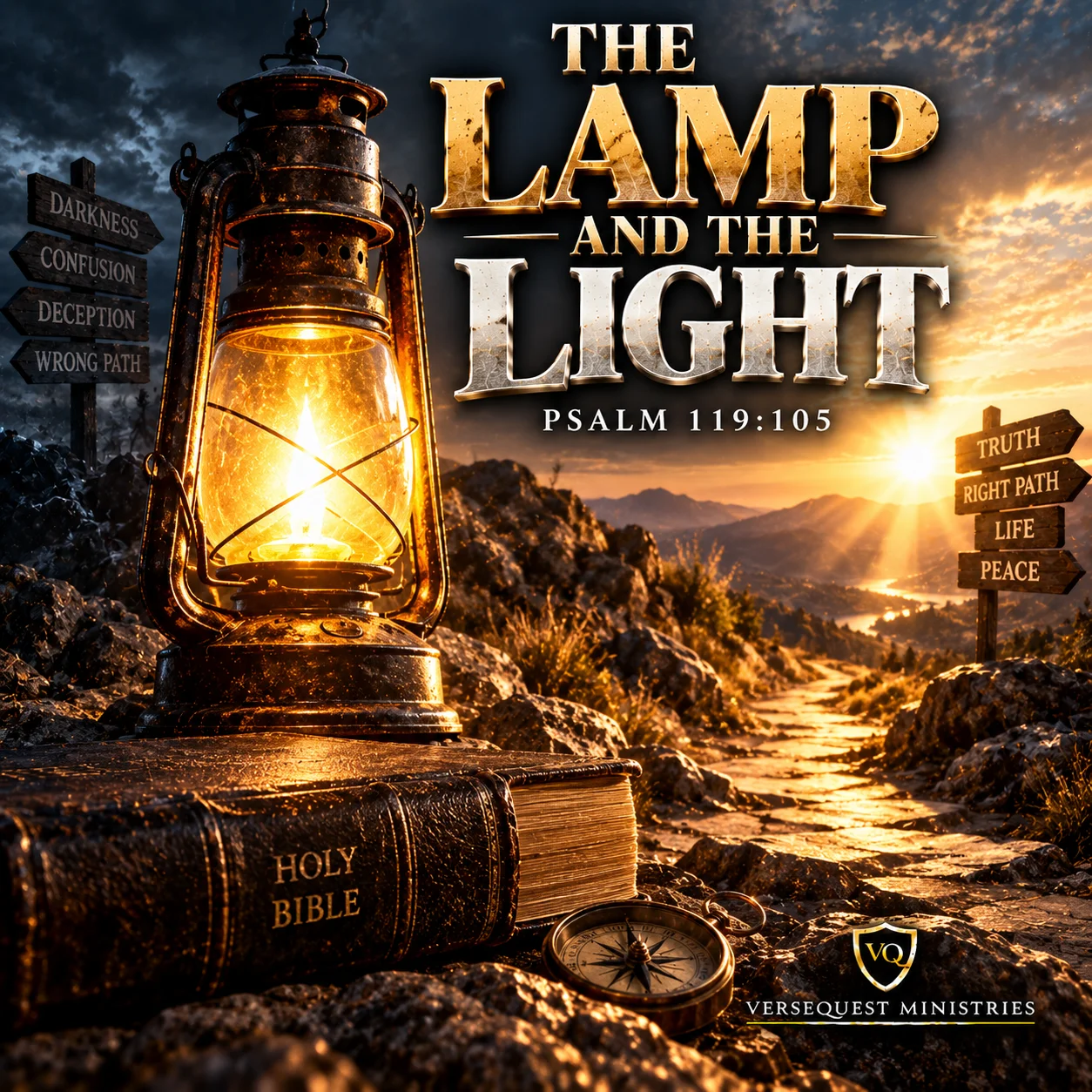
Sermon Title:
The Lamp and the Light
Key Passage:
Psalm 119:105
“Thy word is a lamp unto my feet, and a light unto my path.” (Psalm 119:105)
Series:
The Book God Gave
Topic:
The Word of God as the Believer’s Light for Daily Steps and the Path Ahead
Book:
Psalms
Speaker:
Paul Tackett
Suggested Sermon Text:
Psalm 119:97–112; Psalm 19:7–11; Psalm 27:1; Psalm 43:3; Proverbs 4:18–19; Proverbs 6:20–23; Isaiah 8:20; Matthew 4:4; John 8:12; John 17:17; Romans 12:1–2; Ephesians 5:8–17; Philippians 2:15–16; 2 Timothy 2:15; 2 Timothy 3:15–17; 2 Peter 1:19
Short Sermon Description:
Psalm 119:105 presents the word of God in two complementary pictures: a lamp unto the believer’s feet and a light unto his path. This sermon examines how Scripture gives sufficient light for the next step while also revealing the direction of the road ahead, protecting believers from spiritual darkness, exposing hidden dangers, correcting wrong turns, and supplying wisdom for decisions God has not addressed by a direct command. It distinguishes biblical guidance from subjective impressions, shows why the believer must walk in the light already given instead of demanding additional revelation, explains the relationship between Scripture, right division, a renewed mind, and practical Christian discernment, and demonstrates why a neglected Bible produces avoidable darkness. Preachers, teachers, and Bible students will gain a detailed, sermon-ready treatment built according to the VerseQuest KJV-only, rightly divided production standard. Sermon Outline Prompt – VerseQu…
THE LAMP AND THE LIGHT
Introduction
Psalm 119:105 contains one of the most familiar statements in the Bible, but familiarity can make a verse easy to quote without stopping long enough to see what it says. “Thy word is a lamp unto my feet, and a light unto my path.” David does not describe God’s word as decoration for the shelf, an emergency charm for bad days, or a collection of inspirational sayings for religious people. He describes it as light. Light exists because darkness exists. A lamp matters because there are things in the dark that cannot be seen safely without it. A path needs illumination because the traveler can take a wrong step even while sincerely believing he is headed in the right direction.
The verse contains two scales of guidance. A lamp shines near the feet. It shows where the next step lands. Light upon a path reaches farther and shows direction. God often guides the Christian in exactly that manner. Scripture may not show every circumstance ten years in advance, but it gives enough truth for obedience today and enough doctrine to identify the road a believer should be traveling. The flesh wants a floodlight that exposes the whole journey before taking the first step. God often gives a lamp and says, walk.
This becomes especially important in an age obsessed with finding God’s will through feelings, impressions, signs, coincidences, dreams, prophetic words, and the phrase “God told me.” Psalm 119 points the believer somewhere safer: “Thy word.” If God has already put a lamp in your hand, it is foolish to stumble around in darkness demanding a private flash of lightning. Scripture supplies objective truth, moral boundaries, doctrinal direction, spiritual wisdom, and principles sufficient for faithful Christian living. The question is often not whether God has supplied light. The question is whether the Christian has opened the Book.
I. GOD’S WORD IS A LAMP BECAUSE THE WORLD IS DARK
Key Text: Psalm 119:105
Supporting Texts: Proverbs 4:19; John 3:19–21; Ephesians 5:8; 2 Corinthians 4:3–4
A lamp has no purpose in broad daylight. The very image assumes darkness. Scripture describes the present world in exactly those terms. Proverbs says, “The way of the wicked is as darkness: they know not at what they stumble” (Proverbs 4:19). That is one of the tragedies of spiritual darkness: a man can trip over something and still not understand what caused his fall.
Jesus said men loved darkness rather than light because their deeds were evil (John 3:19). Paul says unbelievers have their understanding darkened and that “the god of this world hath blinded the minds of them which believe not” (2 Corinthians 4:4). Darkness in Scripture is not merely lack of education. It is spiritual ignorance, deception, sin, blindness, and separation from God’s truth.
The saved believer has been brought into light, but he still lives in a dark world. Cultural values, entertainment, religion, philosophy, social pressure, temptation, and human reasoning constantly attempt to redefine what is right. The Christian therefore cannot navigate merely by what feels normal. Darkness eventually makes crooked things look straight.
Main Truth: The believer needs the light of Scripture because he lives in a world spiritually darkened by sin, deception, and falsehood.
II. THE LAMP SHOWS THE BELIEVER WHERE TO PLACE THE NEXT STEP
Key Text: Psalm 119:105
Supporting Texts: Psalm 119:9–11; Proverbs 3:5–7; James 1:22; Luke 11:28
David says the word is “a lamp unto my feet.” The picture is close and practical. A traveler carrying a lamp at night does not necessarily see the entire road. He sees enough ground to avoid the rock, hole, serpent, or cliff immediately before him.
Christians often become anxious because they want answers about distant circumstances while ignoring plainly revealed duties today. A man wants to know God’s ten-year plan while neglecting prayer, Bible reading, honesty, purity, forgiveness, work, family responsibility, or faithful service this morning.
Psalm 119:9 asks, “Wherewithal shall a young man cleanse his way?” The answer is, “by taking heed thereto according to thy word.” Notice the practicality. Scripture tells the believer what to do with the next step. James likewise commands Christians to be doers of the word and not hearers only.
God does not owe us detailed information about tomorrow before we obey what He has plainly said today. The believer who refuses the lamp at his feet has little reason to complain that the horizon is dark.
Main Truth: God’s word gives sufficient light for immediate obedience even when the believer cannot yet see every future detail.
III. THE LIGHT REVEALS THE DIRECTION OF THE PATH
Key Text: Psalm 119:105
Supporting Texts: Proverbs 4:18; Psalm 25:4–5; Psalm 43:3; Proverbs 6:23
The verse moves from feet to path. The lamp deals with individual steps; the light deals with direction. Scripture does more than tell us whether one isolated action is sinful. It shapes the entire course of life.
Proverbs says, “the path of the just is as the shining light, that shineth more and more unto the perfect day” (Proverbs 4:18). A biblical life develops direction. The believer begins learning what kinds of friendships strengthen him, what ambitions corrupt him, what ministries deserve investment, what habits darken the conscience, what priorities belong to eternity, and what roads repeatedly lead away from fellowship with God.
Many decisions have no verse saying, “Take Job A instead of Job B” or “Move to City A instead of City B.” But the Bible supplies principles concerning stewardship, responsibility, associations, family, provision, honesty, contentment, ministry, and wisdom. Those truths illuminate the direction of the path.
A mature Christian increasingly asks not merely, “Is this technically forbidden?” but, “Where does this road lead?” The lamp shows the next stone. The light shows whether the road itself is heading toward Jerusalem or Babylon.
Main Truth: Scripture guides not only individual decisions but the larger direction, priorities, and trajectory of the Christian life.
IV. LIGHT EXPOSES DANGERS THAT DARKNESS HIDES
Key Text: Ephesians 5:13
Supporting Texts: Hebrews 4:12–13; Psalm 19:12; Psalm 119:130; John 3:20–21
Paul says, “all things that are reproved are made manifest by the light” (Ephesians 5:13). Light reveals what darkness concealed. The same is true spiritually.
The Bible exposes dangers the flesh would rather rename. Pride becomes “confidence.” Covetousness becomes “ambition.” Bitterness becomes “being hurt.” Lust becomes “being human.” Compromise becomes “balance.” Fear of man becomes “wisdom.” Scripture walks into the room, turns on the light, and calls things by their right names.
Hebrews 4:12 describes the word as discerning “the thoughts and intents of the heart.” The Book does not merely inspect behavior. It illuminates motive. Two people can perform the same outward act with entirely different hearts, and Scripture reaches beneath the appearance.
That can be uncomfortable, but darkness is far more dangerous than discomfort. A doctor who turns off the lights because the patient dislikes seeing the wound has not helped him. God shines light because He intends correction and health.
Main Truth: The word of God exposes hidden sin, false motives, and spiritual dangers that would remain concealed in darkness.
V. THE WORD PREVENTS WRONG TURNS BY ESTABLISHING BOUNDARIES
Key Text: Psalm 119:101
Supporting Texts: Psalm 119:104, 128; Proverbs 4:26–27; 2 Timothy 3:16
The Psalmist says, “I have refrained my feet from every evil way, that I might keep thy word” (Psalm 119:101). Light does not merely show the road ahead; it reveals roads the believer should not take.
Biblical commands establish boundaries before disaster arrives. God says flee fornication before adultery destroys a home. He warns about covetousness before money becomes a master. He condemns false doctrine before deception grows roots. He warns against unequal spiritual associations before compromise demands a price.
Modern culture often treats boundaries as oppression. Scripture treats them as mercy. Guardrails on a mountain road do not restrict your freedom to drive; they prevent your freedom from becoming a two-thousand-foot fall.
Psalm 119:128 says, “Therefore I esteem all thy precepts concerning all things to be right; and I hate every false way.” Once God identifies the right path, false paths deserve rejection regardless of how popular or attractive they appear.
Main Truth: Biblical boundaries are not obstacles to Christian freedom; they are lighted warnings protecting believers from roads that end in destruction.
VI. THE WORD GIVES GUIDANCE WITHOUT REQUIRING NEW REVELATION
Key Text: 2 Timothy 3:16–17
Supporting Texts: Romans 12:2; James 1:5; Colossians 1:9–10; Psalm 119:105
Paul says Scripture makes the man of God “throughly furnished unto all good works.” If Scripture thoroughly furnishes the believer, Christians do not need a continual stream of new revelations to know how to live faithfully.
The Bible does not tell you which color automobile to buy. It does not name the house you should purchase or the person who should hire you. Instead it supplies moral boundaries, spiritual priorities, doctrinal truth, wisdom, and a renewed mind by which decisions can be made responsibly.
Romans 12:2 connects discerning God’s will with the renewing of the mind. James tells the believer lacking wisdom to ask God. Prayer therefore belongs in guidance, but prayer does not transform private impressions into inspired revelation.
The Christian can say, “I believe this is wise,” “Providence appears to be opening this opportunity,” or “This seems consistent with Scripture,” without claiming that God whispered another verse into his ear. The lamp God supplied remains the written word.
Main Truth: God guides believers through Scripture, wisdom, prayer, and a renewed mind without requiring additional inspired revelation.
VII. THE LAMP MUST BE RIGHTLY DIVIDED OR IT CAN BE MISDIRECTED
Key Text: 2 Timothy 2:15
Supporting Texts: 1 Corinthians 10:32; Romans 11:25–29; Ephesians 2:11–16; 2 Timothy 3:16
A lamp pointed in the wrong direction does not help the traveler. Likewise, true Scripture wrongly applied can produce doctrinal confusion.
Paul commands believers to be “rightly dividing the word of truth.” All Scripture is true, but all Scripture is not addressed doctrinally to the same people under the same administration. Israel is not the Church. Law is not grace. Prophecy is not mystery. The earthly kingdom is not the body of Christ’s heavenly calling.
A man can quote a genuine verse and still misdirect somebody with it. Satan quoted Scripture to Christ in Matthew 4. The words were biblical. The application was corrupt.
The mature student therefore asks who is speaking, to whom, when, under what covenant or dispensation, and for what doctrinal purpose. Right division does not dim the lamp. It points it where God intended.
Main Truth: Scripture gives reliable light only when its passages are handled according to their proper context and rightly divided doctrinal setting.
VIII. NEGLECTING THE LAMP PRODUCES AVOIDABLE DARKNESS
Key Text: Psalm 119:130
Supporting Texts: Hosea 4:6; Proverbs 19:2; 2 Timothy 2:15; Hebrews 5:12–14
“The entrance of thy words giveth light” (Psalm 119:130). If the entrance of God’s words gives light, then refusing their entrance leaves unnecessary darkness.
Many Christians ask for guidance while rarely studying the Book designed to guide them. They want discernment without doctrine, wisdom without study, spiritual strength without spiritual food, and clarity without opening the lamp.
Hosea said, “My people are destroyed for lack of knowledge” (Hosea 4:6). Ignorance is not automatically innocence. Sometimes ignorance exists because truth was available but neglected.
A Bible unopened cannot illuminate much. A verse never learned cannot be recalled in temptation. A doctrine never studied cannot protect against false teaching. A distinction never understood cannot prevent confusion.
The problem is not that God hid the lamp. Often the believer left it closed.
Main Truth: Spiritual darkness frequently persists not because God withheld light but because believers neglected the word He provided.
IX. THE BELIEVER MUST WALK IN THE LIGHT HE HAS RECEIVED
Key Text: Psalm 119:106
Supporting Texts: James 1:22–25; John 13:17; Ephesians 5:8; Philippians 2:15–16
Light creates responsibility. Once the path is illuminated, the traveler must walk.
Psalm 119:106 says, “I have sworn, and I will perform it, that I will keep thy righteous judgments.” The Psalmist does not merely admire the lamp. He responds to its light.
James warns against seeing truth and then walking away unchanged. Knowledge without obedience produces self-deception. Jesus said, “If ye know these things, happy are ye if ye do them” (John 13:17). Blessing is connected with obedience, not mere familiarity.
Paul tells believers, “walk as children of light” (Ephesians 5:8). A Christian carrying a Bible while deliberately walking down a dark road cannot blame the lamp for the destination.
The greatest evidence that a man respects Scripture is not the size of his Bible collection or the volume of his arguments defending inspiration. It is whether he alters his life when the Book shines on something that needs to change.
Main Truth: Biblical light must produce obedient walking, because revelation ignored becomes accountability increased.
Conclusion
“Thy word is a lamp unto my feet, and a light unto my path.” The verse gives the believer both nearness and direction. The lamp addresses the next step. The light addresses the road. Scripture shows what must be done today while shaping the direction of the Christian’s life tomorrow.
God has not abandoned His people to stumble through darkness guided by hunches, signs, dreams, popular opinion, religious personalities, or emotional impulses. He gave a Book. That Book exposes danger, establishes boundaries, renews the mind, supplies wisdom, reveals truth, corrects wrong turns, and equips the believer for faithful living.
So open the King James Bible and use the light God gave you. Read it when the road seems clear and when it seems dark. Study it before the crisis rather than waiting until after the fall. Rightly divide it. Memorize it. Believe it. Obey it. A lamp does no good in your backpack while you stumble over rocks in the dark. Hold the Book where it can shine.
Final Call
If you are lost, the word of God shines directly upon the only road to salvation. Jesus Christ died for our sins, was buried, and rose again the third day according to the Scriptures (1 Corinthians 15:3–4). Salvation is not found by following your heart, joining a religion, being baptized, becoming moral, or earning merit. Believe on the Lord Jesus Christ and trust His finished work.
If you are saved, walk in the light God has already given you. Stop demanding another sign while ignoring a verse. Stop asking God to reveal His will while refusing His written instructions. Open the Book. Let it illuminate the next step. Let it expose the wrong road. Let it guide your home, doctrine, decisions, relationships, ministry, and walk. The darkness has plenty of voices. God gave you a lamp.
Closing Verse:
“The entrance of thy words giveth light; it giveth understanding unto the simple.” (Psalm 119:130)
Closing Statement:
God never promised to illuminate every mile before you start walking—but He gave enough light in His word for the next faithful step and the right road ahead.