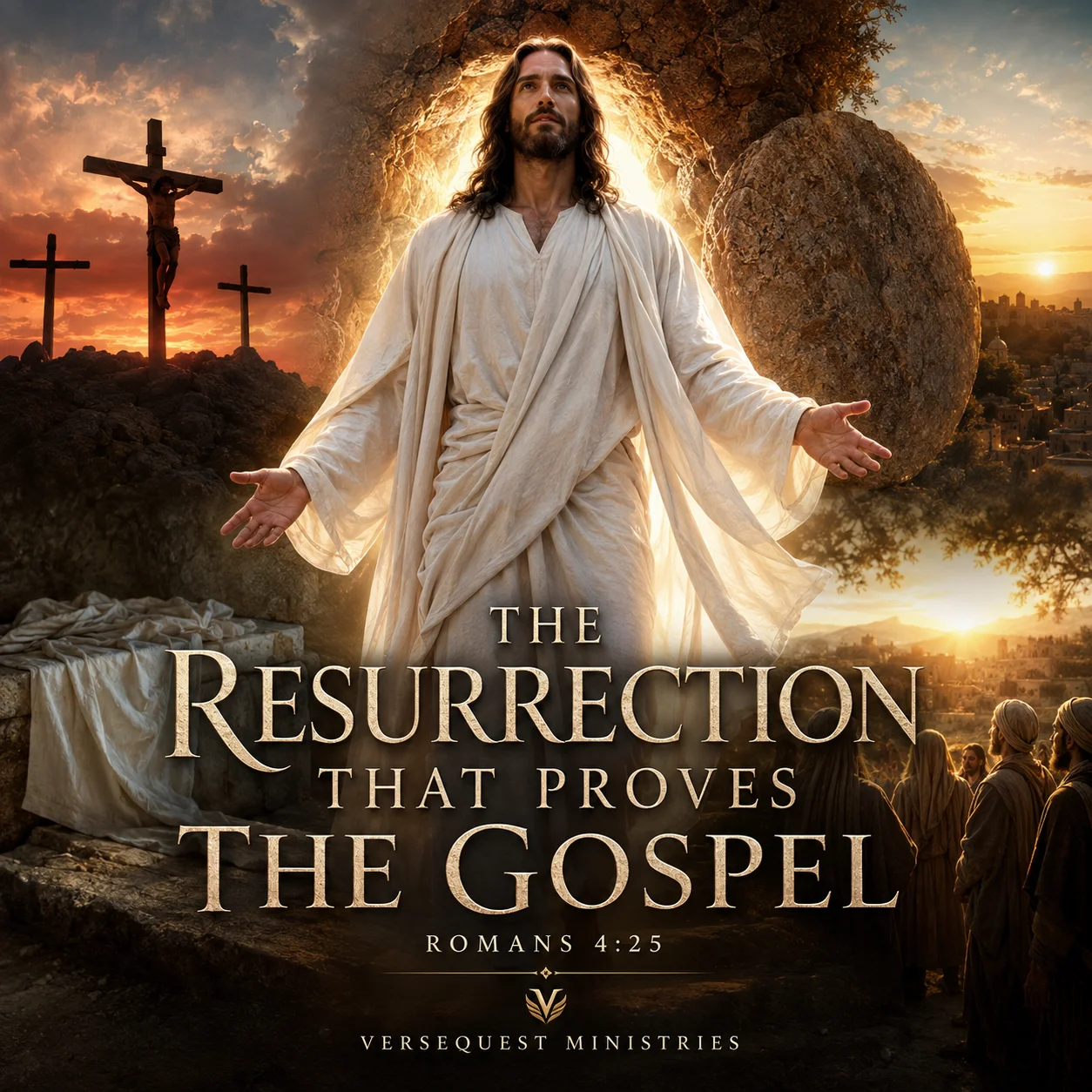
Sermon Title:
Raised for Our Justification: The Resurrection That Proves the Gospel
Key Passage:
Romans 4:25 — “Who was delivered for our offences, and was raised again for our justification.”
Series:
Foundations of the Gospel of Grace
Topic:
The Resurrection of Jesus Christ as God’s Proof That the Gospel Is Finished, Accepted, and Sufficient
Book:
Romans, 1 Corinthians, Acts, John, Ephesians, Colossians, Hebrews, 1 Peter, 2 Timothy
Speaker:
Paul Tackett
Suggested Sermon Text:
Romans 4:20–25; 1 Corinthians 15:1–20; Romans 1:3–4; Romans 3:21–28; Romans 5:1–11; Acts 13:28–39; John 19:30; John 20:1–31; Ephesians 1:19–23; Colossians 2:12–15; Hebrews 10:10–14; 1 Peter 1:3–5; 2 Timothy 2:8
Short Sermon Description:
This detailed VerseQuest Ministries sermon outline explains Romans 4:25 and the doctrine that Jesus Christ “was delivered for our offences, and was raised again for our justification.” The resurrection is not a religious afterthought, a sentimental Easter decoration, or merely a symbol of hope. It is God’s public proof that the sacrifice of Christ was accepted, the debt of sin was paid, death was defeated, justification was secured, and the gospel preached by Paul is true. This sermon shows why Christ had to die for our offences, why the burial proves His real death, why the resurrection proves the finished work of the cross, and why a dead Christ could never save anyone. It distinguishes the historic resurrection from vague religious optimism, defends the bodily resurrection against unbelief, and shows how believers stand justified in the risen Lord Jesus Christ. Designed for pastors, preachers, teachers, Bible students, and believers, this outline magnifies the death, burial, and resurrection of Christ as the saving gospel for today.
Raised for Our Justification
The Resurrection That Proves the Gospel
Introduction
Romans 4:25 gives the believer one of the strongest gospel statements in Paul’s epistles: “Who was delivered for our offences, and was raised again for our justification.” That verse gives both sides of Calvary’s transaction. Christ was delivered because of our offences. He was raised because justification had been secured. The cross was not a tragic failure repaired by the resurrection. The resurrection was God’s open declaration that the cross succeeded. The Lord Jesus Christ did not rise from the dead to try again. He rose because the work was finished, the payment was accepted, and death had no more claim upon Him.
The resurrection is not a religious ornament hanging on the wall of Christianity. It is the foundation stone under the gospel. If Christ is not risen, the preacher is wasting breath, faith is empty, sin remains unpaid, death still reigns, and every sinner is still headed for judgment with no Saviour alive to save him. Paul says plainly in 1 Corinthians 15 that if Christ be not raised, faith is vain and believers are yet in their sins. That is not optional doctrine. That is the dividing line between Bible Christianity and religious corpse-polishing. A dead Christ can inspire pity, but He cannot justify a sinner. A buried teacher can leave memories, but he cannot give eternal life. The gospel requires a risen Saviour.
Romans 4:25 also protects the gospel from every religious counterfeit. If Christ was raised again for our justification, then justification is not secured by law-keeping, baptism, sacraments, church membership, morality, penance, endurance, or human merit. God did not raise Christ so religion could finish what Calvary left undone. God raised Christ as proof that the sin question had been answered by His Son. The sinner’s hope is not in a crucifix with a helpless figure still hanging there, nor in a ritual trying to repeat the sacrifice, nor in a human priest pretending to manage redemption. The sinner’s hope is in the crucified, buried, risen Lord Jesus Christ.
I. Christ Was Delivered for Our Offences
Key Text: Romans 4:25
Supporting Texts: Isaiah 53:5–6; Romans 3:23; 2 Corinthians 5:21; 1 Peter 2:24
Romans 4:25 begins with the reason Christ was delivered: “for our offences.” The cross was not an accident, a misunderstanding, or a political inconvenience. Jesus Christ was delivered because sinners had sinned against God. Our offences required judgment. Our guilt demanded satisfaction. Our sin debt could not be erased by religious effort, moral improvement, sincere intentions, or future promises. Sin had to be dealt with, and God dealt with it in His Son.
Isaiah 53 says, “he was wounded for our transgressions, he was bruised for our iniquities,” and “the LORD hath laid on him the iniquity of us all.” That is substitution. The offences were ours, but the wounds were His. The iniquities were ours, but the bruising was His. The guilt was ours, but the judgment fell on Him. The cross is not man giving God a religious gesture; it is God providing a sinless Substitute for guilty sinners.
Second Corinthians 5:21 says He “knew no sin,” yet God made Him “to be sin for us.” First Peter 2:24 says He “bare our sins in his own body on the tree.” That means the cross was personal. He did not die for abstract theology. He died for actual offences committed by actual sinners. The sinner who thinks lightly of sin has not looked long enough at Calvary. If sin required the death of the Son of God, then sin is not a small stain on human dignity. It is rebellion requiring blood.
Main Truth:
Christ was delivered to the cross because our offences required a sinless Substitute to bear judgment in our place.
II. The Cross Was Finished Before the Resurrection Was Displayed
Key Text: John 19:30
Supporting Texts: Hebrews 10:10–14; Colossians 2:13–14; Ephesians 1:7
Before the resurrection morning came, the cross had already spoken. Jesus cried, “It is finished,” bowed His head, and gave up the ghost. The resurrection did not complete an unfinished payment. It proved the finished payment had been accepted. Christ did not rise so He could continue paying for sin. He rose because the payment had been made in full. Calvary was not a down payment. It was redemption accomplished.
Hebrews 10:14 says, “For by one offering he hath perfected for ever them that are sanctified.” One offering. Perfected forever. Religion has always hated those words because repeated systems need unfinished sacrifices to keep men chained. But the Bible says one offering. Colossians 2 says the handwriting of ordinances that was against us was blotted out, taken out of the way, and nailed to His cross. The debt was not reduced. It was removed.
Ephesians 1:7 says, “In whom we have redemption through his blood, the forgiveness of sins.” Redemption is through His blood, not through human contribution. The resurrection is God’s proof that the blood was enough. If the cross had failed, the tomb would have stayed shut. But the tomb opened because the work was complete. God did not raise Christ to announce a payment plan. He raised Him to announce victory.
Main Truth:
The resurrection proves the finished work of the cross was accepted by God and needs no religious addition.
III. The Burial Proves Christ Really Died
Key Text: 1 Corinthians 15:3–4
Supporting Texts: Matthew 27:57–66; John 19:38–42; Romans 6:3–4
Paul’s gospel includes the burial: “And that he was buried.” That phrase matters. The burial proves that Jesus Christ truly died. He did not swoon, faint, escape, or merely appear dead. His body was taken down, wrapped, laid in a tomb, sealed, and guarded. God allowed friend and foe alike to testify that Christ’s death was real. The cross was not theater. The burial was not symbolic staging. The Saviour actually died.
Matthew records the stone, the seal, and the watch. John records the preparation of the body. These details are not filler. They are historical anchors. The gospel rests on real events in real time: Christ died, Christ was buried, Christ rose again. A gospel without an actual death is no gospel. A gospel without an actual burial is weakened into myth. A gospel without an actual resurrection is a corpse with hymn music.
Romans 6 uses burial as the picture of the believer’s identification with Christ. The old man is not being improved by religious effort; he is counted crucified and buried with Christ. The believer’s Christian life begins on resurrection ground. That is why Paul’s gospel is not “try harder and become religious.” It is “Christ died, was buried, and rose again.” The burial says death really happened. The resurrection says death did not win.
Main Truth:
The burial confirms that Jesus Christ truly died for our sins, making His resurrection a real victory over death.
IV. The Resurrection Proves Christ Is the Son of God With Power
Key Text: Romans 1:4
Supporting Texts: Acts 2:22–36; John 2:18–22; John 10:17–18
Romans 1:4 says Jesus Christ was “declared to be the Son of God with power…by the resurrection from the dead.” The resurrection did not make Him the Son of God. He already was. It declared Him to be the Son of God with power. Men rejected Him, mocked Him, crucified Him, sealed His tomb, and thought they were finished with Him. God answered by raising Him from the dead. That is heaven’s verdict on Jesus Christ.
In John 2, Jesus said, “Destroy this temple, and in three days I will raise it up,” speaking of the temple of His body. In John 10, He said He had power to lay down His life and power to take it again. That is not the language of a helpless victim. That is the language of the Son of God. The resurrection shows that death did not overpower Him. He laid down His life and took it again.
Acts 2 declares that God raised Him up because it was not possible that He should be holden of death. Death could hold Adam’s race because of sin, but it could not hold the sinless Christ after He had finished bearing sin. The resurrection publicly vindicates Him. The One men called blasphemer is the Son of God. The One nailed between thieves is Lord and Christ. The One laid in Joseph’s tomb is alive forevermore.
Main Truth:
The resurrection declares Jesus Christ to be the Son of God with power and vindicates every claim He made.
V. The Resurrection Proves Justification Has Been Secured
Key Text: Romans 4:25
Supporting Texts: Romans 5:1; Acts 13:38–39; Romans 8:33–34
Romans 4:25 says Christ “was raised again for our justification.” Justification is God’s legal declaration that the believing sinner is righteous in Christ. The resurrection proves that God accepted the payment Christ made and that the believer’s standing is secure in the risen Saviour. A dead Christ could not justify anyone. A risen Christ proves the verdict has been settled.
Romans 5:1 follows naturally: “Therefore being justified by faith, we have peace with God through our Lord Jesus Christ.” Peace with God rests on justification, and justification rests on the finished work confirmed by the resurrection. The believer does not have peace because his feelings are steady, his flesh is impressive, or his religious record is clean. He has peace because Christ died for offences and rose for justification.
Acts 13 says through the risen Christ is preached forgiveness of sins, and by Him all that believe are justified from all things. Romans 8 asks, “Who shall lay any thing to the charge of God’s elect? It is God that justifieth.” Then Paul points to Christ who died, rose again, and makes intercession. The believer’s justification is not defended by his performance but by the risen Lord. If Christ is risen, the case is closed.
Main Truth:
The resurrection proves that God accepted Christ’s payment and justifies every sinner who believes on Him.
VI. The Resurrection Is Essential to the Gospel That Saves Today
Key Text: 1 Corinthians 15:1–4
Supporting Texts: Romans 10:9–10; 2 Timothy 2:8; Galatians 1:11–12
First Corinthians 15 defines the gospel Paul preached: Christ died for our sins, was buried, and rose again the third day according to the Scriptures. The resurrection is not optional. It is part of the saving message. Remove the resurrection, and the gospel collapses. A dead Christ leaves sinners in their sins. A risen Christ saves completely.
Romans 10 connects salvation with confessing the Lord Jesus and believing that God hath raised Him from the dead. The sinner today is not saved by vague belief in religion, general respect for Jesus, church membership, water baptism, or moral effort. He is saved by believing the gospel of the crucified and risen Christ. Paul told Timothy, “Remember that Jesus Christ of the seed of David was raised from the dead according to my gospel.” That is Pauline clarity.
Right division matters here. During Christ’s earthly ministry, Israel was offered kingdom truth in connection with their Messiah. But after the death, burial, and resurrection, Paul declares the gospel of grace in its full doctrinal form. The saving message today centers on the finished work of Christ and His resurrection. The risen Christ is not merely a Jewish miracle. He is the Head of the Body, the Saviour of sinners, and the One through whom justification is preached to all who believe.
Main Truth:
The resurrection is an essential part of the gospel that saves sinners today in the dispensation of grace.
VII. The Resurrection Defeats Every Dead Religion
Key Text: 1 Corinthians 15:17
Supporting Texts: Acts 17:30–31; Revelation 1:18; Colossians 2:15
First Corinthians 15:17 says, “And if Christ be not raised, your faith is vain; ye are yet in your sins.” That one verse destroys every religion built on dead founders, dead rituals, dead works, and dead hope. Christianity does not rest on the memory of a teacher but on the present life of a risen Saviour. The grave is full of religious founders. The tomb of Jesus Christ is empty.
Acts 17 says God has given assurance unto all men by raising Christ from the dead. The resurrection is God’s warning to the world that judgment is coming and His proof that Jesus Christ is the appointed Judge. Men can mock preaching, ignore Scripture, and flatter themselves with philosophies, but they cannot honestly escape the fact that God raised His Son. The resurrection turns history into a summons.
Revelation 1:18 records Christ saying, “I am he that liveth, and was dead; and, behold, I am alive for evermore.” That is not the language of religion trying to keep hope alive. That is the voice of the risen Lord. Colossians 2 says Christ spoiled principalities and powers, triumphing over them. The resurrection is not merely survival after death. It is conquest. The risen Christ walked out of the grave with the keys in His hand.
Main Truth:
The resurrection defeats every dead religion because Jesus Christ lives forevermore as the victorious Lord.
VIII. The Resurrection Gives the Believer New Life and Hope
Key Text: 1 Peter 1:3
Supporting Texts: Romans 6:4–11; Ephesians 2:4–6; Colossians 3:1–4
First Peter 1:3 says God “hath begotten us again unto a lively hope by the resurrection of Jesus Christ from the dead.” The believer’s hope is not dead hope, fragile hope, emotional hope, or religious hope. It is living hope because the Saviour is living. The resurrection means the believer is not attached to a dead system but joined to a living Christ.
Romans 6 says believers should walk in newness of life because Christ was raised up from the dead by the glory of the Father. The resurrection is not only a doctrine to defend; it is a life to walk in. The saved man is to reckon himself dead indeed unto sin but alive unto God through Jesus Christ our Lord. The flesh still fights, but sin is not the believer’s rightful master. He stands on resurrection ground.
Ephesians 2 says God quickened us together with Christ, raised us up together, and made us sit together in heavenly places in Christ Jesus. Colossians 3 says, “If ye then be risen with Christ, seek those things which are above.” The resurrection gives the believer more than future comfort. It gives present identity, heavenly direction, and spiritual power. A risen Saviour produces a risen people.
Main Truth:
The resurrection gives believers living hope, new life, heavenly standing, and power to walk in Christ.
IX. The Resurrection Guarantees the Believer’s Future Resurrection
Key Text: 1 Corinthians 15:20
Supporting Texts: 1 Corinthians 15:51–57; Philippians 3:20–21; 1 Thessalonians 4:13–18
First Corinthians 15:20 says, “But now is Christ risen from the dead, and become the firstfruits of them that slept.” Firstfruits means more is coming. Christ’s resurrection is the guarantee of the believer’s resurrection. The grave does not get the final word over those in Christ. The body may be planted in weakness, but it will be raised in power. The cemetery is not a warehouse of defeat for the saved; it is a field waiting for resurrection.
First Corinthians 15 says the trumpet shall sound, the dead shall be raised incorruptible, and we shall be changed. Death will be swallowed up in victory. That is not poetic optimism. That is resurrection doctrine. Philippians 3 says the Saviour shall change our vile body, that it may be fashioned like unto His glorious body. The believer’s future is not disembodied fog but glorified life through the power of the risen Christ.
First Thessalonians 4 gives the Church’s blessed hope: the Lord Himself shall descend, the dead in Christ shall rise first, and living believers shall be caught up together with them. The resurrection of Christ guarantees that those in Christ will not be abandoned to the grave. The risen Head will not leave His Body buried. The same power that brought Christ out will bring His saints up.
Main Truth:
Christ’s resurrection guarantees the future resurrection and glorification of every believer in Him.
Conclusion
Romans 4:25 gives the gospel in judicial power: Christ “was delivered for our offences, and was raised again for our justification.” The cross answered sin. The burial proved death. The resurrection proved acceptance. God did not raise Christ to create a religious symbol. He raised Him to declare that the sacrifice was sufficient, the debt was paid, justice was satisfied, and justification was secured.
The resurrection is the proof that the gospel is true. Without it, preaching is vain, faith is vain, and sinners remain in sin. With it, the whole gospel stands in glory. Christ died for our sins according to the Scriptures. He was buried. He rose again the third day according to the Scriptures. The believer does not stand in a dead religion but in the living Christ. His justification is not hanging by a thread of human performance; it rests on the risen Saviour.
The Church must preach the resurrection with force. Not as a yearly holiday theme. Not as a soft springtime metaphor. Not as a sentimental ending to the cross. The resurrection is God’s public amen to “It is finished.” It is the death of unbelief, the terror of devils, the hope of saints, and the proof that Jesus Christ is Lord. The tomb is empty, and because it is empty, the gospel is full.
Final Call
Sinner, if Christ is risen, you cannot treat Him as a religious option. The risen Christ is the Son of God, the Saviour, the Judge, and the only hope of guilty men. Your works cannot justify you. Your religion cannot raise you. Your baptism cannot pay for sin. Your morality cannot defeat death. You need the risen Lord Jesus Christ.
Jesus Christ was delivered for your offences. He died for your sins according to the Scriptures. He was buried. He rose again the third day according to the Scriptures. Believe on the Lord Jesus Christ, and thou shalt be saved. Trust the One whom God raised from the dead.
Believer, stand in the power of the resurrection. Your justification is secure. Your hope is living. Your future is guaranteed. Preach Christ crucified, buried, and risen. Never let religion turn the empty tomb into a decoration. The resurrection proves the gospel.
Closing Verse:
1 Corinthians 15:20 — “But now is Christ risen from the dead, and become the firstfruits of them that slept.”
Closing Statement:
The cross paid the debt, the tomb proved the death, and the resurrection is God’s receipt that the believer is justified in the risen Christ.