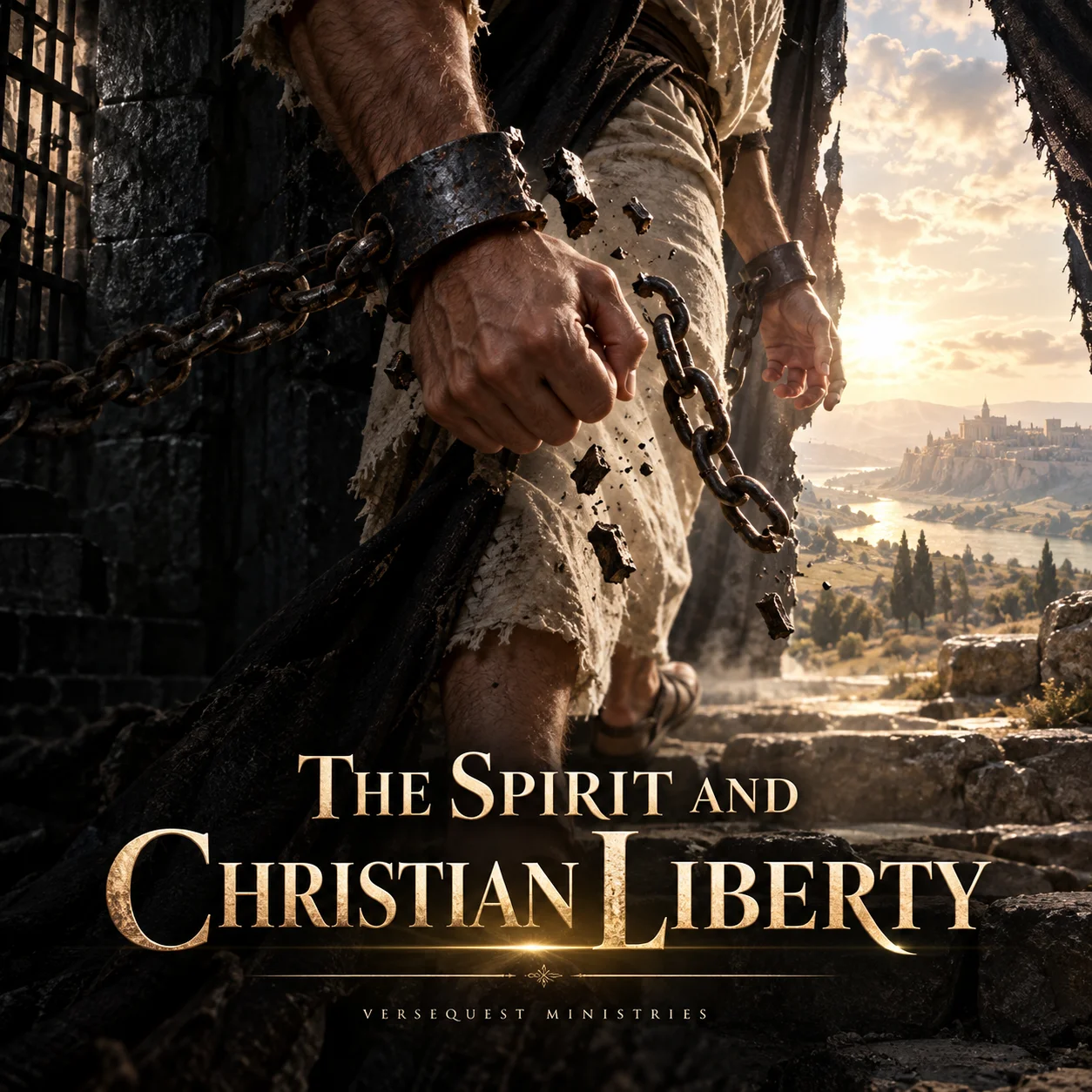
Sermon Title:
The Spirit and Christian Liberty
Key Passage:
2 Corinthians 3:17
“Now the Lord is that Spirit: and where the Spirit of the Lord is, there is liberty.” (2 Corinthians 3:17)
Series:
The Ministry of the Holy Ghost
Topic:
The Holy Spirit, Grace, and the Liberty of the Believer in Christ
Book:
2 Corinthians
Speaker:
Paul Tackett
Suggested Sermon Text:
2 Corinthians 3:6–18; Romans 6:11–18; Romans 8:1–4, 14–16; 1 Corinthians 6:12; 1 Corinthians 10:23–24; Galatians 2:16–21; Galatians 4:21–31; Galatians 5:1, 13–18; Colossians 2:13–17; James 1:25
Short Sermon Description:
Second Corinthians 3:17 declares, “where the Spirit of the Lord is, there is liberty,” but biblical Christian liberty must be understood in its immediate context and through the rest of Pauline revelation. Paul contrasts the ministration of the Spirit with the ministration of death written and engraven in stones, the unveiled believer with Israel’s veiled understanding, and the transforming work of the Spirit with bondage under the old covenant. This sermon explains what Christian liberty is, what it is not, why liberty in Christ does not mean lawlessness or license, how the Holy Spirit frees believers from condemnation and bondage without freeing them to serve the flesh, and why grace produces willing obedience rather than legalistic servitude. The outline follows the VerseQuest requirement for a KJV-only, rightly divided, detailed, sermon-ready treatment.
THE SPIRIT AND CHRISTIAN LIBERTY
Introduction
Few Bible words are used more carelessly than liberty. The world hears liberty and thinks, “Nobody tells me what to do.” The flesh hears liberty and thinks, “I can do whatever I want.” Religion hears liberty and becomes nervous because religious systems often maintain control through regulations, fear, ceremonies, traditions, and human requirements. But the Holy Ghost uses the word in 2 Corinthians 3:17 deliberately: “where the Spirit of the Lord is, there is liberty.” That liberty is neither anarchy nor carnality. It is the freedom that belongs to those who have been brought into a new relationship with God through Jesus Christ.
The immediate context matters. Second Corinthians 3 is not primarily a chapter about political liberty, personal independence, or freedom from every restriction imaginable. Paul is contrasting two ministries and two covenants. He speaks of “the letter” and “the spirit,” of tables of stone and fleshy tables of the heart, of the “ministration of death” and the “ministration of the spirit,” of Moses’ veil and the unveiled believer, and of a glory that fades compared with a glory that excels. Verse 17 stands in that doctrinal setting. The Holy Spirit brings liberty where the old covenant exposed sin, pronounced guilt, and placed men under a ministry that could command righteousness but could not impart the life necessary to produce it.
Yet the same apostle who proclaims liberty warns Christians not to turn liberty into fleshly opportunity. “For, brethren, ye have been called unto liberty; only use not liberty for an occasion to the flesh” (Galatians 5:13). Biblical liberty therefore has two enemies: legalism, which puts the believer back under a yoke God removed, and license, which uses grace as an excuse to indulge the flesh. The Holy Ghost leads the believer away from both. Christian liberty is freedom from condemnation, ceremonial bondage, and the dominion of sin so that the saved man can serve God from a new principle of life.
I. CHRISTIAN LIBERTY MUST BE UNDERSTOOD IN THE CONTEXT OF THE TWO MINISTRATIONS
Key Text: 2 Corinthians 3:6–8
Supporting Texts: Exodus 34:27–35; Romans 7:7–13; Galatians 3:19–25; Hebrews 8:6–13
Paul writes that God “hath made us able ministers of the new testament; not of the letter, but of the spirit” (2 Corinthians 3:6). He immediately adds, “for the letter killeth, but the spirit giveth life.” That verse has often been abused as though careful Bible study or literal interpretation somehow kills people while vague spirituality gives life. That is not Paul’s argument. The following verses identify the “letter” with something “written and engraven in stones” (2 Corinthians 3:7). Paul is dealing with the Mosaic covenant and the law written on stone.
He calls that law “the ministration of death,” yet he also says it “was glorious.” The law was not evil. Romans 7:12 says, “Wherefore the law is holy, and the commandment holy, and just, and good.” The problem was never that God gave a bad law. The problem was sinful man. The law revealed God’s standard, exposed transgression, and pronounced the sinner guilty, but it did not regenerate the sinner or supply righteousness through human effort.
Paul then asks, “How shall not the ministration of the spirit be rather glorious?” (2 Corinthians 3:8). The greater glory belongs to what God accomplishes through Christ and the Spirit. Christian liberty cannot be understood properly until the believer understands what God has delivered him from and what God has brought him into.
Main Truth: Christian liberty belongs to the greater ministry of the Spirit and must be understood against the law’s ministry of condemnation and death.
II. LIBERTY IN THE SPIRIT MEANS THE VEIL HAS BEEN TAKEN AWAY IN CHRIST
Key Text: 2 Corinthians 3:14–17
Supporting Texts: Exodus 34:33–35; Romans 10:1–4; Galatians 3:23–29; Colossians 2:13–17
Paul uses the veil over Moses’ face as a doctrinal picture. Israel could not steadfastly look to the end of that which was abolished, and Paul says that “even unto this day, when Moses is read, the vail is upon their heart” (2 Corinthians 3:15). The problem is spiritual blindness concerning Christ and the purpose of the law.
Then comes the turning point: “Nevertheless when it shall turn to the Lord, the vail shall be taken away” (2 Corinthians 3:16). Liberty is connected with seeing what the law pointed toward and recognizing its fulfillment in Jesus Christ. The believer is no longer standing outside, staring through shadows, ceremonies, and ordinances while waiting for the substance. Colossians 2:17 calls such things “a shadow of things to come; but the body is of Christ.”
That is why putting a saved Gentile back under Israel’s ceremonial system is not spiritual advancement. It is walking backward into shadows after the Substance has come. The believer does not need Israel’s dietary restrictions, feast observances, sabbath system, Levitical priesthood, temple worship, or ceremonial ordinances to complete what Christ accomplished. The veil comes off in Christ.
Main Truth: The Spirit brings liberty by unveiling Christ and freeing the believer from dependence upon the shadows and ordinances of the old covenant.
III. CHRISTIAN LIBERTY IS FREEDOM FROM CONDEMNATION, NOT FREEDOM TO SIN
Key Text: Romans 8:1–2
Supporting Texts: Romans 6:1–2, 14–18; Galatians 5:13; Titus 2:11–14
Romans 8 opens with one of the great declarations of grace: “There is therefore now no condemnation to them which are in Christ Jesus.” The believer’s standing before God no longer depends upon his ability to satisfy the law. Christ satisfied the righteous demands, bore the curse, died for sins, rose again, and the believing sinner is placed into Him.
Paul continues, “For the law of the Spirit of life in Christ Jesus hath made me free from the law of sin and death” (Romans 8:2). That is liberty. But nothing in that statement permits the Christian to turn around and willingly submit himself again to the sin from which Christ delivered him. Romans 6 anticipates the foolish objection: “Shall we continue in sin, that grace may abound? God forbid.”
Biblical liberty removes condemnation without removing responsibility. It destroys sin’s title to reign; it does not issue sin a license to operate. A prisoner released from jail is not liberated so that he can break back into the prison and demand his old cell. Yet believers sometimes treat sin precisely that way. Christ breaks the chain, and the flesh asks permission to wear it as jewelry.
Main Truth: Liberty in Christ frees the believer from condemnation and sin’s dominion, not from the responsibility to walk in holiness.
IV. THE HOLY SPIRIT LEADS THE BELIEVER WITHOUT PUTTING HIM BACK UNDER THE LAW
Key Text: Galatians 5:18
Supporting Texts: Galatians 5:1, 13–18; Romans 8:14; Galatians 3:1–3; Colossians 2:20–23
Paul writes, “But if ye be led of the Spirit, ye are not under the law” (Galatians 5:18). That sentence is about as plain as the Holy Ghost could make it. The Christian life is not begun by grace and then maintained by returning to the Mosaic covenant. Paul rebuked the Galatians for attempting exactly that: “Are ye so foolish? having begun in the Spirit, are ye now made perfect by the flesh?” (Galatians 3:3).
Galatians 5:1 commands, “Stand fast therefore in the liberty wherewith Christ hath made us free.” The opposite is being “entangled again with the yoke of bondage.” Paul was especially combating circumcision and justification through law keeping, but the principle reaches any system that makes legal observance the ground of spiritual acceptance before God.
Yet being led by the Spirit produces more righteousness, not less. The works of the flesh are listed plainly in Galatians 5, followed by the fruit of the Spirit: love, joy, peace, longsuffering, gentleness, goodness, faith, meekness, and temperance. Grace does not lower God’s moral standard until carnality becomes acceptable. Grace changes the principle under which the believer lives.
Main Truth: The Spirit leads believers in holiness from within without returning them to the Mosaic law as the governing covenant of their Christian life.
V. LIBERTY MUST NEVER BECOME AN OCCASION TO THE FLESH
Key Text: Galatians 5:13
Supporting Texts: 1 Corinthians 6:12; 1 Corinthians 10:23–24; Romans 14:13–23; 1 Peter 2:16
Paul says, “For, brethren, ye have been called unto liberty.” If the verse stopped there, the flesh would happily write its own conclusion. But Paul continues: “only use not liberty for an occasion to the flesh, but by love serve one another.” Christian liberty is therefore governed by love, edification, conscience, testimony, and responsibility toward other believers.
Paul makes the same point in 1 Corinthians: “All things are lawful unto me, but all things are not expedient” (1 Corinthians 6:12). Again: “All things are lawful for me, but all things edify not” (1 Corinthians 10:23). The mature Christian does not merely ask, “Am I allowed to do this?” He asks whether it profits, whether it edifies, whether it masters him, whether it harms another believer’s conscience, and whether it glorifies God.
That distinction separates liberty from childish selfishness. A child thinks freedom means nobody can stop him. Spiritual maturity recognizes that liberty gives the believer the ability to voluntarily limit himself for somebody else’s good. Christ was perfectly free, yet He humbled Himself and served. The Spirit produces that same direction in those who walk with Him.
Main Truth: Christian liberty is controlled by love and edification, never by the selfish demands of the flesh.
VI. TRUE LIBERTY PRODUCES TRANSFORMATION INTO CHRIST’S IMAGE
Key Text: 2 Corinthians 3:18
Supporting Texts: Romans 12:1–2; Galatians 5:22–25; Ephesians 4:22–24; Colossians 3:9–14
The verse immediately following Paul’s declaration of liberty explains where that liberty leads: “But we all, with open face beholding as in a glass the glory of the Lord, are changed into the same image from glory to glory” (2 Corinthians 3:18). The Spirit does not liberate the believer so that nothing in his life changes. The result is transformation.
Notice the direction: “into the same image.” The goal is Christlikeness. Genuine liberty does not make the believer increasingly independent of Christ; it makes him increasingly conformed to Christ. The Spirit who frees also transforms. The believer beholds the Lord through truth, and the Spirit works that truth into his thinking, conduct, desires, and character.
This exposes another counterfeit form of liberty. If a supposed doctrine of grace consistently produces arrogance, impurity, drunkenness, bitterness, selfishness, uncontrolled appetites, contempt for weaker believers, and resistance to biblical correction, something has gone wrong. Paul’s liberty ends in glory and transformation, not spiritual deterioration.
Main Truth: The liberty produced by the Spirit moves the believer toward Christlikeness rather than deeper conformity to the flesh.
VII. THE HIGHEST USE OF CHRISTIAN LIBERTY IS VOLUNTARY SERVICE
Key Text: Galatians 5:13
Supporting Texts: Romans 6:18, 22; 1 Corinthians 9:19; Philippians 2:3–8; 2 Corinthians 5:14–15
Paul says something that sounds contradictory to the natural man: the believer is called to liberty, yet through love he is to “serve one another.” Romans 6 likewise says, “Being then made free from sin, ye became the servants of righteousness” (Romans 6:18). Biblical freedom is not the elimination of every master. It is deliverance from cruel masters so that the believer can serve the right Master.
Before salvation, sin enslaved the sinner while pretending to offer freedom. Christ breaks that dominion. Now the believer can serve righteousness voluntarily. Paul himself said, “For though I be free from all men, yet have I made myself servant unto all” (1 Corinthians 9:19). That is mature liberty: freedom strong enough to kneel.
Jesus Christ provides the supreme pattern. Philippians 2 describes the One who had every right to glory but “made himself of no reputation, and took upon him the form of a servant.” Christian liberty therefore reaches its noblest expression not when a believer demands every right he possesses, but when love enables him to surrender a right for the glory of Christ and the good of others.
Main Truth: The greatest expression of Christian liberty is the freedom to serve God and others willingly out of love rather than bondage.
Conclusion
“Where the Spirit of the Lord is, there is liberty.” That liberty is magnificent, but it must remain attached to the context God gave it. It is liberty from the condemnation associated with broken law, liberty from the veil that hides Christ, liberty from ceremonial shadows, liberty from sin’s right to rule, and liberty from attempting to earn acceptance before God through human performance. Christ finished the work. The Spirit indwells the believer. The veil has been removed. The saved man stands before God in Christ.
But Christian liberty never means that God has become indifferent to the believer’s conduct. Paul does not free the Christian from law so he can crawl back into lust. He frees him from bondage so he can walk in the Spirit. The Spirit leads him, produces fruit in him, transforms him, and teaches him to use liberty for service rather than self-indulgence. Legalism says, “Obey so God will accept you.” License says, “God accepts you, so obedience does not matter.” Grace says, “God has accepted you in Christ; now walk like a man who belongs to Him.”
The Bible believer therefore should stand fast in liberty without apologizing for grace and without abusing it. Do not allow religious men to rebuild chains Christ removed. Do not allow your flesh to redefine liberty as permission to sin. Do not put yourself back under shadows when you possess the Substance. Walk in the Spirit. Serve through love. Protect weaker consciences. Refuse bondage to sin. Let the King James Bible define liberty instead of the world, the flesh, or religious tradition. The Spirit’s liberty does not make a Christian less holy—it frees him to become what bondage never could produce.
Final Call
If you are lost, you are not spiritually free simply because you reject religion, rules, or churches. Jesus said, “Whosoever committeth sin is the servant of sin” (John 8:34). The greatest bondage is not external regulation; it is sin, guilt, condemnation, and separation from God. Jesus Christ died for your sins, was buried, and rose again the third day according to the Scriptures (1 Corinthians 15:3–4). Believe on Him. Salvation is not earned by law keeping, ceremonies, church membership, baptism, reform, or human merit. It is the gift of God received through faith.
If you are saved, stand fast in the liberty Christ purchased for you. Do not surrender it to legalism, and do not prostitute it to the flesh. You are free from condemnation so you can serve God without terror. You are free from ceremonial bondage so you can live in the reality found in Christ. You are free from sin’s dominion so you can yield yourself to righteousness. You are free enough to love, free enough to serve, free enough to deny yourself, and free enough to let the Spirit transform you into the image of Jesus Christ.
Closing Verse:
“Now the Lord is that Spirit: and where the Spirit of the Lord is, there is liberty.” (2 Corinthians 3:17)
Closing Statement:
Christian liberty is not freedom from God’s authority—it is freedom from bondage so the redeemed man can finally serve God from the heart.