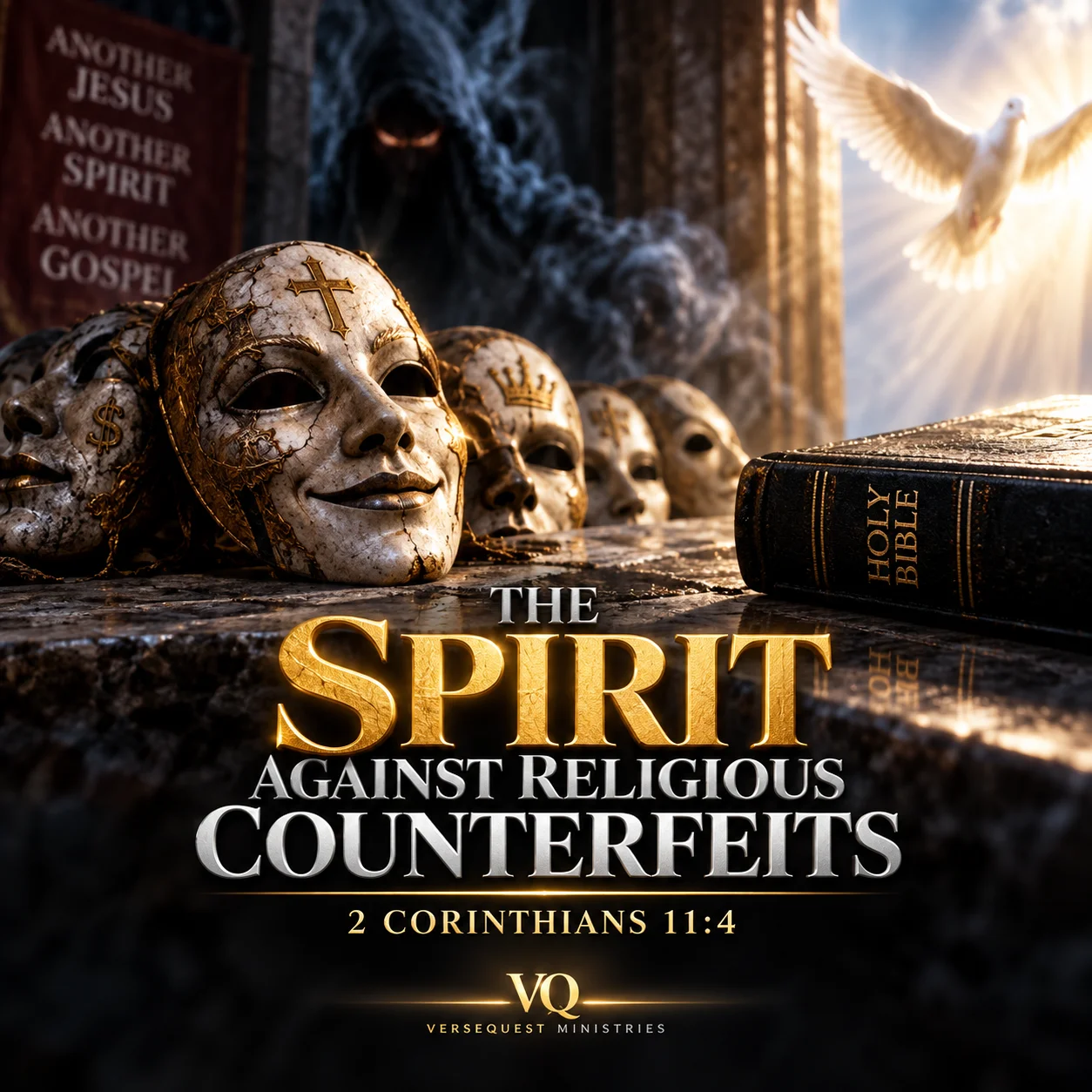
Sermon Title:
The Spirit Against Religious Counterfeits
Key Passage:
2 Corinthians 11:4
“For if he that cometh preacheth another Jesus, whom we have not preached, or if ye receive another spirit, which ye have not received, or another gospel, which ye have not accepted, ye might well bear with him.” (2 Corinthians 11:4)
Series:
The Ministry of the Holy Ghost
Topic:
The Holy Spirit and the Exposure of Religious Counterfeits
Book:
2 Corinthians
Speaker:
Paul Tackett
Suggested Sermon Text:
2 Corinthians 11:1–15; 1 Corinthians 2:12–14; 1 Corinthians 12:3; Galatians 1:6–9; John 16:13–14; Acts 17:10–11; 1 John 4:1–6; 1 Timothy 4:1; 2 Timothy 3:13–17; 2 Timothy 4:2–4
Short Sermon Description:
Second Corinthians 11:4 exposes one of Satan’s most dangerous methods: religious counterfeiting. Paul warns that deception may present “another Jesus,” “another spirit,” and “another gospel”—counterfeits close enough to biblical language to deceive believers who fail to test what they hear. This sermon distinguishes the Holy Spirit from false spiritual influences, shows how Satan transforms himself into “an angel of light,” explains why doctrinal error often appears respectable and religious rather than openly wicked, and establishes the written word of God and Paul’s gospel as the standard by which spiritual claims must be tested. It also warns against emotionalism, personality worship, supernatural claims, and religious experiences that bypass Scripture. The outline follows the VerseQuest standard of KJV-only, rightly divided, detailed, sermon-ready exposition for pastors, teachers, Bible students, and believers. Sermon Outline Prompt – VerseQu…
THE SPIRIT AGAINST RELIGIOUS COUNTERFEITS
Introduction
The most dangerous counterfeit is not the one that looks ridiculous. It is the one that looks almost right. Nobody is fooled by a counterfeit bill printed in purple ink on notebook paper. The deception works because the imitation resembles the genuine article closely enough to pass unnoticed. Paul applies that principle to the spiritual realm in 2 Corinthians 11. He does not merely warn the Corinthians about atheism, paganism, or obvious wickedness. He warns them about another Jesus, another spirit, and another gospel. Those are religious counterfeits, and they are dangerous precisely because they borrow the language of truth.
The passage also destroys the childish notion that Satan always appears frightening, filthy, or openly hostile to Christianity. Paul says, “Satan himself is transformed into an angel of light” (2 Corinthians 11:14). He can operate through religion, morality, preaching, spiritual experiences, persuasive personalities, supernatural claims, and ministries that use biblical vocabulary while corrupting biblical doctrine. The devil does not have to persuade a man to burn his Bible if he can persuade him to misread it. He does not have to remove the name of Jesus if he can substitute “another Jesus.” He does not have to eliminate spirituality if he can substitute “another spirit.” He does not have to abolish the word gospel if he can change what the gospel means.
That is why the ministry of the Holy Ghost must never be separated from truth. Jesus called Him “the Spirit of truth” (John 16:13). He glorifies Jesus Christ, agrees with the revelation He inspired, and never contradicts the gospel God committed to Paul. Genuine spiritual discernment is therefore not mystical suspicion, emotional intuition, or an imagined ability to sense whether somebody has the right atmosphere around him. The believer must know the Book, know the biblical Christ, know the gospel, and compare every spiritual claim with revealed truth. The Spirit of God does not fear doctrinal examination. Counterfeits do.
I. SATAN’S COUNTERFEIT BEGINS WITH ANOTHER JESUS
Key Text: 2 Corinthians 11:4
Supporting Texts: John 1:1, 14; Colossians 1:15–20; Colossians 2:9; 1 Corinthians 15:1–4; 1 John 4:2–3
Paul’s first warning is “another Jesus, whom we have not preached.” That wording should arrest every Christian who assumes that merely hearing the name Jesus proves a message is Christian. The question is not simply whether a preacher talks about Jesus. The question is: Which Jesus? The Jesus Christ of Scripture is the eternal Word made flesh, the sinless Son of God, the Creator, the crucified Saviour, the risen Lord, and the only Mediator between God and men.
Religious counterfeits frequently preserve the name while changing the Person. One system makes Jesus merely a prophet. Another makes Him a created being. Another reduces Him to a moral teacher. Another turns Him into a social reformer whose primary mission was improving earthly society. Another presents Him as a dispenser of material prosperity. But changing Christ’s identity while retaining His name produces exactly what Paul warned about: another Jesus.
The Holy Ghost never leads men toward a diminished Christ. Jesus said of the Spirit, “He shall glorify me” (John 16:14). Genuine spiritual ministry exalts the biblical Lord Jesus Christ rather than reconstructing Him according to culture, philosophy, religious tradition, or human preference. If somebody’s “Jesus” contradicts the Christ revealed in the King James Bible, the familiar name does not rescue the counterfeit.
Main Truth: The first test of religious authenticity is whether its Jesus is the Jesus Christ revealed and preached in Scripture.
II. ANOTHER SPIRIT CAN OPERATE INSIDE RELIGIOUS ACTIVITY
Key Text: 2 Corinthians 11:4
Supporting Texts: 1 Corinthians 12:3; 1 John 4:1–6; 1 Timothy 4:1; John 16:13–14
Paul next warns, “or if ye receive another spirit, which ye have not received.” That phrase demolishes the assumption that every spiritual manifestation must come from the Holy Ghost. Scripture explicitly recognizes counterfeit spiritual activity. First Timothy 4:1 warns of “seducing spirits, and doctrines of devils.” First John 4:1 commands believers, “believe not every spirit, but try the spirits whether they are of God.”
A religious meeting can be emotional without being spiritual in the biblical sense. A person can fall down, cry, tremble, shout, experience unusual sensations, claim visions, speak dramatically, or report supernatural encounters, and none of those things automatically identifies the Holy Ghost as the source. Experiences must be judged by doctrine, not doctrine by experiences. If an experience requires the believer to disregard Scripture, the experience has failed the test.
The Holy Spirit’s ministry has recognizable biblical characteristics. He glorifies Christ. He leads into truth. He never contradicts Scripture. He produces spiritual fruit rather than uncontrolled flesh. He agrees with the gospel He inspired. The Spirit who wrote the Book does not lead men to despise the Book. Any spiritual influence that elevates sensation above Scripture has already moved onto counterfeit ground.
Main Truth: Not every spiritual experience comes from the Holy Ghost, so every claimed spiritual influence must be tested by revealed truth.
III. ANOTHER GOSPEL IS STILL FALSE EVEN WHEN IT SOUNDS RELIGIOUS
Key Text: 2 Corinthians 11:4
Supporting Texts: 1 Corinthians 15:1–4; Galatians 1:6–9; Romans 3:24–28; Ephesians 2:8–9; Titus 3:5
Paul’s third counterfeit is “another gospel, which ye have not accepted.” Galatians 1 treats this matter with tremendous severity. Paul marvels that believers were being removed “unto another gospel,” then immediately says, “Which is not another.” A counterfeit gospel may call itself good news, but altering God’s gospel does not create an alternative route to God. It creates error.
The gospel for this dispensation is stated plainly in 1 Corinthians 15:1–4. Christ died for our sins according to the Scriptures, He was buried, and He rose again the third day according to the Scriptures. Salvation comes through faith in Christ and His finished work, not through human merit. When men add church membership, water baptism, sacraments, law keeping, endurance, religious works, moral reformation, or institutional loyalty as requirements for justification, grace has been corrupted.
Paul makes the standard so absolute that he says, “Though we, or an angel from heaven, preach any other gospel unto you…let him be accursed” (Galatians 1:8). Notice that supernatural appearance does not override doctrine. Even an angelic messenger must bow before the gospel already revealed. God’s message judges the messenger; the messenger does not rewrite God’s message.
Main Truth: The true gospel is Christ’s finished work received by faith, and any message that alters that gospel is a religious counterfeit.
IV. SATAN’S MOST EFFECTIVE DISGUISE IS AN ANGEL OF LIGHT
Key Text: 2 Corinthians 11:13–15
Supporting Texts: Genesis 3:1–5; Matthew 4:5–7; Acts 20:29–30; 2 Peter 2:1–3
Paul writes, “For such are false apostles, deceitful workers, transforming themselves into the apostles of Christ” (2 Corinthians 11:13). He then adds, “And no marvel; for Satan himself is transformed into an angel of light.” The counterfeit therefore does not necessarily look evil. It may look virtuous, compassionate, learned, supernatural, respectable, traditional, exciting, or deeply religious.
Satan has been twisting God’s words since Genesis 3. He approached Eve not by denying that God existed but by questioning and altering what God had said. In Matthew 4, he even quoted Scripture to Jesus Christ. A Bible quotation therefore proves nothing by itself. Scripture can be quoted accurately and applied wrongly. It can be isolated from context, directed to the wrong doctrinal group, or used to support a conclusion contradicted by clearer passages.
This explains why discernment requires more than detecting obvious wickedness. A wolf wearing a sign marked “wolf” would not fool many sheep. The danger comes when the wolf has wool on. False apostles appear like apostles. Satan appears like light. Ministers of deception can appear as “ministers of righteousness.” The disguise is the strategy.
Main Truth: Satan’s religious counterfeits are dangerous because they often appear righteous, biblical, spiritual, and full of light.
V. FALSE MINISTERS CAN USE BIBLICAL LANGUAGE WHILE CORRUPTING BIBLICAL TRUTH
Key Text: 2 Corinthians 11:13
Supporting Texts: Matthew 7:15–23; Acts 20:29–31; 2 Timothy 4:3–4; 2 Peter 2:1–3
Paul calls them “deceitful workers.” Deception requires some measure of plausibility. False teachers usually do not walk into a church announcing, “I have come to destroy your doctrine.” They quote verses, use Christian terminology, speak about love, faith, blessing, Jesus, salvation, the Spirit, and the Bible. The problem appears when those familiar words are given unfamiliar meanings.
Jesus warned of false prophets who come “in sheep’s clothing” (Matthew 7:15). Paul warned the Ephesian elders that men would arise from among their own number “speaking perverse things, to draw away disciples after them” (Acts 20:30). Religious deception therefore may arise close to the flock and from individuals whom believers already trust.
That is why personality cannot become the standard. Charisma is not doctrine. Popularity is not proof. A massive ministry is not proof. Academic credentials are not proof. Miracles are not proof. Sincerity is not proof. Longevity is not proof. A preacher stands or falls doctrinally by what he teaches compared with the written word of God. The Bible does not need a famous man’s endorsement; the famous man needs the Bible’s approval.
Main Truth: Familiar Christian language does not guarantee biblical truth, so doctrine must be examined independently of personality, popularity, or reputation.
VI. THE HOLY GHOST WORKS THROUGH TRUTH, NOT DOCTRINAL CONFUSION
Key Text: John 16:13–14
Supporting Texts: 1 Corinthians 2:12–13; 2 Timothy 3:16–17; Ephesians 6:17; 1 John 4:6
Jesus calls the Holy Ghost “the Spirit of truth.” That title matters. Truth is not a side issue in the Spirit’s ministry. He inspired Scripture, teaches spiritual truth, glorifies Christ, and guides believers according to what God has revealed. The sword of the Spirit is “the word of God” (Ephesians 6:17).
This means doctrinal confusion should never be praised as evidence of spiritual depth. The Holy Ghost does not tell one church that Christ is God and another that He is a created being. He does not teach salvation by grace in one place and salvation by works in another. He does not reveal one gospel through Paul and then contradict it through somebody’s private revelation centuries later. God is not the author of confusion.
First John 4:6 distinguishes “the spirit of truth, and the spirit of error.” Truth can therefore be identified, and error can be identified. The Christian is not condemned to wander among competing religious claims shrugging his shoulders and saying nobody can know. God gave a Book. The believer’s responsibility is to study it, rightly divide it, compare Scripture with Scripture, and reject what contradicts it.
Main Truth: The Holy Ghost is the Spirit of truth and will never lead the believer contrary to the written revelation He inspired.
VII. THE BELIEVER’S DEFENSE AGAINST COUNTERFEITS IS TO KNOW THE GENUINE ARTICLE
Key Text: Acts 17:11
Supporting Texts: 2 Timothy 2:15; 2 Timothy 3:13–17; Psalm 119:104–105; 1 Thessalonians 5:21; Philippians 1:9–10
The Bereans received preaching with readiness of mind, but they also “searched the scriptures daily, whether those things were so” (Acts 17:11). They did not insult Paul by checking his preaching against Scripture. Luke calls them noble for doing it. A preacher who fears Bible examination has a problem the Bereans would have exposed quickly.
The safest way to identify counterfeit money is not to spend your life memorizing every possible counterfeit. Know genuine currency thoroughly enough that the false stands out. The same principle works doctrinally. Know the biblical Jesus. Know Paul’s gospel. Know the Holy Ghost’s ministry. Know the doctrines of grace. Know your Bible. Know how to rightly divide it. Counterfeit religion becomes easier to identify when biblical truth is familiar.
Second Timothy 3 warns that “evil men and seducers shall wax worse and worse, deceiving, and being deceived.” Paul’s answer is not panic. He tells Timothy, “continue thou in the things which thou hast learned.” Then he points him directly to Scripture. The answer to increasing deception is increasing familiarity with divine revelation.
Main Truth: The believer is protected from religious counterfeits by knowing, believing, studying, and rightly dividing the genuine truth of Scripture.
Conclusion
Second Corinthians 11:4 gives us three religious counterfeits: another Jesus, another spirit, and another gospel. Those three are not unrelated. Corrupt Christology eventually corrupts the gospel. A corrupt gospel opens the door to another spirit. Another spirit encourages experiences and teachings that draw men farther from the biblical Christ. The counterfeit system reinforces itself until somebody can use Christian vocabulary while standing miles away from biblical Christianity.
Paul’s warning becomes even more serious when we remember that Satan is transformed into an angel of light and his ministers appear as ministers of righteousness. The Christian therefore cannot evaluate truth primarily by appearance. The auditorium may be full. The preacher may be polished. The music may be moving. The testimony may be dramatic. The supernatural claim may be astonishing. The organization may be ancient. The credentials may be impressive. None of those things answers the doctrinal question. What saith the Scripture?
The Holy Ghost has not left the believer defenseless. He gave us the word of God. He glorifies the true Jesus Christ. He agrees with the true gospel. He leads into truth. The King James Bible gives the believer an objective standard against which every preacher, spirit, gospel, movement, miracle, tradition, vision, and experience can be measured. Do not become fascinated with counterfeits. Become familiar with truth. The believer who knows the genuine Christ, the genuine gospel, the genuine Spirit, and the genuine Book is much harder to deceive.
Final Call
If you are lost, do not settle for another Jesus or another gospel. The biblical Jesus Christ “died for our sins according to the scriptures; And…was buried, and…rose again the third day according to the scriptures” (1 Corinthians 15:3–4). Your religion cannot save you. Your works cannot save you. Your baptism cannot save you. Your church membership cannot save you. Your spiritual experiences cannot save you. Salvation is by grace through faith in the finished work of Jesus Christ. Believe on Him.
If you are saved, do not outsource your discernment. Open the Book. Study the Book. Compare every message with the Book. Test every spirit. Examine every gospel. Ask which Jesus is being preached. Refuse to be impressed by religious packaging when the doctrine inside the package is counterfeit. The Holy Ghost will never resent you for testing spiritual claims by the Scriptures He inspired.
Closing Verse:
“But though we, or an angel from heaven, preach any other gospel unto you than that which we have preached unto you, let him be accursed.” (Galatians 1:8)
Closing Statement:
Satan’s most dangerous counterfeit is not religion without Jesus—it is religion with another Jesus, another spirit, and another gospel.