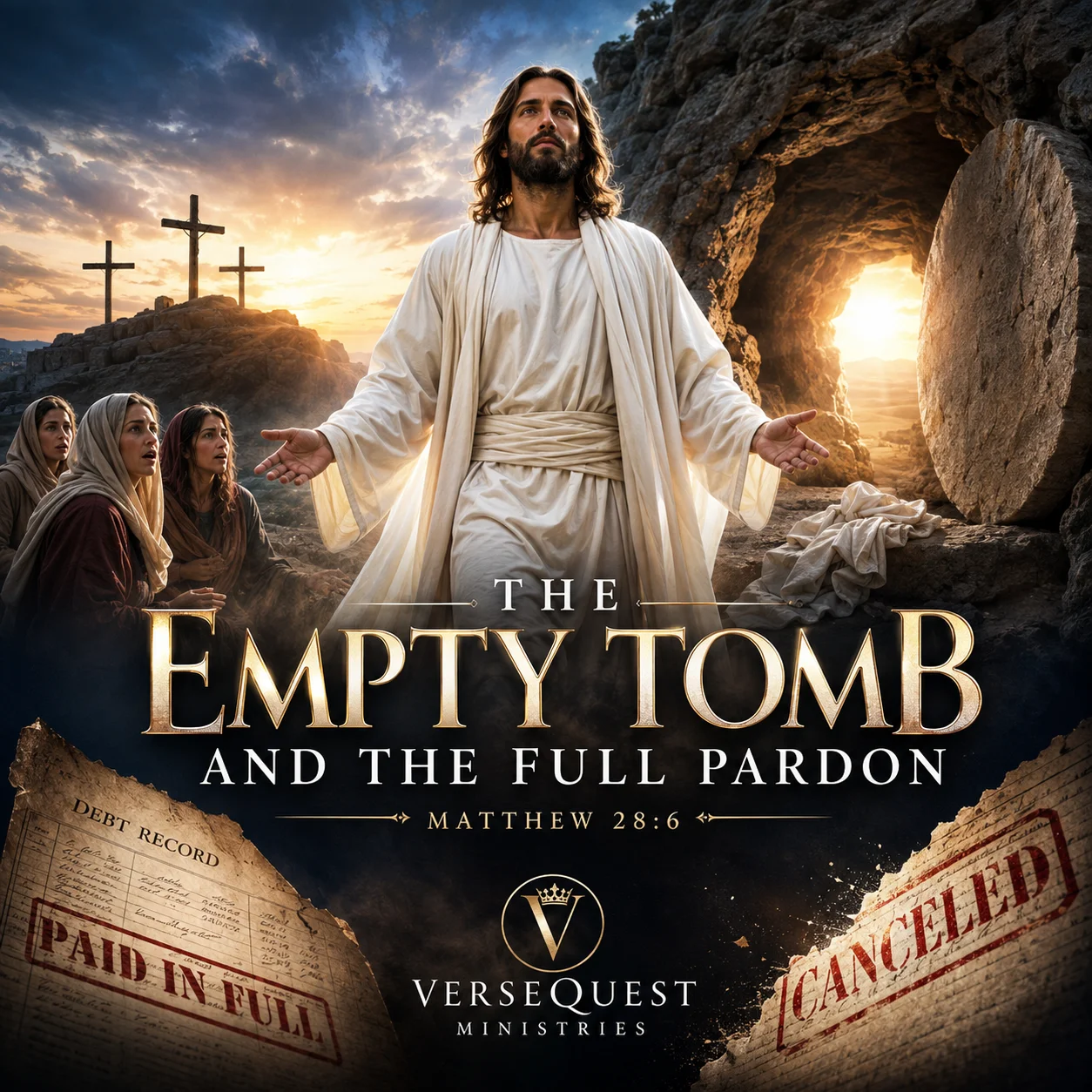
The Empty Tomb and the Full Pardon
Sermon Title:
The Empty Tomb and the Full Pardon: He Is Risen, as He Said
Key Passage:
Matthew 28:6 — “He is not here: for he is risen, as he said. Come, see the place where the Lord lay.”
Series:
Foundations of the Gospel of Grace
Topic:
The Empty Tomb, the Resurrection of Jesus Christ, and the Full Pardon Secured by the Risen Saviour
Book:
Matthew, Romans, 1 Corinthians, Acts, Colossians, Ephesians, Hebrews, 1 Peter, John
Speaker:
Paul Tackett
Suggested Sermon Text:
Matthew 28:1–10; 1 Corinthians 15:1–20; Romans 4:24–25; Romans 5:1–11; Acts 13:28–39; Colossians 2:13–15; Ephesians 1:7; Hebrews 10:10–14; 1 Peter 1:3–5; John 19:30; John 20:1–31; Luke 24:1–8
Short Sermon Description:
This detailed VerseQuest Ministries sermon outline explains Matthew 28:6 and the glorious truth announced at the empty tomb: “He is not here: for he is risen, as he said.” The empty tomb is not a religious decoration, a sentimental Easter picture, or a vague symbol of hope; it is God’s public witness that Jesus Christ truly died, was truly buried, and truly rose again. This sermon shows how the resurrection proves the finished work of the cross, confirms the full pardon of the believer, validates the gospel of Christ’s death, burial, and resurrection, and destroys every religion that leaves sinners uncertain, guilty, or dependent on works, sacraments, law-keeping, church membership, morality, or human merit. Designed for pastors, preachers, teachers, Bible students, and believers, this outline magnifies the risen Lord Jesus Christ as the only Saviour, the accepted sacrifice, the conqueror of death, and the living proof that sinners who believe are fully forgiven, justified, reconciled, and secure in Him.
The Empty Tomb and the Full Pardon
He Is Risen, as He Said
Introduction
Matthew 28:6 records the angelic announcement that split human history open like lightning across a midnight sky: “He is not here: for he is risen, as he said. Come, see the place where the Lord lay.” The women came looking for a body, but heaven sent them away with a message. They came expecting sorrow, spices, and a sealed grave; they left with the first great sunrise report of resurrection victory. The stone was rolled away, not to let Christ out, but to let witnesses look in. The grave did not release Jesus Christ because death got tired. The Lord rose because death had no lawful claim left upon Him. The debt had been paid. The sacrifice had been accepted. The tomb was empty because Calvary was finished.
The empty tomb is God’s answer to every religious system that tries to keep sinners working for a pardon Christ already purchased. Religion loves a cross without finality and a tomb without power. It wants a Jesus who inspires, a ceremony that mediates, a church that controls, a law that threatens, a priesthood that dispenses, and a sinner who never quite knows if enough has been done. But Matthew 28:6 does not sound like nervous religion. It sounds like heaven’s courtroom announcement: “He is risen.” If Christ is risen, the sacrifice was accepted. If the sacrifice was accepted, the believer’s pardon is not partial. If the believer’s pardon is not partial, then no religious debt collector has authority to keep sending bills after God has already raised the Substitute from the dead.
This sermon deals with the connection between the empty tomb and the full pardon. The resurrection is not a disconnected miracle tacked onto the end of the crucifixion story. It is God’s public receipt that the death of Christ for sinners was enough. Paul says Christ “was delivered for our offences, and was raised again for our justification.” The empty tomb tells the believer that the blood was not wasted, the cross was not defeated, the burial was not permanent, the gospel is not uncertain, and the pardon is not unfinished. Jesus Christ did not rise from the dead to begin a religious payment plan. He rose to prove that the account was settled forever.
I. The Empty Tomb Was Announced by Heaven
Key Text: Matthew 28:5–6
Supporting Texts: Luke 24:5–8; Mark 16:6; John 20:11–17
The angel said, “Fear not ye: for I know that ye seek Jesus, which was crucified.” Heaven knew exactly whom the women sought. Not a myth. Not a symbol. Not a spiritual idea. Not a religious memory. “Jesus, which was crucified.” The same Jesus who was nailed to the cross was the One announced as risen. The resurrection is not the survival of a doctrine after its founder died. It is the bodily resurrection of the crucified Lord. Heaven did not preach vague optimism at the tomb. Heaven preached historical truth.
“He is not here.” That is one of the strongest statements ever spoken over a grave. Every other tomb in history says, “He is here.” The tomb of every king, philosopher, prophet, rebel, emperor, pope, scholar, and religious founder eventually says, “Here lies.” But the tomb of Jesus Christ says, “He is not here.” Men put Him in the tomb. Rome sealed it. Soldiers guarded it. Religious leaders feared it. But heaven emptied it. The place where the Lord lay became a pulpit, and the first sermon was short enough for a child and strong enough to shake hell: “He is risen.”
Luke 24 asks, “Why seek ye the living among the dead?” That question rebukes every attempt to keep Christ trapped in dead religion. The Lord Jesus is not a relic, a corpse, a memory, or a sacramental object to be handled by religious professionals. He is the living Christ. The empty tomb was announced by heaven because the resurrection is not man’s theory about God; it is God’s testimony about His Son.
Main Truth:
The empty tomb was heaven’s announcement that the crucified Jesus is risen bodily from the dead.
II. The Empty Tomb Proves Christ Truly Died and Was Truly Buried
Key Text: Matthew 28:6
Supporting Texts: Matthew 27:57–66; John 19:38–42; 1 Corinthians 15:3–4
The angel said, “Come, see the place where the Lord lay.” That invitation matters. The place was real. The burial was real. The tomb was real. The body had been laid there. Christianity does not rest on fog, fables, emotional impressions, or clever religious metaphors. It rests on events that happened in time: Christ died for our sins, He was buried, and He rose again the third day according to the Scriptures. The empty tomb only means something because the tomb had first held a real body.
Matthew 27 records the burial of Jesus Christ with careful detail. Joseph of Arimathaea took the body, wrapped it in clean linen, and laid it in his own new tomb. The stone was rolled to the door. The chief priests and Pharisees requested a guard because they remembered that Jesus said He would rise again. The tomb was sealed. The watch was set. God allowed both friends and enemies to establish that Jesus Christ was dead, buried, and guarded. The resurrection was not staged in a corner.
First Corinthians 15 includes the burial as part of Paul’s gospel. The burial proves the reality of the death. A Christ who merely fainted could not save sinners. A Christ who only appeared to die could not pay the wages of sin. The burial says the price went all the way to death. The empty tomb says death could not hold Him. The same gospel that requires a real cross also requires a real grave and a real resurrection.
Main Truth:
The empty tomb proves that Jesus Christ truly died, was truly buried, and truly rose again in bodily victory.
III. The Empty Tomb Confirms the Finished Work of the Cross
Key Text: John 19:30
Supporting Texts: Romans 4:25; Hebrews 10:10–14; Colossians 2:13–14
Before the tomb was empty, the cross was finished. Jesus cried, “It is finished,” bowed His head, and gave up the ghost. The resurrection did not complete a payment left unfinished at Calvary. It confirmed that the payment had been accepted. Christ did not rise to continue paying for sin. He rose because sin had been answered, death had been faced, justice had been satisfied, and the work of redemption was complete.
Romans 4:25 gives the doctrinal connection: Christ “was delivered for our offences, and was raised again for our justification.” The cross deals with the offences. The resurrection proves justification. The empty tomb is God’s receipt. It says the cheque cleared. It says the sacrifice was received. It says the Substitute was accepted. It says the sinner who believes is not waiting on a religious institution to finish what the risen Christ proved was finished.
Hebrews 10 says by one offering Christ has perfected forever them that are sanctified. Colossians 2 says God forgave all trespasses, blotted out the handwriting of ordinances that was against us, and nailed it to Christ’s cross. The empty tomb stands beside that finished work and says, “Amen.” Religion may try to drag sinners back to an unpaid ledger, but the risen Christ is God’s living proof that the debt was nailed to the cross and taken out of the way.
Main Truth:
The empty tomb confirms that the finished work of Christ on the cross was fully accepted by God.
IV. The Empty Tomb Secures the Full Pardon of the Believer
Key Text: Acts 13:38–39
Supporting Texts: Ephesians 1:7; Colossians 2:13; Romans 5:1
Acts 13:38–39 says, “Be it known unto you therefore, men and brethren, that through this man is preached unto you the forgiveness of sins: And by him all that believe are justified from all things.” That is full pardon language. Not partial pardon. Not temporary pardon. Not religious probation. Not a reduced sentence with payments due later. “Forgiveness of sins” and “justified from all things.” The risen Christ is the basis of that proclamation.
Ephesians 1:7 says, “In whom we have redemption through his blood, the forgiveness of sins, according to the riches of his grace.” The believer does not hope to have forgiveness after religion gets finished with him. He has forgiveness in Christ. Colossians 2 says God has forgiven “all trespasses.” That word “all” ought to be allowed to mean what God wrote. If all trespasses are forgiven, then no sin debt remains for the believer to pay before God’s judgment bench.
Romans 5:1 says, “Therefore being justified by faith, we have peace with God through our Lord Jesus Christ.” Peace with God comes from justification, and justification is secured in the risen Christ. The empty tomb is not merely a message that death was defeated. It is the evidence that the believer’s pardon is full, legal, righteous, and final. God does not raise the Substitute and then keep the believer under condemnation.
Main Truth:
The empty tomb proclaims full pardon because the risen Christ provides forgiveness of sins and justification from all things.
V. The Empty Tomb Destroys the Fear of Condemnation
Key Text: Romans 8:1
Supporting Texts: Romans 8:31–34; John 5:24; Hebrews 7:25
Romans 8:1 says, “There is therefore now no condemnation to them which are in Christ Jesus.” That is not weak comfort. That is courtroom thunder. No condemnation means the case has been settled. The believer is not waiting to see whether the resurrection was enough. He is in Christ, and Christ is risen. The Judge who accepted the sacrifice does not keep the believer under the curse Christ bore.
Romans 8 asks, “Who shall lay any thing to the charge of God’s elect?” The answer is not, “No one because the believer never fails.” The answer is, “It is God that justifieth.” Then Paul points to Christ who died, rose again, and makes intercession. The believer’s security is not defended by his emotional stability, religious performance, or personal merit. It is defended by the death, resurrection, and present intercession of Jesus Christ.
John 5:24 says the believer “hath everlasting life, and shall not come into condemnation; but is passed from death unto life.” The empty tomb is the proof that death has been defeated for those in Christ. Religion keeps believers nervous because nervous people are easier to control. The gospel gives assurance because Christ lives. A risen Saviour does not produce a half-pardoned people trembling under a maybe-so salvation.
Main Truth:
The empty tomb destroys the fear of condemnation because the believer stands justified in the risen Christ.
VI. The Empty Tomb Validates the Gospel That Saves Today
Key Text: 1 Corinthians 15:1–4
Supporting Texts: Romans 1:16; Ephesians 1:13; Galatians 1:8–9
Paul declares the gospel by which sinners are saved: Christ died for our sins according to the Scriptures, He was buried, and He rose again the third day according to the Scriptures. The resurrection is not a decorative ending. It is part of the saving gospel. Remove the resurrection, and the gospel collapses. Keep the resurrection, and the gospel stands with power, authority, and finality.
Romans 1:16 says the gospel of Christ is “the power of God unto salvation to every one that believeth.” The power is not in religion, ceremony, mood, music, psychology, law-keeping, sacraments, baptism, or church membership. The power is in the gospel of the crucified, buried, and risen Christ. Ephesians 1:13 says sinners are sealed after hearing and believing the word of truth, the gospel of salvation. That gospel includes the empty tomb.
Galatians 1 warns against another gospel. Any message that replaces or adds to Christ’s finished death, burial, and resurrection corrupts the saving message. A dead religion cannot save. A works gospel cannot justify. A sacramental system cannot raise the dead. The gospel that saves today is not “do and hope.” It is “Christ died, was buried, and rose again—believe on Him and live.”
Main Truth:
The empty tomb validates the gospel that saves today: Christ’s death, burial, and resurrection received by faith.
VII. The Empty Tomb Defeats Dead Religion and Human Merit
Key Text: 1 Corinthians 15:17
Supporting Texts: Titus 3:5; Ephesians 2:8–9; Philippians 3:8–9
First Corinthians 15:17 says, “And if Christ be not raised, your faith is vain; ye are yet in your sins.” That verse means if the tomb is not empty, no religion on earth can help you. Not Rome. Not ritual. Not Moses. Not morality. Not baptism. Not sacraments. Not church membership. Not self-improvement. If Christ is dead, sinners remain in sin. If Christ is risen, sinners do not need dead systems pretending to finish what the living Christ already proved.
Titus 3:5 says salvation is not by works of righteousness which we have done, but according to His mercy. Ephesians 2:8–9 says salvation is by grace through faith, not of works. The empty tomb agrees. God did not raise Christ so man could boast in his religious contribution. The risen Lord is the end of human boasting. If Christ rose for justification, then justification is not produced by the sinner’s works.
Philippians 3 shows Paul rejecting his own righteousness in order to be found in Christ. Religious flesh loves to parade its credentials, but the empty tomb strips man’s merit to rags. The question is not whether you have performed enough. The question is whether Christ rose. And He did. The sinner is not saved by improving Adam but by trusting the risen Christ.
Main Truth:
The empty tomb defeats every dead religion and every boast of human merit because salvation is in the risen Christ alone.
VIII. The Empty Tomb Gives the Believer a Living Hope
Key Text: 1 Peter 1:3
Supporting Texts: Colossians 3:1–4; Romans 6:4–11; 1 Corinthians 15:20
First Peter 1:3 says God “hath begotten us again unto a lively hope by the resurrection of Jesus Christ from the dead.” The believer’s hope is not a religious wish, an emotional boost, or a sentimental thought for funerals. It is living hope because the Saviour is living. A dead Christ could only leave memories. A risen Christ gives hope that breathes, stands, and conquers.
Romans 6 says believers should walk in newness of life because Christ was raised from the dead. The empty tomb changes the believer’s standing and walk. He is not under sin as the old master. He is alive unto God through Jesus Christ our Lord. Grace does not excuse sin. Grace gives new ground to stand on. The same resurrection that proves pardon also calls the believer to live as one raised with Christ.
Colossians 3 says, “If ye then be risen with Christ, seek those things which are above.” The believer’s life is hid with Christ in God. First Corinthians 15 says Christ is the firstfruits of them that slept. That means the empty tomb is not the last resurrection story. It is the firstfruits guarantee. The risen Head will raise His Body. The believer has a living hope because Jesus Christ is alive forevermore.
Main Truth:
The empty tomb gives believers living hope, new life, heavenly direction, and the promise of future resurrection.
IX. The Empty Tomb Must Be Preached With Boldness
Key Text: Matthew 28:6–7
Supporting Texts: Acts 4:33; 2 Timothy 2:8; Romans 10:9–13
The angel said, “Come, see the place where the Lord lay. And go quickly, and tell his disciples that he is risen from the dead.” The empty tomb was not given for private admiration only. It was given to be announced. Come and see. Go and tell. That is still the order. The Church must examine the truth of the risen Christ and then proclaim Him without shame.
Acts 4:33 says, “And with great power gave the apostles witness of the resurrection of the Lord Jesus.” The resurrection was central to apostolic preaching. They did not preach life advice with a resurrection footnote. They preached the risen Christ. Second Timothy 2:8 says, “Remember that Jesus Christ of the seed of David was raised from the dead according to my gospel.” Paul’s gospel is not complete without the resurrection.
Romans 10 says if a sinner believes in his heart that God hath raised Jesus from the dead, he shall be saved. That does not mean a bare fact without the gospel saves; it means the risen Lord is central to saving faith. Preachers must proclaim the empty tomb with the cross. Christ died for our sins, was buried, and rose again. Do not leave sinners with a dead example. Give them the living Saviour.
Main Truth:
The empty tomb must be preached boldly because sinners are saved by believing on the crucified and risen Lord Jesus Christ.
Conclusion
Matthew 28:6 gives the Church a message that religion cannot improve: “He is not here: for he is risen, as he said.” The empty tomb proves that Jesus Christ is exactly who He said He was, that His death was accepted, that His words are true, that death is defeated, and that the gospel stands. The stone rolled away from the tomb is God’s open door of testimony to the world: Christ is risen.
The empty tomb also declares the full pardon of the believer. If Christ was delivered for our offences and raised again for our justification, then the believer is not half-for