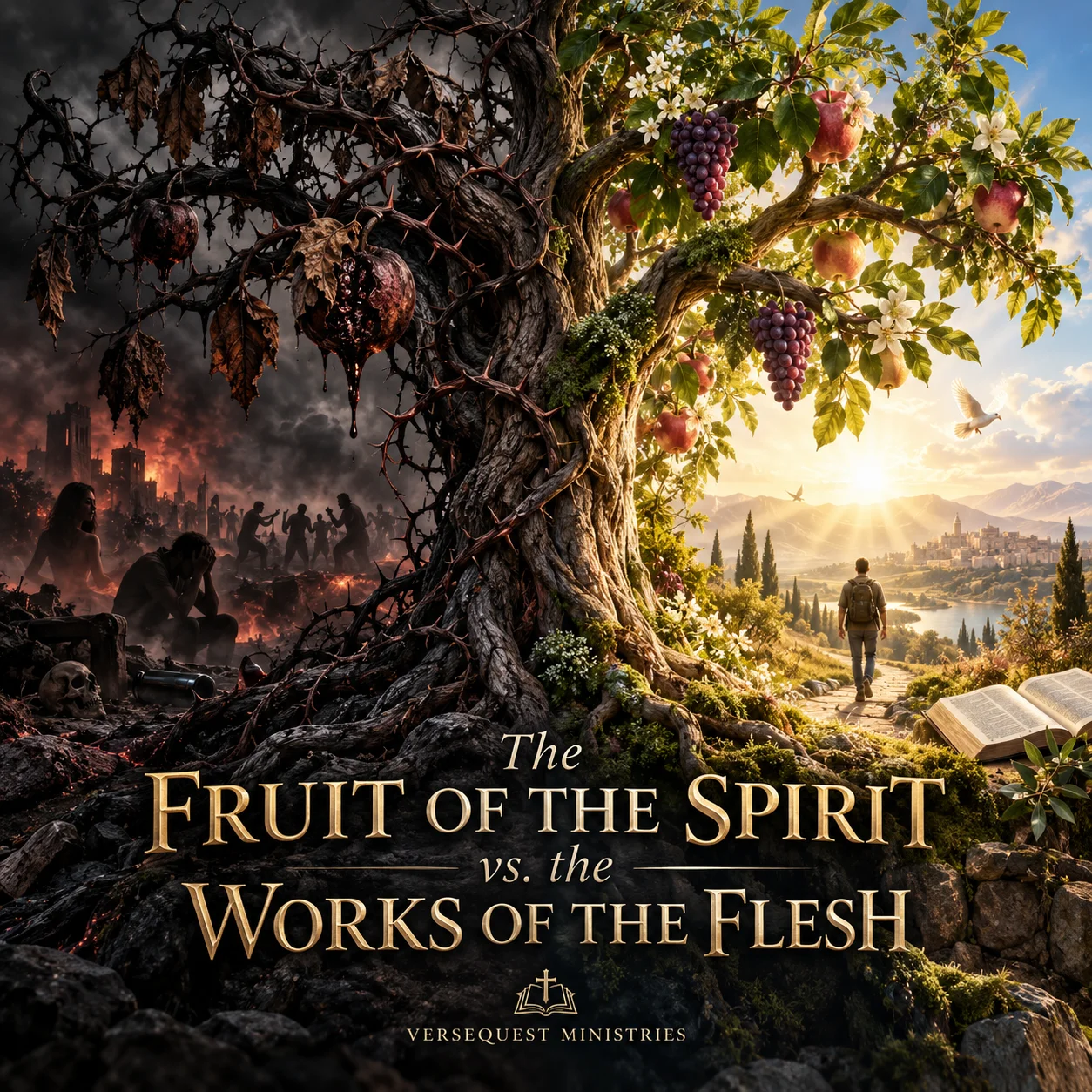
Sermon Title:
The Fruit of the Spirit vs. the Works of the Flesh: Two Natures, Two Harvests
Key Passage:
Galatians 5:19–23 — “Now the works of the flesh are manifest, which are these; Adultery, fornication, uncleanness, lasciviousness, Idolatry, witchcraft, hatred, variance, emulations, wrath, strife, seditions, heresies, Envyings, murders, drunkenness, revellings, and such like: of the which I tell you before, as I have also told you in time past, that they which do such things shall not inherit the kingdom of God. But the fruit of the Spirit is love, joy, peace, longsuffering, gentleness, goodness, faith, Meekness, temperance: against such there is no law.”
Series:
Foundations of the Gospel of Grace
Topic:
The Works of the Flesh, the Fruit of the Spirit, the Believer’s Two Natures, Practical Sanctification, and Spirit-Controlled Christian Living
Book:
Galatians, Romans, Ephesians, Colossians, 1 Corinthians, Philippians
Speaker:
Paul Tackett
Suggested Sermon Text:
Galatians 5:13–26; Romans 6:1–14; Romans 7:14–25; Romans 8:1–14; Ephesians 4:17–32; Ephesians 5:8–21; Colossians 3:1–17; 1 Corinthians 3:1–17; 1 Corinthians 6:9–20; Philippians 2:12–16
Short Sermon Description:
This detailed VerseQuest Ministries sermon outline examines Galatians 5:19–23 and Paul’s sharp contrast between “the works of the flesh” and “the fruit of the Spirit.” The passage exposes what fallen human nature naturally produces when given control and what the Holy Ghost produces when a saved believer walks in submission to Him. This sermon explains the continuing conflict between flesh and Spirit, why salvation does not eradicate the flesh, why the works of the flesh cannot be polished into spirituality, and why the fruit of the Spirit is produced rather than manufactured. It also addresses the warning concerning those who “shall not inherit the kingdom of God,” distinguishes eternal security from careless living, and shows how carnality can bring loss, chastening, damaged fellowship, and ruined testimony without turning salvation by grace into salvation by performance. Preachers, teachers, and Bible students will gain a strong KJV framework for teaching practical holiness, Spirit-filled character, the believer’s two natures, Christian liberty, and the difference between religious activity and genuine spiritual fruit.
The Fruit of the Spirit vs. the Works of the Flesh
Two Natures, Two Harvests
Introduction
Galatians 5 does not give us a personality test. It gives us a battlefield report. Paul has already said in verse 17, “For the flesh lusteth against the Spirit, and the Spirit against the flesh: and these are contrary the one to the other.” Then, beginning in verse 19, he shows us what each side produces. The flesh has works. The Spirit has fruit. One is Adam at work. The other is God at work in the yielded believer. The flesh does not need training to produce sin any more than a thorn bush needs piano lessons to grow thorns. Leave fallen nature to itself and it will produce exactly what Paul lists.
The contrast is especially important because Galatians is a book about grace and liberty. Paul has spent the epistle fighting Judaizers who wanted to place believers under circumcision and law. But Paul refuses the false choice between legalism and carnality. The believer is not under the law, but neither is he turned loose to feed the flesh. Galatians 5:13 says, “use not liberty for an occasion to the flesh.” Grace does not open the prison door so Adam can start a parade. Grace places the believer in Christ, gives him the Spirit, and then commands him to walk under the Spirit’s control.
That means Galatians 5:19–23 must be read as Christian doctrine for saved people concerning practical living. Paul is not giving lost sinners a checklist by which they can slowly become saved. Neither is he teaching that one outbreak of anger, envy, or uncleanness instantly unsaves a sealed member of Christ’s Body. He is contrasting the output of the old nature with the output of the Holy Ghost. The Christian must decide which nature gets fed, followed, obeyed, and expressed. One field grows thorns. The other grows fruit. The harvest tells you which ground you have been cultivating.
I. The Flesh Produces Works Because Fallen Nature Is Active
Key Text: Galatians 5:19
Supporting Texts: Romans 7:18; Romans 8:7–8; Ephesians 2:3
Paul begins, “Now the works of the flesh are manifest.” The word works is important. Flesh works. Flesh produces. Flesh expresses itself. Romans 7:18 says, “For I know that in me (that is, in my flesh,) dwelleth no good thing.” Paul does not say the flesh merely needs encouragement. He says no good thing dwells in it. That is not low self-esteem; that is inspired diagnosis.
Romans 8 says the carnal mind “is enmity against God” and “is not subject to the law of God, neither indeed can be.” Fallen flesh is not merely weak; it is hostile. Ephesians 2 says believers once lived “fulfilling the desires of the flesh and of the mind.” Flesh has appetites, plans, reactions, pride, lust, fear, anger, envy, and religion. It does not have to be taught self-centeredness. Adam comes preloaded.
That is why sanctification cannot be reduced to improving the old man. The flesh does not become spiritual because it learned Bible vocabulary. It may stop cursing and start boasting about its doctrinal position, but pride with a concordance is still pride. God’s answer is not rehabilitated flesh. It is a believer walking in the Spirit and refusing to give the old nature the steering wheel.
Main Truth:
The flesh naturally produces sinful works because fallen human nature remains incapable of pleasing God apart from the Spirit.
II. The Works of the Flesh Begin With Moral Corruption
Key Text: Galatians 5:19
Supporting Texts: 1 Corinthians 6:18; Ephesians 5:3–5; Colossians 3:5
Paul starts his list with “Adultery, fornication, uncleanness, lasciviousness.” The flesh immediately reveals that it has no built-in respect for God’s moral boundaries. Sexual sin is not a modern invention. Adam’s descendants have been trying to rename lust since shortly after Eden. Culture changes the vocabulary; flesh keeps the same appetite.
First Corinthians 6 tells the believer to “Flee fornication.” Ephesians 5 says fornication and uncleanness should not be “once named among you, as becometh saints.” Colossians 3 says, “Mortify therefore your members which are upon the earth; fornication, uncleanness, inordinate affection, evil concupiscence.” The Bible does not tell Christians to negotiate with sexual sin. It tells them to flee and mortify.
Lasciviousness is unrestrained sensuality, the attitude that appetite deserves satisfaction simply because it exists. That spirit dominates modern culture. The world says desire defines identity. Scripture says desire must answer to God. Flesh says, “I want it.” The Spirit asks, “Is it holy?” Those are two very different governments.
Main Truth:
The flesh produces moral corruption by treating sinful appetite as an authority instead of bringing desire under God’s holiness.
III. The Flesh Also Produces Religious Counterfeits
Key Text: Galatians 5:20
Supporting Texts: 1 Corinthians 10:14; Colossians 2:18–23; 2 Corinthians 11:13–15
After sexual sins, Paul lists “Idolatry, witchcraft.” Flesh is not always secular. Sometimes it becomes intensely religious. Idolatry is worship directed toward something other than the true God, and witchcraft seeks supernatural power apart from God’s revealed order. Fallen man can be immoral on Saturday night and mystical on Sunday morning without ever leaving the flesh.
Colossians 2 warns about voluntary humility, worshipping of angels, ordinances, and “neglecting of the body,” yet says these things are “to the satisfying of the flesh.” That is a devastating statement. Flesh can fast. Flesh can bow. Flesh can wear religious clothing. Flesh can become fascinated with angels, visions, ceremonies, and ascetic discipline. The fact that something looks spiritual does not mean the Holy Ghost produced it.
This is why every religious experience must be judged by Scripture. Satan himself can appear as an angel of light. A supernatural claim that contradicts the Bible does not become true because somebody trembled while telling it. Flesh loves spirituality without submission because it gets mystery without authority and experience without obedience.
Main Truth:
The flesh can produce religious and supernatural counterfeits just as readily as open immorality, so every spiritual claim must be tested by Scripture.
IV. The Flesh Destroys Relationships Through Pride and Conflict
Key Text: Galatians 5:20–21
Supporting Texts: James 3:14–16; Philippians 2:3; Ephesians 4:31–32
Paul continues: “hatred, variance, emulations, wrath, strife, seditions, heresies, Envyings.” Notice how much of the list deals with people fighting people. Flesh is not content to ruin private morality; it wants to wreck homes, churches, friendships, and ministries. Pride is remarkably productive when given enough room and enough people to offend it.
Variance is contention. Emulations involve jealous rivalry. Wrath explodes. Strife divides. Seditions form factions. Envy resents another person’s blessing. James says where “envying and strife is, there is confusion and every evil work.” That sounds like a fair description of a lot of religious disputes where everybody claims to be defending God while mostly defending himself.
Philippians 2 gives the Spirit-shaped alternative: “in lowliness of mind let each esteem other better than themselves.” Ephesians 4 says to put away bitterness, wrath, anger, clamour, and evil speaking, and instead be kind, tenderhearted, and forgiving. Flesh asks, “How dare they treat me that way?” Grace remembers how Christ treated us when we deserved considerably worse.
Main Truth:
The flesh produces rivalry, anger, division, envy, and strife because self remains at the center of its world.
V. The Flesh Ends in Bondage, Excess, and Destruction
Key Text: Galatians 5:21
Supporting Texts: Proverbs 23:29–35; Romans 6:16; Ephesians 5:18
Paul includes “murders, drunkenness, revellings, and such like.” The phrase “and such like” tells us the list is representative, not exhaustive. Paul has given enough samples to identify the factory. When flesh rules, excess follows. Appetite becomes master. What begins as liberty eventually becomes chains.
Romans 6 says, “to whom ye yield yourselves servants to obey, his servants ye are to whom ye obey.” Sin always advertises freedom and delivers slavery. Drunkenness is an obvious picture. The man drinks because he thinks he controls the bottle, then eventually discovers the bottle has a key to his house, his bank account, his marriage, and his body.
Ephesians 5:18 contrasts drunkenness with Spirit-filling: “be not drunk with wine, wherein is excess; but be filled with the Spirit.” The issue is control. Fleshly appetite enslaves. The Spirit produces temperance. Sin says, “More.” The Spirit teaches the believer when enough is enough. The flesh is a landlord who raises the rent every month and still evicts you in the end.
Main Truth:
The flesh promises liberty but ultimately produces bondage, excess, ruined judgment, and destructive consequences.
VI. Paul’s Kingdom Warning Does Not Turn Grace Into Works Salvation
Key Text: Galatians 5:21
Supporting Texts: 1 Corinthians 6:9–11; Ephesians 5:5; 1 Corinthians 3:13–15
Paul warns “that they which do such things shall not inherit the kingdom of God.” That warning must not be softened, but neither should it be twisted into a contradiction of salvation by grace. Galatians has already made justification apart from law unmistakable. Galatians 2:16 says a man is “not justified by the works of the law, but by the faith of Jesus Christ.”
First Corinthians 6 gives a similar list and then says, “And such were some of you: but ye are washed, but ye are sanctified, but ye are justified.” Salvation changes a man’s position and identity. The works of the flesh belong to the old life, not the new position God has given the believer in Christ. Persistent carnality is therefore a contradiction of Christian calling, even where eternal security remains intact.
A saved man can also suffer real loss without losing salvation. First Corinthians 3 says a believer’s works can burn and “he shall suffer loss: but he himself shall be saved.” Eternal security is not eternal immunity from consequences. The careless Christian may lose reward, usefulness, testimony, joy, fellowship, health, opportunity, and honour at Christ’s judgment seat. Grace does not make sin cheap; Calvary proved the exact opposite.
Main Truth:
Paul’s warning against the works of the flesh demands holy living without overturning justification by grace through faith or the believer’s security in Christ.
VII. The Spirit Produces Fruit Rather Than Religious Performance
Key Text: Galatians 5:22
Supporting Texts: John 15:4–5; Philippians 1:11; Ephesians 5:9
Paul changes vocabulary in verse 22: “But the fruit of the Spirit is…” Flesh has works; the Spirit has fruit. Fruit is the expression of life within. You can manufacture a machine part. You cannot manufacture a peach. Fruit grows because life is present and conditions permit that life to express itself.
Jesus used similar language in John 15: “Abide in me…for without me ye can do nothing.” Philippians 1 speaks of believers being “filled with the fruits of righteousness, which are by Jesus Christ.” The righteous character God desires is not human flesh imitating Christianity hard enough to fool people. It is divine life bearing visible fruit through yielded believers.
That exposes religious cosmetics. A man can learn Christian manners, Christian vocabulary, Christian music, Christian dress, Christian social habits, and Christian arguments without walking in the Spirit. Artificial fruit can look impressive from across the room, but bite into a wax apple and theology becomes very practical very quickly.
Main Truth:
Spiritual fruit is produced by the Holy Ghost through yielded believers and cannot be manufactured by religious flesh.
VIII. The Ninefold Fruit Reveals the Character the Spirit Produces
Key Text: Galatians 5:22–23
Supporting Texts: Colossians 3:12–15; Ephesians 4:1–3; 2 Peter 1:5–8
“The fruit of the Spirit is love, joy, peace, longsuffering, gentleness, goodness, faith, Meekness, temperance.” Notice Paul says fruit, singular. These are not nine unrelated spiritual trophies where one Christian specializes in joy while another opts out of temperance. Together they describe the character the Spirit produces.
Love seeks another’s good. Joy rests deeper than circumstances. Peace remains settled in God. Longsuffering endures difficult people and difficult seasons. Gentleness handles others without unnecessary cruelty. Goodness chooses what is morally right. Faith trusts God and proves faithful. Meekness places strength under control. Temperance governs appetite.
None of those qualities requires stage lights. They show up at home, at work, in traffic, during disagreement, under pressure, when insulted, when tempted, and when nobody is applauding. A man can fake religious excitement for an hour. Longsuffering takes considerably longer to counterfeit.
Main Truth:
The ninefold fruit of the Spirit reveals Christlike character produced by the Holy Ghost in ordinary Christian life.
IX. The Harvest Depends on Which Nature the Believer Feeds
Key Text: Galatians 5:24–25
Supporting Texts: Galatians 6:7–8; Romans 8:13; Colossians 3:1–10
Paul concludes, “they that are Christ’s have crucified the flesh with the affections and lusts. If we live in the Spirit, let us also walk in the Spirit.” Life comes first; walk follows. Salvation gives the believer spiritual life. Daily choices determine whether his practical walk reflects that life.
Galatians 6 continues the farming picture: “whatsoever a man soweth, that shall he also reap.” Sow to flesh and corruption grows. Sow to the Spirit and spiritual fruit develops. Nobody plants poison ivy in March and demands strawberries in June. Yet Christians sometimes spend months feeding flesh and then wonder why love, joy, peace, and temperance seem scarce.
Romans 8 says believers are to mortify the deeds of the body “through the Spirit.” Colossians 3 says put off the old man’s conduct and put on the new. The Christian life is active dependence. Feed truth. Pray. Obey. Refuse known sin. Guard inputs. Walk in the Spirit. The harvest will eventually reveal what has been planted.
Main Truth:
The believer’s practical harvest reflects whether he continually sows to the flesh or yields his life to the Holy Spirit.
Conclusion
Galatians 5:19–23 presents two unmistakably different harvests. Flesh produces adultery, fornication, uncleanness, idolatry, hatred, wrath, strife, envy, drunkenness, and everything of the same rotten family. The Spirit produces love, joy, peace, longsuffering, gentleness, goodness, faith, meekness, and temperance. God does not blur the distinction, and neither should the preacher.
The passage also keeps grace and holiness in their proper order. The believer is not saved because he successfully manufactures fruit. He produces fruit because God has saved him, indwelt him, and given him the Holy Spirit. Works of the flesh do not belong to the new identity the believer has in Christ, and indulging them carries real consequences. Eternal security is never divine permission to let the old man run the house.
So inspect the harvest. Not somebody else’s—yours. What is growing in the speech, attitude, relationships, private habits, reactions, appetites, and thoughts? Flesh never produces spiritual fruit, no matter how religiously you decorate the tree. Walk in the Spirit. Feed the new man with truth. Mortify the deeds of the body. And let the Holy Ghost produce something in your life that Adam could never grow.
Final Call
Sinner, you cannot produce the fruit of the Spirit because you do not possess the Spirit apart from Jesus Christ. Moral reform cannot regenerate you. Religion cannot regenerate you. Law cannot regenerate you.
Jesus Christ died for your sins according to the Scriptures. He was buried. He rose again the third day according to the Scriptures. Believe on the Lord Jesus Christ. Salvation is the gift of God, received by grace through faith.
Believer, stop expecting flesh to produce what only the Spirit can grow. Walk in the Spirit. Refuse the old nature. Feed on the word. Pray. Obey. Mortify known sin. Let God produce in you what religious self-effort never could.
Closing Verse:
Galatians 5:25 — “If we live in the Spirit, let us also walk in the Spirit.”
Closing Statement:
The flesh will always grow thorns when you feed it, but the Holy Ghost will grow fruit when you yield the ground to Him.