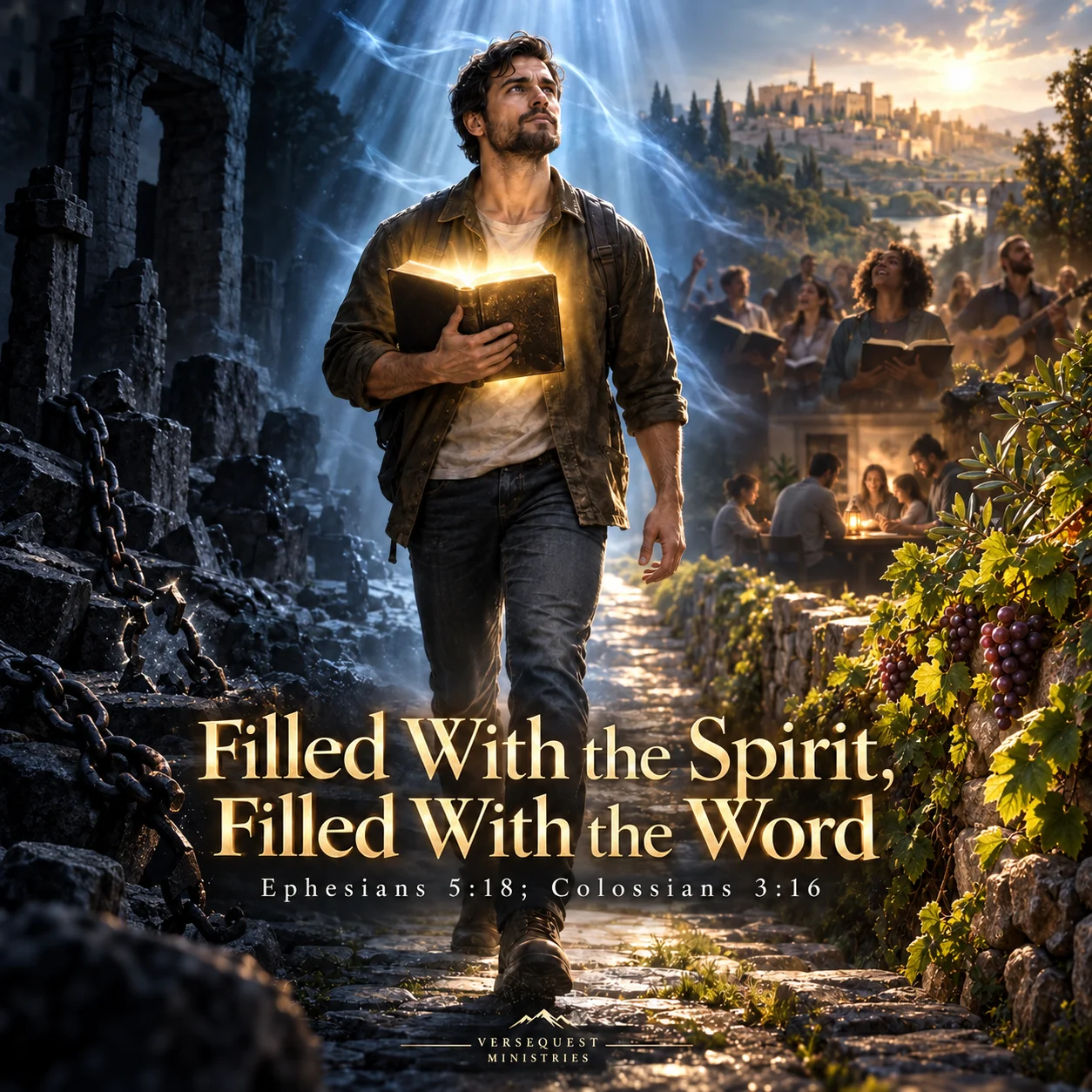
Filled With the Spirit, Filled With the Word
When the Word of Christ Dwells Richly, the Spirit Controls the Walk
Sermon Title:
Filled With the Spirit, Filled With the Word: When the Word of Christ Dwells Richly
Key Passage:
Ephesians 5:18 — “And be not drunk with wine, wherein is excess; but be filled with the Spirit;”
Colossians 3:16 — “Let the word of Christ dwell in you richly in all wisdom; teaching and admonishing one another in psalms and hymns and spiritual songs, singing with grace in your hearts to the Lord.”
Series:
Foundations of the Gospel of Grace
Topic:
The Filling of the Holy Spirit, the Indwelling Word of Christ, Spirit-Controlled Christian Living, and the Relationship Between Scripture and Spirituality
Book:
Ephesians, Colossians, Galatians, Romans, 1 Corinthians, 2 Timothy, 1 Thessalonians
Speaker:
Paul Tackett
Suggested Sermon Text:
Ephesians 5:15–21; Colossians 3:12–17; Galatians 5:16–25; Ephesians 1:13–14; Ephesians 4:30; Romans 8:1–14; 1 Corinthians 2:9–16; 1 Corinthians 6:19–20; 1 Corinthians 12:13; 2 Timothy 3:15–17; 1 Thessalonians 5:16–22; Psalm 119:9–16
Short Sermon Description:
This detailed VerseQuest Ministries sermon outline compares Ephesians 5:18 with Colossians 3:16 and demonstrates the inseparable relationship between being filled with the Holy Spirit and letting “the word of Christ dwell in you richly.” Paul does not present Spirit-filled Christianity as emotional excitement, uncontrolled religious experience, mystical impressions, or spectacular manifestations detached from Scripture. The parallel passages show remarkably similar results: wisdom, worship, psalms and hymns and spiritual songs, thanksgiving, godly relationships, and a Christ-centered walk. This sermon distinguishes the Spirit’s indwelling and sealing from His practical filling, explains why the Word-filled believer becomes increasingly Spirit-controlled, contrasts divine filling with the controlling influence of wine, and shows how Scripture produces discernment, holiness, worship, service, and spiritual fruit. Pastors, teachers, Bible students, and believers will gain a strong KJV framework for understanding that genuine spirituality never leads away from the Book the Holy Ghost inspired.
Filled With the Spirit, Filled With the Word
When the Word of Christ Dwells Richly, the Spirit Controls the Walk
Introduction
Ephesians 5:18 contains one of the clearest commands concerning the believer’s practical relationship with the Holy Ghost: “And be not drunk with wine, wherein is excess; but be filled with the Spirit.” Paul is writing to people who are already saved, already “accepted in the beloved,” already redeemed through Christ’s blood, and already “sealed with that holy Spirit of promise” according to Ephesians 1:6–14. He is not telling lost sinners how to receive eternal life. He is telling saved people how to live after receiving it. That distinction matters. Every member of Christ’s Body possesses the Spirit, but every believer is not practically controlled by the Spirit at every moment. Indwelling is a fact of salvation. Filling concerns the walk. A Christian does not need the Holy Ghost to move in again every morning; he needs to stop acting like the Owner of the house is merely renting a back bedroom.
Colossians 3:16 gives the companion truth: “Let the word of Christ dwell in you richly in all wisdom.” Put Ephesians 5 and Colossians 3 side by side and something becomes impossible to miss. In Ephesians the believer is commanded to be filled with the Spirit, and the results include psalms, hymns, spiritual songs, singing, thanksgiving, and godly relationships. In Colossians the believer is commanded to let the word of Christ dwell richly, and the results include psalms, hymns, spiritual songs, singing, thanksgiving, and godly conduct. That is not an accident. The Spirit who inspired the word works through the word. A Christian who wants to be filled with the Spirit while remaining empty of Scripture is asking God for a spiritual fire while refusing the fuel God put beside the fireplace.
This corrects a great deal of modern confusion. Spirit-filled Christianity is often presented as if the chief evidence were emotional intensity, unusual behaviour, physical sensations, loud music, ecstatic speech, falling bodies, private revelations, or somebody repeatedly announcing what “the Spirit told me.” Paul’s evidence looks considerably less theatrical and considerably more useful. Wisdom. Truth. Thanksgiving. Singing to the Lord. Holy conduct. Right relationships. Submission. Spiritual fruit. A mind inhabited by the word of Christ. The Spirit-filled life is not a religious amusement ride where the goal is to feel something dramatic before the music stops. It is the life of a believer so yielded to the Holy Ghost and saturated with His word that Christ increasingly governs what he thinks, says, desires, worships, and does.
I. Every Saved Believer Possesses the Holy Spirit
Key Text: Ephesians 1:13
Supporting Texts: Romans 8:9; 1 Corinthians 6:19–20; 1 Corinthians 12:13
Before discussing filling, we must establish indwelling. Ephesians 1:13 says that after hearing “the word of truth, the gospel of your salvation” and believing, “ye were sealed with that holy Spirit of promise.” Romans 8:9 says, “if any man have not the Spirit of Christ, he is none of his.” The Holy Spirit is not a deluxe option added later for unusually advanced Christians. If a man belongs to Christ, the Spirit belongs in him.
First Corinthians 6:19 calls the believer’s body “the temple of the Holy Ghost which is in you.” First Corinthians 12:13 says, “For by one Spirit are we all baptized into one body.” These are positional truths concerning members of the Body of Christ. The believer does not achieve them through improved behaviour, emotional experience, prolonged prayer, or receiving a second class of salvation. God performs them when the sinner believes the gospel.
This protects the doctrine of filling from becoming another religious ladder. A saved man does not pray himself into possessing more of the Holy Ghost in the sense that God gave him only twenty percent at conversion. The issue is not how much of the Spirit the believer possesses. The issue is how much practical control the Spirit has over the believer. God already owns the house. Filling concerns whether the furniture is arranged according to the Owner or according to the old tenant called the flesh.
Main Truth:
Every saved believer possesses the indwelling Holy Spirit, so Spirit-filling concerns practical control rather than receiving another salvation.
II. Being Filled With the Spirit Is a Command to Saved People
Key Text: Ephesians 5:18
Supporting Texts: Ephesians 4:30; Galatians 5:16; 1 Thessalonians 5:19
Paul says, “be filled with the Spirit.” That is a command. Therefore Spirit-filled living is not reserved for missionaries, pastors, elderly saints, or Christians who have unlocked a secret second blessing. Every believer is responsible to live under the Spirit’s practical influence.
The surrounding epistle proves that saved people can resist that influence. Ephesians 4:30 says believers can grieve the Holy Spirit. First Thessalonians 5:19 says, “Quench not the Spirit.” Galatians 5:16 says, “Walk in the Spirit.” If Spirit-control were automatic after salvation, none of those commands would be necessary. A believer can possess the Spirit while walking carnally, and the Corinthian church left us a rather thick case file proving it.
Filling therefore involves yieldedness. The believer must submit his thinking, speech, body, habits, relationships, ambitions, time, worship, and service to revealed truth. The Holy Ghost does not seize Christians like puppets and override their wills. God commands the believer to walk, put off, put on, mortify, reckon, yield, forgive, speak truth, give thanks, pray, and obey. Biblical spirituality never eliminates responsibility.
Main Truth:
Spirit-filling is a practical command requiring the saved believer to yield his daily life to the Holy Ghost.
III. Wine and the Spirit Represent Two Different Controlling Influences
Key Text: Ephesians 5:18
Supporting Texts: Proverbs 20:1; Proverbs 23:29–35; Romans 13:13–14
Paul deliberately contrasts drunkenness with Spirit-filling: “be not drunk with wine, wherein is excess; but be filled with the Spirit.” Alcohol changes behaviour because it brings the drinker under an outside influence. Speech changes. Judgment changes. Reactions change. Restraints weaken. Paul takes a familiar picture of control and turns it spiritually: do not come under the controlling influence of wine; come under the controlling influence of God’s Spirit.
That does not mean Spirit-filled believers behave like drunk men with a religious label pasted on the bottle. The contrast is between two different controlling powers, not a comparison saying both produce chaos. Drunkenness destroys sound judgment. The Holy Ghost produces wisdom. Drunkenness loosens restraint. The Spirit produces temperance. Drunkenness can lead to foolish speech. The Spirit produces psalms, hymns, thanksgiving, and edifying words. One produces excess; the other produces order.
The Spirit-filled life therefore increases spiritual sobriety. The closer a believer walks with God, the clearer his discernment should become. He should not become easier to manipulate through emotionalism. He should become harder to fool because the word is dwelling richly within him. The Holy Ghost never intoxicates a man into theological stupidity.
Main Truth:
The Spirit-filled believer comes under God’s holy control, producing wisdom and self-government rather than the excess and disorder of fleshly influences.
IV. The Word of Christ Must Dwell Richly in the Believer
Key Text: Colossians 3:16
Supporting Texts: 2 Timothy 3:16–17; Psalm 119:11; John 17:17
Colossians 3:16 says, “Let the word of Christ dwell in you richly in all wisdom.” The word dwell is household language. Scripture is not supposed to visit the Christian occasionally like a distant relative stopping by for Christmas dinner. It should live there. It should occupy the mind, furnish the thoughts, govern the conscience, shape the vocabulary, correct the attitude, and direct the decisions.
Second Timothy 3:16–17 says all Scripture is given by inspiration of God and is profitable for doctrine, reproof, correction, and instruction in righteousness, “That the man of God may be perfect, throughly furnished unto all good works.” Scripture furnishes the spiritual house. Psalm 119:11 says, “Thy word have I hid in mine heart, that I might not sin against thee.” Jesus said, “thy word is truth.”
The phrase “dwell in you richly” also rebukes starvation-level Christianity. Many believers want enough Bible to decorate the living room but not enough to rearrange the furniture. They know a handful of famous verses but remain strangers to Romans, Ephesians, doctrine, prophecy, dispensational distinction, Christian conduct, and the whole counsel of God. A richly indwelt believer does not merely own a Bible. The Bible increasingly owns his thinking.
Main Truth:
The word of Christ must inhabit the believer’s mind abundantly so that Scripture governs doctrine, conscience, conduct, and spiritual judgment.
V. Ephesians 5 and Colossians 3 Reveal the Connection Between Spirit-Filling and Word-Filling
Key Text: Ephesians 5:18–20
Supporting Texts: Colossians 3:16–17; John 16:13–14; Ephesians 6:17
Compare the passages. Ephesians says, “be filled with the Spirit,” followed by “psalms and hymns and spiritual songs,” singing and making melody, and giving thanks. Colossians says, “Let the word of Christ dwell in you richly,” followed by “psalms and hymns and spiritual songs,” singing with grace, and giving thanks. The similarities are too exact to dismiss.
The lesson is not that the Holy Spirit and the Bible are the same thing. The Spirit is a divine Person; Scripture is the inspired word He gave. But the Spirit works in harmony with the word. Ephesians 6:17 even calls Scripture “the sword of the Spirit, which is the word of God.” The Spirit does not lead believers away from His own sword.
Jesus called Him “the Spirit of truth” and said, “he shall glorify me.” Therefore genuine Spirit-filling will make a believer increasingly responsive to truth and increasingly Christ-centered. Any spirituality that makes experience more authoritative than Scripture has reversed God’s order. “The Spirit told me” never outranks “It is written.” The Holy Ghost does not need to contradict Himself to keep religion interesting.
Main Truth:
Spirit-filled living and Word-filled living operate together because the Holy Ghost governs believers through the truth He inspired.
VI. Spirit-Filling Produces Biblical Worship, Not Religious Spectacle
Key Text: Ephesians 5:19
Supporting Texts: Colossians 3:16; John 4:23–24; 1 Corinthians 14:33, 40
Ephesians 5 says Spirit-filled believers speak “to yourselves in psalms and hymns and spiritual songs, singing and making melody in your heart to the Lord.” Colossians says nearly the same thing. Music is one fruit of spiritual fullness, but notice its direction: “to the Lord.” Biblical worship is Godward, truth-filled, and spiritually intelligent.
The text does not portray worship as an attempt to manipulate people into a trance before the preacher arrives. The purpose of Christian music is not to bypass the mind. Colossians explicitly connects singing with “teaching and admonishing one another.” Spiritual songs ought to carry spiritual truth. A chorus can repeat the same seven words for twenty minutes and create emotion, but repetition alone does not constitute doctrine. A washing machine has a repeat cycle too; nobody has ordained it as a worship leader.
First Corinthians 14 says, “God is not the author of confusion,” and commands, “Let all things be done decently and in order.” Spirit-filled worship does not require chaos to prove the Holy Ghost attended. Genuine worship carries truth into the heart, directs praise toward God, edifies believers, and glorifies Christ.
Main Truth:
The filling of the Spirit produces intelligent, Christ-centered, truth-filled worship rather than emotional spectacle detached from Scripture.
VII. Spirit-Filling Produces Thanksgiving and Godly Relationships
Key Text: Ephesians 5:20–21
Supporting Texts: Colossians 3:13–15, 17; Philippians 2:3–5; Ephesians 4:31–32
Paul moves directly from singing to thanksgiving: “Giving thanks always for all things unto God and the Father in the name of our Lord Jesus Christ.” Colossians repeatedly says, “be ye thankful,” “singing with grace,” and “giving thanks to God.” Gratitude is one of the marks of spiritual health because thanksgiving recognizes God’s goodness rather than enthroning personal expectations.
Spirit-filling also reaches relationships. Ephesians proceeds to mutual submission and then discusses marriage, the home, and practical responsibilities. Colossians does the same. This means spirituality is tested in places considerably less glamorous than a church platform. The easiest person to impress may be someone who sees you for forty-five minutes on Sunday. Your family has considerably more evidence.
A man may talk loudly about being Spirit-filled while remaining harsh, proud, unforgiving, selfish, and impossible to live with. Paul’s doctrine brings the claim home for inspection. The Spirit produces kindness, forgiveness, humility, gratitude, love, and consideration. A spiritual testimony that evaporates at the front door is probably running more on religious fumes than Holy Ghost power.
Main Truth:
The Spirit-filled and Word-filled life produces thanksgiving, humility, forgiveness, love, and transformed relationships in ordinary Christian living.
VIII. Spirit-Filling Produces the Fruit of the Spirit
Key Text: Galatians 5:22–25
Supporting Texts: Galatians 5:16–18; Romans 8:13–14; Colossians 3:12–14
Galatians tells us what the Spirit produces: “love, joy, peace, longsuffering, gentleness, goodness, faith, Meekness, temperance.” These qualities do not make exciting advertising for religious sensationalism, but God apparently thinks character is more important than spectacle.
The fruit stands opposite the works of the flesh. Hatred gives way to love. Strife gives way to peace. Uncontrolled appetite gives way to temperance. Flesh wants instant gratification; the Spirit produces longsuffering. The spiritual life is therefore not measured primarily by what happens during a church service but by what grows throughout a Christian’s life.
Romans 8 says believers are to mortify the deeds of the body “through the Spirit.” Again, Christian sanctification is neither self-salvation nor passive surrender to sin. The believer actively obeys through divine enablement. He yields, mortifies, walks, puts off, puts on, and follows truth while trusting the Spirit rather than the flesh.
Main Truth:
The clearest practical evidence of the Spirit’s control is the fruit He produces in the believer’s character and conduct.
IX. The Word-Filled, Spirit-Filled Believer Becomes Useful to God
Key Text: Colossians 3:16–17
Supporting Texts: 2 Timothy 2:15, 21; Ephesians 2:10; Philippians 2:15–16
Colossians says the richly indwelling word enables believers to teach and admonish one another “in all wisdom.” Spirit-filled Christianity therefore produces usefulness. The believer becomes able to help others because he possesses something more substantial than personal opinion.
Second Timothy 2 commands study and speaks of a vessel “meet for the master’s use, and prepared unto every good work.” Ephesians 2:10 says believers are created in Christ Jesus “unto good works.” God did not save Christians merely to occupy pew space while waiting for the Rapture. He intends them to serve, witness, teach, pray, give, encourage, contend for truth, and shine as lights in a dark world.
The Word-filled believer also becomes harder for error to capture. When Scripture dwells richly inside, counterfeit doctrine has less vacant property in which to set up shop. The Christian who knows the Book can test preaching, trends, spiritual claims, traditions, and cultural pressure. Ignorance leaves the front door unlocked; Scripture gives discernment a deadbolt.
Main Truth:
A believer filled with the Spirit and saturated with Scripture becomes spiritually discerning, doctrinally stable, and useful in the service of Jesus Christ.
Conclusion
Ephesians 5:18 says, “be filled with the Spirit.” Colossians 3:16 says, “Let the word of Christ dwell in you richly.” These commands belong together. The same apostle wrote both passages, and the resulting worship, thanksgiving, wisdom, and godly conduct run in parallel. God did not design a Spirit-filled Christianity divorced from a Word-filled mind.
This also gives us a biblical measuring stick. Spirit-filling is not proven merely by intensity, volume, emotion, claims of private revelation, or unusual religious experiences. The Bible points to truth, wisdom, worship, thanksgiving, holiness, fruit, transformed relationships, and Christ-centered service. The Holy Ghost does not draw attention away from Christ or away from the Scriptures He inspired. He takes a believer increasingly deeper into both.
So fill the heart with the Book. Study it. Believe it. Rightly divide it. Memorize it. Let it correct you. Let it rebuke you. Let it comfort you. Let it direct the home, tongue, mind, worship, relationships, and service. Yield to the Spirit who wrote it. The Christian does not have to choose between being Spirit-filled and Bible-filled. According to Paul, trying to separate the two is the mistake.
Final Call
Sinner, you cannot become Spirit-filled before you become Spirit-indwelt. You need salvation first. Religion, moral reform, emotional experience, church attendance, and spiritual excitement cannot place the Holy Ghost within you.
Jesus Christ died for your sins according to the Scriptures. He was buried. He rose again the third day according to the Scriptures. Believe on the Lord Jesus Christ. Ephesians 1:13 says that after hearing “the gospel of your salvation” and believing, you are sealed with that Holy Spirit of promise.
Believer, you already possess the Spirit. Now be filled with Him. Let the word of Christ dwell in you richly. Stop starving the mind of Scripture while praying for spiritual power. Read the Book, obey the Book, walk in the Spirit, worship in truth, give thanks, bear fruit, and let Jesus Christ govern the life He purchased.
Closing Verse:
Colossians 3:16 — “Let the word of Christ dwell in you richly in all wisdom.”
Closing Statement:
The believer who wants to be filled with the Spirit while remaining empty of the Word is asking the Author to control a life that refuses to read His instructions.