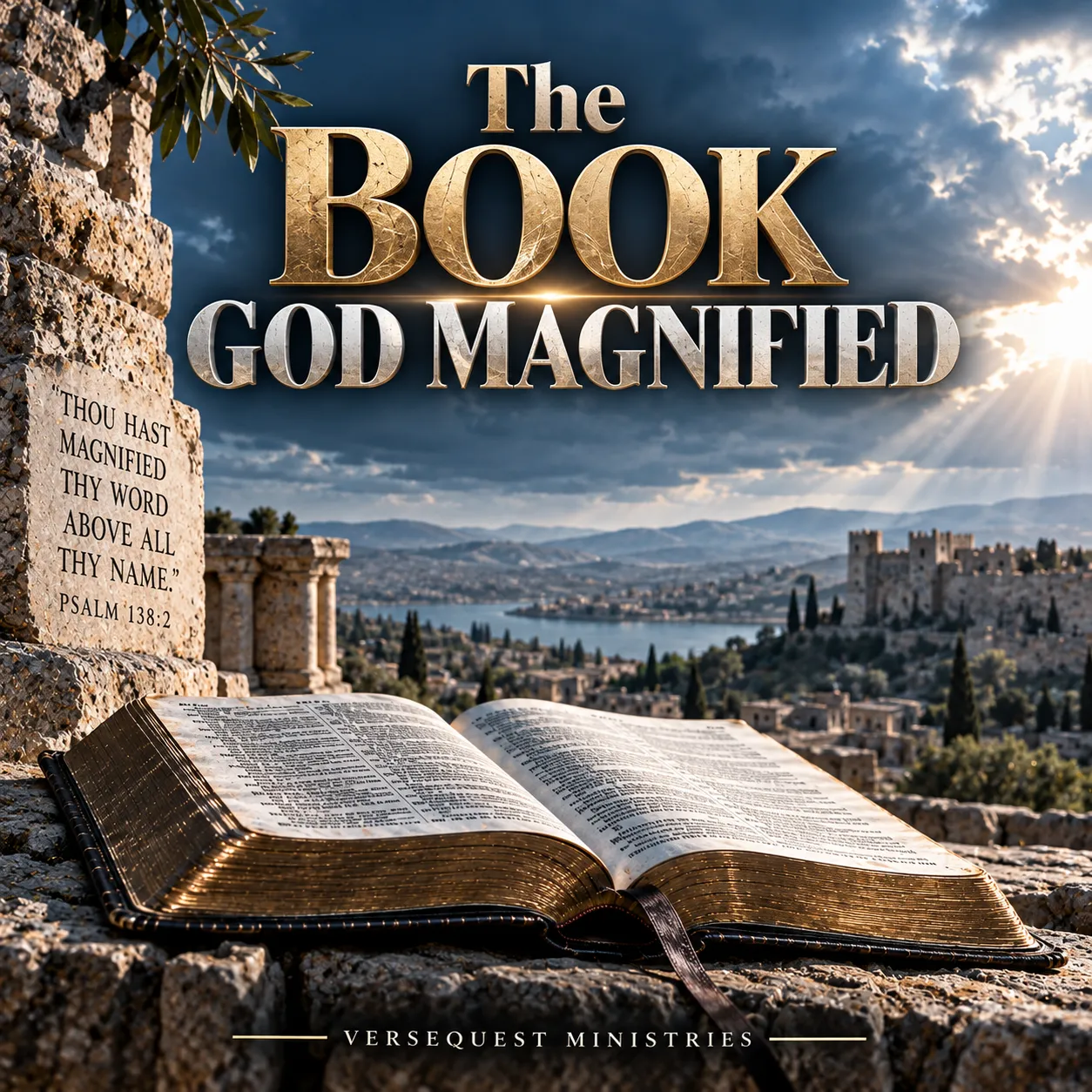
Sermon Title:
The Book God Magnified
Key Passage:
Psalm 138:2
“I will worship toward thy holy temple, and praise thy name for thy lovingkindness and for thy truth: for thou hast magnified thy word above all thy name.” (Psalm 138:2)
Series:
The Book God Gave
Topic:
The Supreme Place God Gives His Own Word and the Believer’s Responsibility to Believe, Honor, Study, and Obey It
Book:
Psalms
Speaker:
Paul Tackett
Suggested Sermon Text:
Psalm 138:1–8; Psalm 12:6–7; Psalm 19:7–11; Psalm 119:89, 97–105, 128, 140, 152, 160; Proverbs 30:5–6; Isaiah 40:8; Isaiah 55:10–11; Matthew 4:4; Matthew 5:18; Matthew 24:35; John 10:35; John 17:17; Romans 3:4; 1 Corinthians 2:12–13; 2 Timothy 2:15; 2 Timothy 3:15–17; Hebrews 4:12; 1 Peter 1:23–25; 2 Peter 1:19–21
Short Sermon Description:
Psalm 138:2 contains one of Scripture’s strongest declarations concerning the value God places upon what He has spoken: “for thou hast magnified thy word above all thy name.” In its immediate setting David praises God for His lovingkindness, truth, answered prayer, and faithfulness, and the statement should first be honored in that context rather than turned into a detached slogan. From there, this sermon develops the larger biblical truth that God consistently places extraordinary authority upon His words: they are pure, true, settled, enduring, powerful, spiritually life-giving, and incapable of being broken. The message examines why believers should not claim to honor God while treating His words casually, why Scripture must stand above tradition, feelings, experience, scholarship, and human opinion, how Christ Himself honored the written word, and why right division is essential to handling faithfully the Book God has magnified. Preachers, teachers, and Bible students will gain a detailed, sermon-ready framework for teaching biblical authority, reverence for Scripture, preservation, obedience, and confidence in the King James Bible. Sermon Outline Prompt – VerseQu…
THE BOOK GOD MAGNIFIED
Introduction
Men are very good at magnifying the wrong things. They magnify personalities, institutions, traditions, denominations, scholarship, experiences, movements, political causes, and their own opinions. Put a famous name on a statement and people quote it for fifty years. Put God’s words beside it and somebody immediately asks whether a committee of scholars has approved the translation. Psalm 138:2 turns that whole religious pecking order upside down. David says to God, “thou hast magnified thy word above all thy name.” Whatever else that statement requires us to understand carefully in its context, it certainly does not leave room for treating God’s word like a disposable footnote to human wisdom.
The verse occurs in a Psalm of praise. David says he will praise God with his whole heart, worship toward His holy temple, and praise His name “for thy lovingkindness and for thy truth.” Then comes the reason: “for thou hast magnified thy word above all thy name.” The verse is not teaching that God has somehow made His word divine while diminishing Himself. God and His truth cannot be set against one another like competitors. Rather, God has attached the honor of His own name to the reliability of what He speaks. If God’s word fails, God’s truthfulness is implicated. That is why Scripture never treats divine speech casually.
A Bible believer therefore cannot say, “I love God,” while maintaining a low view of what God said. You cannot honor the Speaker while despising His speech. You cannot praise His name and continually put His words on trial. A man who says he respects you while correcting every sentence you utter is offering a peculiar kind of respect. God’s word is not one religious authority among many. It is the authority by which every lesser authority must be tested. The Book God magnified deserves more than a place on the shelf. It deserves belief, study, obedience, preaching, defense, and submission.
I. GOD MAGNIFIED HIS WORD BECAUSE HIS CHARACTER STANDS BEHIND IT
Key Text: Psalm 138:2
Supporting Texts: Numbers 23:19; Titus 1:2; Psalm 119:160; Romans 3:4
David connects God’s “truth” directly with God’s word. That connection matters. The reliability of Scripture ultimately rests upon the character of the One who spoke.
Numbers 23:19 says, “God is not a man, that he should lie.” Titus 1:2 speaks of “God, that cannot lie.” Psalm 119:160 says, “Thy word is true from the beginning.” God’s words are trustworthy because falsehood is contrary to God’s nature.
That is why Romans 3:4 establishes the order so sharply: “Let God be true, but every man a liar.” Man does not sit as final referee over God’s testimony. If every human opinion on earth assembled on one side and God’s word stood alone on the other, truth would not be decided by majority vote.
Modern religion often talks as though Scripture must continually prove itself to man. The biblical position is the reverse. Man must answer to the word God has magnified.
Main Truth: God’s word carries supreme authority because the perfectly truthful character of God stands behind everything He has spoken.
II. GOD’S WORD IS PURE, NOT A MIXTURE REQUIRING HUMAN REPAIR
Key Text: Psalm 12:6
Supporting Texts: Proverbs 30:5–6; Psalm 119:140; 2 Samuel 22:31
“The words of the LORD are pure words: as silver tried in a furnace of earth, purified seven times” (Psalm 12:6).
Purity means freedom from contamination. God does not describe His words as spiritually useful material mixed with enough error to keep scholars employed correcting Him.
Proverbs 30:5 says, “Every word of God is pure.” The very next verse warns, “Add thou not unto his words.” That connection is important. If the words are pure, addition does not improve them. You do not purify silver by throwing dirt into it.
Psalm 119:140 says, “Thy word is very pure: therefore thy servant loveth it.” The biblical response to pure words is love and confidence, not perpetual suspicion.
This does not eliminate careful Bible study. It demands it. Study the wording precisely because the wording matters. Compare Scripture with Scripture precisely because God speaks consistently. Rightly divide because God placed distinctions in the Book. But do not confuse careful study with correcting the Author.
Main Truth: Because God’s words are pure, the believer approaches Scripture as truth to be understood rather than defective material requiring human repair.
III. GOD’S WORD IS SETTLED, NOT DRIFTING WITH HUMAN OPINION
Key Text: Psalm 119:89
Supporting Texts: Isaiah 40:8; Matthew 24:35; 1 Peter 1:23–25
“For ever, O LORD, thy word is settled in heaven.”
That is a remarkably calm statement in a remarkably unstable world. Civilizations change. Languages change. Governments collapse. Scientific theories are revised. Philosophies move in and out of fashion. God’s word is “settled.”
Isaiah says, “The grass withereth, the flower fadeth: but the word of our God shall stand for ever.” Jesus says, “Heaven and earth shall pass away, but my words shall not pass away.”
First Peter speaks of “the word of God, which liveth and abideth for ever.” Scripture is not preserved because mankind treats it reverently. It abides because God gave it.
That should affect the believer’s confidence. We do not need to chase the theological fashion of the month. God’s truth does not require seasonal updates like a software subscription.
The world changes its mind because it keeps discovering things it did not know. God does not discover.
Main Truth: God’s word possesses permanent stability that stands above changing cultures, theories, philosophies, and human opinions.
IV. JESUS CHRIST HONORED THE WRITTEN WORD AS FINAL AUTHORITY
Key Text: Matthew 4:4
Supporting Texts: Matthew 4:1–11; Matthew 5:18; John 10:35; Luke 24:25–27
When Satan tempted Jesus Christ, the Lord repeatedly answered, “It is written.”
Christ did not answer the devil with religious tradition, emotional experience, philosophical speculation, or private revelation. He appealed to Scripture.
That matters tremendously. If anybody possessed authority to speak without citing a written text, it was Jesus Christ. Yet the recorded temptation shows the incarnate Son of God wielding Scripture as the decisive answer.
John 10:35 contains the Lord’s declaration, “the scripture cannot be broken.” Matthew 5:18 places weight upon “one jot or one tittle.” Luke 24 shows Christ opening the Scriptures concerning Himself.
The attitude of Jesus toward Scripture should settle something for anyone claiming to follow Him. He did not stand above the written word to criticize it. He fulfilled it, quoted it, explained it, and declared its permanence.
It is a strange Christianity that claims Christ as Lord while treating His view of Scripture as embarrassingly outdated.
Main Truth: Jesus Christ demonstrated perfect confidence in written Scripture and treated it as authoritative, enduring, and incapable of being broken.
V. GOD MAGNIFIED HIS WORD ABOVE HUMAN TRADITION AND OPINION
Key Text: Matthew 15:3
Supporting Texts: Matthew 15:1–9; Colossians 2:8; Isaiah 8:20; Romans 3:4
Jesus asked religious leaders, “Why do ye also transgress the commandment of God by your tradition?”
Tradition becomes dangerous when it stops serving Scripture and begins overruling Scripture.
The Pharisees possessed history, scholarship, religious pedigree, institutional authority, and public respect. None of those things gave them permission to make God’s commandment “of none effect.”
The same principle remains. A denomination may be wrong. A creed may be wrong. A commentary may be wrong. A preacher may be wrong. A scholar may be wrong. A beloved teacher may be wrong. A church tradition repeated for centuries may still deserve correction.
The Bible believer does not disrespect teachers by testing them. The Bereans were called noble for doing exactly that.
If God magnified His word, we should be careful not to magnify our favorite human voice above it.
Main Truth: Every tradition, teacher, institution, and human opinion must remain subordinate to the word God has magnified.
VI. THE MAGNIFIED WORD IS POWERFUL ENOUGH TO DO GOD’S WORK
Key Text: Isaiah 55:11
Supporting Texts: Hebrews 4:12; Jeremiah 23:29; Romans 10:17; 1 Thessalonians 2:13
God says His word “shall not return unto me void.”
Hebrews calls it “quick, and powerful, and sharper than any twoedged sword.” Jeremiah compares it to fire and a hammer that breaks rock. Romans says faith comes by hearing the word of God.
Scripture therefore does not require religious theatrics to give it life. Preachers may communicate clearly and passionately, but no preacher can inject divine power into God’s word. The power did not originate in the preacher.
This matters in an age when churches sometimes trust atmosphere more than Scripture. Turn down the lights, raise the music, manufacture emotion, tell a moving story, and perhaps everybody will feel something. Feeling something is not the same thing as hearing from God.
A flashlight does not become brighter because the man holding it shouts.
Preach the Book. Teach the Book. Trust the Book. Let God use the instrument He magnified.
Main Truth: God’s word possesses inherent spiritual power to accomplish divine purposes without depending upon human manipulation or religious spectacle.
VII. THE WORD GOD MAGNIFIED MUST BE RIGHTLY DIVIDED
Key Text: 2 Timothy 2:15
Supporting Texts: 1 Corinthians 10:32; Ephesians 2:11–16; Ephesians 3:1–10; Romans 11:25–29
A high view of Scripture requires more than saying the Bible is inspired. It requires handling the inspired Bible correctly.
Paul commands, “Study to shew thyself approved unto God…rightly dividing the word of truth.”
Notice what he calls it: “the word of truth.” Right division does not repair a faulty Bible. It corrects faulty handling by the workman.
The Bible distinguishes Israel, Gentiles, and the Church. It distinguishes law and grace, prophecy and mystery, the earthly kingdom and the body of Christ, the Rapture and Second Advent, and national covenant promises from Church Age doctrine.
Failure to observe those distinctions creates confusion. A man can quote a perfectly inspired verse and apply it to the wrong people in the wrong dispensation.
The Book is right. The workman may be wrong.
The answer is not correcting Scripture but becoming an approved student of Scripture.
Main Truth: Honoring God’s magnified word requires rightly dividing it according to the doctrinal distinctions God placed within the Book.
VIII. THE BOOK GOD MAGNIFIED MUST CORRECT US
Key Text: 2 Timothy 3:16–17
Supporting Texts: Hebrews 4:12; James 1:22–25; Psalm 119:128; Romans 12:2
Scripture is profitable “for doctrine, for reproof, for correction, for instruction in righteousness.”
Correction moves from the Book toward the reader.
That direction bothers human pride. We naturally prefer a Bible that confirms our opinions, excuses our habits, supports our tradition, and agrees with our favorite teachers.
But Hebrews describes Scripture as a twoedged sword, not a feather pillow.
James compares it to a mirror. A mirror that edits your reflection to protect your feelings is useless. Scripture reveals what is actually there.
Psalm 119:128 gives the healthy response: “I esteem all thy precepts concerning all things to be right.”
That means when Scripture and I disagree, the investigation should begin with me.
A believer who claims the Bible is his final authority only when it agrees with him has confused final authority with a personal assistant.
Main Truth: The practical evidence that we honor Scripture is our willingness to let the Book correct our doctrine, conduct, assumptions, and desires.
IX. THE BOOK GOD MAGNIFIED SHOULD BE LOVED, STUDIED, PREACHED, AND OBEYED
Key Text: Psalm 119:97
Supporting Texts: Psalm 119:11, 105, 140; Colossians 3:16; 2 Timothy 4:2
“O how love I thy law! it is my meditation all the day.”
Love for Scripture is not merely sentimental admiration for a leather cover. It produces attention.
If you love the Book, read it.
If you believe the Book, study it.
If you trust the Book, obey it.
If God called you to preach, preach it.
Colossians says, “Let the word of Christ dwell in you richly.” Second Timothy says, “Preach the word.” Psalm 119 says, “Thy word have I hid in mine heart.”
A Bible believer should know more Bible next year than he knows this year. A preacher should not spend thirty years recycling seven favorite verses. A Christian home should hear Scripture more often than political commentary and entertainment noise.
God magnified His word. Our schedules often reveal whether we have done the same.
Main Truth: Genuine reverence for God’s word expresses itself through continual reading, study, meditation, preaching, memorization, and obedience.
Conclusion
Psalm 138:2 places extraordinary weight upon what God has spoken: “thou hast magnified thy word above all thy name.” In context David is praising God for His truth, lovingkindness, faithfulness, and answered prayer. The statement should first be honored there. But its larger biblical harmony is unmistakable. God consistently treats His words as pure, true, settled, powerful, enduring, and authoritative.
That truth should rearrange the believer’s hierarchy. Scripture above tradition. Scripture above feelings. Scripture above experience. Scripture above scholarship. Scripture above culture. Scripture above denominational loyalty. Scripture above personal preference. Every lesser authority may serve us, but none may sit on the throne belonging to what God said.
Take the King James Bible and treat it like the Book God magnified. Do not merely defend it online while neglecting it at home. Read it. Study it. Rightly divide it. Memorize it. Believe it. Preach it. Let it rebuke you. Let it change you. God has already told you what He thinks about His word. The remaining question is whether your treatment of the Book agrees with His.
Final Call
If you are lost, God has magnified a word that tells you exactly where salvation is found. Jesus Christ “died for our sins according to the scriptures; And that he was buried, and that he rose again the third day according to the scriptures” (1 Corinthians 15:3–4). Salvation is not earned through baptism, religion, morality, sacraments, works, or church membership. Believe on the Lord Jesus Christ and trust His finished work.
If you are saved, give the Book the place in your life that God gives His word in Scripture. Stop allowing culture, feelings, religious personalities, and human opinions to overrule it. Study to show yourself approved. Rightly divide the word of truth. Let Scripture correct you before you attempt to correct everybody else. And never become embarrassed to stand where God has already placed the weight of His own authority.
Closing Verse:
“Thy word is very pure: therefore thy servant loveth it.” (Psalm 119:140)
Closing Statement:
The safest place for a Bible believer to stand is beneath the authority of the Book God Himself chose to magnify.