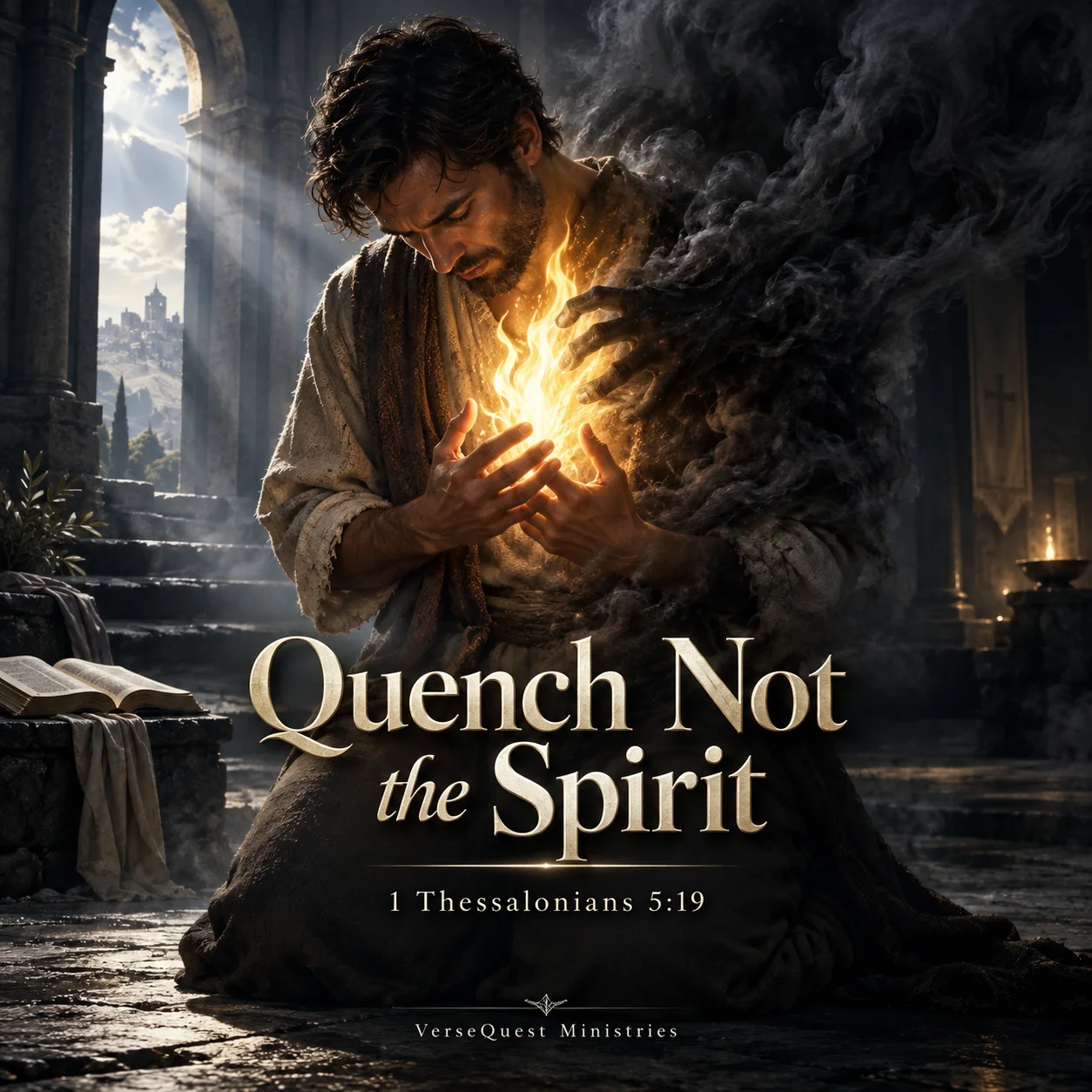
Quench Not the Spirit — 1 Thessalonians 5:19
Key Passage: 1 Thessalonians 5:19 — “Quench not the Spirit.”
The command is only four words long, but a stick of dynamite does not have to be the size of a telephone pole to blow something apart. “Quench not the Spirit.” Paul drops that command into the closing exhortations of 1 Thessalonians with no theological fog around it. He has been writing to believers who are “in God the Father and in the Lord Jesus Christ” (1 Thessalonians 1:1), people who had “turned to God from idols to serve the living and true God; And to wait for his Son from heaven” (1 Thessalonians 1:9–10). These are saved people, serving people, waiting people, and yet Paul warns them that something in their Christian conduct can obstruct the practical working of the Holy Ghost. Salvation does not turn a man into a spiritual robot. God gives the believer the indwelling Spirit, but He does not remove the believer’s responsibility to walk in obedience to that Spirit.
The immediate setting is worth reading slowly because the Holy Ghost did not scatter these words across the page with a salt shaker. Paul says, “Rejoice evermore. Pray without ceasing. In every thing give thanks: for this is the will of God in Christ Jesus concerning you. Quench not the Spirit. Despise not prophesyings. Prove all things; hold fast that which is good. Abstain from all appearance of evil” (1 Thessalonians 5:16–22). There is rejoicing, prayer, thanksgiving, spiritual discernment, holding fast truth, and abstaining from evil all around the command. The Christian who wants the Spirit’s unhindered working cannot divorce verse 19 from verses 16–22. Some folks want to shout about “the Spirit” while despising Bible testing, ignoring holiness, neglecting prayer, and living like the flesh won an election. Paul will not permit that kind of religious circus. The Spirit who fills a believer is the Spirit of holiness, truth, gratitude, prayer, discernment, and obedience.
The word “quench” itself gives the picture. Ephesians 6:16 speaks of “the fiery darts of the wicked” being quenched by the shield of faith. Matthew 12:20 says of Christ, “smoking flax shall he not quench.” To quench is to suppress a flame, smother its burning, stop its effect, or extinguish what is giving light and heat. The Holy Ghost Himself is God and cannot be annihilated by a carnal Christian, but His practical influence in the believer’s walk can be resisted, suppressed, ignored, and hindered. God is not teaching that the Spirit becomes less divine every time a Baptist loses his temper. He is teaching that a believer can refuse the Spirit’s work in his conduct. The fire is not defective; the wet blanket is. The problem is never that the Holy Ghost ran out of power. The problem is that flesh can stubbornly resist the One who indwells the Christian.
1. The Command Is Given to People Who Already Possess the Spirit
Paul is not telling lost men how to receive the Holy Ghost in 1 Thessalonians 5:19. He is addressing brethren. Earlier he said, “For God hath not called us unto uncleanness, but unto holiness. He therefore that despiseth, despiseth not man, but God, who hath also given unto us his holy Spirit” (1 Thessalonians 4:7–8). God had already given them the Holy Spirit. That doctrinal order matters. The Spirit is not dangled over their heads as a prize for sufficiently successful Christian living. He is given to those who belong to Christ. Romans 8:9 states it plainly: “Now if any man have not the Spirit of Christ, he is none of his.” A man without the Spirit is not a spiritually weak Christian; he is not Christ’s at all. The Christian addressed in 1 Thessalonians 5 possesses the Spirit and therefore has the solemn capacity to resist the Spirit’s practical influence.
This is where careless Bible reading gets expensive. If a man sees “Quench not the Spirit” and immediately concludes, “There, you can lose the Holy Ghost and become unsaved,” he has imported a conclusion the verse never states. Paul says quench, not lose, depart, remove, or become unborn. The same apostle tells the Ephesians, “after that ye believed, ye were sealed with that holy Spirit of promise” (Ephesians 1:13), and later commands, “grieve not the holy Spirit of God, whereby ye are sealed unto the day of redemption” (Ephesians 4:30). The believer can grieve Him and quench His practical working, yet the Spirit remains the divine seal unto redemption day. God knows the difference between relationship and fellowship even when theologians occasionally misplace their reading glasses.
The command therefore makes Christian responsibility more serious, not less. The saved man carries the indwelling Holy Ghost everywhere he goes. First Corinthians 6:19 asks, “What? know ye not that your body is the temple of the Holy Ghost which is in you?” The Spirit is present when the believer speaks, chooses, watches, reads, argues, spends, works, worships, and sits alone where nobody else can see him. The Christian life is not God shouting instructions from a distant heaven while the believer tries to remember them. God Himself dwells within His people. To quench the Spirit is therefore to resist a divine Person who is already present. That is considerably more serious than breaking a religious rule written on a bulletin board. Holiness is personal because the Holy Ghost is personal.
2. Quenching the Spirit Means Resisting His Practical Work
The Holy Ghost works in the believer according to truth. He takes the things of Christ and makes them known, produces spiritual fruit, strengthens the inner man, illuminates the word, leads the believer in holiness, and empowers service that honours Jesus Christ. Galatians 5:16 says, “Walk in the Spirit, and ye shall not fulfil the lust of the flesh.” Notice the competing directions. The Spirit leads one way; flesh pulls another. When the believer repeatedly chooses flesh against revealed truth, he is throwing cold water on the practical operation of the Spirit in his life. A man cannot spend six days feeding lust, bitterness, pride, envy, filthy entertainment, dishonest speech, and selfish ambition, then expect to flip the Holy Ghost on Sunday morning like a light switch because the organ began playing.
Quenching often begins quietly. The Spirit uses Scripture to expose something, and the believer delays obedience. The Book says forgive, but he nurses resentment. The Book says flee fornication, but he keeps flirting with temptation. The Book says speak truth, but he keeps trimming facts until lying has acquired church clothes. The Book says pray, but the believer gives God whatever crumbs remain after entertainment, work, gossip, and distraction have eaten the meal. One refusal seldom feels dramatic. That is the danger. A campfire is not always extinguished by dumping a swimming pool on it; sometimes it dies because nobody adds wood. Spiritual decline often works the same way. Neglected truth eventually produces a cold heart, and the believer wonders why heaven seems quiet while his Bible has been collecting dust.
The believer should never imagine that quenching the Spirit means he has somehow defeated God Almighty. The Holy Ghost is not pacing nervously inside the Christian hoping the flesh will permit Him to remain divine. The issue is the believer’s usefulness, fellowship, fruitfulness, discernment, testimony, and practical power. Samson learned in another dispensational setting what it meant to presume upon divine power while playing games with sin. The Church Age believer should not steal Samson’s doctrinal arrangement, but he can certainly learn from the wreckage. God’s gifts are not permission slips for rebellion. The Christian who continually says no to divine truth will eventually discover that sin has a way of making the spiritual ear dull. The Spirit has not become weak; the believer has become stubborn.
3. Quenching and Grieving Are Different Pictures of the Same Rebellion
Ephesians 4:30 says, “grieve not the holy Spirit of God,” while 1 Thessalonians 5:19 says, “Quench not the Spirit.” The two expressions are related but not identical. Grieving emphasizes the personal sorrow caused to the indwelling Spirit by sinful conduct. Quenching emphasizes suppressing or resisting His practical operation and influence. One points to wounded fellowship; the other pictures a fire being smothered. Both reveal that the Christian’s relationship with the Holy Ghost is not mechanical. He is neither a religious battery nor a spiritual mood. He is the holy Spirit of God, and believers can offend His holiness while resisting His work.
The context of Ephesians 4 identifies what grieves Him: lying, sinful anger, stealing, corrupt communication, bitterness, wrath, clamour, evil speaking, and malice. The context of 1 Thessalonians 5 places quenching alongside prayer, thanksgiving, prophesyings, proving all things, holding fast what is good, and abstaining from evil. Put the passages together and the lesson becomes painfully practical. You grieve and quench the Spirit not merely by committing spectacular sins that make newspaper headlines, but by refusing truth in everyday Christian conduct. The devil would love Christians to imagine spirituality is measured by dramatic experiences while bitterness sits comfortably in the pew wearing a necktie. God has a less theatrical measuring stick.
There is also comfort inside the warning. The fact that a believer can grieve the Spirit demonstrates relationship, and the fact that he can quench the Spirit’s working does not mean God has abandoned him. Ephesians 4:30 places the warning against grieving inside the promise of sealing “unto the day of redemption.” That verse ought to cure both presumption and panic. Presumption says, “Since I am sealed, my conduct does not matter.” The command says it matters enough to grieve God. Panic says, “Since I failed, the Spirit must be gone.” The seal says He remains. The proper doctrine leaves the believer secure enough to obey without fear and serious enough to obey without foolishness.
4. The Immediate Context Connects Quenching With Despising God’s Revealed Truth
Immediately after “Quench not the Spirit,” Paul writes, “Despise not prophesyings. Prove all things; hold fast that which is good” (1 Thessalonians 5:20–21). In the early apostolic churches, before the completed New Testament Scriptures had been gathered as believers possess them today, God used prophetic revelation in the assembly. First Corinthians 14 discusses prophecy among the spiritual gifts operating in that transitional apostolic setting. Paul’s command was not, “Believe anything supernatural because somebody raised his voice and claimed God said it.” He immediately added, “Prove all things.” Genuine spiritual operation never fears examination. Counterfeit religion usually gets nervous when the Bible enters the room with the lights on.
That principle remains essential. The Holy Ghost is the Spirit of truth, and the word He inspired is the standard by which doctrine is tested. Second Timothy 3:16 says, “All scripture is given by inspiration of God.” Second Peter 1:21 says holy men of God “spake as they were moved by the Holy Ghost.” It would be theological comedy to claim the Spirit privately told a man something that contradicts the Book the Spirit publicly inspired. Yet churches have built whole movements on “God told me” while treating “God wrote” as optional reading. A claimed revelation that contradicts Scripture does not need further discernment, a conference, or three weeks of prayer. It needs a wastebasket.
Quenching the Spirit can therefore occur when believers despise, neglect, reject, or trivialize divine truth. A Christian who continually refuses the plain teaching of Scripture is not becoming more spiritual; he is resisting the Spirit who gave the Scripture. Modern religion sometimes separates being “Spirit-led” from being “Bible-led,” as though the Holy Ghost is attempting an escape from His own Book. He is not. The Spirit uses truth. He glorifies Christ. He leads into holiness. He never whispers permission to disobey what He inspired in black and white. If a man wants the Spirit’s fire while despising the Spirit’s words, he wants heat without fuel, light without flame, and spirituality without God.
5. The Flesh Is the Great Wet Blanket on Spiritual Fire
Galatians 5 sets the conflict plainly: “For the flesh lusteth against the Spirit, and the Spirit against the flesh: and these are contrary the one to the other” (Galatians 5:17). The flesh is not rehabilitated at salvation. The believer receives a new nature and the indwelling Spirit, but the old flesh remains until the redemption of the body. That is why Paul commands Christians to walk in the Spirit rather than assuming Spirit-control is automatic. The flesh has religious versions of itself as well as immoral versions. It can sit in a bar or stand behind a pulpit. Flesh is flesh whether it is wearing a leather jacket or carrying a Scofield Bible.
The works of the flesh are listed without makeup: adultery, fornication, uncleanness, hatred, variance, emulations, wrath, strife, envyings, drunkenness, and the rest. In contrast, “the fruit of the Spirit is love, joy, peace, longsuffering, gentleness, goodness, faith, meekness, temperance” (Galatians 5:22–23). The Christian who habitually feeds the works of the flesh should not be surprised when spiritual fruit withers. You cannot plant crabgrass all week and complain to God because no roses appeared by Sunday. Spiritual fruit comes from walking in the Spirit, not from admiring the concept of walking in the Spirit.
This is why quenching must be treated practically. What are you feeding? What repeatedly occupies the mind? What conversation has become normal? What secret compromise has been excused because nobody knows? What bitterness gets rehearsed every night like a favourite hymn? Romans 8:13 says, “if ye through the Spirit do mortify the deeds of the body, ye shall live.” Mortification is not negotiation. God does not tell believers to put sinful desires on a committee and hear both sides. Kill what feeds the flesh. Stop supplying the wet blanket and then wondering why the flame is low. The Spirit’s power has not diminished; too many Christians simply keep handing the flesh another bucket.
6. Quenching the Spirit Does Not Cancel the Believer’s Eternal Security
Nothing in 1 Thessalonians 5:19 says the believer loses salvation by quenching the Spirit. Paul does not threaten these saints with becoming lost again. Their salvation rests in Christ, not in their ability to maintain a flawless level of spiritual responsiveness. Ephesians 1:13 says believers are sealed after believing the gospel, and Ephesians 4:30 says that seal lasts “unto the day of redemption.” Romans 8:1 says, “There is therefore now no condemnation to them which are in Christ Jesus.” The believer’s standing is settled in Christ even while his state may become painfully poor.
This distinction is essential because otherwise every command becomes a hidden threat of hell. Fail to rejoice? Lost. Miss a season of prayer? Lost. Fail to give thanks? Lost. Quench the Spirit? Lost. Despise a teaching? Lost. Suddenly salvation by grace has been converted into salvation by maintaining a perfect score on 1 Thessalonians 5. Paul would not recognize that gospel. The Christian is saved by the finished work of Christ, not by achieving uninterrupted spiritual performance. The man who confuses Christian discipline with justification has put the cart in front of the horse and then blamed the horse for walking backward.
Yet security must never be used as a pillow for rebellion. First Corinthians 11 shows saved believers being chastened severely, some even becoming weak, sickly, and dying under divine discipline. Paul says, “when we are judged, we are chastened of the Lord, that we should not be condemned with the world” (1 Corinthians 11:32). There is the distinction. The believer may lose fellowship, joy, testimony, usefulness, health, opportunity, reward, and even length of earthly service without losing Christ. Eternal security does not make sin harmless; it makes chastening fatherly rather than judicial. God does not throw His children away. He corrects them because they are His.
7. The Answer Is to Walk in the Spirit and Keep the Fire Unhindered
The positive answer to quenching is not chasing emotional excitement; it is yielded Christian living. Paul says, “Walk in the Spirit” (Galatians 5:16), “be filled with the Spirit” (Ephesians 5:18), and “Let the word of Christ dwell in you richly” (Colossians 3:16). Those passages belong together. A Spirit-filled Christian is not one who has learned how to produce the loudest religious atmosphere. He is one whose mind, tongue, conduct, worship, relationships, and service are increasingly governed by truth. The Holy Ghost does not need a smoke machine, coloured lights, and a fifteen-minute musical loop to prove He is present. He produces holiness, truth, courage, fruit, and Christlike conduct.
Prayer matters because Paul places “Pray without ceasing” immediately before “Quench not the Spirit.” Thanksgiving matters because ingratitude turns the heart inward until every inconvenience looks like divine betrayal. The word matters because the Spirit works through truth. Fellowship with sound believers matters because God did not design Christianity as a hermit religion. Service matters because spiritual fire is meant to give light, not merely keep one Christian warm. Witness matters because Acts 1:8 connects the Spirit’s power with testimony to Christ. The believer who wants spiritual vitality should begin with the ordinary means God actually gave instead of hunting mystical shortcuts that usually end in a ditch.
And when the believer realizes he has quenched the Spirit’s working, the answer is not theatrical despair. Confess the sin. Agree with God. Put away what is wrong. Return to the Book. Pray. Obey the truth already known. Stop waiting for a lightning bolt to tell you to do what a verse has already commanded. God is merciful, and the Holy Ghost has not become reluctant to work because a Christian stumbled. But restoration requires honesty. A man cannot cling to the bucket and pray for the fire. Put away the resistance. Give the Spirit the practical right of way. The flame does not need a new God; the Christian needs renewed obedience.
Conclusion
“Quench not the Spirit” is not a decorative sentence for a church bulletin. It is a command from God to saved people who possess the indwelling Holy Ghost. The warning assumes both privilege and responsibility. The Christian has something the world does not have: God dwelling within. He therefore has a responsibility the world does not have: to walk in harmony with the One who indwells him. Lying, bitterness, lust, pride, prayerlessness, ingratitude, doctrinal indifference, resistance to Scripture, and fleshly living all work against the Spirit’s practical purpose. The Christian cannot extinguish God, but he can waste years resisting the fire God placed within the temple.
The doctrine must remain balanced. Quenching is not unsealing. Grieving is not losing sonship. Chastening is not condemnation. Poor fellowship is not the destruction of eternal life. The believer remains secure in Jesus Christ because salvation rests upon Christ’s finished work and the Spirit’s seal unto redemption day. But that security does not lower the stakes of Christian living. It raises them. The man who knows he belongs to God should be more careful with his life, not less. Grace is not God saying sin does not matter; grace is God giving the believer every reason and every spiritual resource to stop serving the master from whom Christ delivered him.
So keep the command where God put it: among rejoicing, prayer, thanksgiving, discernment, holding fast truth, and abstaining from evil. Do not quench the Spirit by resisting the Book He inspired, feeding the flesh He opposes, or excusing the sin He convicts. Walk in the Spirit. Let the word of Christ dwell richly in you. Pray without ceasing. Give thanks. Prove all things. Hold fast that which is good. Abstain from all appearance of evil. A fire gives light when it is allowed to burn, and a Christian gives spiritual light when the Holy Ghost is not continually being smothered by stubborn flesh. Quench not the Spirit.