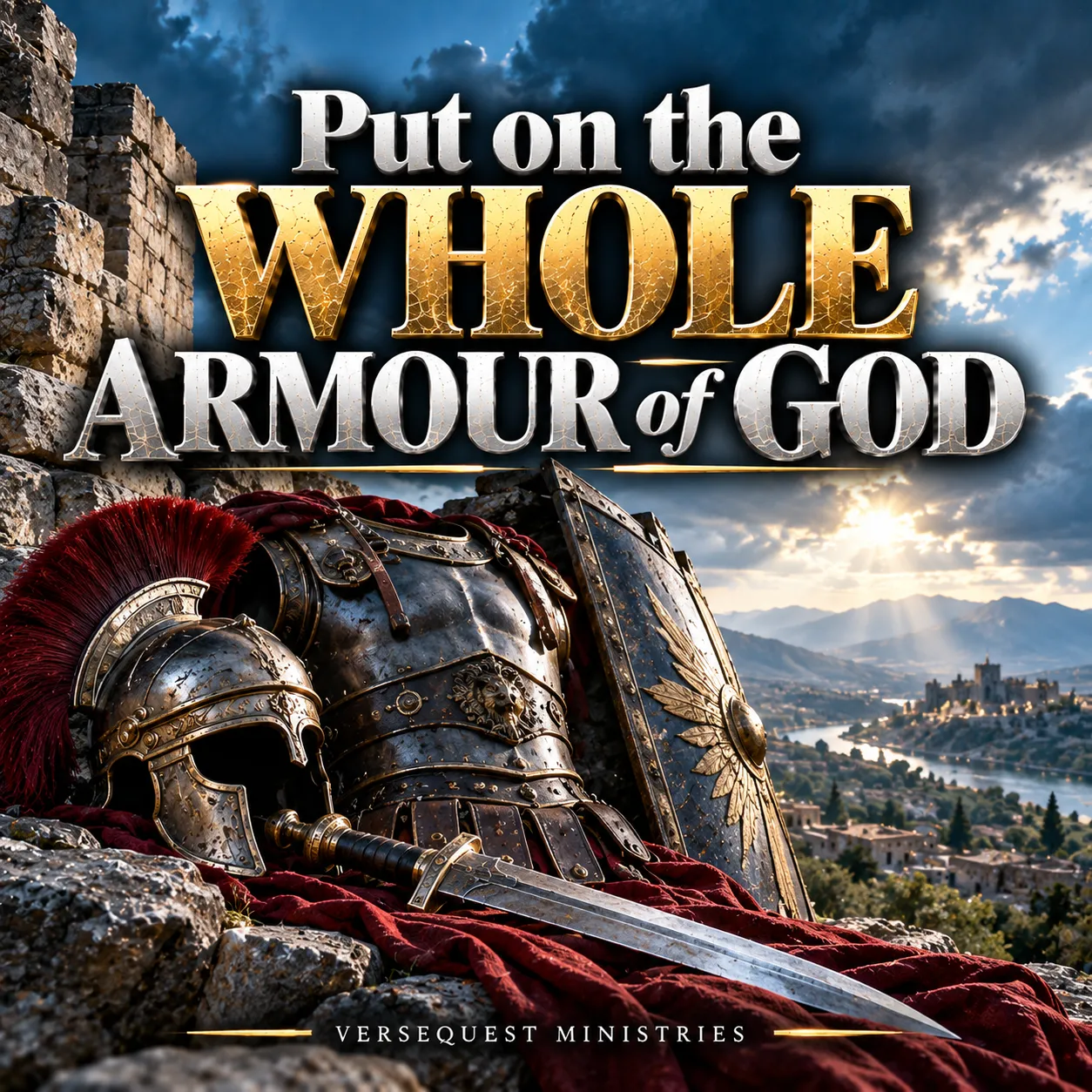
Sermon Title:
Put on the Whole Armour of God
Key Passage:
Ephesians 6:10–18
“Put on the whole armour of God, that ye may be able to stand against the wiles of the devil.” (Ephesians 6:11)
Series:
The Book God Gave
Topic:
How the Church-Age Believer Stands in Spiritual Warfare Through the Whole Armour God Has Provided
Book:
Ephesians
Speaker:
Paul Tackett
Suggested Sermon Text:
Ephesians 1:3, 19–23; Ephesians 2:1–10; Ephesians 3:8–12; Ephesians 4:11–32; Ephesians 5:1–21; Ephesians 6:10–20; Romans 8:31–39; Romans 13:11–14; 1 Corinthians 10:12–13; 2 Corinthians 2:10–11; 2 Corinthians 10:3–5; Galatians 5:16–25; Philippians 1:27–30; Philippians 4:6–9; Colossians 2:13–15; Colossians 3:1–17; 1 Thessalonians 5:8; 2 Timothy 2:3–5, 15; 2 Timothy 3:15–17; James 4:7; 1 Peter 5:8–9
Short Sermon Description:
Ephesians 6:10–18 closes Paul’s great doctrinal and practical epistle by revealing that the Christian life involves genuine spiritual conflict. The believer does not wrestle primarily against flesh and blood, but against principalities, powers, rulers of the darkness of this world, and spiritual wickedness in high places. Paul therefore commands Christians to be strong “in the Lord, and in the power of his might” and to put on the whole armour of God. This sermon examines each piece of that armour—the girdle of truth, breastplate of righteousness, feet shod with the preparation of the gospel of peace, shield of faith, helmet of salvation, sword of the Spirit, and continual prayer—while emphasizing that the believer’s purpose is to stand, not invent spectacular forms of spiritual warfare Scripture never commands. It distinguishes biblical spiritual warfare from superstition, emotionalism, demon obsession, mystical visualization, and fleshly combat, while showing how right doctrine, practical holiness, faith, assurance, Scripture, and prayer equip the Church-Age believer to withstand the devil’s wiles. The supplied VerseQuest standard calls for a KJV-only, rightly divided, detailed, sermon-ready treatment suitable for preaching and teaching. Sermon Outline Prompt – VerseQu…
PUT ON THE WHOLE ARMOUR OF GOD
Introduction
Paul does not close Ephesians by telling Christians to relax because they now understand doctrine. He closes it by putting them on a battlefield. Ephesians has taken the believer from being “dead in trespasses and sins” to being made alive with Christ, seated together “in heavenly places in Christ Jesus,” made part of one body, instructed concerning the new man, commanded concerning marriage, family, work, holiness, speech, forgiveness, and Christian conduct—and then suddenly Paul says, “Finally, my brethren, be strong in the Lord.” Why? Because understanding your position in Christ does not cause the devil to congratulate you and retire. Truth believed makes the believer stable, and stability makes him harder to move.
But Paul immediately removes the flesh from the throne of Christian warfare. He does not say, “Be strong in your personality.” He does not say, “Develop a more aggressive temperament.” He says, “be strong in the Lord, and in the power of his might.” That single sentence wrecks a great deal of religious theatre. Screaming louder at the devil is not spiritual strength. Emotional excitement is not spiritual armour. Human determination is not the power of God. The Christian does not stand because he is impressive; he stands because God has supplied what he could never manufacture.
Then Paul gives the reason: “For we wrestle not against flesh and blood.” Christians continually forget that. We see the person, the institution, the argument, the insult, the temptation, the cultural pressure, or the false teacher, and we assume the visible thing is the entire battle. Paul pulls back the curtain. There are spiritual powers operating in rebellion against God, and the believer lives in hostile territory. Yet the command is not panic. It is not fascination with devils. It is not spiritual superstition. It is simple, sober, Bible-believing preparation: put on the whole armour of God, and stand.
I. THE BELIEVER’S STRENGTH MUST COME FROM THE LORD
Key Text: Ephesians 6:10
Supporting Texts: Philippians 4:13; 2 Corinthians 12:9–10; John 15:5; Colossians 1:11
Paul begins, “Finally, my brethren, be strong in the Lord, and in the power of his might.” Notice where the strength is located. Not in the believer. In the Lord.
Christian warfare begins with dependence.
The flesh loves the idea of being a spiritual warrior because it gives the flesh another opportunity to admire itself. A man can become proud of how fiercely he fights pride. That is how tricky Adam’s nature is.
Paul cuts the legs out from under that nonsense immediately. The power belongs to God.
Second Corinthians 12 records Christ saying, “My grace is sufficient for thee: for my strength is made perfect in weakness.” The Christian does not become useful by pretending he has no weakness. He becomes useful by learning where genuine strength resides.
The devil has been dealing with human flesh longer than any living Christian has been alive. If your battle plan is merely stronger willpower, he has seen that plan before.
But Satan cannot outmatch the power of the Lord.
Main Truth: Spiritual victory begins when the believer stops trusting his own strength and depends upon the power God supplies in Christ.
II. THE ENEMY USES WILES, NOT MERELY OPEN ATTACKS
Key Text: Ephesians 6:11
Supporting Texts: 2 Corinthians 2:11; 2 Corinthians 11:3, 13–15; Genesis 3:1; 1 Peter 5:8
Paul says the armour enables believers “to stand against the wiles of the devil.”
A wile is a scheme, craft, trick, strategy, or deceptive method.
The devil does not always attack like a roaring lion. Sometimes he approaches like the serpent in Eden.
Genesis 3 begins with subtlety: “Yea, hath God said?” Second Corinthians 11 warns that Satan himself “is transformed into an angel of light.” The believer who expects every satanic attack to look openly wicked has already misunderstood the enemy.
Some attacks look religious.
Some quote Scripture.
Some flatter pride.
Some appear intellectual.
Some appeal to compassion while contradicting truth.
Some offer shortcuts around obedience.
Paul says in 2 Corinthians 2:11, “we are not ignorant of his devices.”
A trap works best when it does not look like one.
That is why spiritual warfare requires truth rather than instinct. Your feelings are not sufficient radar. The devil is perfectly capable of making disobedience feel noble.
Main Truth: The believer needs God’s armour because Satan commonly attacks through deception, subtlety, counterfeit light, and carefully designed spiritual traps.
III. OUR WRESTLING IS NOT AGAINST FLESH AND BLOOD
Key Text: Ephesians 6:12
Supporting Texts: 2 Corinthians 10:3–5; Colossians 2:15; Ephesians 2:2; Daniel 10:12–13
Paul states it plainly: “For we wrestle not against flesh and blood.”
That does not mean human beings never oppose truth. They obviously do. It means the Christian must understand the deeper nature of the conflict.
Paul lists “principalities,” “powers,” “the rulers of the darkness of this world,” and “spiritual wickedness in high places.”
The Christian worldview contains real supernatural evil.
Yet notice what Paul does not do next. He does not give Christians instructions for roaming neighborhoods identifying territorial demons. He does not teach believers to shout names into the atmosphere, perform spiritual mapping, or invent formulas for binding Satan.
He gives them armour.
That is significant.
The New Testament emphasis is not fascination with the enemy. It is faithfulness to Christ.
Christ already “spoiled principalities and powers” through the cross (Colossians 2:15). The believer’s responsibility is not to finish Christ’s victory but to stand in what God has provided.
Spiritual warfare becomes unhealthy when Christians spend more time studying devils than studying Scripture.
Main Truth: The Christian conflict is genuinely spiritual, but Scripture directs believers toward faithful standing in God’s provision rather than speculative obsession with demonic powers.
IV. THE FIRST PIECE OF ARMOUR IS TRUTH
Key Text: Ephesians 6:14
Supporting Texts: John 17:17; Psalm 119:160; 2 Timothy 2:15; John 8:31–32
“Stand therefore, having your loins girt about with truth.”
Truth comes first because deception is Satan’s native language.
Jesus said of the devil, “there is no truth in him” (John 8:44). Christ says to the Father, “thy word is truth” (John 17:17).
There is the battlefield.
Lie against truth.
The believer cannot stand spiritually while treating doctrine as optional.
A girdle held the soldier’s clothing in place and prepared him for movement. Truth gives the Christian stability. Without truth, everything else starts hanging loose.
That includes doctrinal truth and truthful living.
A man defending the Bible while living dishonestly has left part of his armour on the floor.
A church that talks about spiritual warfare while refusing doctrinal precision is trying to fight in bedroom slippers.
Second Timothy 2:15 therefore matters: “rightly dividing the word of truth.” The truth must not merely be possessed. It must be handled correctly.
Main Truth: The believer’s defense against satanic deception begins with knowing, believing, rightly dividing, and living according to God’s truth.
V. THE BREASTPLATE OF RIGHTEOUSNESS PROTECTS THE BELIEVER’S WALK
Key Text: Ephesians 6:14
Supporting Texts: 1 Corinthians 1:30; 2 Corinthians 5:21; Philippians 1:11; Titus 2:11–14
Paul says, “having on the breastplate of righteousness.”
The believer possesses perfect righteousness positionally in Christ. First Corinthians 1:30 says Christ is made unto us “righteousness.”
That standing cannot be improved by human effort.
But Ephesians 6 is discussing practical warfare, and practical righteousness matters greatly.
Sin gives the enemy opportunities.
Ephesians 4:27 has already warned, “Neither give place to the devil.” In the immediate context Paul has discussed lying, uncontrolled anger, stealing, corrupt communication, bitterness, wrath, and malice.
Those things are not harmless personality quirks. They expose weaknesses in the Christian walk.
A believer cannot deliberately feed sin Monday through Saturday and expect to become spiritually invincible Sunday morning because he prayed loudly.
Grace teaches holiness.
The breastplate reminds the believer that doctrine should protect conduct.
Main Truth: The believer stands in Christ’s righteousness while also maintaining practical righteousness that denies the devil opportunities through deliberate sin.
VI. THE FEET MUST BE SHOD WITH THE GOSPEL OF PEACE
Key Text: Ephesians 6:15
Supporting Texts: Romans 5:1; Romans 10:15; 1 Corinthians 15:1–4; 2 Corinthians 5:18–20
Paul says, “And your feet shod with the preparation of the gospel of peace.”
The gospel gives stability because it settles the believer’s relationship with God.
Romans 5:1 says, “Therefore being justified by faith, we have peace with God through our Lord Jesus Christ.”
That peace is not emotional calm. It is reconciliation.
The believer who is uncertain whether God accepts him will be easy prey for accusation. The gospel answers the accusation: Christ died for our sins, was buried, and rose again.
But feet also move.
Romans 10 speaks of the beautiful feet of those who preach the gospel of peace.
The Christian does not merely defend ground. He carries a message into enemy territory.
The devil would prefer Christians spend all their energy arguing among themselves while lost sinners never hear the gospel.
A church obsessed with internal warfare and silent about Christ’s death, burial, and resurrection has forgotten why the shoes were issued.
Main Truth: The gospel gives the believer settled peace with God and prepares him to carry Christ’s saving message into the world.
VII. THE SHIELD OF FAITH QUENCHES THE FIERY DARTS
Key Text: Ephesians 6:16
Supporting Texts: Romans 10:17; 2 Corinthians 5:7; Hebrews 11:1–6; Psalm 56:3–4
“Above all, taking the shield of faith.”
Faith does not mean pretending difficulties are unreal. Faith means believing God when circumstances, feelings, accusations, temptation, and fear argue otherwise.
Paul describes Satan’s attacks as “fiery darts.”
A dart comes suddenly.
A thought arrives.
A fear hits.
An accusation flashes.
A temptation appears.
A lie enters the mind: “God has forgotten you.” “You will never change.” “One sin will not matter.” “The Bible cannot be trusted.” “Everybody else gets away with it.”
Faith raises the shield and asks one question: What did God say?
Romans 10:17 says faith comes by hearing the word of God.
Biblical faith is therefore not psychological self-confidence. The shield is not faith in faith. It is confidence resting upon divine truth.
The believer does not extinguish Satan’s lies by arguing with his emotions all afternoon. He puts God’s word between himself and the dart.
Main Truth: The shield of faith protects believers as they trust God’s revealed truth above satanic accusations, fears, temptations, and changing circumstances.
VIII. THE HELMET OF SALVATION GUARDS THE MIND WITH ASSURANCE
Key Text: Ephesians 6:17
Supporting Texts: 1 Thessalonians 5:8; Romans 8:31–39; Ephesians 1:13–14; 2 Timothy 1:12
“And take the helmet of salvation.”
The helmet protects the head.
The devil understands that confusion about salvation can cripple Christian service.
If every failure makes a believer wonder whether he became unsaved overnight, that Christian will spend his entire life inspecting himself instead of serving Christ.
Ephesians has already taught believers that they were sealed with the Holy Spirit “unto the day of redemption.”
Romans 8 says nothing can separate the believer from the love of God in Christ Jesus.
That assurance does not produce carelessness when understood biblically. It produces stability.
The Christian does not fight for salvation. He stands because salvation is already his in Christ.
First Thessalonians calls it “the hope of salvation” as a helmet.
Satan’s accusations hit differently when the believer knows the difference between his imperfect daily performance and his perfect standing in Christ.
Main Truth: Assurance of salvation protects the believer’s mind from destabilizing accusations and enables him to serve from security in Christ rather than fear.
IX. THE SWORD OF THE SPIRIT IS THE WORD OF GOD, AND PRAYER KEEPS THE SOLDIER WATCHFUL
Key Text: Ephesians 6:17–18
Supporting Texts: Matthew 4:1–11; Hebrews 4:12; Psalm 119:11; Colossians 4:2; Philippians 4:6–7
Paul identifies the offensive weapon directly: “the sword of the Spirit, which is the word of God.”
There is no mystery about the weapon.
When Satan tempted Christ, Jesus answered repeatedly, “It is written.”
The Lord did not answer with feelings. He answered with Scripture accurately applied.
A sword sitting in the armoury does not help the soldier on the field. Christians must know the Book.
Read it.
Study it.
Memorize it.
Rightly divide it.
Learn where passages belong.
Learn the gospel.
Learn your position in Christ.
Learn how temptation works.
The Spirit uses the word He inspired.
Then Paul moves immediately into prayer: “Praying always with all prayer and supplication in the Spirit, and watching thereunto with all perseverance.”
Prayer is not listed as decorative trim. It permeates the entire battle.
The armed Christian remains dependent.
He watches.
He perseveres.
He prays for other saints.
He even prays, as Paul requested, for boldness in gospel proclamation.
The soldier wearing every piece but refusing communication with headquarters has misunderstood warfare.
Main Truth: The believer fights error with the written word of God and maintains spiritual watchfulness through persistent, Spirit-led prayer.
Conclusion
Ephesians 6 does not describe a Christian chasing demons through every shadow. It describes a Christian standing. The command appears repeatedly: “stand,” “withstand,” “stand therefore.” The devil wants movement in the wrong direction—retreat from truth, compromise of holiness, abandonment of faith, uncertainty about salvation, silence concerning the gospel, neglect of Scripture, and prayerlessness. God says stand.
The armour also reveals that spiritual warfare is far more doctrinal and practical than much modern religious sensationalism suggests. Truth. Righteousness. Gospel. Faith. Salvation. Scripture. Prayer. None of those pieces depends upon emotional spectacle. They depend upon believers taking seriously what God has already provided in Christ and revealed in His Book.
So put on the whole armour. Not half of it. A man who loves doctrine but lives dishonestly has left off righteousness. A man who talks constantly about faith but ignores Scripture has dropped his sword. A Bible student who never prays has forgotten dependence. A believer who guards himself but never shares the gospel has forgotten his shoes. God issued the entire armour because the entire battle requires it. Stand in the Lord, stand in truth, stand in grace, and when the smoke clears, still be standing.
Final Call
If you are lost, the armour of God is not a method for an unsaved man to make himself acceptable to God. Your first need is salvation. Jesus Christ “died for our sins according to the scriptures; And that he was buried, and that he rose again the third day according to the scriptures” (1 Corinthians 15:3–4). Believe on the Lord Jesus Christ and trust His finished work rather than religion, baptism, morality, sacraments, church membership, or your own works.
If you are saved, stop entering spiritual conflict dressed in your own confidence. Put on the armour God supplied. Know the truth. Walk righteously. Stand in the gospel. Believe God. Rest in your salvation. Use the sword of the Spirit. Pray always. Rightly divide the Book. Watch for the devil’s wiles without becoming fascinated with the devil himself. Your assignment is not to impress the battlefield. Your assignment is to stand.
Closing Verse:
“Submit yourselves therefore to God. Resist the devil, and he will flee from you.” (James 4:7)
Closing Statement:
God never told the Christian to invent his own weapons for spiritual warfare—He told him to put on the armour already hanging in God’s armoury and stand.