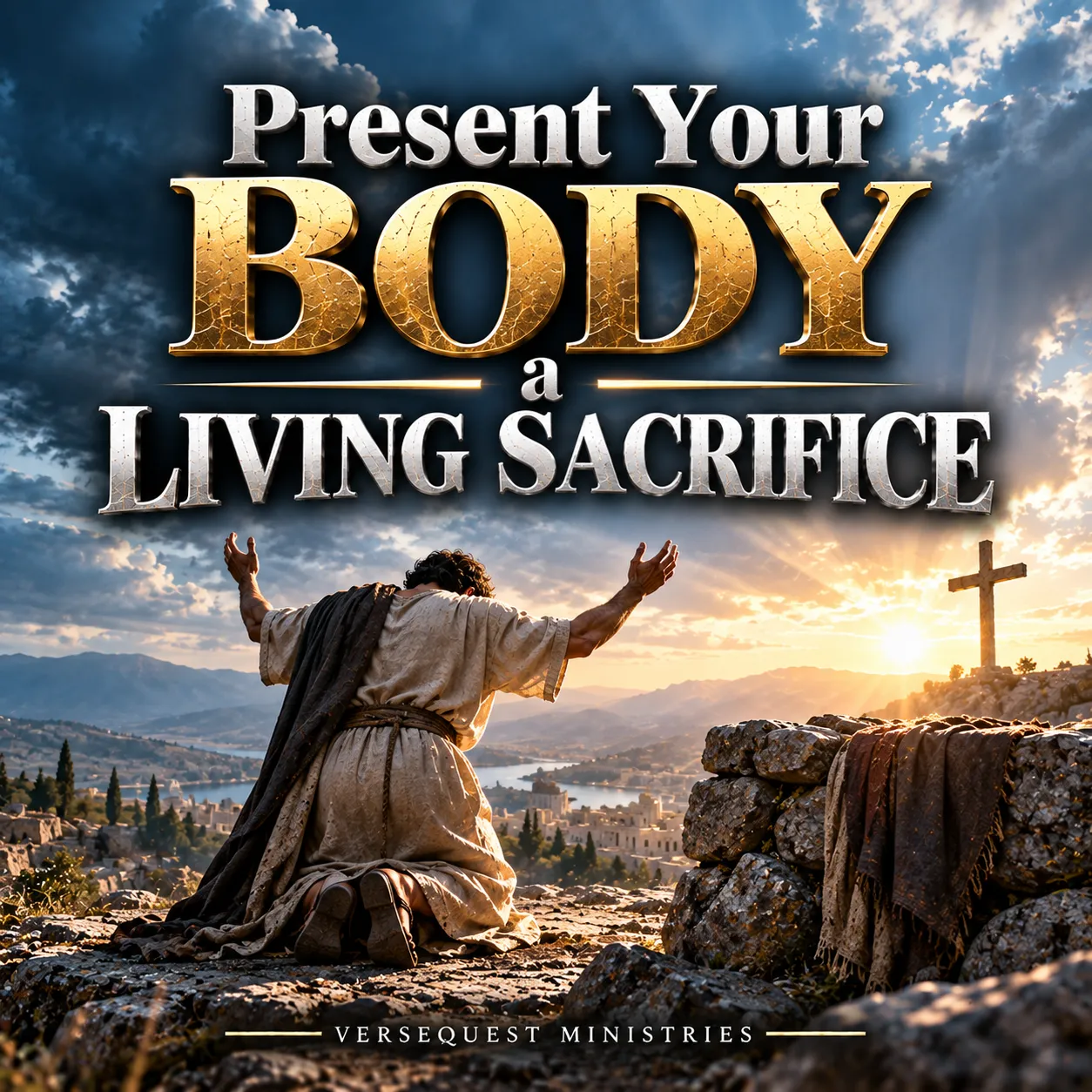
Sermon Title:
Present Your Body a Living Sacrifice
Key Passage:
Romans 12:1–2
“I beseech you therefore, brethren, by the mercies of God, that ye present your bodies a living sacrifice, holy, acceptable unto God, which is your reasonable service.
And be not conformed to this world: but be ye transformed by the renewing of your mind, that ye may prove what is that good, and acceptable, and perfect, will of God.” (Romans 12:1–2)
Series:
The Book God Gave
Topic:
The Believer’s Reasonable Response to the Mercies of God — Presenting the Body, Renewing the Mind, and Living the Will of God
Book:
Romans
Speaker:
Paul Tackett
Suggested Sermon Text:
Romans 6:1–14; Romans 8:1–13; Romans 11:33–36; Romans 12:1–21; 1 Corinthians 6:12–20; 1 Corinthians 9:24–27; 2 Corinthians 5:14–15; Galatians 2:20; Galatians 5:16–25; Ephesians 4:17–24; Philippians 1:20–21; Colossians 3:1–17; 1 Thessalonians 4:1–7; 2 Timothy 2:15, 20–22; Titus 2:11–14
Short Sermon Description:
Romans 12:1–2 marks one of the great turning points in Paul’s epistle to the Romans. After eleven chapters establishing the guilt of man, justification by faith, peace with God, identification with Christ, life in the Spirit, the security of the believer, Israel’s place in God’s prophetic program, and the unfathomable mercies of God, Paul turns from doctrine to Christian duty with the word “therefore.” This sermon examines what it means for a saved believer to present his body “a living sacrifice,” why this presentation is the response to grace rather than a payment for salvation, how the Christian’s body becomes an instrument of service rather than a master to be obeyed, and why genuine consecration includes both separation from the world and transformation through a renewed mind. It also explains the “good, and acceptable, and perfect, will of God,” distinguishes biblical surrender from religious asceticism and works-righteousness, and shows how grace should govern the believer’s speech, habits, appetites, relationships, work, worship, and daily conduct.
PRESENT YOUR BODY A LIVING SACRIFICE
Introduction
Romans 12 does not begin with a threat. It begins with a plea: “I beseech you therefore, brethren, by the mercies of God.” Paul has spent eleven chapters showing what God has done for the sinner and for the saint before he begins telling the believer what ought to be done in response. That order is the difference between Christianity and religious bondage. Religion puts the cart in front of the horse and then whips the cart for not moving. It tells man to perform so God might accept him. Paul tells the believer that God has justified him, reconciled him, placed him in Christ, given him the Spirit, promised him security, and poured out mercy—and therefore he ought to present himself to God. Christian service does not purchase grace. Christian service answers grace.
The command is also remarkably physical. Paul does not merely say, “Give God your heart,” though the heart certainly matters. He says, “present your bodies.” Christianity is not an invisible philosophy floating between the ears. The saved man still lives in a body, and that body is where doctrine eventually puts on work clothes. Your eyes belong to God. Your tongue belongs to God. Your hands belong to God. Your feet belong to God. Your appetites, strength, sexuality, time, energy, and physical habits all become part of Christian stewardship. A man can talk about surrender until the rafters grow tired of hearing him, but sooner or later surrender shows up in what he does with his body on Tuesday afternoon.
Romans 12:1–2 also gives us a complete picture of practical Christian consecration. There is a presentation of the body, a refusal to be conformed to the world, a transformation through the renewing of the mind, and a life that increasingly proves the will of God. That is not how a sinner gets saved. Paul addresses “brethren.” This is Church Age doctrine for people already justified by faith. The passage does not teach that surrender keeps you saved, finishes the cross, or earns divine favor. It teaches that the mercies of God deserve a reasonable response from the people who have received them.
I. THE WORD “THEREFORE” BUILDS CHRISTIAN SERVICE UPON CHRISTIAN DOCTRINE
Key Text: Romans 12:1
Supporting Texts: Romans 1:16–17; Romans 3:24–28; Romans 5:1; Romans 8:1; Romans 11:33–36
Paul begins, “I beseech you therefore.” That one word reaches backward through everything he has already written. Man is guilty. God justifies the ungodly by faith. Christ died for sinners. The believer has peace with God. He is identified with Christ’s death and resurrection. He is not under the law but under grace. There is no condemnation to those who are in Christ Jesus. Nothing can separate the believer from the love of God which is in Christ Jesus our Lord. Israel has not been erased from God’s prophetic purposes. Then Paul reaches Romans 11:36: “For of him, and through him, and to him, are all things: to whom be glory for ever. Amen.” Therefore—present your body.
That is the order grace establishes. Doctrine first. Duty second. Position first. Practice second. Salvation first. Service second. You do not climb into Christ by presenting your body. You present your body because God has already put you in Christ by grace through faith. Remove Romans 1–11 and Romans 12 becomes religious slavery. Keep Romans 1–11 in front of it and Romans 12 becomes gratitude with shoes on.
The believer should never allow Christian service to become an attempt to repay God in the sense of settling a debt. You cannot repay Calvary. Eternity itself is too short to balance that ledger. Service is not repayment; it is response.
Main Truth: Christian consecration rests upon what God has already done for the believer by grace and is never a substitute for justification by faith.
II. THE APPEAL IS “BY THE MERCIES OF GOD,” NOT BY FEAR OF LOSING SALVATION
Key Text: Romans 12:1
Supporting Texts: Romans 8:31–39; Ephesians 1:13–14; Ephesians 4:30; Titus 2:11–14
Paul could have written, “Present your body or God may cast you out.” He did not. He says, “by the mercies of God.”
That matters doctrinally. The believer’s motivation for service is not insecurity about whether Christ’s finished work will hold. Romans 8 has already declared that nothing can separate the believer from the love of God in Christ. The Holy Spirit has sealed the believer unto the day of redemption. Eternal security does not weaken Christian service when taught biblically; it gives Christian service the proper motive.
Fear may produce outward activity for a while, but grace reaches deeper. A slave works because he fears the whip. A son serves because he knows whose family he belongs to.
Titus 2 says the grace of God teaches us to deny ungodliness and worldly lusts. Grace is not a hammock for the flesh. Grace is a schoolmaster for the saved man’s walk.
The man who says eternal security gives Christians permission to live however they please has not understood either security or grace. Paul looks at God’s mercy and says it should move the believer toward surrender, not toward sin.
Main Truth: The believer presents himself to God because of divine mercy and grace, not because he must earn or preserve eternal salvation.
III. GOD CALLS FOR THE BODY BECAUSE THE BODY IS NOW HIS PROPERTY
Key Text: Romans 12:1
Supporting Texts: 1 Corinthians 6:19–20; Romans 6:12–13; Philippians 1:20; 1 Corinthians 9:27
Paul says, “present your bodies.”
First Corinthians 6 explains why: “ye are not your own. For ye are bought with a price.” The believer’s body belongs to the Lord who purchased him.
That immediately makes Christianity practical. If my body belongs to God, then what I watch matters. What I eat can matter. Where I go matters. What I say matters. Sexual purity matters. Laziness matters. Drunkenness matters. Drug abuse matters. How I use physical strength matters. The believer cannot divide life into “spiritual” and “none of God’s business.” He was bought whole.
Romans 6 tells Christians not to yield their members “as instruments of unrighteousness unto sin,” but to yield themselves unto God. The same hands can steal or serve. The same tongue can curse or bless. The same feet can carry a man toward sin or toward ministry.
Your body is a tool. The question is whose hand is holding it.
Paul even speaks in Philippians of Christ being magnified “in my body, whether it be by life, or by death.” Christianity reaches all the way down to bone, muscle, tongue, appetite, and schedule.
Main Truth: Because the believer has been purchased by Christ, his physical body is God’s property and should be yielded as an instrument of righteousness.
IV. THE SACRIFICE IS “LIVING” BECAUSE CHRISTIAN SURRENDER IS DAILY
Key Text: Romans 12:1
Supporting Texts: Galatians 2:20; Romans 6:11–13; 1 Corinthians 15:31; Luke 9:23
Under the Old Testament sacrificial system, the animal placed upon the altar died. Romans 12 uses sacrificial language but gives it an unmistakable Christian application: “a living sacrifice.”
The believer is not commanded to crawl onto a stone altar and die physically. He is called to live as one whose life belongs to God.
That may actually be harder.
A dead sacrifice does not crawl off the altar. A living sacrifice has a remarkable tendency to reconsider the arrangement around breakfast.
Consecration therefore is not merely an emotional event during one church service. A man may respond to an invitation, weep, pray, make sincere promises, and still have to get out of bed Monday morning and decide what owns him.
Galatians 2:20 gives the principle: “I am crucified with Christ: nevertheless I live; yet not I, but Christ liveth in me.” Romans 6 says to reckon ourselves dead indeed unto sin and alive unto God.
The Christian life is lived repeatedly from settled truth.
Main Truth: Presenting oneself as a living sacrifice is an ongoing practical surrender in which the believer continually lives according to his identification with Christ.
V. THE SACRIFICE MUST BE “HOLY, ACCEPTABLE UNTO GOD”
Key Text: Romans 12:1
Supporting Texts: 1 Thessalonians 4:3–7; Titus 2:11–14; Ephesians 5:8–11; 2 Timothy 2:20–22
Paul does not merely say, “Give God something.” He says the sacrifice is to be “holy, acceptable unto God.”
Holiness means separation unto God. It does not mean theatrical religion. It does not mean pretending temptation no longer exists. It does not mean inventing extra-biblical rules and judging everybody by them.
Biblical holiness is agreement with God concerning what belongs in the believer’s life and what does not.
First Thessalonians says plainly, “this is the will of God, even your sanctification.” Titus says grace teaches us to deny ungodliness. Second Timothy speaks of a vessel “sanctified, and meet for the master’s use.”
Notice that usefulness and holiness belong together.
A dirty vessel may still belong to the house, but nobody wants to pour drinking water through it.
Salvation makes you God’s child by grace. Practical holiness affects your usefulness as a servant.
The goal is not to impress other Christians with how separated you look. The standard is “acceptable unto God.” The audience matters.
Main Truth: Christian consecration requires practical holiness because the believer’s life is to be pleasing to God rather than shaped by religious performance or worldly standards.
VI. PRESENTING THE BODY IS “YOUR REASONABLE SERVICE”
Key Text: Romans 12:1
Supporting Texts: 2 Corinthians 5:14–15; 1 Corinthians 6:20; Psalm 116:12; Philippians 1:21
Paul calls this sacrifice “your reasonable service.”
That word “reasonable” destroys the idea that consecration is some heroic achievement performed only by an elite class of Christians.
After Calvary, surrender is reasonable.
After justification, surrender is reasonable.
After forgiveness, eternal life, the indwelling Spirit, adoption, peace with God, and a promised heavenly future, surrender is reasonable.
What would be unreasonable is accepting all the benefits of grace while insisting that the One who bought you has no claim on your life.
Second Corinthians 5 says the love of Christ constrains us because He died for all, “that they which live should not henceforth live unto themselves, but unto him which died for them, and rose again.”
Christian service is not God asking too much. It is grace asking what grace has made reasonable.
We sometimes treat full surrender as though God requested a kidney and the deed to the house while offering nothing in return. Paul has spent eleven chapters explaining the return.
Main Truth: In light of everything God has done for the believer through Christ, wholehearted Christian service is not extreme—it is reasonable.
VII. “BE NOT CONFORMED TO THIS WORLD” REQUIRES ACTIVE SEPARATION
Key Text: Romans 12:2
Supporting Texts: Galatians 1:4; Ephesians 2:2; 1 John 2:15–17; Colossians 2:8
Paul moves from presentation to separation: “And be not conformed to this world.”
The world has a mold. It presses constantly.
It tells the believer what success looks like, what beauty looks like, what morality should be, what sexuality means, what money is for, what entertainment deserves attention, what opinions must be approved, and what sins should be renamed.
Paul says do not be conformed.
The Christian does not escape the world geographically. Jesus did not tell believers to hide from unbelievers. But the saved man must refuse the world’s pattern.
First John warns against the lust of the flesh, lust of the eyes, and pride of life. Galatians says Christ gave Himself to deliver us from “this present evil world.”
Separation is not hatred of people. It is refusal to let a fallen system dictate the believer’s values.
A cookie cutter works by pressing dough into its own shape. The world does the same thing to minds that offer no resistance.
Main Truth: The Christian must consciously resist the values, desires, priorities, and thinking patterns of the present evil world.
VIII. TRANSFORMATION COMES THROUGH THE RENEWING OF THE MIND
Key Text: Romans 12:2
Supporting Texts: Ephesians 4:23; Colossians 3:10; Philippians 4:8; 2 Corinthians 10:5; 2 Timothy 3:16–17
Paul does not stop with “be not conformed.” Christianity is not merely avoiding bad things. He says, “but be ye transformed by the renewing of your mind.”
Real change begins inside.
The world tries to shape the believer from the outside inward. Scripture renews the believer from the inside outward.
The mind is where beliefs, desires, assumptions, fears, ambitions, and decisions are processed. If the mind remains saturated with worldly thinking, the body will eventually follow.
That is why Bible study is not religious decoration. Scripture changes categories.
God’s word teaches you how to think about money, sex, marriage, anger, forgiveness, enemies, work, suffering, success, death, eternity, and yourself.
Ephesians 4 speaks of being renewed in the spirit of the mind. Second Corinthians speaks of bringing thoughts into captivity. Philippians tells believers what things deserve their mental attention.
A transformed life requires transformed thinking.
You cannot think like Egypt all week and expect to walk like Canaan on Sunday.
Main Truth: Christian transformation occurs as the believer’s thinking is continually renewed by biblical truth rather than governed by the world.
IX. A RENEWED LIFE PROVES THE WILL OF GOD
Key Text: Romans 12:2
Supporting Texts: Ephesians 5:15–17; Colossians 1:9–10; Philippians 1:9–11; 1 Thessalonians 4:3
Paul says renewed believers may “prove what is that good, and acceptable, and perfect, will of God.”
This verse is often dragged into mystical discussions about finding some secret individual blueprint hidden behind feelings and circumstances. The context is far more practical.
Present the body.
Reject conformity.
Renew the mind.
Then discern and live what pleases God.
God’s will is called good, acceptable, and perfect. The believer discovers its wisdom increasingly as he lives according to truth.
Scripture already tells us much of God’s will plainly. It is God’s will that believers be sanctified. Give thanks. Walk wisely. Grow in knowledge. Serve Christ. Avoid fornication. Love one another. Preach the gospel.
A Christian who ignores revealed Scripture while begging for a supernatural sign about some private decision has skipped the obvious and requested special effects.
Renewed minds learn to judge decisions by biblical principles.
Main Truth: The believer increasingly understands and demonstrates God’s will as a surrendered body and renewed mind operate under the authority of Scripture.
Conclusion
Romans 12:1–2 is not a salvation formula. It is the reasonable response of saved people to the mercies of God. Paul does not tell lost sinners to present themselves until God finally accepts them. He tells justified brethren to present themselves because God has already shown them mercy in Christ. Grace comes first. Consecration follows.
The passage also refuses to separate the body from the mind. Present the body. Renew the mind. Refuse conformity. Live God’s will. Christian surrender touches what you think and what you do, what you watch and what you say, where you go and what you desire, how you work and how you worship. The altar of Romans 12 is not built from stone. It is built from daily decisions.
So present your body. Not because Christ’s sacrifice was incomplete, but because it was complete. Not because salvation hangs by a thread, but because grace has made you secure. Not to become God’s child, but because you already are. Give God what He bought. Let the Book renew your mind. Refuse the world’s mold. And live so that the mercies celebrated in Romans 1–11 become visible in the walk commanded in Romans 12.
Final Call
If you are lost, presenting your body will not save you. Religious surrender cannot replace the gospel. Jesus Christ “died for our sins according to the scriptures; And that he was buried, and that he rose again the third day according to the scriptures” (1 Corinthians 15:3–4). Believe on the Lord Jesus Christ and trust His finished work rather than your morality, baptism, church membership, religion, or dedication.
If you are saved, Romans 12 asks a simple question: Who has your body? Christ bought you. Grace saved you. The Spirit sealed you. The Book instructs you. Present yourself to God. Stop handing the world what belongs to the Saviour. Renew your mind. Walk in holiness. Serve because grace has already given you far more than you could ever return.
Closing Verse:
“For ye are bought with a price: therefore glorify God in your body, and in your spirit, which are God’s.” (1 Corinthians 6:20)
Closing Statement:
The mercies of God do not ask the believer to die in order to become accepted—they call the already accepted believer to live as though he truly belongs to the One who bought him.