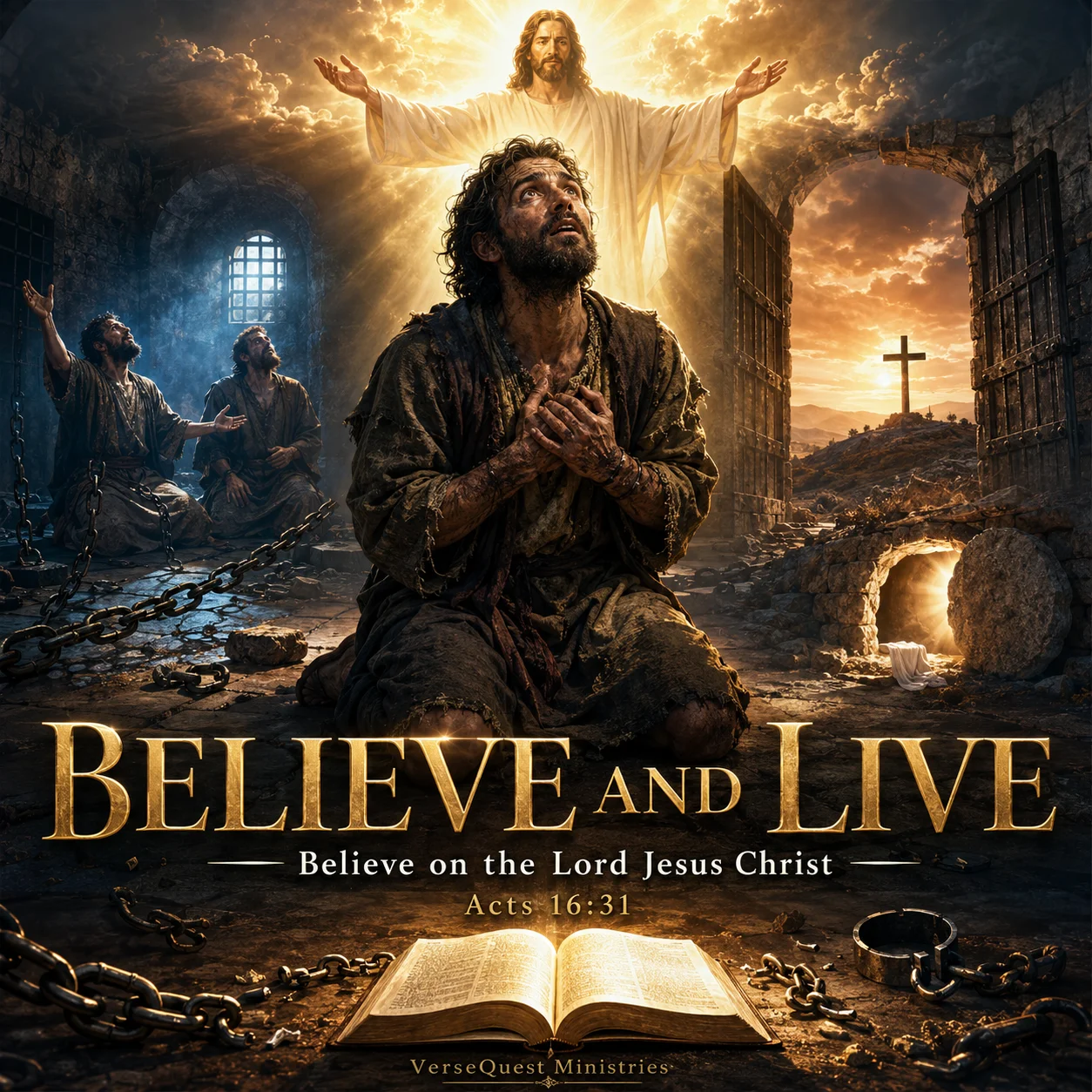
Sermon Title:
Believe and Live: The Only Answer God Gave the Sinner
Key Passage:
Acts 16:31 — “And they said, Believe on the Lord Jesus Christ, and thou shalt be saved, and thy house.”
Series:
Foundations of the Gospel of Grace
Topic:
Salvation by Faith in the Lord Jesus Christ Apart From Works, Religion, Law, Sacraments, or Human Merit
Book:
Acts, Romans, Ephesians, Galatians, 1 Corinthians, John, Titus, Philippians
Speaker:
Paul Tackett
Suggested Sermon Text:
Acts 16:25–34; Romans 3:21–28; Romans 4:4–5; Romans 5:1; Romans 10:9–13; 1 Corinthians 15:1–4; Ephesians 1:13; Ephesians 2:8–9; Galatians 2:16; Titus 3:5–7; John 3:16–18; John 5:24; John 6:47; 1 John 5:11–13
Short Sermon Description:
This detailed VerseQuest Ministries sermon outline explains Paul and Silas’s direct answer to the Philippian jailer’s desperate question: “Sirs, what must I do to be saved?” The answer was not religion, law-keeping, baptism, sacraments, church membership, moral reform, confession to a priest, emotional experience, or lifelong uncertainty. The Bible answer was, “Believe on the Lord Jesus Christ, and thou shalt be saved.” This sermon shows what it means to believe, who the Lord Jesus Christ is, why salvation is by faith alone in Christ alone, and how the gospel of Christ’s death, burial, and resurrection provides complete salvation in this present dispensation of grace. It also explains the phrase “and thy house,” showing that the jailer’s household was not saved by proxy but by hearing and believing the same word of the Lord. Designed for pastors, preachers, Bible teachers, Bible students, and believers, this outline gives a clear, bold, KJV foundation for preaching salvation plainly and defending the gospel from religious additions.
Believe and Live
The Only Answer God Gave the Sinner
Introduction
Acts 16:31 is one of the clearest salvation verses in the King James Bible: “Believe on the Lord Jesus Christ, and thou shalt be saved.” The verse is short enough for a child to memorize and deep enough to bury every false gospel ever manufactured by religious flesh. The Philippian jailer did not ask Paul and Silas how to join a denomination, earn merit, endure a probationary salvation, perform a sacrament, keep Moses’ law, climb a moral ladder, or become respectable in the eyes of religious men. He asked, “Sirs, what must I do to be saved?” That question was urgent, personal, and eternal. Paul’s answer was just as urgent, just as personal, and just as eternal: believe on the Lord Jesus Christ.
The setting is not a polished cathedral or a soft devotional retreat. Paul and Silas have been beaten, cast into prison, and fastened in the stocks. At midnight they prayed and sang praises unto God. Then the earthquake came, the foundations shook, the doors opened, and the bands were loosed. The jailer, thinking the prisoners had fled, was ready to kill himself. Paul cried, “Do thyself no harm: for we are all here.” The man who had guarded prisoners suddenly realized he was the prisoner. The man with the keys discovered he had no key to eternity. He came trembling, fell before Paul and Silas, and asked the only question that matters when death is near and judgment is real.
Paul’s answer leaves no room for religious fog. He did not say, “Believe and be baptized to complete it.” He did not say, “Believe and keep the law.” He did not say, “Believe and join our movement.” He did not say, “Believe and hope you endure.” He did not say, “Believe and receive sacraments until the account balances out.” He said, “Believe on the Lord Jesus Christ, and thou shalt be saved.” The sinner’s hope is not in what he promises to do for God, but in what Jesus Christ has already done for sinners through His death, burial, and resurrection. Religion keeps adding receipts to Calvary; the Bible keeps pointing to Christ alone.
I. The Jailer Asked the Question Every Sinner Must Face
Key Text: Acts 16:30
Supporting Texts: Hebrews 9:27; Romans 3:23; Romans 6:23; Luke 13:3
The jailer’s question was not casual curiosity. He came trembling and asked, “Sirs, what must I do to be saved?” Saved from what? Saved from sin, death, judgment, hell, condemnation, and the wrath of God. Modern religion has softened the word “saved” until many people think it means becoming happier, more fulfilled, more positive, or more church-involved. But in the Bible, salvation means deliverance from real danger. A drowning man does not need encouragement; he needs rescue. A condemned man does not need decoration in his cell; he needs pardon. A lost sinner does not need religious cosmetics; he needs salvation.
Hebrews 9:27 says, “it is appointed unto men once to die, but after this the judgment.” That appointment stands over every man. The jailer came face to face with death that night, but every sinner is already walking toward the same appointment. A man may avoid sickness for a while, avoid poverty for a season, avoid consequences for a few years, and avoid serious thoughts for most of his life, but he will not avoid death. Death is the sheriff of Adam’s race, and it never loses the address.
Romans 3:23 says, “For all have sinned, and come short of the glory of God.” That is why the jailer’s question belongs to every man. The issue is not whether a sinner is worse than his neighbour. The issue is that he has sinned against God. The wages of sin is death. The soul that sinneth, it shall die. A man may not feel lost, but his feelings are not the judge. God’s word is. The wise sinner asks the question before eternity forces him to face the answer.
Main Truth:
Every sinner must face the question of salvation because sin, death, and judgment are real.
II. Paul Gave One Direct Answer
Key Text: Acts 16:31
Supporting Texts: John 3:16; John 6:47; Romans 10:13
Paul and Silas answered with divine simplicity: “Believe on the Lord Jesus Christ, and thou shalt be saved.” That answer is not vague. It is not complicated. It is not hidden beneath layers of ritual. It is not stored in a church treasury for religious professionals to dispense. God gave the sinner a plain answer through Paul. Believe. Not work. Not earn. Not buy. Not crawl. Not perform. Not join. Believe.
John 3:16 says, “that whosoever believeth in him should not perish, but have everlasting life.” John 6:47 says, “He that believeth on me hath everlasting life.” Romans 10:13 says, “For whosoever shall call upon the name of the Lord shall be saved.” The Bible does not present salvation as an uncertain religious experiment. It presents salvation as God’s promise to the sinner who believes on Christ. The sinner’s confidence is not in the strength of his feelings but in the faithfulness of God’s word.
The simplicity of this answer offends religious pride. Men love complexity when complexity gives them control. A religious system can manage sacraments, ceremonies, confessions, payments, membership records, penance, and performance standards. But “Believe on the Lord Jesus Christ” takes salvation out of man’s control and places it entirely in Christ. That is why religion keeps adding fog to the verse. Clear grace is dangerous to religious middlemen.
Main Truth:
God’s answer to the sinner is clear and direct: believe on the Lord Jesus Christ and be saved.
III. Saving Faith Has the Right Object
Key Text: Acts 16:31
Supporting Texts: John 14:6; Acts 4:12; 1 Timothy 2:5–6
Paul did not merely say, “Believe.” He said, “Believe on the Lord Jesus Christ.” Faith is only as good as its object. A man may sincerely trust a broken bridge and still fall. A man may weakly trust a strong bridge and cross safely. The saving power is not in the emotional strength of faith but in the sufficiency of the Saviour trusted. Faith in faith saves no one. Faith in religion saves no one. Faith in sincerity saves no one. Faith must rest on Jesus Christ.
The title matters: “the Lord Jesus Christ.” “Lord” declares His authority, deity, and rightful claim. “Jesus” identifies the Saviour who came into the world to save His people from their sins. “Christ” identifies Him as God’s anointed One, the promised Messiah, the One appointed and approved by God. The sinner is not being told to believe in a religious slogan. He is being pointed to the crucified, buried, risen, living Lord.
Acts 4:12 says, “Neither is there salvation in any other.” John 14:6 says, “no man cometh unto the Father, but by me.” First Timothy 2:5 says there is one Mediator between God and men, the man Christ Jesus. There are not twenty roads to God. There are not seven sacramental ladders. There are not multiple mediators behind curtains, altars, offices, or robes. There is one Saviour, and salvation is in Him.
Main Truth:
Saving faith rests only upon the Lord Jesus Christ, the one Saviour and Mediator between God and men.
IV. The Gospel Reveals Why Christ Can Save
Key Text: 1 Corinthians 15:3–4
Supporting Texts: Romans 4:25; Romans 5:8–9; 2 Corinthians 5:21
The sinner is not saved by believing an empty phrase. He is saved by believing God’s gospel concerning Jesus Christ. Paul defines that gospel in 1 Corinthians 15:3–4: “Christ died for our sins according to the scriptures; And that he was buried, and that he rose again the third day according to the scriptures.” That is the saving message for this present dispensation of grace. Christ died for our sins. He was buried. He rose again.
“Christ died for our sins” means substitution. He did not die for His own sins because He had none. He died for ours. Second Corinthians 5:21 says God made Him to be sin for us, “who knew no sin; that we might be made the righteousness of God in him.” The cross is not merely a symbol of love, courage, suffering, or religious devotion. It is the place where the sinless Substitute bore the guilt of sinners and satisfied the justice of God.
He was buried, proving the reality of His death. He rose again the third day, proving the payment was accepted. Romans 4:25 says He “was delivered for our offences, and was raised again for our justification.” A dead saviour cannot save. A buried teacher cannot justify. A religious martyr cannot give eternal life. But Jesus Christ rose from the dead. The empty tomb is God’s receipt that the sacrifice was accepted and the believer’s justification is secure.
Main Truth:
Jesus Christ can save because He died for our sins, was buried, and rose again for our justification.
V. Salvation Is by Faith Apart From Works
Key Text: Ephesians 2:8–9
Supporting Texts: Romans 4:4–5; Galatians 2:16; Titus 3:5
Ephesians 2:8–9 says, “For by grace are ye saved through faith… Not of works, lest any man should boast.” That agrees perfectly with Acts 16:31. Believe, and thou shalt be saved. Salvation is not by grace plus works, faith plus law, Christ plus sacraments, the cross plus church membership, or the blood plus human merit. The Bible says “not of works.” Religion says “not of works” means “some works.” The Bible says what it means.
Romans 4:5 says, “But to him that worketh not, but believeth on him that justifieth the ungodly.” That verse is a wrecking ball against works-based religion. The man being justified is described as one who “worketh not.” That does not mean the saved man should never serve God. It means works are excluded from the ground of justification. Works belong after salvation as fruit, not before salvation as the price.
Galatians 2:16 says a man is not justified by the works of the law. Titus 3:5 says salvation is “not by works of righteousness which we have done.” If works of righteousness cannot save, then religious works cannot save either. Baptism, sacraments, confession, fasting, tithing, morality, law-keeping, and church attendance cannot justify the sinner. Christ saves. Faith receives. Grace gives. Man boasts in nothing.
Main Truth:
Salvation is received by faith in Christ apart from works, law, rituals, religion, or human merit.
VI. “Thou Shalt Be Saved” Is a Promise, Not a Possibility
Key Text: Acts 16:31
Supporting Texts: John 5:24; Romans 5:1; Ephesians 1:13–14; 1 John 5:13
Paul said, “thou shalt be saved.” He did not say, “Thou might begin a process that may eventually result in salvation if thou performest well enough.” He gave the jailer a promise. Salvation is certain because the Saviour is sufficient. The sinner who believes on Christ is not placed on religious probation. He is saved.
John 5:24 says the believer “hath everlasting life, and shall not come into condemnation; but is passed from death unto life.” That verse gives present possession, future security, and completed transfer. Romans 5:1 says, “being justified by faith, we have peace with God.” The believer does not have a temporary religious feeling. He has peace with God through the Lord Jesus Christ.
Ephesians 1:13 says that after hearing and believing the gospel, believers are sealed with the Holy Spirit of promise. First John 5:13 says believers may know that they have eternal life. God does not save sinners by making them uncertain. Religion keeps people nervous because nervous people are easier to control. The gospel gives assurance because the believer’s salvation rests on Christ’s work and God’s word.
Main Truth:
The believer has God’s promise of salvation, eternal life, justification, peace, and security in Christ.
VII. “And Thy House” Does Not Teach Salvation by Proxy
Key Text: Acts 16:31–32
Supporting Texts: Acts 16:34; Romans 10:17; John 1:12
Paul said, “and thy house,” but the next verse explains how that household would be reached: “And they spake unto him the word of the Lord, and to all that were in his house.” The jailer’s family did not get saved automatically because he believed. They heard the word too. Salvation is not inherited like furniture, transferred like property, or absorbed by living near a believer. Every sinner must personally receive Christ.
Acts 16:34 says the jailer rejoiced, “believing in God with all his house.” The household believed. The phrase “and thy house” means the same promise extended to them. Believe on the Lord Jesus Christ, and thou shalt be saved. Let thy house hear and believe the same word, and they shall be saved too. The gospel is personal, but it is not private. When one sinner is saved, the word often enters the house with him.
Romans 10:17 says faith comes by hearing, and hearing by the word of God. John 1:12 says, “as many as received him, to them gave he power to become the sons of God.” Not as many as had believing parents. Not as many as lived in a Christian household. Not as many as were related to a saved man. As many as received Him. God has no grandchildren. Each soul must believe on the Lord Jesus Christ.
Main Truth:
The jailer’s household was saved by hearing and believing the same gospel, not by another man’s faith.
VIII. Believing on Christ Produces a Changed Life
Key Text: Acts 16:33–34
Supporting Texts: 2 Corinthians 5:17; Ephesians 2:10; Titus 2:11–14
After the jailer believed, his conduct changed immediately. He washed the stripes of Paul and Silas, brought them into his house, set meat before them, and rejoiced. Those works did not save him. They followed salvation. The man who had guarded beaten prisoners now cared for their wounds. Grace had done what law could not do. It changed the heart.
Second Corinthians 5:17 says, “if any man be in Christ, he is a new creature.” That does not mean every believer instantly becomes mature, consistent, and free from all struggle. It means a new life has begun. Ephesians 2:10 says believers are created in Christ Jesus unto good works. Works are not the root of salvation; they are the fruit. Religion keeps trying to hang fruit on a dead tree and call it life. God gives life, and fruit follows.
Titus 2:11–12 says the grace of God teaches us to deny ungodliness and worldly lusts. Grace is not permission to sin. Paul already answered that slander in Romans 6: “God forbid.” The same grace that saves also teaches, trains, corrects, and directs. The believer serves Christ because he is saved, not to become saved. Love and gratitude are better engines than fear and religious debt.
Main Truth:
Good works do not save the sinner, but true salvation produces new life, gratitude, and service.
IX. The Church Must Preach This Answer Clearly
Key Text: Acts 16:31
Supporting Texts: 2 Corinthians 5:18–21; Romans 1:16; Galatians 1:8–9
The Church has been entrusted with the ministry of reconciliation. Sinners need to hear the answer clearly: “Believe on the Lord Jesus Christ, and thou shalt be saved.” Not a foggy answer. Not a mixed answer. Not a denominational answer. Not a sacramental answer. Not a motivational answer. A dying sinner does not need religious jazz and smoke machines. He needs the gospel of Jesus Christ preached plainly.
Romans 1:16 says the gospel of Christ is “the power of God unto salvation to every one that believeth.” The power is not in the preacher’s charm, the church’s branding, the music’s atmosphere, the emotional pressure, or the cleverness of presentation. The power is in the gospel. Christ died for our sins, was buried, and rose again. Believe on Him and be saved. That message may sound too simple for sophisticated religion, but it is the wisdom and power of God.
Galatians 1 warns against another gospel. Any message that adds works, law, sacraments, rituals, human merit, or institutional control to the finished work of Christ is not an improvement. It is corruption. The Church must guard the gospel like a soldier guards the gate. When sinners ask, “What must I do to be saved?” the answer must not be muffled by religious static. Believe on the Lord Jesus Christ.
Main Truth:
The Church must preach salvation by faith in Christ clearly, without adding works, rituals, law, or religious confusion.
Conclusion
Acts 16:31 gives the sinner God’s answer: “Believe on the Lord Jesus Christ, and thou shalt be saved.” The question was urgent. The answer was clear. The Saviour was sufficient. The jailer did not need a religious maze. He needed Christ. That is still true today. Sinners are not saved by baptism, sacraments, church membership, morality, law-keeping, family heritage, emotional experiences, or religious effort. They are saved by believing on the Lord Jesus Christ.
The gospel behind that command is the death, burial, and resurrection of Jesus Christ. He died for our sins according to the Scriptures. He was buried. He rose again the third day according to the Scriptures. The sinner believes God’s testimony concerning His Son and receives salvation by grace through faith. Faith is not a work that earns salvation. Faith receives the salvation Christ purchased. The value is not in the sinner’s hand but in the Saviour the hand receives.
The Church must never be ashamed of the simplicity of God’s answer. Religious men will always want to add something. Proud flesh needs a contribution. But grace leaves man with nothing to boast in and Christ with all the glory. The jailer asked the greatest question, and Paul gave the greatest answer. Believe and live. Believe and be saved. Believe on the Lord Jesus Christ.
Final Call
You cannot save yourself. You cannot wash away your sins with religious water. You cannot erase guilt with good intentions. You cannot buy eternal life with church membership, rituals, law-keeping, morality, or promises to do better. The wages of sin is death, and you need a Saviour.
Jesus Christ died for your sins according to the Scriptures. He was buried. He rose again the third day according to the Scriptures. He paid the debt. He bore the wrath. He conquered death. He now offers salvation freely by grace through faith.
Believe on the Lord Jesus Christ, and thou shalt be saved. Trust Him alone. Rest in His blood, His cross, His burial, His resurrection, and His promise. Believer, preach the answer plainly. Do not let religion complicate what God made clear.
Closing Verse:
John 6:47 — “Verily, verily, I say unto you, He that believeth on me hath everlasting life.”
Closing Statement:
When the sinner asks the right question, God gives one saving answer: Believe on the Lord Jesus Christ, and thou shalt be saved.