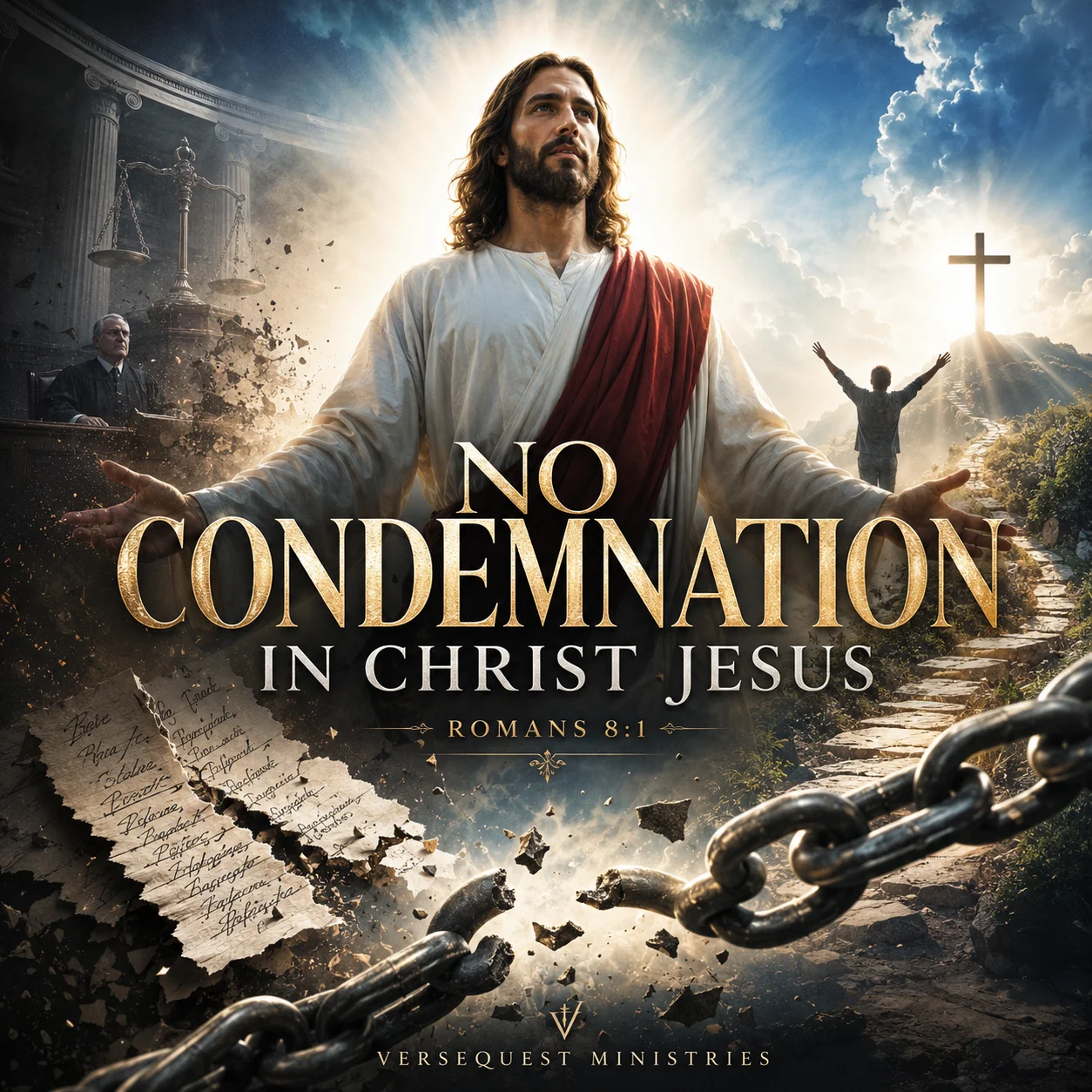
No Condemnation in Christ Jesus
The Verdict Grace Wrote in the Blood of Christ
Sermon Title:
No Condemnation in Christ Jesus: The Verdict Grace Wrote in Blood
Key Passage:
Romans 8:1 — “There is therefore now no condemnation to them which are in Christ Jesus, who walk not after the flesh, but after the Spirit.”
Series:
Foundations of the Gospel of Grace
Topic:
The Believer’s Freedom From Condemnation Through Union With Jesus Christ
Book:
Romans, John, Galatians, Colossians, Ephesians, Hebrews, 1 Corinthians, 2 Corinthians
Speaker:
Paul Tackett
Suggested Sermon Text:
Romans 8:1–11; Romans 3:21–28; Romans 4:5–8; Romans 5:1–11; Romans 6:1–14; Romans 7:4–25; John 5:24; Galatians 2:16–21; Galatians 3:13; Colossians 2:13–14; 2 Corinthians 5:21; Ephesians 1:7; Hebrews 10:10–14; 1 Corinthians 15:1–4
Short Sermon Description:
This detailed VerseQuest Ministries sermon outline explains Romans 8:1 and the believer’s settled standing in Jesus Christ: “There is therefore now no condemnation to them which are in Christ Jesus.” This sermon shows that no condemnation is not a religious mood, emotional optimism, temporary relief, or a fragile status earned by good behaviour, but God’s present verdict upon the believer who is in Christ. It explains the “therefore” of Romans 8, the believer’s justification by faith, peace with God, death to the law as a condemning system, freedom from the law of sin and death, Christ condemning sin in the flesh, and the Spirit-led walk that follows salvation. It also distinguishes no condemnation from chastening, loss of reward, and practical failure, while defending the gospel of grace from legalism, works salvation, sacramental confusion, and religious fear. Designed for pastors, preachers, teachers, Bible students, and believers, this outline magnifies Jesus Christ as the One who bore condemnation so believers would never come into condemnation.
No Condemnation in Christ Jesus
The Verdict Grace Wrote in the Blood of Christ
Introduction
Romans 8:1 is one of the great mountain peaks of Paul’s epistles: “There is therefore now no condemnation to them which are in Christ Jesus.” That verse does not whisper. It thunders. It does not offer a maybe, a hope-so, a try-harder, or a religious probation slip. It declares a present verdict from God’s courtroom. The believer in Jesus Christ is not under condemnation. Not less condemnation. Not delayed condemnation. Not condemnation reduced by good behaviour. No condemnation. Religion spends centuries building fear machines to keep sinners and saints nervous, but Romans 8:1 walks into the room with a King James Bible in its hand and says the case has already been settled in Christ.
The word “therefore” ties Romans 8 to everything Paul has already established. The sinner has been proven guilty in Romans 1–3. Justification by faith has been declared in Romans 3–4. Peace with God has been announced in Romans 5. The believer’s identification with Christ has been explained in Romans 6. The law’s inability to deliver from the flesh has been exposed in Romans 7. Then Romans 8 opens the prison door and shows where the believer stands: in Christ Jesus, outside condemnation, under the law of the Spirit of life, and beyond the condemning jurisdiction of sin and death. This is not cheap grace. This is blood-bought grace.
The doctrine matters because many Christians live as though Calvary only postponed their case instead of settling it. They think every failure puts them back under God’s wrath. They confuse chastening with condemnation, conviction with damnation, the judgment seat of Christ with the great white throne, and fellowship with sonship. Legalism loves that fog because scared saints are easier to control. But the Bible believer must learn to distinguish things that differ. A saved man can be corrected, chastened, rebuked, and made to reap what he sows, but he is not condemned with the world. Jesus Christ bore the condemnation. The believer is in Christ. And where Christ is, condemnation has already spent its force.
I. The “Therefore” Rests on the Finished Argument of Romans
Key Text: Romans 8:1
Supporting Texts: Romans 3:23–24; Romans 4:5; Romans 5:1; Romans 7:24–25
Romans 8:1 begins with “therefore,” and that word must not be skipped like a speed bump on a familiar road. Paul has spent seven chapters laying the foundation. He has shown the guilt of the Gentile, the guilt of the Jew, the guilt of the whole world, and the complete inability of the law to justify sinful flesh. Then he has shown justification freely by grace through the redemption that is in Christ Jesus. The “therefore” of Romans 8:1 is not floating in the air. It is anchored in the blood, righteousness, and finished work of Christ.
Romans 4:5 says God justifies the ungodly who believe. Romans 5:1 says, “Therefore being justified by faith, we have peace with God through our Lord Jesus Christ.” Romans 7 ends with a man discovering that the flesh cannot deliver him from itself and crying, “O wretched man that I am! who shall deliver me from the body of this death?” The answer is not Moses. The answer is not self-discipline. The answer is not sacraments. The answer is “Jesus Christ our Lord.” Then Romans 8 says, “There is therefore now no condemnation.”
This order matters. No condemnation is not built on the believer’s flesh finally behaving well enough to impress God. Romans 7 already buried that hope. No condemnation is built on justification by faith, union with Christ, redemption through His blood, and deliverance by the risen Lord. The religious man wants Romans 8 without Romans 3–7. He wants assurance without substitution, holiness without grace, and victory without first admitting ruin. Paul gives the whole argument, then writes the verdict.
Main Truth:
The believer’s no-condemnation standing rests on Paul’s full gospel argument of guilt, justification, redemption, and deliverance in Christ.
II. “Now” Means Present Possession, Not Future Possibility
Key Text: Romans 8:1
Supporting Texts: John 5:24; Romans 5:9; Ephesians 1:7; 1 John 5:13
Paul says, “There is therefore now no condemnation.” Not eventually. Not after a lifetime of religious bookkeeping. Not after purgatorial inventions have finished what Scripture never started. Not after the sinner has crossed every denominational checkpoint. Now. The believer’s freedom from condemnation is a present possession because salvation is a present possession in Christ. God does not leave the saved man hanging between heaven and hell like a religious yo-yo.
John 5:24 says the believer “hath everlasting life, and shall not come into condemnation; but is passed from death unto life.” That verse gives present life, future security, and completed transfer. Ephesians 1:7 says, “In whom we have redemption through his blood, the forgiveness of sins.” First John 5:13 says believers may know that they have eternal life. God did not inspire these words so His children could live under permanent suspense.
The word “now” is poison to religious fear merchants. Fear-based religion says, “You might be safe later if you perform well enough.” The gospel says the believer is in Christ now. Fear says, “You may be condemned again if you fail.” Grace says Christ already bore the condemnation. Fear says, “You better keep paying.” Scripture says the account was settled by blood. The believer’s present standing is not arrogance. It is confidence in God’s word.
Main Truth:
No condemnation is the believer’s present standing in Christ, not a future possibility earned by religious performance.
III. “No Condemnation” Is God’s Courtroom Verdict
Key Text: Romans 8:1
Supporting Texts: Romans 8:33–34; Romans 3:26; Colossians 2:13–14; Hebrews 10:14
Condemnation is legal language. It belongs to judgment, guilt, sentence, and penalty. Romans 8:1 is not saying the believer never feels bad, never gets convicted, never suffers consequences, or never has the Lord deal with him severely. It says there is no condemnation. The legal sentence has been removed. The believer in Christ is not awaiting eternal punishment for sin because Christ already bore sin’s judgment at Calvary.
Romans 8:33–34 asks, “Who shall lay any thing to the charge of God’s elect? It is God that justifieth.” Then Paul points to Christ who died, rose again, and makes intercession. The believer’s defense is not his flawless conduct but God’s justification and Christ’s finished work. Colossians 2 says God forgave all trespasses, blotted out the handwriting of ordinances that was against us, took it out of the way, and nailed it to Christ’s cross. That is courtroom language, not therapy talk.
Hebrews 10:14 says, “For by one offering he hath perfected for ever them that are sanctified.” One offering settled what endless religious effort could never settle. When God says no condemnation, no priest, preacher, devil, memory, conscience, law system, or religious accuser has authority to overrule the verdict. The Judge of all the earth has spoken. A pardoned man may still need correction, but he is not waiting for execution.
Main Truth:
No condemnation is God’s legal verdict that the believer in Christ is freed from the sentence and penalty of sin.
IV. No Condemnation Belongs to Those Who Are “In Christ Jesus”
Key Text: Romans 8:1
Supporting Texts: 2 Corinthians 5:17; Ephesians 1:6–7; Colossians 2:10; 1 Corinthians 12:13
The blessing is not attached to religion in general. It is attached to location: “to them which are in Christ Jesus.” That phrase is the believer’s spiritual address. Outside Christ there is condemnation. In Christ there is none. Outside Christ there is guilt. In Christ there is justification. Outside Christ there is wrath. In Christ there is peace with God. The difference is not moral polish. The difference is union with the Son of God.
Second Corinthians 5:17 says, “if any man be in Christ, he is a new creature.” Ephesians 1 says believers are accepted in the beloved and have redemption through His blood. Colossians 2:10 says believers are complete in Him. The saved man is not partly in Christ and partly in Adam before God. His standing has changed. He has been placed into Christ, and God deals with him in the beloved Son.
This is where all man-centered religion collapses. The question is not whether a man is in church, in a denomination, in a ritual system, in a moral program, or in a religious family. The question is whether he is in Christ. A man outside Christ may be religious and condemned. A man in Christ may be weak in himself and yet free from condemnation. The safety is not in the sheep’s grip on the Shepherd, but in the Shepherd’s possession of the sheep.
Main Truth:
No condemnation belongs only to those who are in Christ Jesus, because the believer’s standing is in the risen Saviour.
V. Christ Bore the Condemnation Sin Deserved
Key Text: Romans 8:3
Supporting Texts: 2 Corinthians 5:21; Galatians 3:13; Isaiah 53:5–6; 1 Peter 2:24
Romans 8:3 says God sent His own Son in the likeness of sinful flesh, and for sin, “condemned sin in the flesh.” God did not ignore sin. He condemned it. But He condemned it in the flesh of His Son at Calvary. That is why the believer is free from condemnation. Sin’s judgment did not vanish into thin air. It fell upon the Substitute. The cross is where condemnation spent its fury on Christ so the believer would not face it in eternity.
Second Corinthians 5:21 says Christ, who knew no sin, was made sin for us. Galatians 3:13 says Christ was made a curse for us. Isaiah 53 says the LORD laid on Him the iniquity of us all. First Peter 2:24 says He bare our sins in His own body on the tree. These verses are not religious decorations. They are the reason Romans 8:1 can be true. The believer has no condemnation because Christ bore condemnation.
This is the difference between biblical grace and cheap religious optimism. Grace does not say sin is no big deal. Grace says sin was such a big deal that the Son of God had to shed blood to answer it. No condemnation does not minimize sin. It magnifies the cross. The believer is not free because God became careless. He is free because God was satisfied with the sacrifice of Christ.
Main Truth:
The believer has no condemnation because Jesus Christ bore sin’s condemnation as the Substitute at Calvary.
VI. The Law of the Spirit of Life Frees the Believer
Key Text: Romans 8:2
Supporting Texts: Romans 6:14; Galatians 5:1; 2 Corinthians 3:17; John 8:36
Romans 8:2 says, “For the law of the Spirit of life in Christ Jesus hath made me free from the law of sin and death.” The believer is not merely declared free from condemnation and then left chained to the same old master. He is placed under a new operating principle: the law of the Spirit of life in Christ Jesus. Sin and death had a law, a pull, a dominion, and a sentence. But the Spirit of life in Christ Jesus makes the believer free.
Romans 6:14 says sin shall not have dominion over believers, because they are not under the law, but under grace. That verse does not excuse sin; it explains why grace is stronger than sin’s dominion. Legalism cannot break the flesh. Law can expose sin, name sin, condemn sin, and stir up sin in the rebellious heart, but it cannot produce the life of Christ. The Spirit of God works in the believer on resurrection ground.
Galatians 5:1 says, “Stand fast therefore in the liberty wherewith Christ hath made us free.” This liberty is not license. It is freedom from condemnation, fear, law as a condemning system, and sin as a reigning master. The man in Christ is not saved to crawl under the old chains and call it humility. He is saved to walk after the Spirit, reckoning himself dead indeed unto sin but alive unto God through Jesus Christ our Lord.
Main Truth:
The Spirit of life in Christ Jesus frees the believer from the law of sin and death and gives him new ground for holy living.
VII. “Who Walk Not After the Flesh” Describes the Spirit-Governed Life
Key Text: Romans 8:1
Supporting Texts: Romans 8:4–9; Galatians 5:16–25; Romans 6:11–13; Ephesians 5:8
Romans 8:1 includes the phrase, “who walk not after the flesh, but after the Spirit.” That phrase must be handled rightly. It is not teaching that the believer earns no condemnation by maintaining a perfect walk. If that were the case, no honest Christian would have assurance for five minutes. The ground of no condemnation is being “in Christ Jesus.” The walk after the Spirit is the proper character, direction, and practical life of those who are in Christ, not the purchase price of their justification.
Romans 8:4–9 contrasts those after the flesh with those after the Spirit. The lost man is “in the flesh” and cannot please God. The believer is not in the flesh, but in the Spirit, if so be that the Spirit of God dwell in him. That does not mean the believer no longer has flesh to battle. Romans 7 already showed the struggle. It means his position and governing life have changed. He belongs to Christ and has the Spirit of Christ.
Galatians 5 says, “Walk in the Spirit, and ye shall not fulfil the lust of the flesh.” The Spirit-led walk is not the cause of salvation but the result and calling of the saved man. Grace does not say, “You have no condemnation, so go feed the flesh.” Grace says, “You have no condemnation in Christ, now walk like a man who belongs to the Spirit.” The same Bible that gives assurance also commands holiness.
Main Truth:
The Spirit-led walk does not earn no condemnation, but it is the proper life and direction of those who are in Christ Jesus.
VIII. No Condemnation Is Not the Same as No Chastening
Key Text: Hebrews 12:6
Supporting Texts: 1 Corinthians 11:31–32; Galatians 6:7–8; 2 Corinthians 5:10; Romans 14:10–12
No condemnation does not mean no correction. Hebrews 12:6 says, “For whom the Lord loveth he chasteneth, and scourgeth every son whom he receiveth.” Chastening proves sonship; it does not cancel sonship. A father who corrects his child has not turned the child into a stranger. God’s discipline is real, serious, and sometimes severe, but it is not eternal condemnation.
First Corinthians 11 says some believers were weak, sickly, and some slept because of sin concerning the Lord’s supper. Paul says when believers are judged, they are chastened of the Lord, “that we should not be condemned with the world.” That verse draws the line clearly. Chastening is not condemnation with the world. God may deal with His children in time so they are not condemned in eternity.
The believer will also stand before the judgment seat of Christ. Romans 14 and 2 Corinthians 5 teach accountability for service, motives, and works. Rewards can be gained or lost. A saved man can suffer loss and yet be saved, as 1 Corinthians 3 teaches. No condemnation does not erase accountability. It removes eternal damnation. The saved man should fear sin, not because he may lose Christ, but because he belongs to Christ.
Main Truth:
No condemnation removes eternal judgment, but it does not remove the Father’s chastening or the believer’s accountability at the judgment seat of Christ.
IX. No Condemnation Produces Assurance, Worship, and Holy Service
Key Text: Romans 8:1
Supporting Texts: Romans 12:1–2; Titus 2:11–14; 2 Corinthians 5:14–15; 1 John 4:19
The doctrine of no condemnation is not meant to produce careless living. It is meant to produce grateful service. Romans 12 follows Romans 1–11 with, “I beseech you therefore, brethren, by the mercies of God.” The believer presents his body a living sacrifice because of mercy, not to buy mercy. He serves because he is accepted in Christ, not to escape condemnation. Gratitude is a stronger engine than terror.
Titus 2 says the grace of God teaches believers to deny ungodliness and worldly lusts. Grace is not a pillow for sin; it is a teacher against sin. The legalist thinks only fear can keep a man straight because the legalist does not understand the power of grace. A man who knows Christ bore his condemnation should not ask how close he can live to the flesh. He should ask how fully he can glorify the One who set him free.
Second Corinthians 5 says the love of Christ constraineth us, because if One died for all, then those who live should not henceforth live unto themselves, but unto Him who died for them and rose again. No condemnation gives the believer assurance, but assurance should lead to worship, obedience, preaching, holiness, and service. The verdict of grace should put steel in the spine and fire in the soul.
Main Truth:
No condemnation produces assurance and grateful holiness because the believer serves from mercy, love, and life in Christ.
Conclusion
Romans 8:1 is one of the clearest declarations of the believer’s standing in the word of God: “There is therefore now no condemnation to them which are in Christ Jesus.” The verse rests on the gospel foundation Paul has already laid. Sinners are guilty, the law cannot justify, Christ has redeemed, faith receives righteousness, peace with God is established, and the believer is delivered through Jesus Christ our Lord. Therefore, now, no condemnation.
This does not make sin harmless. Calvary proves sin was so deadly that only the blood of Jesus Christ could answer it. No condemnation is not God ignoring sin; it is God judging sin in Christ. It is not an excuse for the flesh; it is the believer’s liberty to walk after the Spirit. It is not a denial of chastening; it is freedom from eternal condemnation. It is not sentimental comfort; it is God’s legal verdict written in the blood of the Lamb.
The Church must preach this truth clearly. Saints living under constant fear will either collapse into despair or pretend their way into hypocrisy. Saints established in Christ will serve from gratitude, stand against sin, worship with assurance, and preach the gospel without chains on their conscience. The believer is not waiting to find out whether condemnation will return. He is in Christ Jesus. The sentence fell on the Substitute. The verdict now reads: no condemnation.
Final Call
Sinner, outside Christ there is condemnation already. Your religion cannot remove it. Your morality cannot erase it. Your baptism cannot wash it away. Your church membership cannot overturn it. Your works cannot pay the debt. You need Jesus Christ.
Jesus Christ died for your sins according to the Scriptures. He was buried. He rose again the third day according to the Scriptures. He bore sin’s condemnation so guilty sinners could be justified by faith and have peace with God. Believe on the Lord Jesus Christ, and thou shalt be saved.
Believer, stop letting the devil, dead religion, bad memories, or legalistic accusers drag you back into a courtroom God already emptied. Walk after the Spirit. Live holy. Receive correction. Serve faithfully. But do it as one who is in Christ Jesus, where condemnation has no claim because Christ has already borne it.
Closing Verse:
John 5:24 — “Verily, verily, I say unto you, He that heareth my word, and believeth on him that sent me, hath everlasting life, and shall not come into condemnation.”
Closing Statement:
The believer in Christ is not a criminal awaiting sentence, but a blood-bought son standing under God’s verdict: no condemnation.