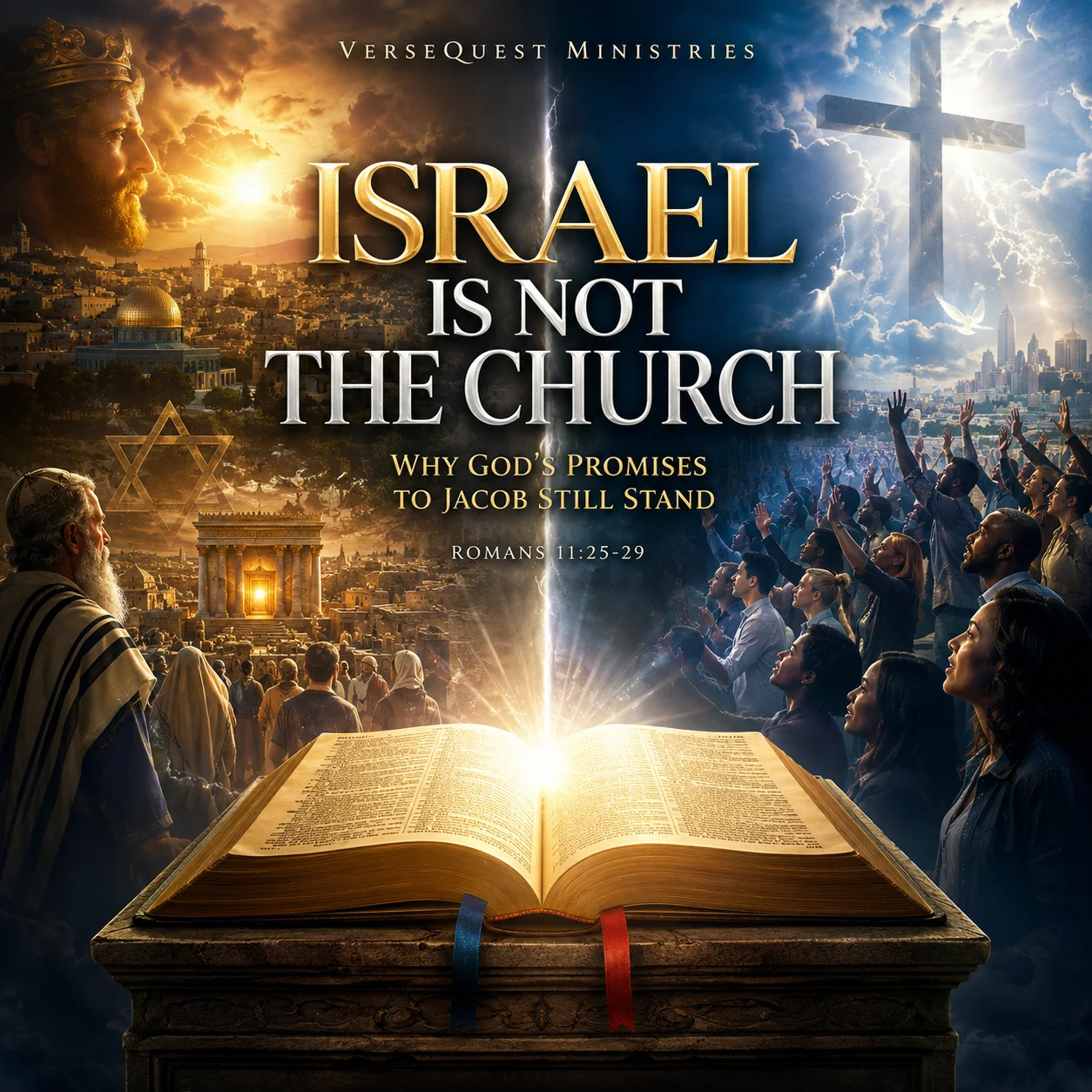
Israel Is Not the Church
Why God’s Promises to Jacob Still Stand
Introduction
Few errors have produced more Bible confusion than the idea that the Church has replaced Israel. It sounds spiritual to some people because they have been taught that anything literal must be less spiritual and anything symbolic must be deeper. But the Bible does not teach that God made promises to Abraham, Isaac, Jacob, David, and the nation of Israel only to transfer those promises to Gentile church systems after Israel stumbled. Romans 11:25 warns Gentile believers directly: “lest ye should be wise in your own conceits.” That warning is needed because Gentile religion has a long history of becoming wise in its own conceits. It looks at Israel’s fall and says, “God is done with them. We are the new Israel. Their promises are now ours.” Paul says that is ignorance and conceit.
Romans 11:25–29 is one of the strongest passages in the New Testament against replacement theology. Paul says blindness “in part” has happened to Israel. Not total blindness. Not final blindness. Not permanent cancellation. He says that blindness lasts “until the fulness of the Gentiles be come in.” That means Israel’s present condition has an expiration point in God’s program. Then Paul says, “And so all Israel shall be saved.” He does not say, “And so the Church shall be called Israel.” He does not say, “And so the promises shall be spiritualized.” He does not say, “And so the Gentiles shall inherit Jacob’s covenant identity.” He says Israel. Then he speaks of Jacob. Then he speaks of covenant. Then he says the gifts and calling of God are without repentance.
Right division keeps a man from stealing mail. Israel has promises connected to land, nation, covenants, throne, temple, kingdom, and national restoration. The Church, the Body of Christ, has a heavenly calling, spiritual blessings in heavenly places, union with a risen Head, and doctrine revealed chiefly through Paul. The Jew, the Gentile, and the Church of God are three distinct groups named by God in 1 Corinthians 10:32. If a preacher mixes those groups, he will confuse law and grace, prophecy and mystery, the rapture and the Second Advent, the time of Jacob’s trouble and the blessed hope, the gospel of the kingdom and the gospel of the grace of God. But when the Bible is believed where it stands, Israel remains Israel, the Church remains the Church, and God remains faithful to every word He spoke.
I. God Names Israel and the Church as Distinct Groups
Key Text: 1 Corinthians 10:32
Supporting Texts: Romans 9:4–5; Ephesians 2:11–16; Galatians 3:28
First Corinthians 10:32 says, “Give none offence, neither to the Jews, nor to the Gentiles, nor to the church of God.” That verse gives three groups God expects the Bible student to recognize. The Jews are not the Gentiles. The Gentiles are not the Church. The Church of God is not national Israel. A man may be born a Jew or born a Gentile, but when he is saved in this dispensation, he is placed by the Spirit into the Body of Christ. That does not erase Israel’s national future, and it does not turn the Church into Israel.
Romans 9:4–5 says that to Israel pertain “the adoption, and the glory, and the covenants, and the giving of the law, and the service of God, and the promises.” Paul does not say those things pertain to the Body of Christ. They pertain to Israel. The covenants were made with Israel. The law was given to Israel. The temple service belonged to Israel. The promises were connected to Israel. The fact that Gentiles are now blessed in Christ does not mean Gentiles become the covenant nation to whom those national promises were made.
Galatians 3:28 says that in Christ “there is neither Jew nor Greek.” That verse describes spiritual standing inside the Body of Christ. It does not cancel every distinction God makes elsewhere in Scripture. If Galatians 3:28 erased Israel as a nation, then it would also erase male and female in every practical and prophetic sense, because the same verse says “there is neither male nor female.” The verse teaches unity in Christ, not the abolition of all God-given distinctions in every context. Inside the Body, all believers are one in Christ. In prophecy, Israel still has promises God will fulfill.
Main Truth:
God names Jews, Gentiles, and the Church of God as distinct groups, and the Bible student must not mix what God has separated.
II. Israel Began With God’s Covenant Promises to Abraham, Isaac, and Jacob
Key Text: Genesis 12:1–3
Supporting Texts: Genesis 17:7–8; Genesis 26:3–4; Genesis 28:13–15
Israel did not begin at Pentecost. Israel did not begin with a church council. Israel did not begin as a metaphor for saved people in general. Israel’s national and covenant history begins with God’s call of Abraham and continues through Isaac and Jacob. In Genesis 12:1–3, God promised Abram a land, a seed, a great nation, blessing, and worldwide blessing through him. That promise was not given to a Gentile church. It was given to Abram and his seed.
Genesis 17:7–8 says God made an everlasting covenant with Abraham and his seed and promised them “all the land of Canaan, for an everlasting possession.” That is plain language. If “everlasting” means temporary, and “land” means heaven, and “Canaan” means the Church, then no Bible word is safe from theological vandalism. God knew how to say what He meant. He promised a real land to a real people through a real covenant. That covenant was confirmed through Isaac in Genesis 26 and through Jacob in Genesis 28.
The Church does not inherit Israel’s identity by stealing Abraham’s land promises. Believers today are blessed through Abraham in connection with faith and the promised Seed, which is Christ, but that does not make the Church the nation of Israel. A saved Gentile is not promised a farm in Canaan. He is blessed with all spiritual blessings in heavenly places in Christ. Right division allows Abraham’s covenant to stand and allows the Church’s blessings to stand without forcing one into the place of the other.
Main Truth:
Israel is rooted in God’s covenant promises to Abraham, Isaac, and Jacob, including a land, a nation, and a seed.
III. Israel Has Earthly Covenants and National Promises
Key Text: Romans 9:4
Supporting Texts: 2 Samuel 7:12–16; Jeremiah 31:31–37; Ezekiel 36:24–28
Romans 9:4 says the covenants belong to Israel. One of those covenants is the Davidic covenant. In 2 Samuel 7:12–16, God promised David a throne, a house, and a kingdom. Luke 1:32–33 later says Jesus Christ will receive “the throne of his father David” and “reign over the house of Jacob for ever.” Those words cannot honestly be turned into a Gentile church program without doing violence to the text. David’s throne is not a denomination. The house of Jacob is not a vague spiritual metaphor. The kingdom promised through David is a real kingdom.
Jeremiah 31:31 says, “Behold, the days come, saith the LORD, that I will make a new covenant with the house of Israel, and with the house of Judah.” God names the parties of the covenant. He does not say He will make it with the Baptist church, Rome, Protestantism, America, or Gentile religion. He says Israel and Judah. The Church receives spiritual blessing through the blood of the new testament because of Christ’s finished work, but that does not erase the future national fulfillment God promised to Israel.
Ezekiel 36 speaks of Israel being gathered from the nations, brought into their own land, cleansed, given a new heart, and caused to walk in God’s statutes. That is national restoration language. It is tied to land, people, cleansing, and God’s name among the heathen. Replacement theology must spiritualize these passages because it has already decided God is finished with Israel. But Romans 11 says otherwise. God will keep His earthly covenants and national promises.
Main Truth:
Israel has earthly covenants and national promises that God will fulfill exactly as He spoke them.
IV. The Church Is the Body of Christ, Not Israel Renamed
Key Text: Ephesians 1:22–23
Supporting Texts: Ephesians 2:15–16; 1 Corinthians 12:13; Colossians 1:18
The Church is not Israel with a new name. Ephesians 1:22–23 says the Church is Christ’s Body. That is a distinct spiritual organism joined to a risen Head in heaven. Israel was a nation with land, tribes, covenants, temple service, sacrifices, priesthood, and a throne. The Church is a Body made up of saved Jews and Gentiles placed into Christ by the Holy Ghost. These are not the same things.
Ephesians 2:15 says Christ made “in himself of twain one new man.” The “twain” are Jew and Gentile. God did not make Gentiles into Israel. He did not make Israel into Gentiles. He made believing Jews and believing Gentiles one new man in Christ. That one new man is not the old nation refurbished. It is new. The Body of Christ is a new creation in Christ, revealed in connection with the mystery.
First Corinthians 12:13 says, “For by one Spirit are we all baptized into one body.” That operation is not Israel’s national covenant identity. It is the Spirit placing believers into Christ. The Church has a heavenly Head, a heavenly position, a heavenly calling, and a heavenly hope. Israel has an earthly prophetic kingdom program. Both are glorious in their places, but they are not the same.
Main Truth:
The Church is the Body of Christ, a new spiritual organism in Christ, not Israel renamed or replaced.
V. Israel’s Blindness Is Partial and Temporary
Key Text: Romans 11:25
Supporting Texts: 2 Corinthians 3:14–16; Luke 21:24; Hosea 3:4–5
Romans 11:25 says, “blindness in part is happened to Israel.” That phrase matters. Paul does not say blindness in full. He does not say blindness forever. He says “in part.” There has always been a believing remnant of Israel according to grace. Paul himself was proof that God had not cast away His people. Earlier in Romans 11, Paul says, “God hath not cast away his people which he foreknew.” Israel’s national blindness is real, but it is not total in the sense that no Jew can be saved, and it is not final in the sense that Israel has no future.
Romans 11:25 also says Israel’s blindness lasts “until the fulness of the Gentiles be come in.” The word “until” destroys replacement theology. It points to a limit. God’s present work among the Gentiles in the dispensation of grace does not mean Israel’s story is over. It means Israel is temporarily set aside nationally while God forms the Body of Christ. When the fulness of the Gentiles comes in, God will resume His direct prophetic dealings with Israel.
Hosea 3:4–5 says the children of Israel would abide many days without a king, prince, sacrifice, image, ephod, or teraphim, but “afterward shall the children of Israel return, and seek the LORD their God, and David their king.” That is the Bible’s pattern: judgment, blindness, scattering, then restoration. Replacement theology stops the story at judgment. God continues it to restoration.
Main Truth:
Israel’s blindness is partial and temporary, not total, final, or proof that the Church has replaced Israel.
VI. All Israel Shall Be Saved
Key Text: Romans 11:26
Supporting Texts: Isaiah 59:20–21; Zechariah 12:10; Jeremiah 30:7
Romans 11:26 says, “And so all Israel shall be saved.” Paul does not say every Jew in every age is automatically saved by bloodline. He is speaking of Israel’s future national salvation in connection with the Deliverer coming out of Sion. This future salvation is tied to prophecy, covenant, repentance, and Messiah’s return. Israel as a nation will one day be brought to repentance and restoration under the Lord Jesus Christ.
Zechariah 12:10 says Israel will look upon Him whom they have pierced and mourn. That is national repentance connected to the Second Advent. The same nation that rejected Messiah will one day recognize Him. The same house of David and inhabitants of Jerusalem that were hardened will be broken. The same people scattered among the nations will be gathered and restored. God’s word does not fail because Israel failed. God’s grace will triumph over their unbelief.
Jeremiah 30:7 calls the future tribulation “the time of Jacob’s trouble,” but adds, “he shall be saved out of it.” That period is not the Church’s destiny. It is Israel’s refining, trouble, and national crisis before restoration. The Body of Christ is not waiting to become Israel in the tribulation. The Church is waiting for the blessed hope, while Israel’s prophetic future remains in God’s hands.
Main Truth:
Romans 11 teaches a future national salvation of Israel in connection with Messiah’s return and God’s covenant faithfulness.
VII. God’s Covenant With Israel Has Not Been Cancelled
Key Text: Romans 11:27
Supporting Texts: Jeremiah 31:35–37; Psalm 89:34–37; Ezekiel 37:21–28
Romans 11:27 says, “For this is my covenant unto them, when I shall take away their sins.” Paul grounds Israel’s future salvation in covenant. That is not vague sentiment. God made promises, and God intends to keep them. Jeremiah 31:35–37 says Israel will cease from being a nation before God only if the ordinances of the sun, moon, and stars depart and the heavens above can be measured. God ties Israel’s national continuance to the stability of creation.
Psalm 89:34 says, “My covenant will I not break, nor alter the thing that is gone out of my lips.” God does not need theologians to edit His promises. He does not speak covenant words with crossed fingers. He does not promise David a throne and then later redefine throne to mean church influence. He does not promise Israel restoration and then hand it to Gentiles who spiritualize the text. God will not alter what has gone out of His lips.
Ezekiel 37 speaks of Israel gathered into their own land, made one nation, and ruled by Davidic kingdom authority under the Lord’s everlasting covenant of peace. That is not the Church. That is Israel restored. The new covenant will be fulfilled with the house of Israel and Judah, just as Jeremiah said. The Church enjoys salvation blessings through Christ’s blood, but Israel’s national covenant future remains intact.
Main Truth:
God’s covenant with Israel has not been cancelled, altered, or transferred to the Church.
VIII. The Church Has a Heavenly Calling While Israel Has an Earthly Kingdom Hope
Key Text: Philippians 3:20
Supporting Texts: Ephesians 1:3; Colossians 3:1–4; Luke 1:32–33; Zechariah 14:4
Philippians 3:20 says, “For our conversation is in heaven; from whence also we look for the Saviour, the Lord Jesus Christ.” The Church’s calling is heavenly. Ephesians 1:3 says believers are blessed with all spiritual blessings “in heavenly places in Christ.” Colossians 3 tells believers to seek those things which are above, where Christ sitteth. The Body of Christ is joined to a Head in heaven and waits for the Saviour from heaven.
Israel’s hope is earthly and kingdom-centered. Luke 1:32–33 says Christ will sit on David’s throne and reign over the house of Jacob. Zechariah 14:4 says His feet shall stand upon the mount of Olives. Isaiah 2 says the law will go forth from Zion and the word of the LORD from Jerusalem. Those are earthly kingdom passages. They concern Messiah’s reign over the earth from Jerusalem, not the Church’s heavenly position in Christ.
Right division protects both hopes. It does not make the Church less blessed to say Israel has earthly promises. It does not make Israel less important to say the Church has a heavenly calling. God has purposes in heaven and earth, and both are gathered in Christ. Confusion comes when men try to make every promise fit one group. Clarity comes when the Bible is allowed to speak.
Main Truth:
Israel’s hope is earthly and kingdom-centered, while the Church’s calling is heavenly in Christ.
IX. Replacement Theology Attacks the Faithfulness of God
Key Text: Romans 11:29
Supporting Texts: Numbers 23:19; Malachi 3:6; 2 Timothy 2:13
Romans 11:29 says, “For the gifts and calling of God are without repentance.” That is the death blow to replacement theology. God does not repent of His calling of Israel. He does not take back His covenant promises because Israel stumbled. He does not need to transfer Israel’s blessings to prove His faithfulness. His faithfulness is proved by keeping exactly what He promised, even after Israel’s unbelief, scattering, and blindness.
Numbers 23:19 says, “God is not a man, that he should lie; neither the son of man, that he should repent.” If God promised Israel land, kingdom, throne, restoration, and national salvation, then those promises stand. Malachi 3:6 says, “For I am the LORD, I change not; therefore ye sons of Jacob are not consumed.” The survival of Israel is tied to the unchanging character of God. If God can permanently discard Israel after covenant promises, then no promise is safe from theological reinterpretation.
Replacement theology is not just a mistake about Israel. It is an attack on the plain meaning of Scripture and the faithfulness of God. It teaches men to read promises literally until Israel is blessed, then spiritually when the Church wants the blessing. It keeps curses literal and makes blessings symbolic. That is dishonest handling of the word of God. The Bible believer should reject it and stand with Paul: Israel is blinded in part until, all Israel shall be saved, and the gifts and calling of God are without repentance.
Main Truth:
Replacement theology attacks God’s faithfulness by denying that He will keep His covenant promises to Israel.
Conclusion
Israel is not the Church. That is not a political slogan. It is Bible doctrine. God called Abraham, confirmed His promises through Isaac and Jacob, formed Israel as a nation, gave them covenants, law, temple service, promises, prophets, land, and a kingdom hope. Israel failed, rejected her Messiah, and is presently blinded in part, but God has not cast away His people. Their blindness is partial and temporary. Their promises remain. Their covenants stand. Their restoration is sure.
The Church is the Body of Christ, not Israel renamed. It is made up of saved Jews and Gentiles baptized by one Spirit into one Body. It has a heavenly calling, spiritual blessings in heavenly places, a risen Head, and a blessed hope. The Church does not need to steal Israel’s promises to be rich. It is already complete in Christ. Israel does not need to become the Church for God to be faithful. God will fulfill His promises to Israel and His promises to the Church exactly as He spoke them.
The answer to the confusion is right division. Let Israel be Israel. Let the Church be the Church. Let prophecy remain prophecy. Let mystery remain mystery. Let the kingdom be the kingdom. Let the Body of Christ be the Body of Christ. Let the gospel of grace remain clear. When the Bible is handled this way, God’s faithfulness is magnified, Christ’s glory is preserved, prophecy becomes clear, and the believer is protected from the religious blender that mixes everything into doctrinal confusion.
Final Call
The sinner is not saved by becoming Jewish, joining a church, keeping ordinances, taking sacraments, or claiming covenant identity. The sinner is saved by the Lord Jesus Christ. Jew and Gentile alike are guilty before God. All have sinned and come short of the glory of God. There is no salvation in bloodline, nationality, religion, morality, or tradition.
Christ died for our sins according to the scriptures. He was buried. He rose again the third day according to the scriptures. The gospel of grace is the only message that saves today. Believe on the Lord Jesus Christ, and thou shalt be saved.
Believer, stop letting theology rob God of His faithfulness. Study Romans 11. Believe the words. Do not be wise in your own conceits. God will keep His promises to Israel, and God will keep His promises to you in Christ. Rightly divide the Book, preach the gospel clearly, and let the God of truth be true though every man be a liar.
Closing Verse:
Romans 11:29 — “For the gifts and calling of God are without repentance.”
Closing Statement:
If God can break His promises to Israel, no promise is safe; but because His gifts and calling are without repentance, Israel’s future stands and the Church’s hope is secure in Christ.