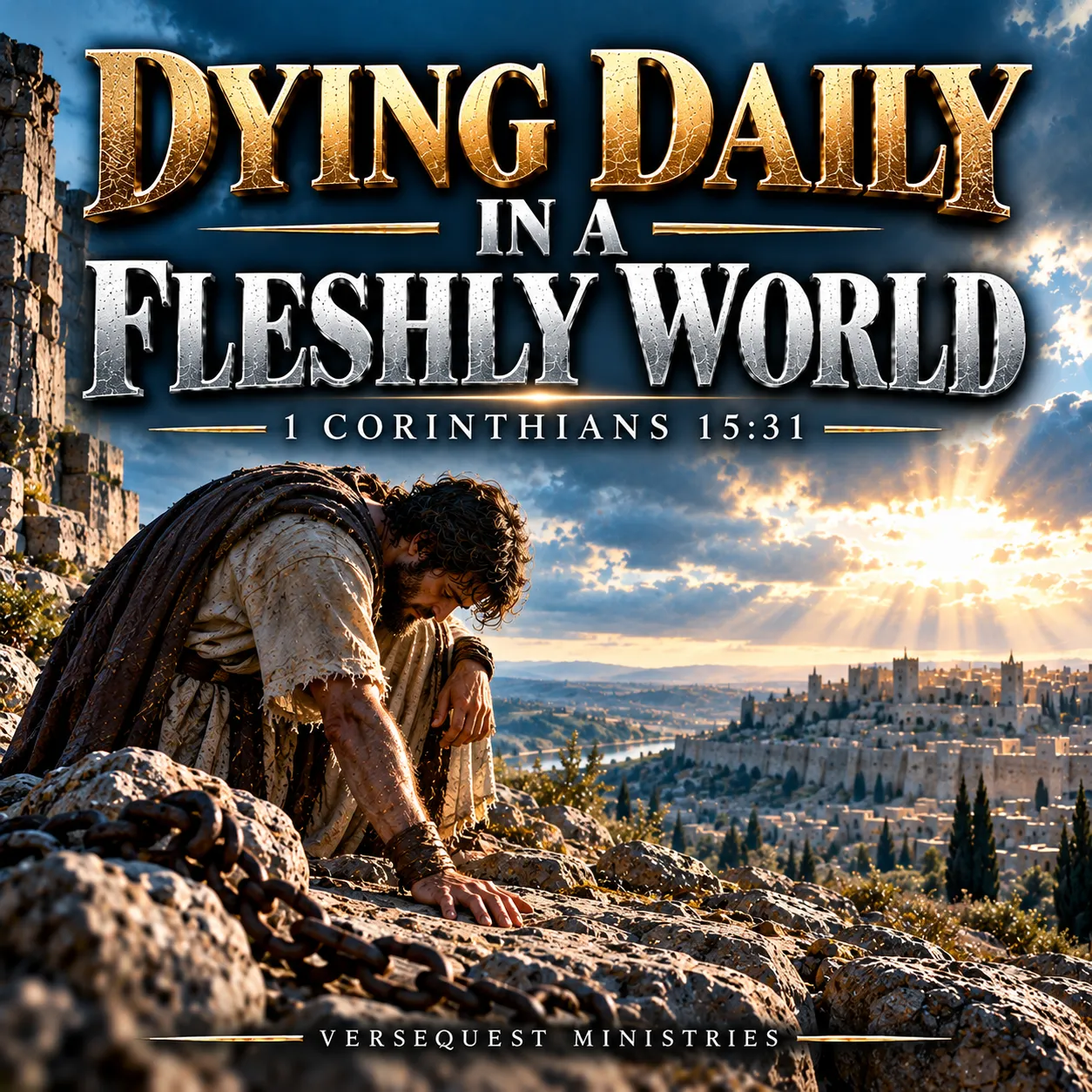
Sermon Title:
Dying Daily in a Fleshly World
Key Passage:
1 Corinthians 15:31
“I protest by your rejoicing which I have in Christ Jesus our Lord, I die daily.” (1 Corinthians 15:31)
Series:
The Book God Gave
Topic:
The Believer’s Daily Identification With Christ, Victory Over the Flesh, Endurance in a Hostile World, and Hope in the Resurrection
Book:
1 Corinthians
Speaker:
Paul Tackett
Suggested Sermon Text:
1 Corinthians 15:1–58; 1 Corinthians 9:24–27; Romans 5:1–11; Romans 6:1–14; Romans 7:14–25; Romans 8:1–18; Romans 12:1–2; 2 Corinthians 1:8–10; 2 Corinthians 4:7–18; 2 Corinthians 5:14–15; 2 Corinthians 6:3–10; 2 Corinthians 11:23–33; Galatians 2:20; Galatians 5:16–26; Galatians 6:7–14; Ephesians 4:17–32; Philippians 1:20–23; Philippians 3:7–14; Colossians 3:1–17; 1 Thessalonians 4:13–18; 2 Timothy 2:15; 2 Timothy 3:10–12; Titus 2:11–14; 1 Peter 2:11–12; 1 John 2:15–17.
Short Sermon Description:
First Corinthians 15:31 contains Paul’s remarkable declaration, “I die daily.” Those three words have frequently been applied to the Christian’s struggle against the flesh, but their immediate setting concerns the Apostle Paul’s continual exposure to danger, suffering, and possible death because of his ministry and his confidence in the resurrection of Jesus Christ. This sermon first establishes that historical and doctrinal context, showing why Paul considered daily danger worthwhile in view of Christ’s resurrection and the promised resurrection of believers. From that foundation, it develops the biblical application of daily Christian consecration, distinguishing the believer’s completed identification with Christ’s death from his continuing responsibility to reckon himself dead to sin, refuse the demands of the flesh, and walk in the Spirit. The message examines why a saved man must live faithfully in a hostile and fleshly world without adopting its values, why persecution and suffering cannot invalidate the promises of God, and how biblical truth, spiritual discipline, holiness, and gospel witness should govern daily life. It also distinguishes salvation by grace from religious self-denial, eternal security from practical sanctification, and genuine Christian sacrifice from attempts to earn divine acceptance through suffering. Preachers, teachers, and Bible students will gain a detailed, rightly divided, sermon-ready treatment of daily Christian faithfulness, resurrection hope, spiritual conflict, the old man, practical sanctification, and steadfast service to Jesus Christ.
DYING DAILY IN A FLESHLY WORLD
Introduction
The Christian lives in a world that has made an entire religion out of satisfying the flesh. Everything is advertised to make the natural man more comfortable, more entertained, more admired, more powerful, more prosperous, and more thoroughly convinced that his personal desires ought to govern the universe. The world tells him to follow his heart, trust his feelings, satisfy his appetites, protect his ambitions, and never permit anybody to interfere with whatever makes him happy. Then a Bible-believing Christian opens the word of God and discovers an Apostle Paul declaring, “I die daily.” That is a remarkable contrast. One system teaches man to enthrone himself. The other reveals a servant of Jesus Christ willing to face death rather than abandon the truth entrusted to him. One makes personal comfort the supreme objective of existence. The other considers faithfulness to Christ more important than physical safety. If contemporary Christianity seems uncomfortable with Paul’s statement, perhaps it is because modern religion has spent too much time teaching people how to enjoy the world and too little time teaching them why the resurrection makes eternal faithfulness worth more than temporary comfort.
But before we turn Paul’s statement into another religious slogan, we had better read what he actually said in context. First Corinthians 15 is the great resurrection chapter. Paul is not primarily discussing a daily ceremony of crucifying his personal appetites when he declares, “I die daily.” He is defending the resurrection of the dead against those who denied it. He reminds the Corinthians that Christ died for our sins according to the Scriptures, was buried, rose again the third day according to the Scriptures, and was witnessed alive after His resurrection. Then Paul explains what becomes of the gospel, salvation, the departed saints, and Christian suffering if there is no resurrection. Immediately before verse 31 he asks, “And why stand we in jeopardy every hour?” Immediately afterward he refers to fighting with beasts at Ephesus and asks what advantage such suffering would have if the dead rise not. The context is unmistakably dangerous Christian service in light of a certain resurrection. Paul is saying that he faces death continually because the gospel is true and the resurrection is worth suffering for. A preacher who skips that context and announces that the verse exclusively means overcoming one sinful habit every morning has taken a real biblical application and mistaken it for the primary meaning of the passage. God gave us a Book to study, not a collection of inspirational phrases to rearrange whenever convenient.
Nevertheless, the wider Pauline revelation unquestionably teaches that the saved believer must reckon himself dead to sin, refuse the reign of the flesh, present his body as a living sacrifice, and walk in the Spirit. Romans 6 declares that our old man is crucified with Christ. Galatians 2:20 says, “I am crucified with Christ: nevertheless I live.” Galatians 5:16 commands, “Walk in the Spirit, and ye shall not fulfil the lust of the flesh.” Romans 12:1 calls Christians to present their bodies as living sacrifices. Those passages establish the practical doctrine of daily Christian surrender without forcing 1 Corinthians 15:31 to say something its immediate context does not say. Taken together, the Scriptures reveal a powerful truth: the believer belongs to a risen Saviour, possesses a completed identification with His death, lives in a mortal body where the flesh remains active, and must serve Christ faithfully in a world that frequently despises the truth. The Christian life is not an endless attempt to earn salvation by dying to enough things. It is a saved man’s daily responsibility to live according to the death and resurrection of the One who has already purchased him. We are not called to make Adam impressive. We are called to live for Christ while the world, the flesh, and the devil would rather we did almost anything else.
I. “I DIE DAILY” DESCRIBES PAUL’S CONTINUAL EXPOSURE TO DEATH FOR THE GOSPEL
Key Text: 1 Corinthians 15:30–31
Supporting Texts: 1 Corinthians 15:29–34; 2 Corinthians 1:8–10; 2 Corinthians 4:8–12; 2 Corinthians 11:23–28; Acts 20:22–24
Paul declares, “I protest by your rejoicing which I have in Christ Jesus our Lord, I die daily.” The immediate context explains what he means. Verse 30 asks, “And why stand we in jeopardy every hour?” Paul is describing the continual danger accompanying his apostolic ministry. His life was not a pleasant religious tour financed by comfortable admirers who applauded every sermon. He endured beatings, imprisonment, persecution, hardship, hunger, opposition, and repeated threats of death. Second Corinthians 11:23 includes the extraordinary expression, “in deaths oft.” The Apostle Paul repeatedly found himself in circumstances where death was a genuine possibility because he refused to abandon the gospel. His declaration in 1 Corinthians 15:31 therefore concerns the daily willingness to face death for Christ, especially in view of the resurrection doctrine he is defending throughout the chapter.
Second Corinthians 1:8–10 supplies a particularly revealing example. Paul describes severe trouble in Asia, saying that he and his companions were “pressed out of measure, above strength, insomuch that we despaired even of life.” He continues, “But we had the sentence of death in ourselves, that we should not trust in ourselves, but in God which raiseth the dead.” Notice the connection between mortal danger and resurrection confidence. Paul’s circumstances taught him not to depend upon the preservation of his physical life as though God had promised an uninterrupted existence of comfort. His confidence rested in the God who raises the dead. The Lord who delivered him from death could deliver him again, and even if his earthly ministry ended in death, the resurrection remained certain. This was not recklessness. It was conviction grounded in revealed truth.
That context protects the sermon from careless interpretation. Paul is not claiming that he purchases forgiveness through repeated personal sacrifices. He is not describing a mystical experience in which his soul dies and is reborn each morning. Nor is he establishing a daily ritual that must be completed to remain saved. He is explaining why he continues risking his earthly life in defense of the gospel when some Corinthians have begun denying the resurrection. The broader application to daily Christian self-denial is legitimate when supported by Romans 6, Galatians 5, and other Pauline passages, but we must first allow 1 Corinthians 15:31 to speak in its proper context. A verse does not become more powerful when we remove its meaning. It becomes more powerful when we understand why the Holy Ghost placed it where He did.
Main Truth: Paul’s declaration, “I die daily,” primarily describes his continual exposure to death in gospel ministry, sustained by confidence in the resurrection.
II. THE RESURRECTION MAKES DAILY SACRIFICE WORTHWHILE
Key Text: 1 Corinthians 15:19–20
Supporting Texts: 1 Corinthians 15:12–34; Romans 8:18–25; 2 Corinthians 4:16–18; Philippians 3:20–21
Paul’s willingness to face death cannot be separated from the central doctrine of 1 Corinthians 15: the bodily resurrection of Jesus Christ and the future resurrection of those who belong to Him. Some among the Corinthians were saying that there was no resurrection of the dead. Paul exposes the devastating consequences of that teaching. If the dead rise not, then Christ is not raised. If Christ is not raised, preaching is vain, faith is vain, the apostles are false witnesses, believers remain in their sins, and those who have fallen asleep in Christ have perished. Then Paul declares in verse 19, “If in this life only we have hope in Christ, we are of all men most miserable.” That statement explains why daily danger would make little sense if the resurrection were false. What advantage would there be in enduring persecution, losing earthly comfort, and risking death for a message that ended in the grave?
But verse 20 overturns the entire hypothetical argument: “But now is Christ risen from the dead, and become the firstfruits of them that slept.” The Christian’s hope is not built upon wishful thinking about surviving death. It rests upon the historical resurrection of Jesus Christ. The gospel is not merely a philosophy that helps sinners become more pleasant neighbors before they disappear into the ground. It announces that Christ died for our sins, was buried, and rose again the third day according to the Scriptures. That resurrection establishes the certainty of God’s saving work and the believer’s future. Consequently, the Christian can sacrifice temporary advantages without surrendering ultimate hope. He may lose earthly possessions without losing his inheritance in Christ. He may endure affliction without forfeiting eternal life. He may even face physical death without believing death has the final word.
Second Corinthians 4:17–18 reinforces that perspective. Paul describes affliction as temporary when measured against “a far more exceeding and eternal weight of glory.” He then distinguishes visible temporal things from invisible eternal things. The believer who measures everything by the present life will naturally prioritize comfort, safety, recognition, prosperity, and immediate satisfaction. But the man who knows Christ has risen and that his own resurrection is certain possesses a different scale for measuring life. That does not make pain imaginary. It does not make persecution enjoyable or grief meaningless. It means suffering can no longer claim to be the final chapter. A man who believes the grave is the finish line will organize his life differently from a man who knows Jesus Christ has already walked out of it.
Main Truth: The bodily resurrection of Jesus Christ and the believer’s promised resurrection give eternal significance to temporary suffering, sacrifice, and faithful Christian service.
III. THE BELIEVER DOES NOT DIE DAILY TO EARN A SALVATION CHRIST ALREADY PURCHASED
Key Text: 1 Corinthians 15:3–4
Supporting Texts: Romans 3:24–28; Romans 4:4–5; Romans 5:1; Ephesians 2:8–10; Galatians 2:16–21; Titus 3:5
Before discussing Christian sacrifice, Paul establishes the gospel itself: “Christ died for our sins according to the scriptures; And that he was buried, and that he rose again the third day according to the scriptures.” The sinner’s salvation rests upon the death, burial, and resurrection of Jesus Christ, not upon the sinner’s willingness to endure daily hardship. That distinction is indispensable. Christ did not accomplish ninety-nine percent of redemption and leave the remaining one percent to be completed through religious self-denial. He finished the work. The sinner receives salvation by grace through faith. Romans 4:5 explicitly declares that God justifies the ungodly who believe upon Him. Ephesians 2:8–9 says salvation is “not of works, lest any man should boast.” The Christian’s sacrifices cannot be inserted into the gospel as additional payments without contradicting the very doctrine Paul spent so much time defending.
This becomes especially important when preaching about dying daily. Some religious systems turn every command concerning Christian dedication into another condition for obtaining or maintaining salvation. A believer may be told that unless he has sufficiently surrendered every personal desire, conquered every habit, endured enough suffering, or achieved complete practical holiness, he cannot possess assurance of eternal life. But that confuses justification with sanctification. Justification concerns the believer’s righteous standing before God through Jesus Christ. Practical sanctification concerns how the justified believer should live. Scripture certainly commands holy living, obedience, service, and separation from sin. But those instructions do not become alternate methods of obtaining the righteousness of Christ. The man who believes he can complete his redemption by suffering enough has misunderstood both his own inadequacy and the sufficiency of Calvary.
The Christian also must resist the opposite error. Salvation by grace does not render obedience unimportant. Romans 6:1 asks, “Shall we continue in sin, that grace may abound?” Paul immediately answers, “God forbid.” The same grace that saves the ungodly teaches saved people to deny ungodliness. Ephesians 2:10 declares that believers are created in Christ Jesus unto good works. Service follows salvation; it never supplies salvation’s foundation. When a Christian accepts inconvenience, persecution, sacrifice, or personal loss for the sake of Christ, he is not purchasing another installment of eternal life. He is responding to the mercy already shown him. The death that saves the sinner happened at Calvary. The daily sacrifices that follow belong to the life of the sinner whom Calvary has already saved.
Main Truth: Daily Christian sacrifice is the grateful response of a believer already justified by faith and must never be confused with the finished work through which Christ provides eternal salvation.
IV. THE OLD MAN WAS CRUCIFIED WITH CHRIST, AND THE BELIEVER MUST RECKON UPON THAT TRUTH
Key Text: Romans 6:6–11
Supporting Texts: Galatians 2:20; Romans 6:1–14; Colossians 2:11–13; Colossians 3:1–10; Ephesians 4:22–24
Romans 6:6 establishes a completed spiritual reality: “Knowing this, that our old man is crucified with him.” Notice that Paul does not say the believer must attempt to crucify his old man successfully every morning so God will accept him by nightfall. God has already identified the believer with the death of Jesus Christ. Galatians 2:20 declares, “I am crucified with Christ: nevertheless I live; yet not I, but Christ liveth in me.” The believer’s former Adamic standing has been judicially dealt with through his identification with Christ. This is not a claim that the flesh has disappeared, that temptation has become impossible, or that the physical body has been glorified. It establishes a new spiritual position. The saved man is no longer defined before God by his former standing in Adam. He belongs to Jesus Christ and possesses new spiritual life through Him.
Romans 6:11 then tells believers what to do with that truth: “Likewise reckon ye also yourselves to be dead indeed unto sin, but alive unto God through Jesus Christ our Lord.” Reckoning means accepting God’s declaration and ordering one’s thinking accordingly. It does not create the believer’s identification with Christ; it recognizes what God has already accomplished. The flesh may continue demanding obedience, but the Christian is commanded to remember that sin no longer possesses the rightful authority of a master. Verse 12 says, “Let not sin therefore reign in your mortal body, that ye should obey it in the lusts thereof.” That is a practical command addressed to saved people. God does not ask the believer to deny that temptation exists. He commands him to refuse the reign of sin because his spiritual position has fundamentally changed.
Here the principle of daily Christian self-denial becomes directly applicable to the sermon. Paul’s “I die daily” in 1 Corinthians 15:31 concerns daily jeopardy, but Romans 6 establishes why the Christian must continually refuse the old nature’s attempts to regain practical control. The believer may need to reject pride repeatedly, resist lust repeatedly, forgive offenses repeatedly, deny selfish ambition repeatedly, and correct worldly thinking repeatedly. Yet these acts of obedience do not repeat Christ’s crucifixion or manufacture a new spiritual death every morning. They express what it means to live according to the completed work of Christ. God already settled the old man’s position at the cross. The Christian’s daily responsibility is to stop behaving as though the old man still possesses the right to govern him.
Main Truth: The believer’s old man was crucified with Christ, and daily Christian obedience involves reckoning upon that accomplished truth rather than attempting to earn salvation through repeated self-crucifixion.
V. THE FLESH REMAINS PRESENT, BUT IT MUST NOT BE ALLOWED TO RULE
Key Text: Galatians 5:16–17
Supporting Texts: Romans 7:15–25; Romans 8:5–13; Romans 13:14; Galatians 5:19–25; Colossians 3:5–10
The saved believer quickly discovers something that would be discouraging if Scripture had not already explained it: the flesh did not become holy when he trusted Christ. Romans 7:18 says, “For I know that in me (that is, in my flesh,) dwelleth no good thing.” Paul is not describing a small personality defect that requires additional encouragement. He is identifying the fallen nature as incapable of producing spiritual righteousness through its own resources. Galatians 5:17 describes the conflict: “For the flesh lusteth against the Spirit, and the Spirit against the flesh.” The two are contrary. The flesh does not become the Spirit’s friend simply because the believer has attended church for forty years, read the Bible repeatedly, or learned enough doctrine to impress a seminary professor. Spiritual maturity may increase the believer’s discernment, but the flesh never graduates into holiness. It remains what Scripture says it is.
That reality must not be confused with defeatism. Paul does not say that because the flesh remains corrupt, the Christian must surrender to every temptation. Galatians 5:16 gives the command and promise: “Walk in the Spirit, and ye shall not fulfil the lust of the flesh.” The answer is not to improve the old nature until it becomes spiritual. The answer is to walk according to the Holy Spirit who indwells the believer. Romans 8 describes the difference between minding the things of the flesh and minding the things of the Spirit. Colossians 3 commands believers to mortify sinful practices, put off the deeds of the old man, and put on conduct consistent with their new spiritual identity. These instructions concern practical sanctification, not the purchase of salvation. The believer does not become saved through holiness. He is called to pursue holiness because he belongs to the Holy One who saved him.
Romans 13:14 brings the responsibility into particularly practical focus: “make not provision for the flesh, to fulfil the lusts thereof.” A Christian cannot spend six hours preparing temptation, fifteen minutes entertaining it, and then act astonished when the flesh responds exactly as Scripture says it will. The flesh does not need encouragement; it already possesses an appetite. Feed bitterness and bitterness grows. Feed covetousness and contentment becomes harder. Feed impurity and the imagination becomes accustomed to what Scripture condemns. Feed pride and correction becomes increasingly offensive. The Christian must stop treating his old nature like a pet that can safely be indulged as long as it occasionally behaves. The flesh does not need a better diet of worldly pleasures. It needs to be denied the throne, refused its provisions, and opposed through the Spirit-led life God has supplied.
Main Truth: The flesh remains corrupt throughout the believer’s earthly life, but the indwelling Holy Spirit enables the Christian to deny its desires and walk in practical righteousness.
VI. A FLESHLY WORLD WILL ALWAYS PRESSURE THE CHRISTIAN TO COMPROMISE
Key Text: Romans 12:2
Supporting Texts: 1 Corinthians 15:32–34; Galatians 1:4; Ephesians 2:2; Colossians 2:8; 1 John 2:15–17; 2 Timothy 3:12
The believer’s struggle is not confined to the flesh within. He also lives in a world that continually advertises the flesh’s preferred way of life. Romans 12:2 commands, “And be not conformed to this world: but be ye transformed by the renewing of your mind.” The present world possesses a pattern of thinking, a system of values, an arrangement of priorities, and a collection of appetites that frequently contradict God’s revealed truth. It teaches man to live for temporary recognition, personal pleasure, material advantage, and immediate satisfaction. It measures success by possessions, popularity, power, and the ability to satisfy desire without inconvenience. Scripture teaches the Christian to evaluate everything in light of Christ, eternity, holiness, and the will of God. Those two standards cannot permanently occupy the same throne. Something must govern the believer’s thinking, and the Christian who refuses to let Scripture govern his mind will increasingly discover the world volunteering for the position.
The connection to 1 Corinthians 15 is particularly revealing. After discussing the consequences of denying the resurrection, Paul says in verse 32, “let us eat and drink; for to morrow we die.” That is the practical philosophy of a life without resurrection hope. If death ends everything, immediate gratification becomes an attractive governing principle. Why endure persecution? Why sacrifice comfort? Why remain faithful when compromise offers an easier path? Why deny an appetite if present pleasure is the highest available good? Paul does not endorse that philosophy. He exposes the disastrous implications of denying the resurrection. Verse 33 immediately warns, “Be not deceived: evil communications corrupt good manners.” The company a person keeps, the teachings he receives, and the ideas he repeatedly entertains can corrupt his practical conduct. False doctrine does not always remain inside a notebook. Eventually it begins issuing instructions to the body.
The Christian therefore must practice biblical separation without confusing separation from worldly values with hatred of the people who need the gospel. Believers remain in the world as witnesses for Jesus Christ. They have families to care for, jobs to perform, neighbors to love, and sinners to reach. But they are not commanded to adopt every cultural fashion, celebrate every fleshly appetite, or surrender every doctrinal distinction simply because the present age dislikes being corrected. First John 2:17 says, “And the world passeth away, and the lust thereof: but he that doeth the will of God abideth for ever.” That is an excellent reason not to organize an entire Christian life around the applause of a passing world. The world is a poor master because everything it offers is temporary, everything it demands is expensive, and even its most enthusiastic admirers eventually discover that its promises cannot defeat the grave.
Main Truth: The Christian must resist the fallen world’s values and fleshly philosophy by renewing his mind through Scripture and living according to the eternal truth of Jesus Christ.
VII. DAILY CHRISTIAN SACRIFICE MUST BECOME VISIBLE IN ORDINARY LIFE
Key Text: Romans 12:1
Supporting Texts: 1 Corinthians 6:19–20; 1 Corinthians 9:24–27; 2 Corinthians 4:10–12; Galatians 2:20; Ephesians 4:25–32; Colossians 3:12–17
Romans 12:1 gives the saved believer a remarkably practical command: “present your bodies a living sacrifice, holy, acceptable unto God, which is your reasonable service.” Paul appeals to the mercies of God rather than threatening justified believers with the loss of eternal salvation. The Christian’s service is the response to grace, not the purchase price of grace. The body being presented is the same body that must rise in the morning, perform ordinary labor, speak to other people, make choices, face temptations, endure fatigue, and carry out responsibilities. Consequently, Christian consecration cannot be confined to dramatic occasions when believers feel unusually spiritual. It belongs to ordinary life. The believer’s tongue, eyes, hands, feet, appetites, strength, time, and habits are all involved. God did not purchase an invisible portion of the Christian while leaving every practical decision under the exclusive authority of Adam’s flesh.
First Corinthians 9:27 illustrates Paul’s seriousness concerning personal discipline: “But I keep under my body, and bring it into subjection.” Paul was not attempting to beat salvation into himself through physical punishment. He was concerned about faithfulness, discipline, and usefulness in the ministry entrusted to him. The body is not evil merely because it is physical, but it must not be permitted to rule through sinful appetites. A preacher may possess tremendous doctrinal knowledge while allowing his temper, pride, covetousness, or selfishness to damage his testimony. A believer may defend eternal security correctly while using that security as an excuse to make careless choices. Neither case reflects biblical maturity. The Christian must learn to govern his conduct according to Scripture rather than allowing every passing desire to announce itself as an emergency requiring immediate satisfaction.
This is where the practical application of daily dying becomes unmistakable. Sometimes faithfulness means denying the urge to return an insult. Sometimes it means doing honest work when nobody is supervising. Sometimes it means refusing immoral entertainment, correcting a dishonest statement, forgiving an offense, controlling an appetite, caring patiently for a family member, or continuing ministry when physical weariness makes easier alternatives attractive. Those choices do not make the believer a second redeemer. They demonstrate practical obedience to the One who has already redeemed him. Second Corinthians 4:10 speaks of “Always bearing about in the body the dying of the Lord Jesus, that the life also of Jesus might be made manifest in our body.” Paul connects his costly ministry with the manifestation of Christ’s life. The Christian does not need to invent dramatic suffering to prove he belongs to Jesus Christ. He needs to obey Jesus Christ in the ordinary places where the flesh keeps demanding its own way.
Main Truth: Daily Christian consecration becomes visible when the saved believer yields his body, choices, habits, relationships, and responsibilities to the Lord who purchased him.
VIII. SUFFERING FOR CHRIST IS NOT DEFEAT WHEN THE GOSPEL REMAINS TRUE
Key Text: 2 Corinthians 4:8–12
Supporting Texts: 1 Corinthians 15:30–32; Acts 20:22–24; 2 Corinthians 6:3–10; 2 Corinthians 11:23–28; Philippians 1:20–21; 2 Timothy 3:10–12
Paul’s declaration that he died daily was not theoretical. He knew what it meant to pay a real price for preaching the gospel. Second Corinthians 4 describes his ministry with a series of astonishing contrasts: “troubled on every side, yet not distressed; we are perplexed, but not in despair; Persecuted, but not forsaken; cast down, but not destroyed.” The apostle did not confuse spiritual faithfulness with guaranteed earthly comfort. He understood that serving Christ could bring physical exhaustion, opposition, imprisonment, rejection, danger, and suffering. Yet he also understood that none of those circumstances could make the resurrection false or cancel the promises of God. His ministry was not successful because every day was pleasant. It was faithful because he continued proclaiming the truth through circumstances that would have persuaded many men to abandon the work.
Acts 20:24 expresses that conviction memorably: “But none of these things move me, neither count I my life dear unto myself, so that I might finish my course with joy, and the ministry, which I have received of the Lord Jesus, to testify the gospel of the grace of God.” Notice Paul’s priorities. He did not hate life, celebrate pain, or seek danger for the sake of appearing courageous. He understood that his life had been entrusted to him for a purpose greater than self-preservation. The ministry he received from Jesus Christ mattered more than temporary safety. That is fundamentally different from deliberately pursuing harm, neglecting legitimate precautions, or imagining that suffering automatically makes a person righteous. The Christian should not manufacture persecution in order to boast about persecution. He should remain faithful when persecution comes because of obedience to Christ.
Second Timothy 3:12 warns, “Yea, and all that will live godly in Christ Jesus shall suffer persecution.” The specific forms and severity may differ considerably among believers, but opposition should not surprise those who stand for biblical truth. Some may encounter ridicule. Others may experience rejection, material loss, governmental hostility, imprisonment, or physical danger. The Christian’s response must be governed by truth, charity, wisdom, and faithfulness rather than bitterness or retaliation. Paul endured suffering because he believed the gospel was true, the lost needed to hear it, and the resurrection guaranteed that death did not have the final victory. The same confidence ought to strengthen Christians today. A faithful servant does not need the world to approve his message before he will preach it, because the authority of the gospel does not come from the audience that hears it.
Main Truth: The believer can endure opposition, hardship, and suffering for Christ because the truth of the gospel and the certainty of the resurrection outweigh temporary earthly loss.
IX. THE RESURRECTION GUARANTEES THAT FAITHFUL LABOR IS NOT IN VAIN
Key Text: 1 Corinthians 15:51–58
Supporting Texts: 1 Corinthians 15:20–23, 35–49; Philippians 3:20–21; 1 Thessalonians 4:13–18; 2 Corinthians 5:1–10; 2 Timothy 4:6–8
The chapter that contains “I die daily” does not end with Paul’s sufferings. It ends with victory over death. That matters tremendously. Paul is not presenting Christian sacrifice as an endless cycle of suffering without hope. He is defending the resurrection that makes Christian service meaningful beyond the grave. First Corinthians 15:51 introduces a mystery: “We shall not all sleep, but we shall all be changed.” Paul describes the transformation of believers, when the corruptible puts on incorruption and the mortal puts on immortality. He declares that death will be swallowed up in victory. For the Church-Age believer, this harmonizes with the revelation of the catching away of the saints in 1 Thessalonians 4:13–18. The dead in Christ shall rise first, and living believers shall be caught up together with them to meet the Lord in the air. The Christian’s final hope is not permanent existence in a weak, corruptible, temptation-prone body. God has promised transformation.
That promise also places the present conflict with the flesh in proper perspective. The believer may mature spiritually, but the flesh does not become sinlessly perfect through increasing age or religious experience. The body remains mortal until God changes it. Romans 8:23 speaks of believers waiting for “the redemption of our body.” Philippians 3:21 declares that Christ “shall change our vile body, that it may be fashioned like unto his glorious body.” Consequently, the Christian’s final deliverance from the present bodily condition does not come through achieving enough willpower to reform fallen flesh. It comes through the power of the risen Saviour. This does not excuse sin while the believer waits. It gives him reason to persevere, because the struggle has a promised conclusion. There is coming a day when the Christian will no longer contend with the present weakness, corruption, and mortality that characterize earthly life. The Lord who redeemed his soul has also promised the redemption of his body.
Paul therefore closes the chapter with a command that completes the sermon: “Therefore, my beloved brethren, be ye stedfast, unmoveable, always abounding in the work of the Lord, forasmuch as ye know that your labour is not in vain in the Lord.” Notice that word “therefore.” Because Christ rose, because the dead will rise, because mortality will be swallowed up in victory, and because death has lost its final claim upon those who belong to Christ, believers should continue faithfully in the Lord’s work. The resurrection is not merely a comforting doctrine for funerals. It is motivation for present service. The Christian who knows his labor is not in vain has reason to keep preaching, teaching, praying, witnessing, forgiving, giving, studying, and serving even when visible results appear small. The man who lives only for today must eventually surrender everything to death. The man who serves the risen Christ can labor today knowing that even death cannot erase what God has promised.
Main Truth: The promised resurrection and glorification of believers guarantee the final defeat of death and give eternal significance to steadfast Christian service in the present life.
Conclusion
First Corinthians 15:31 is a remarkable testimony from a man who understood that the resurrection of Jesus Christ was worth more than his own earthly comfort. “I die daily.” Paul was describing the continual danger that accompanied his ministry, and the surrounding passage explains why he willingly endured it. Christ had risen from the dead. The gospel was true. The resurrection of believers was certain. Therefore, suffering and even death could not make faithful service meaningless. The apostle did not consider physical safety the highest possible good, nor did he measure the truth of his message by whether the world rewarded him for preaching it. He faced jeopardy because he knew that the God who raised Jesus Christ would not fail to accomplish His promises. This original meaning must remain firmly in place. Bible preaching becomes stronger, not weaker, when the passage is allowed to speak according to its actual context.
From that doctrinal foundation, Scripture also teaches the practical responsibility of daily Christian consecration. The believer’s old man is crucified with Christ. The saved man possesses new spiritual life through the risen Saviour. The Holy Spirit dwells within him. His justification is secure through faith in Christ rather than dependent upon his daily performance. Yet he remains in a mortal body where the flesh continues opposing spiritual obedience, and he lives in a world that continually urges him to satisfy temporary desires. Romans 6 commands him to reckon himself dead indeed unto sin. Galatians 5 commands him to walk in the Spirit. Romans 12 commands him to present his body as a living sacrifice and refuse conformity to the world. These passages do not require the Christian to repeat Calvary every morning. They require him to live according to what Calvary has already accomplished. Grace does not teach the saved man to indulge the flesh. Grace teaches him to refuse its authority.
So take the King James Bible and examine both the doctrine and the daily application. Are you allowing temporary comfort to determine whether you will obey Christ? Are you feeding the very flesh you ask God to help you resist? Have worldly ambitions, pleasures, fears, or distractions begun controlling your mind? Are you treating opposition as though it proves God has abandoned you? Have you allowed the work of the Lord to become optional whenever service becomes inconvenient? Return to the truth of the resurrection. Remember your identification with Christ. Reckon yourself dead to sin and alive unto God. Walk in the Spirit. Refuse to make provision for the flesh. Stand faithfully for the gospel. Serve Christ without demanding that every day provide applause, comfort, or visible success. And remember that the Christian life is not a desperate struggle to earn an uncertain salvation. It is the life of a redeemed sinner serving a risen Saviour whose victory over death is already established. You do not need to make peace with the flesh to survive in this world. You need to believe the Book, obey the Spirit, and live in the light of the resurrection.
Final Call
If you are lost, the answer to your condition is not attempting to die daily through religious self-denial, physical suffering, moral reform, or extraordinary personal sacrifice. You need salvation through Jesus Christ. The gospel is plain: “Christ died for our sins according to the scriptures; And that he was buried, and that he rose again the third day according to the scriptures” (1 Corinthians 15:3–4). His death paid the price for sin. His resurrection demonstrates His victory over death. You cannot add anything to His finished work through baptism, church membership, morality, religious observance, personal dedication, or attempts to make the flesh holy. Romans 4:5 declares that God justifies the ungodly who believe on Him. Acts 16:31 says, “Believe on the Lord Jesus Christ, and thou shalt be saved.” Trust Jesus Christ as your Saviour. Receive eternal life through faith in Him. Do not attempt to become righteous enough to deserve the cross. Come as the sinner for whom Christ died.
If you are saved, remember that your life now belongs to the One who purchased you. Your old man is crucified with Christ, your salvation is secure in Him, and the Holy Spirit dwells within you. Those truths should produce gratitude, holiness, and faithfulness rather than careless living. Stop feeding the flesh while asking for spiritual victory. Stop allowing the world’s applause to determine whether you will stand for truth. Read the word of God. Study it. Rightly divide it. Renew your mind. Present your body to God. Refuse sinful appetites. Forgive offenses. Serve your family. Preach the gospel. Endure hardship faithfully. And when this world attempts to convince you that obedience is too costly, remember the empty tomb and the promised resurrection. Paul could face death daily because he knew whom he served. You can face today’s responsibilities with that same confidence in the risen Saviour. Live faithfully today because Christ has already conquered the death that this world considers the end of everything.
Closing Verse:
“Therefore, my beloved brethren, be ye stedfast, unmoveable, always abounding in the work of the Lord, forasmuch as ye know that your labour is not in vain in the Lord.” (1 Corinthians 15:58)
Closing Statement:
Paul could face death every day because he knew the resurrection was certain—and the Christian who knows Christ has conquered the grave has no reason to let the flesh, the world, or the fear of death determine how faithfully he will live today.