


VerseQuest Daily — November 2026: Prayer, Worship, Gratitude, and Stewardship
VerseQuest Daily — November 2026 is a 65-page downloadable devotional PDF containing thirty KJV studies on prayer, worship, gratitude, contentment, generosity, and stewardship. Each day includes an assigned Scripture passage, a developed rightly divided devotional, Seven Things to Learn, and a memorable Thought for the Day.
The month progresses through Milk, Bread, Meat, and Strong Meat readings, taking the reader from private prayer and thanksgiving to giving under grace, eternal reward, imprecatory prayer, Tribulation saints, and heavenly worship. Use it throughout November or begin on any date as a focused thirty-day discipleship study for personal, family, church, or small-group use.
$6.99
Description
VerseQuest Daily — November 2026 is a 65-page downloadable KJV devotional PDF containing thirty daily studies devoted to prayer, worship, gratitude, contentment, generosity, and faithful stewardship. This is Month Three of VerseQuest Daily Discipleship Level One: Foundations and Growth. Following September’s foundation in the word of God, the gospel, assurance, and the believer’s standing in Christ, and October’s instruction concerning identity and the daily Christian walk, November develops the believer’s communion with God and responsible use of everything entrusted to him.
Each daily portion begins with an assigned passage from the King James Bible and a clearly identified subject. The devotional then explains the passage, preserves its biblical and dispensational setting, establishes its doctrinal truth, and applies it carefully to Christian life. Every reading concludes with Seven Things to Learn and a memorable Thought for the Day, giving the reader specific truths to review, remember, discuss, and practice.
The thirty studies progress deliberately through eight Milk readings, eleven Bread readings, eight Meat readings, and three Strong Meat readings. The month begins with private prayer, thanksgiving, praise, contentment, dependence upon God, and cheerful generosity. It then advances into persistent prayer, intercession, confession, biblical worship, singing with the word dwelling richly within, stewardship, spiritual strength, the Spirit’s intercession, access to the Father, fasting, vows, grace giving, and eternal reward. The closing Strong Meat studies distinguish imprecatory prayer, the prayers of Tribulation saints for judgment, and heavenly worship around the throne.
This progression allows newer believers to begin with understandable foundations while steadily leading serious students toward doctrines that require greater biblical discernment. Rather than treating every passage as though it were addressed to the same people under the same conditions, VerseQuest Daily teaches readers to receive the instruction of all Scripture while rightly dividing its audiences, dispensations, promises, and applications.
The PDF may be read on a computer, tablet, or mobile device or printed for regular use. It can be followed throughout November 2026 or begun on any date as a thirty-day discipleship study. It is suited to personal devotions, family Bible reading, one-to-one discipleship, church groups, Sunday school classes, ministry training, and small-group discussion. Every daily study is designed to provide a substantial but manageable portion of Scripture that can be read, considered, and carried into the day.
Private communion with God — Prayer must possess a sincere private root rather than becoming a performance for human approval. Confidence in God’s attention — The believer approaches God knowing that He sees the need, hears sincere prayer, and answers with perfect wisdom. Thanksgiving in every circumstance — Gratitude rests upon God’s unchanging character and the believer’s standing in Christ, not upon comfortable conditions. Praise grounded in revealed truth — Biblical worship begins with knowing who God is rather than attempting to manufacture a religious mood. Public gratitude for redemption — The redeemed should speak of the Redeemer without making themselves the hero of their testimony. Dependence upon divine provision — Anxiety is confronted by confidence in the Father’s knowledge, care, and sufficiency. Contentment against covetousness — God’s presence and provision are presented as the answer to the restless demand for more. Cheerful generosity — Giving should proceed from a willing, purposeful heart rather than grudging pressure or religious manipulation. Persistence and watchfulness in prayer — Prayer is treated as an ongoing discipline of dependence, alertness, and thanksgiving. Unanswered prayer and sufficient grace — A divine refusal may serve a wiser purpose and be accompanied by grace sufficient for the burden. Intercession for others — Mature prayer reaches beyond personal needs to rulers, the lost, fellow believers, and the work of the ministry. Confession and restored fellowship — Hidden sin dries the inner life, while honest confession restores openness in fellowship with God. Worship in spirit and truth — Sincerity cannot replace truth, and correct words cannot replace genuine spiritual worship. Word-filled singing — Christian music is connected to doctrine, teaching, admonition, thanksgiving, and the indwelling word of Christ. Faithful stewardship — Time, substance, spiritual truth, opportunities, and ministry responsibilities are trusts belonging ultimately to God. Spiritual strength in the inner man — Paul’s prayers emphasize inward growth, doctrinal comprehension, love, and spiritual fullness. Access through the Trinity — The believer’s approach to the Father is through the Son and by the Holy Spirit. Grace giving distinguished from legal taxation — Giving under grace is carefully distinguished from compulsory systems imposed upon Israel under the law. Service examined for reward — Christian works will be tested at the Judgment Seat of Christ without placing the believer’s salvation in question. Dispensational distinctions in prayer and worship — Imprecatory Psalms, Tribulation prayers, and heavenly worship are interpreted according to their biblical audiences and prophetic settings.
- Central argument: Prayer, worship, gratitude, and stewardship are not isolated religious activities. Together they reveal whether the believer is living consciously before God, receiving His provision with thanksgiving, and faithfully managing what belongs to Him.
- Daily structure: Every entry contains an assigned KJV passage, a defined topic, a developed devotional exposition, seven lessons, and a closing Thought for the Day.
- Progressive design: The month contains eight Milk readings, eleven Bread readings, eight Meat readings, and three Strong Meat readings. The progression leads readers from accessible devotional foundations into more demanding doctrinal distinctions.
- Prayer is communion, not performance: Matthew 6:6 exposes prayer offered for human recognition and emphasizes the importance of sincere private fellowship with God.
- Access rests upon Christ: Believers are not heard because they have earned an audience. Their approach to the Father rests upon Christ and the ministry of the Holy Spirit.
- God’s hearing does not guarantee the requested answer: The experience of Paul in 2 Corinthians 12 demonstrates that God may deny removal while granting sufficient grace.
- Thanksgiving is revealed obedience: First Thessalonians 5:16–18 identifies gratitude as part of God’s will in Christ Jesus, even when the entire future remains unknown.
- Contentment is not indifference: Biblical contentment does not forbid work, planning, improvement, or responsible provision. It forbids making possessions the foundation of peace.
- Worship requires both spirit and truth: Emotion cannot correct false doctrine, and technical accuracy without a sincere heart does not constitute complete worship.
- Music serves the word: Colossians 3:16 places Christian singing under the authority and instruction of the word of Christ.
- Stewardship begins with ownership: A steward manages something that belongs to another. The believer’s time, abilities, opportunities, resources, and ministry responsibilities belong ultimately to God.
- Grace giving is willing giving: Second Corinthians 8–9 rejects both grudging reluctance and religious compulsion. Giving is to be purposeful, cheerful, and proportionate.
- Salvation and reward must remain distinct: First Corinthians 3:11–15 concerns the testing of a believer’s work. The loss of reward must not be confused with the loss of eternal salvation.
- Fasting is not spiritual theatre: Isaiah 58 exposes outward religious deprivation that is disconnected from humility, mercy, and righteous conduct.
- Vows must not become bargains: Ecclesiastes 5 warns against making careless promises to God in moments of fear, enthusiasm, or attempted negotiation.
- Imprecatory prayer requires right division: Psalm 109 cannot be flattened into ordinary Church-age devotional language. Its setting, prophetic character, and relationship to divine judgment must be respected.
- Tribulation prayers differ from present Church-age emphasis: Revelation 6 records persecuted saints asking how long God will delay judgment. Their prayer belongs to a future prophetic setting in which divine wrath is being openly administered.
- Heavenly worship is God-centered: Revelation 4 directs attention away from human preference and toward the holiness, glory, honor, creative authority, and eternal worth of God.
- Further study question: How do Christ’s kingdom instructions concerning prayer relate to, yet remain distinct from, Paul’s instructions to the Body of Christ?
- Further study question: What distinctions must be maintained among Israel’s covenant giving, Old Testament firstfruits, tithing under the law, and giving under grace?
- Further study question: How does the Judgment Seat of Christ encourage faithful stewardship without weakening the doctrine of eternal security?
- Memorable teaching point: A prayer may be sincere without being eloquent, but worship cannot be biblical while being separated from truth.
- Memorable teaching point: Thanksgiving does not declare that the burden is small; it declares that the grace of God remains greater.
- Memorable teaching point: God does not measure stewardship by how much a person possesses but by faithfulness with what has been entrusted.
Personal Bible study — Read the assigned KJV passage, complete the devotional, review the seven lessons, and carry the Thought for the Day into prayer and daily practice.
Thirty-day discipleship — Use the complete volume to train a newer believer in prayer, worship, gratitude, contentment, giving, and stewardship.
Family devotions — Read one entry together and allow each family member to discuss one of the Seven Things to Learn.
Sunday school lessons — Develop individual readings into lessons on prayer, worship, giving under grace, biblical contentment, or Christian stewardship.
Small groups and church studies — Assign the daily readings during the week and use the lessons and closing thoughts to guide group discussion.
Sermon preparation — Use the passages, doctrinal distinctions, and practical applications as starting points for sermons concerning communion with God and faithful service.
One-to-one mentoring — Discuss the progression from basic prayer and gratitude to the more difficult subjects of unanswered prayer, imprecatory prayer, and eternal reward.
Ministry training — Teach leaders to distinguish private devotion from public performance and spiritual stewardship from personal ownership.
Topical teaching — Group related entries into focused studies on prayer, thanksgiving, worship, contentment, giving, or rewards.
Independent study outside November — Begin on any date and use the volume as a self-contained thirty-day course.
A King James Bible for reading every assigned passage in its complete context.
A Strong’s Exhaustive Concordance for tracing important terms such as prayer, worship, thanksgiving, stewardship, contentment, intercession, and reward.
A reliable King James Bible dictionary for studying biblical terms and historical customs connected with worship, fasting, vows, firstfruits, priesthood, and stewardship.
The Treasury of Scripture Knowledge or another KJV-compatible cross-reference resource for comparing related passages throughout Scripture.
A dispensational Bible timeline for locating Israel’s covenant worship, Christ’s earthly ministry, the present Church age, the Tribulation, and heavenly events in their proper order.
A topical study comparing prayer under the law, kingdom prayer, Pauline instruction for the Body of Christ, and prayer during the Tribulation.
A study of the Judgment Seat of Christ using Romans 14:10–12, 1 Corinthians 3:11–15, 1 Corinthians 4:1–5, 2 Corinthians 5:10, and 2 Timothy 4:7–8.
A study of Christian giving using Acts 20:35, 1 Corinthians 16:1–2, 2 Corinthians 8–9, Philippians 4:10–19, and 1 Timothy 6:17–19.
VerseQuest Daily — September 2026 for the preceding foundation in Scripture, the gospel, assurance, and the believer’s standing in Christ.
VerseQuest Daily — October 2026 for the preceding studies on identity in Christ and the believer’s daily walk.
Related products
-
Gospel Commentary
-
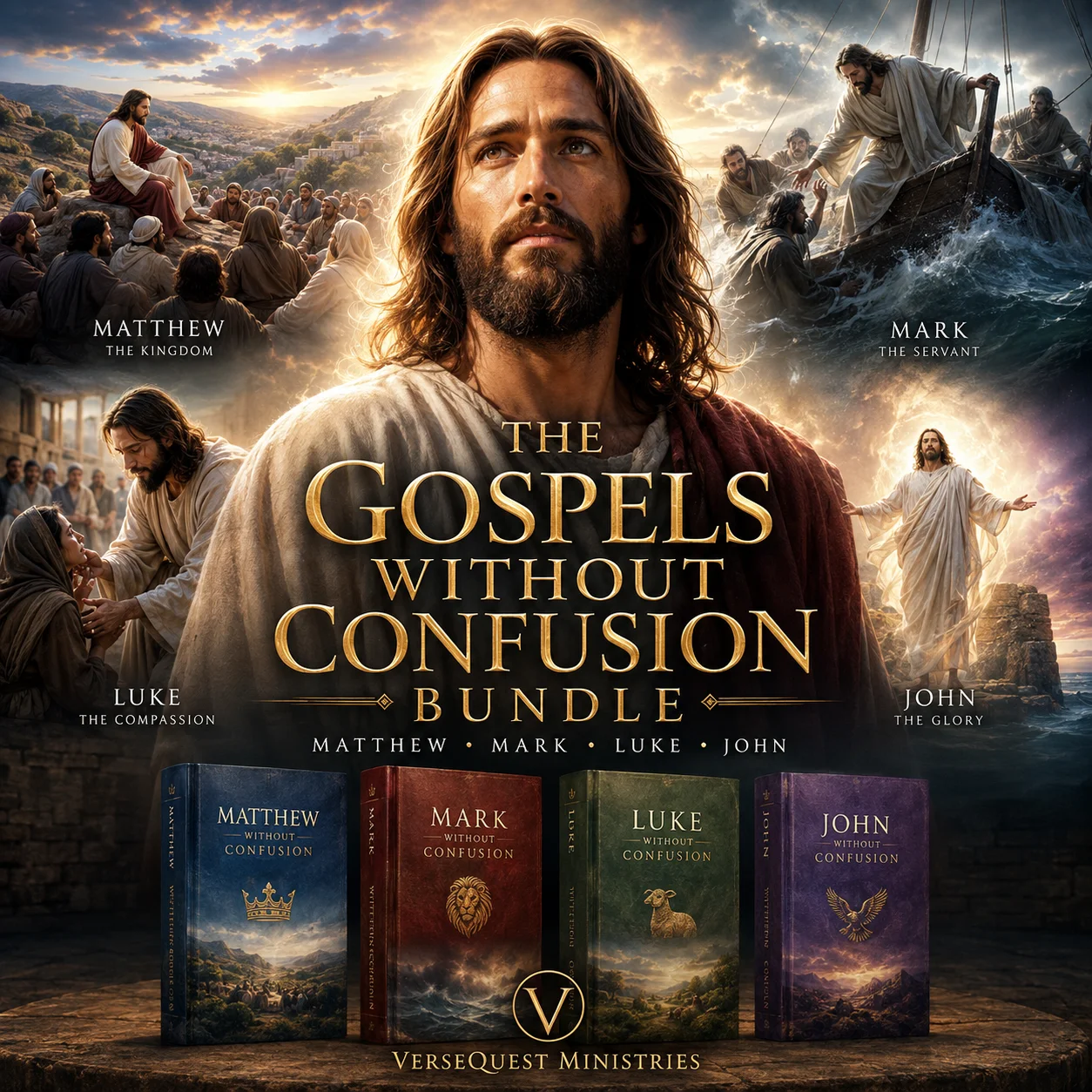
- The Gospels Without Confusion Bundle – Matthew, Mark, Luke & John KJV Commentaries
- The Gospels Without Confusion Bundle combines Matthew, Mark, Luke, and John into one major KJV Bible-study collection. Study Christ as King, Servant, Son of Man, and Son of God while…
- $39.99
- Add to cart
-
-
Daily Bible Study
-

- VerseQuest Daily — September 2026
- VerseQuest Daily — September 2026 is a 66-page downloadable KJV devotional PDF containing thirty complete daily studies. Each entry provides an assigned Scripture reading, a developed devotional, seven clear lessons,…
- $6.99
- Add to cart
-
-
The Rapture
-
-67%
- Caught Up Before the Wrath – 66-Essay KJV Rapture Study
- Caught Up Before the Wrath is a 430-page premium KJV Bible study defending the pre-tribulation Rapture of the Church from a rightly divided, dispensational perspective. This 66-essay VerseQuest Ministries book…
- Original price was: $29.99.$9.99Current price is: $9.99.
- Add to cart
-
-67%
-
2 Peter Commentary
-
- 2 Peter Without Confusion – 50 Detailed KJV Bible Studies
- 2 Peter Without Confusion is a 493-page KJV Bible study PDF containing 50 detailed studies, a thorough introduction, a strong conclusion, and a full-color rightly divided chart. It explains spiritual…
- $9.99
- Add to cart
-
-
Spiritual Growth
-
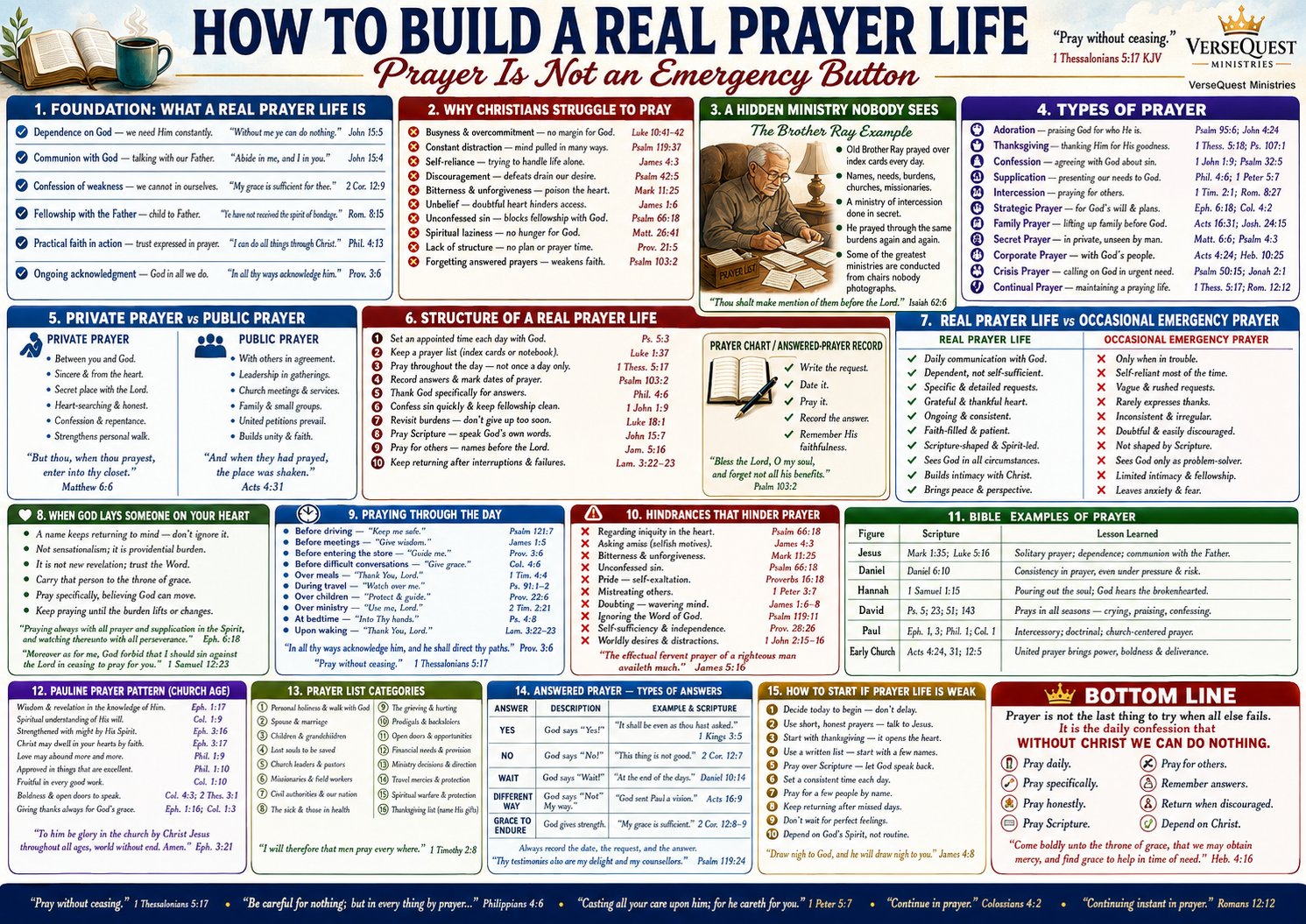
- How to Build a Real Prayer Life – Biblical Prayer Guide and KJV Bible Study Chart
- Build a consistent, biblical prayer life with this detailed KJV Bible study chart. Explore the foundations of prayer, types of prayer, common hindrances, answered prayer, Bible examples, and practical ways…
- $3.99
- Add to cart
-