
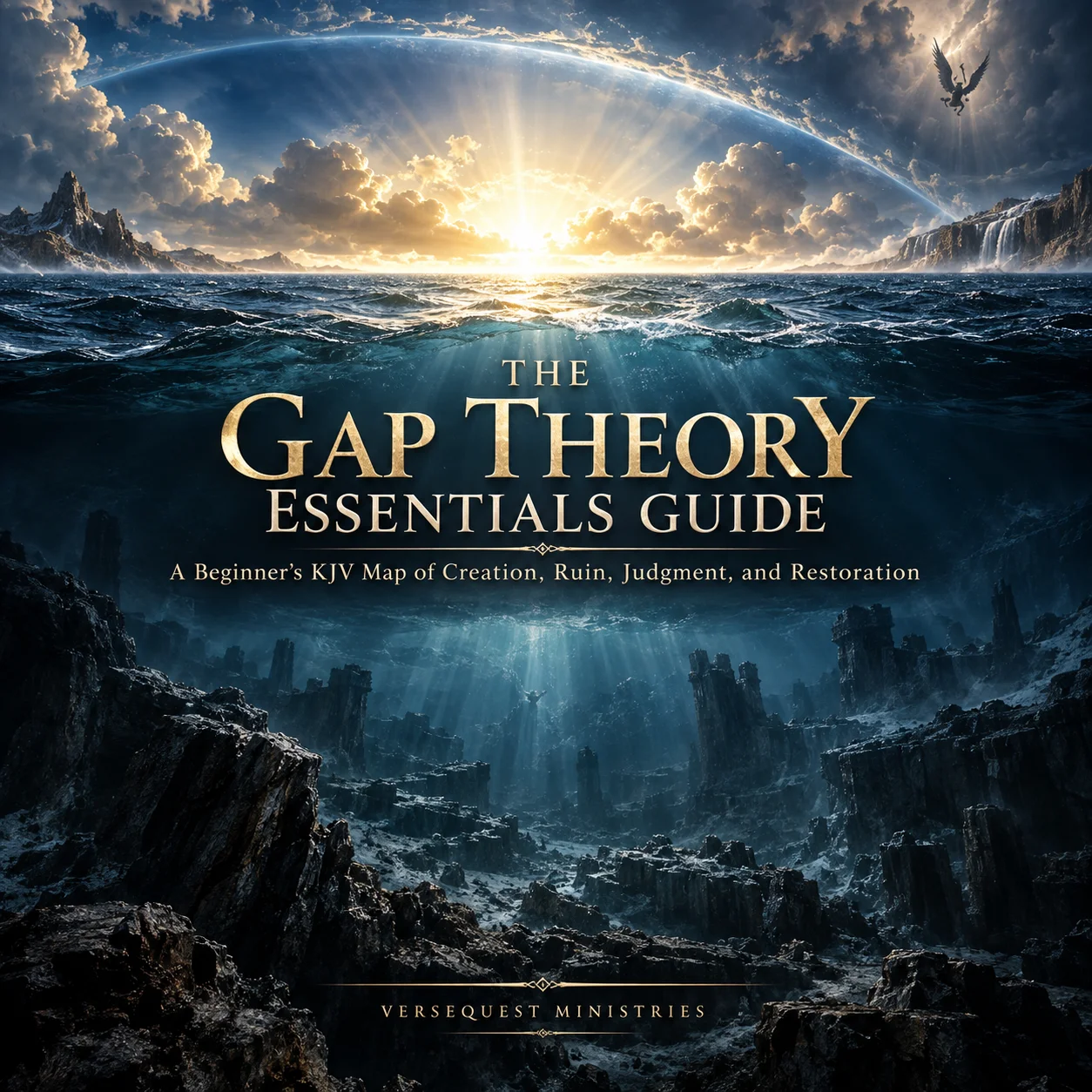
The Gap Theory Essentials Guide: A Beginner’s KJV Map of Creation, Ruin, Judgment, and Restoration
The Gap Theory Essentials Guide is a 72-page downloadable and printable KJV study explaining what may have occurred between the original creation of Genesis 1:1 and the dark, flooded condition described in Genesis 1:2.
Follow the biblical trail through the morning stars, the sons of God, Lucifer’s original perfection, his governmental rebellion, divine judgment, the firmament, the waters above, the six literal days of restoration, Adamic dominion, and Peter’s former, present, and coming worlds.
Every teaching passage is printed in full from the King James Bible. Definitions, doctrinal distinctions, major objections, common questions, twenty-five essential truths, and a five-minute summary make this an ideal introduction for beginners, new believers, discipleship classes, families, pastors, and Bible teachers.
This concise guide distills the essential case from the complete 326-page study The Gap Theory Examined. Download and print the complete PDF for $14.99 and begin following the evidence hidden in plain sight throughout the Bible.
$14.99
Description
The Gap Theory Essentials Guide is a 72-page downloadable and printable PDF study created to introduce beginning Bible students to one of the most fascinating and frequently misunderstood subjects in the opening chapters of Scripture. It presents the essential biblical case for a real pre-Adamic history, Lucifer’s rebellion, the catastrophic condition described in Genesis 1:2, and God’s six-day restoration of the earthly realm for Adam.
The study begins with the controlling question: What happened between the original creation of “the heaven and the earth” in Genesis 1:1 and the dark, flooded, formless condition described in the following verse? Rather than building the doctrine upon speculation, modern scientific theories, or the authority of a particular teacher, the guide follows the words of the King James Bible through Genesis, Job, Psalms, Isaiah, Jeremiah, Ezekiel, the New Testament epistles, and Revelation.
Readers will examine the difference between original creation and subsequent ordering, why the word “was” does not need to be changed to “became,” and why the little word “And” cannot be used as a stopwatch. The guide compares Genesis 1:2 with Isaiah’s declaration that God formed the earth to be inhabited and Jeremiah’s inspired use of “without form, and void” to describe a land devastated under divine judgment.
The study then follows the biblical witnesses from before Adam. Job records the morning stars singing and the sons of God shouting when the foundations of the earth were laid. Ezekiel reveals a created being who was once perfect, beautiful, wise, and appointed as the anointed cherub that covereth. Isaiah exposes Lucifer’s throne, his five rebellious declarations, and his desire to exalt himself above the stars of God. Together, these passages establish that the serpent entered Adam’s garden with a history of rebellion already behind him.
The guide walks carefully through the six literal days in Genesis, showing the movement from darkness to light, divided waters, established boundaries, appearing land, appointed lights, abundant life, and Adamic dominion. It explains that the Gap Theory taught in this study does not turn the six days into evolutionary ages, does not require another race of human beings before Adam, and does not depend upon Darwin, modern geology, or speculative timelines.
A dedicated section introduces the biblical firmament, the waters above, the heavenly lights, the morning stars, and the structured government of the unseen realm. The guide also compares the commissions given to Adam and Noah, examines Peter’s distinction between the world that then was, the heavens and earth which are now, and the promised new heavens and new earth.
The strongest objections are answered directly, including questions concerning Exodus 20:11, Romans 5, the words “very good,” the relationship between “created” and “made,” the history of the doctrine, and the claim that the Gap Theory was invented to accommodate evolution. The reader is also shown where responsible Bible study must stop. Explicit Scripture, strong biblical conclusions, possible but unrevealed details, and unsupported speculation are carefully distinguished.
Every Bible passage used as a teaching proof is printed in full from the King James Bible. Readers do not need to stop continually and look up references while learning the basic case. Definitions, summary panels, comparisons, common questions, memorable statements, twenty-five essential truths, and a five-minute explanation make the material accessible without reducing the authority or depth of Scripture.
This Essentials Guide distills the central argument of the complete 326-page, fifty-study volume The Gap Theory Examined into a concise introduction. It is suitable for newly saved Christians, beginning Bible students, pastors, teachers, preachers, Sunday school classes, families, discipleship groups, and serious readers who want to understand the Gap Theory before beginning a larger doctrinal investigation.
The Gap Theory Essentials Guide is available for $14.99 as a digital PDF that may be downloaded, read electronically, and printed for personal Bible study.
Original creation and subsequent ruin — The guide distinguishes God’s original creation statement from the dark and watery condition immediately described afterward. The controlling question of Genesis 1:1–2 — Readers are taught to slow down and examine the change between creation and desolation. The authority of the King James Bible — The doctrine is developed without changing “was” to “became” or placing human scholarship above the preserved text. The language of divine judgment — Isaiah and Jeremiah demonstrate that confusion, emptiness, darkness, and desolation belong naturally within judgment settings. A pre-Adamic heavenly order — Job’s morning stars and sons of God establish conscious heavenly beings before the creation of Adam. Lucifer’s original perfection — Satan was not created evil but began as a beautiful, wise, and appointed cherub. Lucifer’s governmental rebellion — His desire to exalt his throne reveals a revolt against divine authority and heavenly order. The serpent’s earlier history — Genesis presents Satan entering Eden as an already fallen adversary rather than recording his original rebellion. The six literal days of restoration — God brings light, division, boundaries, habitation, life, and government to the earthly realm in six actual days. The Spirit moving over the waters — The Spirit of God is present over the ruined scene before divine speech commands light. The firmament and waters above — The guide introduces the real structure named by God and its place within biblical creation. Stars and heavenly government — Scripture presents stars in connection with angelic beings, warfare, worship, and delegated authority. Adamic dominion — Man receives earthly government beneath God after the restored world has been ordered and furnished. Adam and Noah compared — Their parallel commissions reveal two world-heads standing after distinct watery catastrophes. Peter’s former, present, and coming worlds — Biblical history is presented through successive ordered realms separated by judgment. Creation, rebellion, judgment, and restoration — The gap introduces a pattern that continues throughout the Bible and concludes in Revelation. Literal creation without evolution — The study rejects evolutionary ages, pre-Adamic human ancestors, and attempts to accommodate Darwin. Doctrine versus speculation — The guide separates explicit statements and strong biblical conclusions from interesting but unsupported theories. Responsible handling of mystery — Readers are encouraged to investigate difficult passages without pretending God revealed details He withheld. The final victory of divine government — Lucifer may rebel and ruin may follow, but God remains sovereign and ultimately makes all things new.
Central Argument
The Gap Theory Essentials Guide argues that Genesis 1:1 records God’s original creation of the heaven and earth, while Genesis 1:2 describes the earth after a catastrophic judgment. A real heavenly order existed before Adam, Lucifer rebelled within that order, and God restored and furnished the earthly realm in six literal days before granting dominion to man.
Major Observations
Genesis begins with creation rather than unfinished raw material. The heaven and earth are created before the narrative turns specifically to the earth’s condition.
The earth is described as without form, void, dark, beneath the deep, and covered by waters. These words describe condition but do not explain how the condition arose.
The word “was” does not need to be corrected. It tells the reader what the earth was like at that point in the account without supplying its entire previous history.
The word “And” connects the first and second verses but does not define the amount of time between the events described.
Isaiah declares that God did not create the earth in vain but formed it to be inhabited. Jeremiah later uses “without form, and void” to describe a land devastated under the fierce anger of the LORD.
Job places morning stars and sons of God at the laying of earth’s foundations. Therefore, intelligent heavenly beings existed before Adam.
Ezekiel reveals that the being later known as Satan was originally a perfect, beautiful, wise, and appointed cherub. Iniquity was found in him after his creation.
Isaiah describes Lucifer possessing a throne and attempting to exalt it above the stars of God. His rebellion was governmental rather than merely personal vanity.
The serpent enters Adam’s garden already opposed to God. He knows how to question Scripture, deny judgment, and sell rebellion as advancement.
The six-day narrative moves from darkness and waters toward light, boundaries, appearing land, habitation, life, and dominion. This movement is consistent with restoration and ordered government.
The firmament is made in the midst of the waters and divides waters below from waters above. The lights are then set within that firmament.
Adam receives dominion after the earthly realm has been prepared. The older rebel then attacks the newly installed earthly ruler through an assault upon the words of God.
Adam and Noah receive similar commands to be fruitful, multiply, and replenish the earth following two different watery settings.
Peter distinguishes the world that then was from the heavens and earth which are now and directs believers toward the coming new heavens and new earth.
Important Distinctions
- Original creation must be distinguished from six-day restoration.
- A pre-Adamic heavenly order must not be turned into a pre-Adamic human race.
- Six literal days must not be confused with evolutionary ages.
- Genesis 1:2 must not be identified automatically with Noah’s Flood.
- Satan’s original rebellion must be distinguished from his future casting down.
- A biblical star may carry personal or angelic significance without requiring every use of “star” to be interpreted identically.
- Explicit Scripture must be distinguished from a conclusion produced by comparing passages.
- A strong biblical conclusion must be distinguished from a possible but unrevealed detail.
- Possibility must be distinguished from unsupported speculation.
- The authority of Scripture must be distinguished from the popularity or reputation of any Bible teacher.
Doctrinal Conclusions
A pre-Adamic history is required because Lucifer must move from created perfection to satanic hostility before he appears as the serpent.
The Bible identifies a heavenly order existing at the foundations of the earth. That order included morning stars, sons of God, ranks, offices, thrones, dominions, principalities, and powers.
Lucifer’s rebellion brought divine judgment. The condition described in Genesis 1:2 bears the marks of ruin rather than God’s declared purpose for an inhabited earth.
The Spirit of God moves over the waters, and God begins restoring order through His spoken word. The restoration occurs in six literal days.
Adam is the first man and the head of the human race. The existence of an earlier angelic order does not require earlier human ancestors.
The doctrine does not depend upon evolution, billions of years, another race of men, or named lost civilizations.
Key Facts
- The completed Essentials Guide contains 72 pages.
- It is divided into nine principal teaching units followed by quick-reference material.
- Every teaching passage is printed in full from the King James Bible.
- The complete source study contains fifty investigations across 326 pages.
- The guide affirms six literal days.
- It leaves the duration of the gap undefined.
- It identifies the pre-Adamic order as heavenly and angelic.
- It answers the leading biblical and historical objections.
- It separates established doctrine from unsupported speculation.
- It concludes with twenty-five essential truths and a five-minute explanation.
Memorable Teaching Points
- Creation is stated first; the ruined condition is described second.
- The gap is before the numbered week, not inside its six literal days.
- Do not turn a conjunction into a stopwatch.
- The inspired allusion is a highlighter, not an eraser.
- Before Adam there was singing.
- The serpent did not enter Eden without a past.
- Satan’s first chapter was written near glory, not in hell.
- A throne without government is furniture.
- The subject is biblical government before it is geology.
- The wreckage is present, but so is the Spirit.
- The land appears because it was already beneath the waters.
- The model must serve the words; the words do not serve the model.
- Adam introduced death to men; he did not introduce iniquity into Lucifer.
- The Gap Theory needs Job’s morning stars, not Darwin’s missing links.
- Interest is not inspiration.
- When God speaks, ruin has an expiration date.
Subjects Worthy of Further Study
- The relationship between the morning stars and the sons of God.
- Lucifer’s office as the anointed cherub that covereth.
- The meaning of Lucifer’s sanctuaries and traffick.
- The governmental significance of Lucifer’s throne.
- The mount of the congregation and the sides of the north.
- The relationship between stars and angels in Scripture.
- The structure and purpose of the biblical firmament.
- The waters above the heavens.
- The parallels and differences between Adam and Noah.
- Peter’s former, present, and coming worlds.
- The stages of Satan’s fall and judgment.
- The recurring pattern of order, rebellion, judgment, desolation, restoration, and renewed government.
- The distinction between what Scripture reveals and what curiosity may imagine.
Personal Bible Study: Readers can work through the guide one page at a time, reading every complete Scripture panel and marking the repeated themes of creation, darkness, waters, heavenly government, rebellion, judgment, restoration, and dominion.
New-Believer Discipleship: The plain definitions and carefully ordered argument help newly saved Christians approach a difficult doctrine without requiring previous theological training.
Sunday School Lessons: The nine teaching units can be adapted into a focused series covering Genesis 1:1–2, judgment language, pre-Adamic witnesses, Lucifer’s rebellion, six-day restoration, biblical cosmology, Peter’s worlds, major objections, and responsible doctrinal boundaries.
Small-Group Study: Groups can read one section before meeting and use the complete KJV passages, summaries, common questions, and doctrinal distinctions as discussion material.
Family Bible Study: Parents can use the beginner-friendly explanations to introduce older children and teenagers to creation, Satan’s origin, the firmament, Adamic dominion, and the importance of comparing Scripture with Scripture.
Sermon Preparation: Pastors and preachers can use the guide’s biblical sequence, central distinctions, major passages, and memorable statements as a framework for sermons about creation, Lucifer’s fall, spiritual government, judgment, restoration, or the authority of Scripture.
Classroom Instruction: The material is suitable for introductory Bible doctrine, Genesis studies, creation studies, biblical cosmology, angelology, or Old Testament survey classes.
Ministry Training: Teachers can use the certainty categories to train students to distinguish explicit revelation, necessary conclusions, possibilities, and speculation.
Apologetics: The objection section provides concise responses to claims involving Exodus 20:11, Romans 5, Genesis 1:31, Hebrew word arguments, Darwin, and the historical popularity of the Gap Theory.
Preparation for Advanced Study: The guide supplies the foundation needed before reading the complete fifty-study volume or pursuing deeper investigations into biblical cosmology, Lucifer’s rebellion, heavenly government, and pre-Adamic judgment.
The King James Bible — Read the opening chapters of Genesis slowly and then trace the subject through Job, Psalms, Isaiah, Jeremiah, Ezekiel, the New Testament epistles, and Revelation.
The Gap Theory Examined — The complete 326-page VerseQuest volume contains fifty developed studies examining the biblical case, major objections, cross-references, implications, and responsible limits in much greater depth.
Genesis Essentials Guide — This VerseQuest guide supplies a broader beginner’s map of creation, the Fall, the Flood, Babel, the patriarchs, and the birth of Israel.
Dispensational Truth – Essentials Guide — This VerseQuest resource helps readers understand biblical divisions, divine administrations, and the importance of keeping different people, periods, and responsibilities in their proper places.
A complete KJV concordance — Useful for tracing creation, make, form, darkness, deep, waters, firmament, stars, sons of God, cherub, throne, dominion, judgment, and restoration.
A KJV cross-reference Bible — Helps readers follow the biblical connections distributed across Genesis, Job, the prophets, the epistles, and Revelation.
A Bible dictionary — Helpful for studying terms such as firmament, cherub, dominion, principality, sanctuary, traffick, deep, and replenishment.
A biblical creation timeline — Useful when it clearly distinguishes original creation, the condition described in Genesis 1:2, the six literal days, Adam’s fall, Noah’s Flood, the present world, and the coming new creation.
A visual study of the firmament — Helpful for examining the waters above, the lights set in the firmament, the throne above, and Scripture’s vertical creation structure.
A topical study of Satan’s career — Trace the created cherub, Lucifer’s rebellion, the serpent, the accuser, the tempter, the prince of this world, the dragon, his future casting down, and his final judgment.
A study of Job 1, Job 2, and Job 38 — These chapters are essential for identifying the sons of God, Satan’s heavenly access, and the morning stars present at the foundations of the earth.
A comparison of Isaiah 14 and Ezekiel 28 — These passages provide the principal prophetic testimony concerning Lucifer’s former rank, pride, rebellion, and judgment.
A study of 2 Peter 3 — Peter’s distinction between the former world, the present heavens and earth, and the world to come is essential to the larger doctrine of successive world-orders.
Related products
-
Premium Studies
-
-25%
- The Doctrine of Hell — Premium Essay Series PDF
- A 383-page premium VerseQuest PDF study book containing 54 KJV essays on hell, fire, darkness, judgment, the lake of fire, the second death, and Jesus Christ as the only escape.
- Original price was: $39.99.$29.99Current price is: $29.99.
- Add to cart
-
-25%
-
Bible Prophecy Charts
-
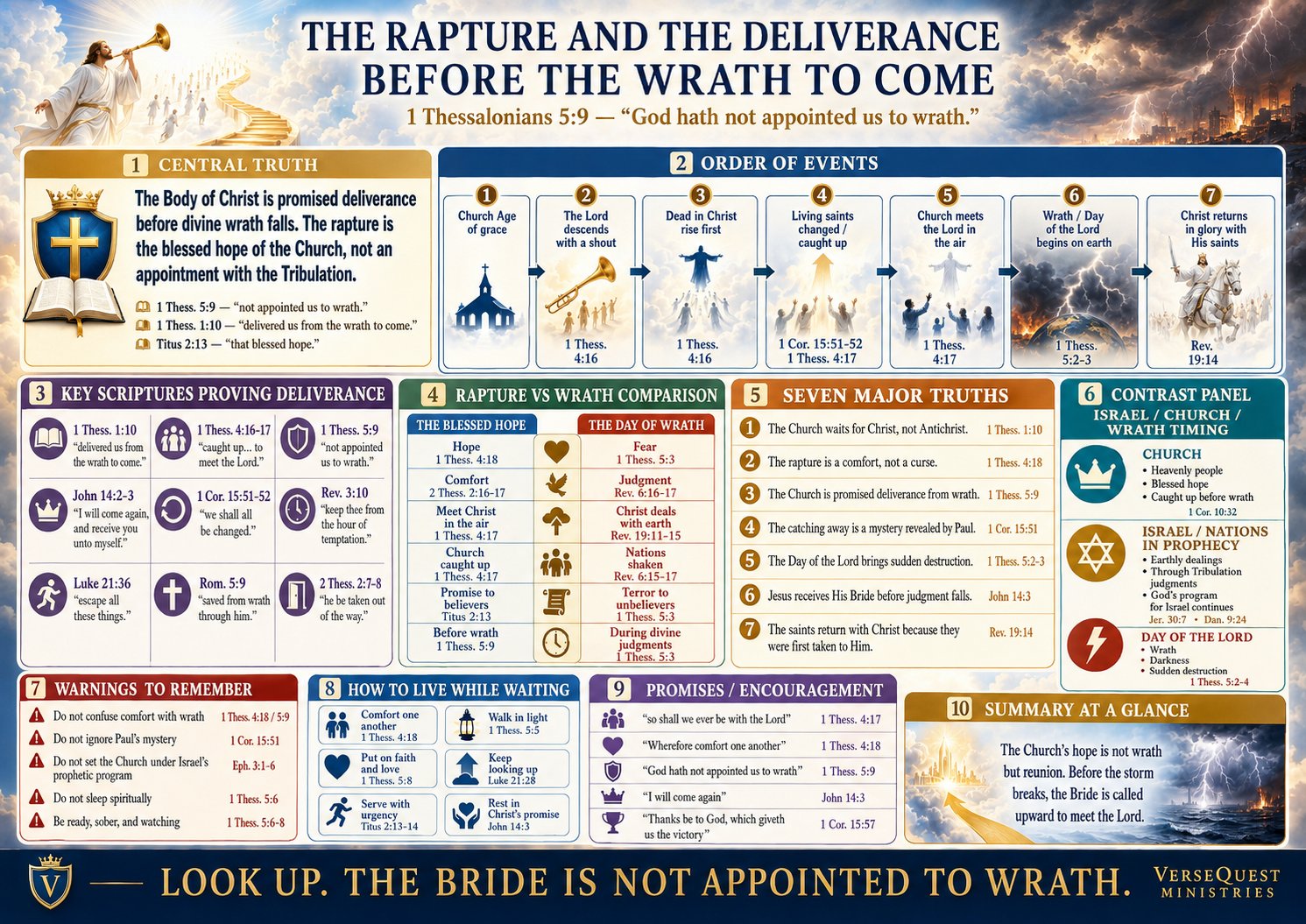
- The Rapture and the Deliverance Before the Wrath to Come – Printable Bible Study Chart
- Printable KJV Bible study chart on The Rapture and the Deliverance Before the Wrath to Come, showing from 1 Thessalonians 5:9 that the Church is not appointed to wrath. This…
- $4.99
- Add to cart
-
-
Jesus Christ
-
-10%
- The Lord Jesus Christ Made Plain – 637-Page KJV Bible Study
- A massive 637-page, 100-part KJV Bible study on the Person and work of the Lord Jesus Christ. This premium VerseQuest resource covers His deity, incarnation, blood, cross, resurrection, present ministry,…
- Original price was: $39.00.$34.99Current price is: $34.99.
- Add to cart
-
-10%
-
Chart Collections
-
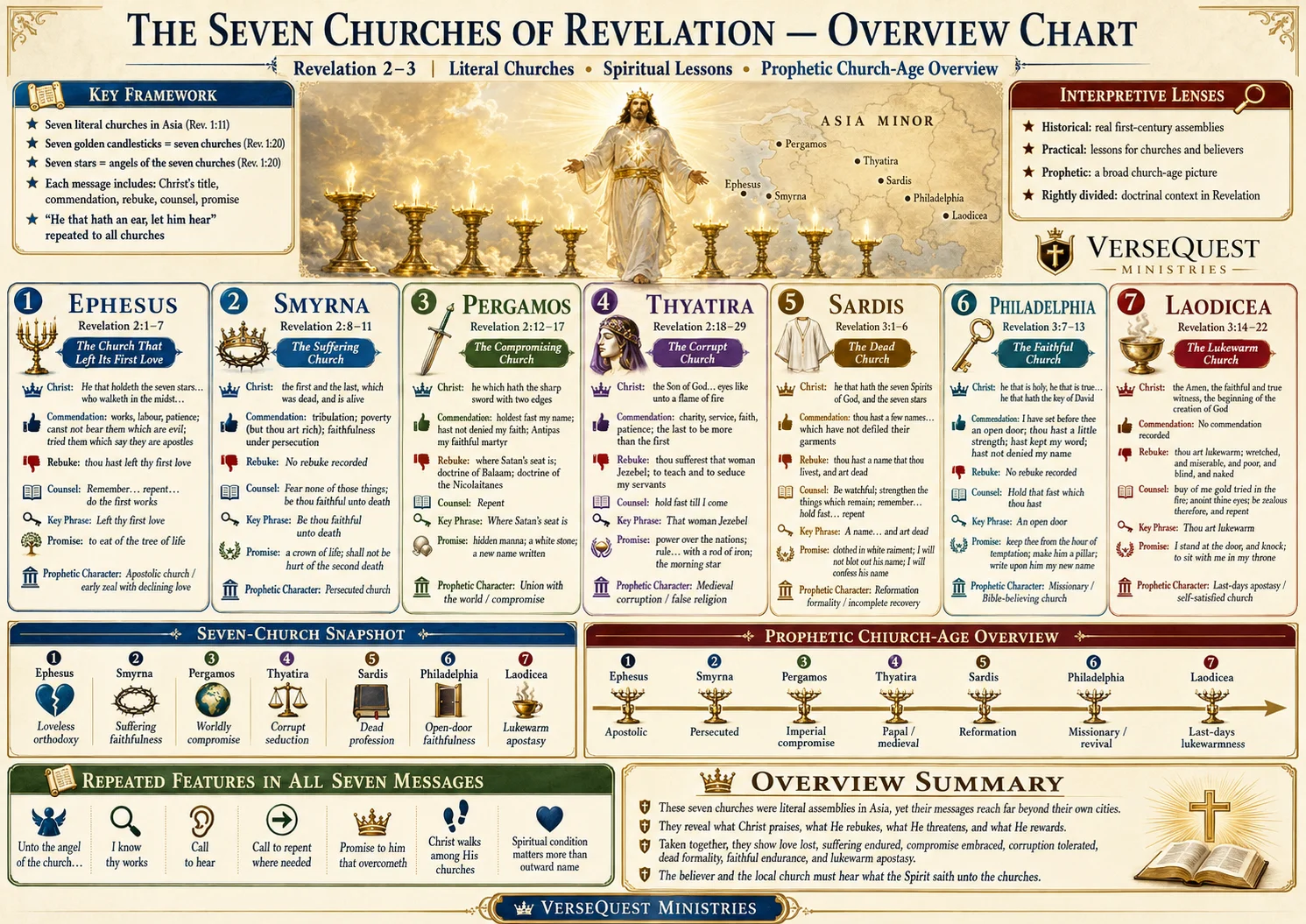
- The Seven Churches of Revelation Chart Collection – Christ Walking Among the Candlesticks
- A premium VerseQuest Ministries™ PDF chart collection covering the Seven Churches of Revelation in Revelation 2–3. Includes one overview chart plus individual KJV Bible study charts for Ephesus, Smyrna, Pergamos,…
- $12.99
- Add to cart
-
-
Premium VerseQuest Books
-
-75%
- Christ in the Old Testament Made Plain — 100-Essay KJV Study PDF
- A massive 670-page premium KJV Bible study PDF featuring 100 detailed essays showing Jesus Christ throughout the Old Testament in promise, type, sacrifice, Christophany, prophecy, suffering, resurrection, priesthood, and future…
- Original price was: $39.99.$9.99Current price is: $9.99.
- Add to cart
-
-75%