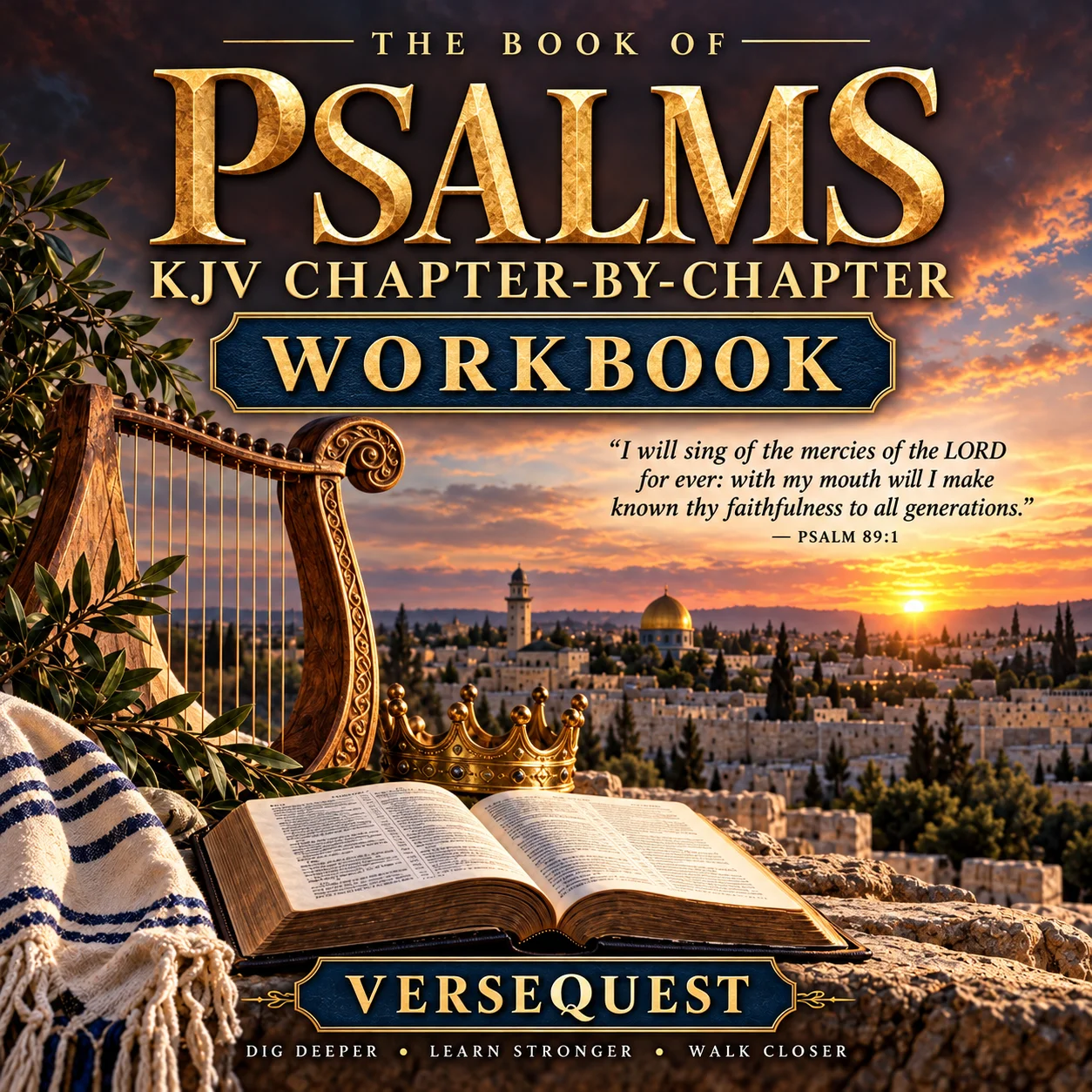
The Book of Psalms KJV Chapter-by-Chapter Workbook
The Psalms KJV Chapter-by-Chapter Workbook is a complete 2,431-page downloadable PDF Bible-study curriculum covering all 150 Psalms. Every Psalm receives a structured study including close observation, exposition, KJV vocabulary, doctrine and right division, cross-references, difficult passages, special studies, review questions, teach-back exercises, teacher guidance, suggested answers, and model summaries.
The workbook also includes 150 advanced studies, 24 master charts, cumulative reviews, assessments, glossary material, subject and Scripture indexes, teaching tools, a final project, course record, and certificate of completion. Designed for serious Bible students, pastors, teachers, homeschool families, Sunday schools, churches, and independent learners, this $59.99 digital resource is built to help the student study the Psalter deeply while keeping the King James Bible at the center.
$59.99
Description
The Psalms KJV Chapter-by-Chapter Workbook is a massive, 2,431-page downloadable PDF Bible-study curriculum designed to take the student through all 150 Psalms from beginning to end. Rather than treating Psalms as a collection of isolated devotional verses, this resource studies the Psalter as an inspired book containing prayer, worship, history, doctrine, prophecy, suffering, judgment, repentance, creation testimony, Messianic revelation, kingdom truth, and praise. It is written for Bible students who want to know not merely what a favorite verse says, but how each Psalm works, who is speaking, what setting is involved, how the passage relates to the rest of Scripture, and what doctrinal and prophetic conclusions can legitimately be drawn from it.
Every Psalm receives a structured study built around a repeatable minimum 12-page chapter-study method. The student works through the Psalm’s focus and principal movements, close textual observation, exposition, speaker and superscription, literary structure, KJV vocabulary, doctrine and right division, cross-references, difficult passages, error correction, a special study, written review, teach-back exercises, teacher guidance, suggested answers, and a model summary. The method is intentionally consistent so the student develops disciplined Bible-study habits while the content remains specific to each individual Psalm.
The workbook also treats the five-book arrangement of Psalms as an important feature of the Psalter: Psalms 1–41, 42–72, 73–89, 90–106, and 107–150. Major subjects include Davidic experience, Messiah, the suffering and reigning Christ, Israel, Zion, Jerusalem, the Davidic covenant, the coming King and Kingdom, Tribulation and the believing remnant, imprecatory Psalms, prayer, praise, repentance, the written Word of God, judgment, resurrection, worship, creation, and the New Testament’s inspired use of Psalms. The course preserves the distinction between Israel and the Body of Christ and teaches students to separate historical setting, covenant ownership, prophecy, doctrine, typology, inference, and lawful present application.
Creation passages are also studied according to the wording of the King James Bible rather than automatically being interpreted through the modern secular cosmological model. The course includes dedicated preparation on biblical cosmology, the Genesis 1:1–2 ruin-restoration framework, the firmament, the heavens, the stars, and the heavenly host, while continuing to distinguish explicit Scripture from strong inference, possible connections, and speculation.
Beyond the 150 primary Psalm units, the workbook includes 150 advanced studies, 24 two-page master charts and analysis tools, cumulative reviews, Book reviews, assessments, an expanded KJV glossary, selected subject and Scripture indexes, teaching tools, course tracking pages, a final teaching project, a course-completion record, and a certificate of completion. The included study schedule provides a flexible 30-week path through the Psalter while allowing teachers and independent students to slow down for major passages such as Psalms 2, 16, 19, 22, 45, 51, 69, 72, 89, 91, 104, 110, 118, and 119.
This is not designed to replace the Bible. It is designed to drive the student repeatedly back into the King James Bible. Observation comes before opinion, Scripture is compared with Scripture, difficult questions are examined rather than avoided, and students are expected to support conclusions from the text. The result is a serious curriculum suitable for personal study, homeschool Bible education, Sunday school, church classes, ministry training, sermon preparation, discipleship, and advanced group study.
The purchase includes the complete 2,431-page digital PDF workbook for $59.99. Because this is a digital PDF resource, no physical book is shipped.
The Five Books of Psalms — The structural divisions of Psalms 1–41, 42–72, 73–89, 90–106, and 107–150. The Blessed Man and the Wicked — The continuing contrast between righteousness and rebellion introduced in Psalm 1. Messiah in the Psalms — Direct Messianic prophecy, inspired New Testament quotations, and carefully distinguished typological connections. The Suffering Messiah — Rejection, reproach, betrayal, crucifixion, suffering, and resurrection. The Reigning Messiah — Zion, throne, inheritance of the nations, rod of iron, righteous government, and worldwide dominion. The Davidic Covenant — David, his seed, his throne, and the prophetic expectation of the greater Son of David. Israel, Zion, and Jerusalem — Literal covenant identities preserved rather than automatically transferred to the Church. Tribulation and the Believing Remnant — Psalms of persecution, enemy oppression, national distress, deliverance, and divine intervention. The Kingdom of God on Earth — The coming righteous King, restored order, judgment of enemies, peace, justice, and praise among the nations. Imprecatory Psalms — Calls for divine judgment examined in their historical, covenant, prophetic, and dispensational settings. Prayer — Confession, petition, intercession, lamentation, thanksgiving, appeal, and answered prayer. Praise and Worship — Worship rooted in the character, works, promises, judgments, mercy, and kingship of the LORD. Repentance and Restoration — Sin, guilt, confession, cleansing, chastening, mercy, and renewed usefulness. The Written Word of God — Law, testimonies, statutes, precepts, commandments, judgments, truth, and the Word, especially in Psalm 119. KJV Vocabulary — Important biblical words studied from immediate context and Scripture-to-Scripture comparison. Biblical Cosmology and Creation — Heavens, firmament, waters, earth, foundations, sun, moon, stars, and heavenly host. Genesis 1:1–2 Ruin-Restoration — A pre-Adamic original creation, judgment associated with Lucifer, and subsequent restoration framework. Death, Hell, Resurrection, and Life — Major Psalm passages concerning mortality, the grave, deliverance, resurrection, and eternal hope. New Testament Use of Psalms — Inspired quotations and applications given priority in interpretation. Right Division — Historical Israel, Mosaic law, Davidic covenant, the Body of Christ, prophecy, kingdom truth, and present application kept in proper relationship. Certainty in Interpretation — Conclusions distinguished as explicit, strong inference, possible, or speculative.
The central approach of this workbook is that Psalms must be studied as Scripture before it is used as inspiration. Familiar verses are not detached slogans. Every statement belongs to a Psalm with a speaker, movement, setting, vocabulary, argument, and conclusion. The student is repeatedly taught to read the complete composition before isolating individual lines and to establish explicit facts before building doctrine, prophecy, typology, or application.
The five-book arrangement provides an important framework for understanding the whole Psalter. Book I covers Psalms 1–41 and gives heavy attention to blessedness, conflict, Davidic experience, Messiah, and redemption. Book II, Psalms 42–72, develops longing, opposition, deliverance, Israel, and the righteous King. Book III, Psalms 73–89, concentrates strongly on sanctuary questions, national distress, Zion, and the Davidic covenant. Book IV, Psalms 90–106, brings Moses, mortality, creation, wilderness history, mercy, and the reign of the LORD into prominence. Book V, Psalms 107–150, moves through redemption, Scripture, pilgrimage, restoration, and increasing praise until the entire book closes in Hallelujah.
One of the workbook’s most important interpretive principles is that the New Testament is allowed to identify Messianic Psalms for itself. Where Christ, the apostles, or inspired New Testament writers apply a Psalm to Jesus Christ, that inspired application receives priority. Elsewhere the course distinguishes direct prophecy from typology and from possible resemblance. This keeps the student from both extremes: denying clear Messianic prophecy or turning every sentence David speaks into a direct prediction of Christ.
Right division remains equally important. Israel is not silently converted into the Body of Christ, Zion does not cease to be Zion, Jerusalem does not become a vague spiritual metaphor whenever interpretation becomes inconvenient, and the Davidic throne is not detached from the covenant God made with David. Present-day believers may receive instruction and application from the entire Bible while still respecting the audience, covenant, office, land, kingdom, and prophetic setting of the passage.
The Psalms also provide one of Scripture’s richest fields for studying the King and His Kingdom. The student encounters the Son in Psalm 2, the suffering Messiah in Psalm 22, the royal Bridegroom in Psalm 45, the righteous King in Psalm 72, the Davidic covenant in Psalm 89, and the Priest-King in Psalm 110. These passages do not stand alone; together they form a network of revelation reaching into the Gospels, Acts, Hebrews, and Revelation.
Psalm 119 receives special importance because the Psalter itself places extraordinary emphasis upon God’s written revelation. Law, word, testimonies, statutes, commandments, precepts, judgments, and truth are not treated as interchangeable religious slogans. Students are trained to notice wording carefully and compare the KJV with the KJV before appealing to outside explanations.
The workbook also addresses difficult material rather than avoiding it. Imprecatory Psalms, enemies, judgment, hell, resurrection, disputed superscriptions, Selah, musical terminology, prophetic horizons, and passages frequently removed from context all receive structured investigation. The recurring certainty labels — Explicit, Strong Inference, Possible, and Speculative — teach students not to present an attractive possibility as though God had plainly stated it.
Creation passages are approached from the language of Scripture itself. The course includes dedicated study of the heavens, firmament, waters, foundations of the earth, sun, moon, stars, and heavenly host, along with a Genesis 1:1–2 ruin-restoration framework. The stated method remains consistent: text first, interpretive framework second, and honest certainty labels throughout.
A major goal of the workbook is teach-back mastery. The student should ultimately be able to close the workbook, open the King James Bible, explain the Psalm’s central truth, trace its movements, identify its key doctrine, preserve its necessary dispensational distinctions, answer a difficult question, connect legitimate cross-references, and give a lawful application. If the student cannot explain the Psalm without reading the workbook aloud, more study is needed.
Personal Bible Study: Work through one Psalm at a time using the observation, exposition, vocabulary, cross-reference, difficult-passage, and teach-back sections. The workbook is especially suited for students who want a guided method without replacing their own reading of the KJV.
Homeschool Bible Curriculum: The course includes measurable written assignments, reviews, advanced worksheets, assessments, progress tracking, teaching exercises, and a certificate of completion. A flexible 30-week plan allows approximately five Psalms per week while giving longer studies extra time.
Sunday School and Church Classes: Teachers can use the core Psalm pages as the weekly lesson and draw from the advanced material for additional depth. Observation questions, doctrinal distinctions, cross-references, review material, and teacher guidance support structured classroom teaching.
Sermon and Lesson Preparation: Pastors and teachers can use Psalm outlines, principal movements, KJV vocabulary, cross-reference chains, prophetic connections, difficult-passage studies, and advanced investigations as preparation tools for sermons and Bible lessons.
Small Groups and Discipleship: The questions and teach-back format encourage students to explain the text from Scripture rather than merely offer opinions. Groups can work through a Psalm, compare answers, and require verse support for conclusions.
Family Bible Study: Families can select shorter Psalms or major thematic Psalms and use the workbook to guide reading, discussion, vocabulary, doctrinal instruction, and Scripture comparison.
Ministry and Bible-Institute Training: The workbook trains students in a repeatable method of observation, interpretation, right division, cross-referencing, certainty labeling, difficult-passage analysis, and teaching the text back to others.
Authorized King James Bible — The primary and controlling text for every lesson.
A KJV Concordance — Useful for tracing repeated words, expressions, names, and themes across Scripture.
Treasury of Scripture Knowledge or Comparable Cross-Reference Tool — Helpful for building Scripture-to-Scripture connections.
Reliable Bible Dictionary — Useful after contextual study for historical terms, places, objects, customs, and older English vocabulary.
Bible Atlas and Biblical Maps — Helpful for Jerusalem, Zion, wilderness settings, Israel’s geography, Davidic history, and pilgrimage Psalms.
Chronological Bible Timeline — Useful for placing historically titled Psalms alongside events in Samuel, Kings, and Chronicles.
1 Samuel and 2 Samuel — Essential historical companions for many Davidic Psalms.
1 Kings, 2 Kings, 1 Chronicles, and 2 Chronicles — Important for Davidic covenant, temple, kingship, Jerusalem, worship, and national history.
The Four Gospels and Acts — Essential for studying inspired Messianic applications and quotations from Psalms.
Hebrews — Particularly important for Psalms concerning Christ’s Sonship, priesthood, suffering, enthronement, and kingdom.
Revelation — Valuable for studying the nations, Messiah’s rule, judgment, kingdom themes, heavenly worship, and prophetic parallels.
VerseQuest 1 Chronicles KJV Chapter-by-Chapter Workbook — A companion VerseQuest curriculum for Davidic history, worship, priestly service, and kingdom preparation.
VerseQuest 2 Chronicles KJV Chapter-by-Chapter Workbook — A companion study emphasizing the temple, Davidic throne, Judah, worship, prophecy, reform, judgment, and captivity.