
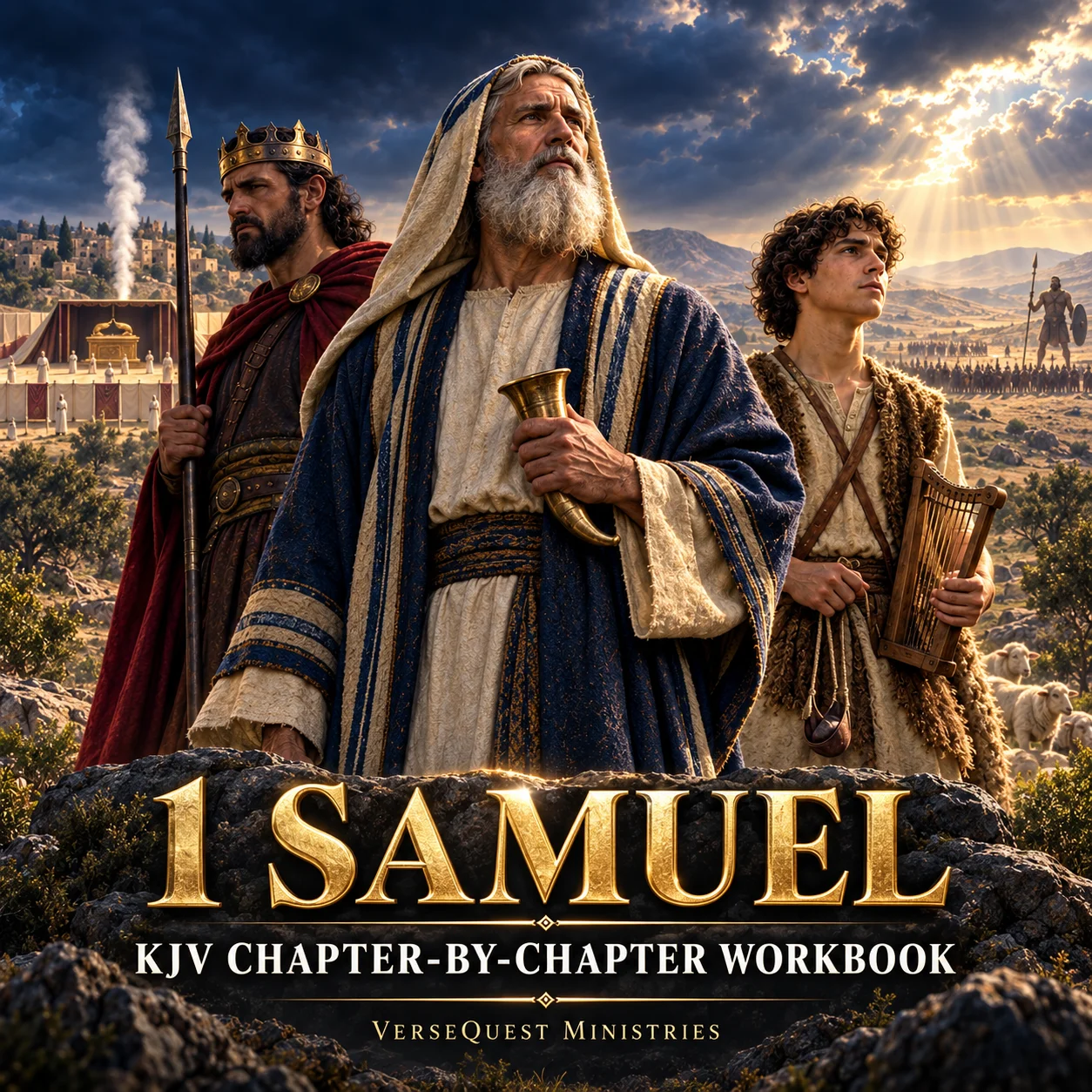
1 Samuel KJV Chapter-by-Chapter Workbook
The 1 Samuel KJV Chapter-by-Chapter Workbook is a complete 516-page downloadable Bible curriculum covering all 31 chapters of 1 Samuel from a Bible-believing, King James Bible-centered, rightly divided perspective.
Every chapter receives twelve coordinated pages: ten student-study pages followed by a Teacher and Leader Guide and suggested answers. Students will examine Hannah’s prayer, Samuel’s call, Eli’s house, the ark and Dagon, Ebenezer, Israel’s demand for a king, Saul’s rise and rejection, Jonathan’s faith, David’s anointing, Goliath, Saul’s persecution, Adullam, Abigail, Endor, Ziklag, and the battle of Gilboa.
The workbook also includes learning tracks, a 31-week schedule, semester plan, 62-lesson teaching schedule, historical and geographical studies, six cumulative reviews, eighteen advanced studies, ten master charts, an eight-part final assessment, answer guidance, KJV glossary, subject and Scripture indexes, final teaching project, evaluation rubric, bookmarks, final challenge, and certificate of completion.
The searchable PDF may be printed for handwritten study or used digitally with compatible PDF software. It is ideal for personal study, homeschool, Christian schools, Sunday school, church classes, small groups, Bible institutes, discipleship, and ministry training.
$19.99
Description
The 1 Samuel KJV Chapter-by-Chapter Workbook is a complete 516-page downloadable Bible curriculum designed to guide students carefully through all 31 chapters of 1 Samuel. This substantial course moves beyond a simple retelling of familiar events by requiring direct interaction with the King James Bible through chapter observation, exposition, written exercises, KJV vocabulary, doctrinal study, cross-reference work, difficult-passage analysis, controlled typology, personal application, review, and teaching preparation.
First Samuel records one of the most important transitions in Israel’s history. The book opens during the closing days of the judges, when the word of the LORD is precious and open vision is rare. It then traces the birth and preparation of Samuel, the corruption and judgment of Eli’s house, the capture and return of the ark, Israel’s repentance at Mizpeh, the nation’s demand for a king, the rise and rejection of Saul, the anointing of David, the defeat of Goliath, Saul’s murderous jealousy, Jonathan’s covenant loyalty, David’s years of flight and testing, the tragedy at Endor, the recovery of Ziklag, and Saul’s final defeat upon Mount Gilboa.
Samuel stands at the center of Israel’s transition from the unstable period of the judges to the establishment of the monarchy. Students will examine Hannah’s surrendered prayer, Samuel’s childhood service at Shiloh, the return of the word of the LORD, Samuel’s prophetic authority, his ministry of intercession, his national circuit, his role in anointing two kings, and his faithfulness after Israel’s demand for a king personally grieved him.
The ark narrative in 1 Samuel 4–7 receives careful treatment. Israel attempts to use the ark as a guarantee of military success, but God refuses to become an instrument of religious presumption. The ark is captured, Dagon falls before it, the Philistine cities suffer beneath the hand of the LORD, and the men of Beth-shemesh discover that rejoicing does not excuse irreverence. Israel’s eventual repentance at Mizpeh and Samuel’s erection of Ebenezer demonstrate the difference between manipulating sacred things and returning to the LORD with the whole heart.
The workbook carefully examines Israel’s demand for a king “like all the nations.” Students will compare the demand with the instructions of Deuteronomy 17, study Samuel’s warning concerning the manner of the king, and trace the difference between God permitting Israel’s request and approving its motives. The monarchy does not replace the authority of the LORD or release the king from submission to His word.
Saul’s entire course receives detailed attention. The workbook follows him from his impressive outward appearance, private anointing, confirming signs, changed heart, Spirit-enabled service, and victory at Jabesh-gilead into impatience, fear, rash vows, partial obedience, excuse-making, envy, attempted murder, unlawful consultation, and final defeat. His life provides a sobering study of spiritual privilege without continued obedience, public gifting without inward submission, and religious sacrifice used as a substitute for obeying the word of God.
Particular attention is given to the important doctrinal questions surrounding Saul. Students will examine what it means that God gave Saul another heart, how the Spirit of God came upon him, why the Spirit later departed from him, and how these Old Testament governmental and royal experiences differ from the sealing of believers in the Body of Christ. The workbook also addresses the statements that the LORD repented that He had made Saul king while “the Strength of Israel will not lie nor repent,” showing the difference between God’s unchanging character and His changing governmental dealings with responsible men.
David’s preparation begins in the sheepfold rather than the palace. The workbook follows his private anointing, musical service before Saul, victory over Goliath, friendship with Jonathan, wisdom under pressure, escape from Saul, reception of distressed followers at Adullam, protection of Keilah, wilderness testing, refusal to kill Saul, encounter with Abigail, dangerous compromise among the Philistines, deliverance from fighting against Israel, and recovery of everything taken from Ziklag.
The famous account of David and Goliath is treated within its historical, covenant, and prophetic setting. Students will examine Goliath’s challenge against the armies of the living God, Israel’s fear, Saul’s paralysis, David’s remembrance of earlier deliverances, his refusal of unproved armor, and his confidence that “the battle is the LORD’S.” David may be studied as a controlled type of the Lord Jesus Christ—the anointed champion who defeats the enemy before the people share in the victory—without turning every stone, weapon, or incidental detail into unsupported allegory.
Jonathan’s faith and covenant loyalty provide a powerful contrast with Saul’s envy. The workbook examines Jonathan’s attack upon the Philistine garrison, his confidence that there is no restraint to the LORD to save by many or by few, his covenant with David, his willingness to surrender personal advantage, his defense of David before Saul, and the tragedy of his continuing identification with his father’s doomed house.
The difficult and controversial passages of 1 Samuel are not ignored. The workbook addresses Samuel’s statement that he did not yet know the LORD, the judgment at Beth-shemesh, the wording of Saul’s reign in 1 Samuel 13:1, Jonathan and Saul’s rash oath, God’s repentance concerning Saul, the evil spirit from the LORD, Saul’s later inquiry about David’s family, David and the shewbread, conditional revelation concerning Keilah, David’s refusal to touch the LORD’s anointed, the appearance of Samuel at Endor, the condition of the dead, and the differing accounts connected with Saul’s death.
Every chapter receives a coordinated twelve-page treatment. The first ten pages contain the chapter focus and structure, detailed exposition, people and motives, KJV vocabulary, doctrine and right division, cross-reference chains, difficult-passage study, a special study, written exercises, and review with teach-back preparation. The final two pages provide a Teacher and Leader Guide followed by suggested answers, interpretive guidance, a model chapter summary, and evaluation standards.
The extensive supplementary material turns the workbook into a complete curriculum. It includes course instructions, purpose and outcomes, interpretive principles, multiple learning tracks, a 31-week course schedule, a semester schedule, a 62-lesson teaching plan, historical setting, the transition from judges to monarchy, structural overview, working chronology, geography study, character map, major themes, repeated words and titles, and an assessment plan.
Six cumulative review units reinforce the movement of the entire book. Eighteen advanced studies explore such subjects as Hannah’s prayer, Eli’s house, the restoration of the word, the ark, Israel’s demand for a king, Saul’s changed heart and Spirit experience, God’s repentance, the man after God’s own heart, the rejected anointed king, David and Goliath, Jonathan’s covenant loyalty, Saul’s attempts against David, Adullam, conditional knowledge at Keilah, vengeance and conscience, Abigail’s intercession, Endor, and Saul’s death.
Ten master-chart studies help students visualize the book’s principal relationships. These cover the book at a glance, Samuel–Saul–Jonathan–David comparisons, patterns of rise and decline, the journey of the ark, Israel’s changing government, Saul’s downward steps, David under pressure, covenants and oaths, anointed office and moral character, and the proper use and limitation of biblical typology.
The final portion contains an eight-part course assessment, suggested answers and evaluation guidance, an eight-page KJV glossary, selected subject and Scripture indexes, a final teaching project, project requirements, a 100-point evaluation rubric, further-study recommendations, a final spiritual challenge, and a certificate of completion.
This downloadable PDF may be printed for handwritten work or studied on a computer or tablet. Its searchable text and organized navigation bookmarks make the major sections, chapters, advanced studies, charts, reviews, and reference material easy to locate. With compatible PDF software, students may also highlight text, insert comments, draw markings, and add typed notes.
The 1 Samuel KJV Chapter-by-Chapter Workbook is suitable for serious personal Bible study, homeschool families, Christian schools, Sunday school classes, church Bible-study groups, discipleship programs, Bible institutes, prison and recovery ministries, pastors, preachers, and teachers. It is a working Bible curriculum designed to help students hear the words of Scripture accurately, distinguish appearance from heart, understand the difference between gifting and obedience, recognize the danger of religious presumption, restrain vengeance, trust the LORD under pressure, and teach the book of 1 Samuel faithfully.
The transition from judges to monarchy — First Samuel records the movement from temporary judges to an established national kingship. The restoration of the word of the LORD — The book begins with revelation rare and concludes Samuel’s early ministry with the LORD revealing Himself by His word. Hannah’s prayer and surrender — Personal affliction becomes the setting through which God prepares a national prophet. The LORD of hosts — The divine title introduced in Hannah’s setting emphasizes God’s command over every earthly and heavenly power. The corruption of Eli’s sons — Religious office becomes a means of satisfying appetite and abusing sacred privilege. Eli’s failure to restrain evil — Eli condemns his sons verbally but honors them above God by failing to act. Samuel’s prophetic call — Samuel learns to hear and deliver the word of the LORD, including painful judgment. The testing of a true prophet — Samuel’s words are confirmed, and all Israel recognizes that he is established as a prophet. The ark and religious presumption — Israel attempts to use the ark as a guarantee of victory without repentance or divine instruction. Ichabod and departed glory — The loss of the ark exposes the nation’s deeper spiritual condition. The humiliation of Dagon — The LORD defends His name without assistance from Israel’s army. The holiness of God — Philistines and Israelites alike discover that sacred things cannot be manipulated or handled carelessly. Repentance at Mizpeh — Israel’s return includes putting away strange gods, preparing the heart, confession, fasting, and dependence upon the LORD. Ebenezer and remembered help — Samuel’s memorial directs attention to the LORD’s past faithfulness. Israel’s desire to imitate the nations — The demand for a king reveals dissatisfaction with Israel’s distinctive relationship to the LORD. The cost of centralized royal power — Samuel warns repeatedly that the king will take sons, daughters, fields, servants, seed, and flocks. Providence through ordinary events — Lost animals, servants, meals, journeys, reports, and military interruptions become instruments of divine direction. Saul’s outward qualifications — Saul possesses the physical appearance Israel expects in a king. Saul’s changed heart and empowerment — God equips Saul for royal responsibility without eliminating his duty to continue in obedience. The difference between gifting and character — Saul’s signs, prophecy, anointing, and victories do not protect him from later rebellion. Saul’s impatience at Gilgal — Fear of scattered support leads Saul to cover unbelief with religious action. Jonathan’s faith — Jonathan understands that the LORD is not restrained by numbers, weapons, or visible disadvantage. The danger of rash vows — Saul’s attempt to control the battle through an oath weakens Israel and nearly kills Jonathan. Obedience above sacrifice — Religious offerings cannot compensate for rejecting the commandment of the LORD. Partial obedience as rebellion — Saul destroys what is undesirable while preserving what benefits his pride and reputation. God’s repentance and unchanging character — God changes His governmental dealings consistently without becoming unstable, mistaken, or deceptive. The LORD’s examination of the heart — David’s selection overturns man’s dependence upon countenance and stature. David’s private preparation — The sheepfold, lion, bear, harp, and daily faithfulness prepare David before public recognition. The anointed but rejected king — David is appointed before enthronement and prepared through years of opposition. David and Goliath — Covenant faith confronts the champion who defies the armies of the living God. The battle belonging to the LORD — David uses tested means while placing confidence in God rather than weapons. Jonathan’s covenant loyalty — Jonathan responds to David’s rise by giving, defending, strengthening, and keeping covenant. Saul’s murderous envy — Jealousy causes Saul to interpret David’s faithfulness as a threat. David’s wise behavior — David repeatedly serves, flees, waits, and refuses to seize the kingdom through rebellion. The rejected king at Adullam — Distressed, indebted, and discontented people gather to David while the reigning government opposes him. Conditional divine knowledge — The Keilah account demonstrates God’s knowledge of what men would do under conditions that never finally occur. Conscience and restraint — David’s heart smites him even for cutting Saul’s skirt. Refusal of personal vengeance — David leaves judgment and succession with the LORD. Abigail’s wise intercession — Courageous, humble counsel prevents David from staining his future reign with needless bloodshed. The fear of man — Fear leads David into deception, flight, divided loyalties, and Philistine entanglement. Forbidden occult consultation — Saul seeks a familiar spirit after repeatedly rejecting the word already given. Providential escape from compromise — Philistine suspicion removes David from a position in which every apparent choice carries grave danger. Encouragement in the LORD — At Ziklag, David turns from grief and accusation to ordered inquiry and obedient pursuit. Shared reward and generous leadership — David protects the place of those too faint to fight but faithful in guarding the supplies. Saul’s final harvest — Gilboa completes the downward course begun through impatience, excuse-making, rebellion, envy, and rejected correction. Israel and the Body of Christ distinguished — Israel’s monarchy, national covenant, priesthood, signs, and governmental Spirit ministry must not be indiscriminately transferred to the Church.
- Central argument: First Samuel demonstrates how the LORD restores His word through Samuel, permits Israel’s demand for a king, rejects Saul for rebellion, and prepares David through anointing, service, persecution, restraint, and providential preservation.
- Opening and conclusion: The book opens with a praying woman at Shiloh and closes with a rejected king dead upon Gilboa.
- The controlling movement: Prayer leads to a prophet, the prophet to national restoration, national dissatisfaction to a king, the king’s disobedience to rejection, and rejection to the preparation of David.
- The governmental transition: Judges give way to a national prophet, and the national prophet anoints the first kings of Israel.
- The spiritual opening: The word of the LORD is precious because revelation is rare.
- The spiritual recovery: The LORD reveals Himself at Shiloh by the word of the LORD through Samuel.
- Samuel’s first assignment: His prophetic ministry begins with a painful message against the household under which he has been raised.
- Eli’s failure: Eli knows the truth about his sons but fails to restrain their destructive conduct.
- The ark lesson: A sacred object cannot substitute for repentance, obedience, or the presence of God rightly honored.
- Dagon’s humiliation: The ark’s capture does not demonstrate the LORD’s defeat; it creates the setting for His unaided victory over Philistine idolatry.
- Beth-shemesh: Joy must remain governed by reverence and revealed order.
- Mizpeh: Israel’s repentance includes putting away idols rather than merely fearing consequences.
- Ebenezer: The stone looks backward to divine help while calling Israel to continued dependence.
- The king demand: Israel uses a legitimate leadership failure to justify a faithless desire to become like surrounding nations.
- Royal accountability: Israel’s king remains under the law and word of the LORD.
- Saul’s appearance: Saul possesses the visible height and strength desired by the nation.
- Saul’s opportunity: God gives Saul anointing, signs, another heart, spiritual enabling, national support, military victory, and prophetic instruction.
- Saul’s first decisive failure: At Gilgal, visible pressure becomes more important to him than waiting for the word of God.
- Saul’s recurring pattern: He fears the people, protects appearances, blames circumstances, uses religious language, and resists complete confession.
- Jonathan’s contrast: Jonathan recognizes that victory depends upon the LORD rather than the size of the army.
- The rash oath: Saul weakens the men through an unnecessary command and nearly destroys the son through whom God worked.
- Amalek: Saul preserves Agag and valuable spoil while claiming that he has performed the commandment.
- The bleating evidence: Saul’s own words are contradicted by what Samuel can hear.
- Obedience and sacrifice: Sacrifice offered from the proceeds of disobedience does not honor God.
- God’s repentance: The LORD changes His dealings toward Saul without changing His holy character or admitting a mistake.
- David’s selection: The LORD rejects the visible standard that caused Samuel to favor Eliab.
- David’s preparation: David’s public courage grows from earlier private faithfulness.
- Goliath: The Philistine champion trusts armor, size, reputation, and intimidation.
- David’s confidence: David trusts the name of the LORD while using a sling he has already proved.
- Representative victory: David defeats the champion before Israel rises to pursue the fleeing army.
- Controlled typology: David strongly pictures the anointed and rejected King, but his later sins prevent indiscriminate comparison with Christ.
- Jonathan’s covenant: Jonathan gives rather than grasps and recognizes God’s purpose even when it costs his expected succession.
- Saul’s envy: Another man’s faithfulness becomes unbearable because Saul views the kingdom as personal possession.
- David’s wisdom: Wise conduct does not remove persecution, but it prevents Saul’s accusations from becoming true.
- Nob: Fear and concealment place innocent people in danger, though Saul and Doeg remain responsible for the massacre.
- Adullam: The rejected anointed king becomes captain over distressed people who later develop under his leadership.
- Keilah: God truthfully reveals what the inhabitants would do if David remained, and the warning becomes the means of David’s departure.
- The cave at En-gedi: David’s men interpret opportunity as permission, but David tests opportunity by divine order.
- “Touch not the LORD’s anointed”: David refuses murder and usurpation, but he still exposes Saul’s injustice and appeals for judgment.
- Abigail: Her wisdom prevents David from turning a personal insult into needless bloodshed.
- The second sparing of Saul: Repeated restraint establishes that David’s conduct in the cave was not accidental.
- Philistine compromise: David’s inward conclusion that he will perish contradicts the future God has already revealed.
- Endor: Rejected revelation is not repaired through forbidden revelation.
- The appearance at Endor: The narrative repeatedly identifies the figure as Samuel, while the woman’s surprise shows that the event exceeds her ordinary practice and control.
- Ziklag: David’s turning point begins before his circumstances improve: he encourages himself in the LORD his God.
- Ordered inquiry: After a prolonged period of compromise, David again seeks direction before acting.
- Recovery and generosity: David recovers all and refuses to despise those too faint to cross the brook.
- Gilboa: Saul’s final defeat is the harvest of a long pattern rather than an isolated failure.
- Jabesh-gilead: The men remember Saul’s earlier deliverance and risk themselves to recover his body.
- Important distinction: Saul’s anointing, signs, prophecy, changed heart, and Spirit empowerment belong to his Old Testament royal setting and must not be equated automatically with the believer’s position in the Body of Christ.
- Question for further study: How does Samuel combine prophetic authority, intercession, judgment, and public accountability?
- Question for further study: At what points could Saul have responded differently to correction?
- Question for further study: How do Jonathan’s faith and loyalty expose the selfishness of Saul’s rule?
- Question for further study: What separates waiting for the LORD from passive refusal to act?
- Question for further study: Which parallels between David and Christ are directly supported by later Scripture?
- Memorable teaching point: First Samuel begins with the word of the LORD rare and ends with the results of a king who repeatedly rejected that word.
- Memorable teaching point: Saul looked like a king before men; David was chosen by the God who looked upon the heart.
- Memorable teaching point: Saul attempted to preserve his throne by destroying David, while David preserved his testimony by refusing to seize Saul’s throne.
- Memorable teaching point: The ark could not save an unrepentant nation, armor could not save a frightened king, and a spear could not stop the purpose of God.
- Memorable teaching point: Samuel heard the word, Saul rejected the word, Jonathan believed the word, and David learned to wait for the word to be fulfilled.
For personal Bible study, the workbook provides a disciplined 31-chapter course through 1 Samuel. Students can read one chapter at a time, construct the chapter movement, define KJV words, trace motives and consequences, compare Scripture with Scripture, answer difficult questions, and prepare a personal summary before consulting the suggested answers.
For homeschool families and Christian schools, the workbook can serve as a complete Old Testament Bible curriculum. Families may follow the 31-week schedule, use the semester plan, or divide each chapter into two lessons according to the included 62-lesson schedule. The repeated chapter format creates predictability while the reviews, final assessment, glossary, indexes, teaching project, rubric, and certificate provide substantial curriculum components.
For Sunday school and church Bible classes, teachers can assign chapter reading and selected student pages before class. The coordinated Teacher and Leader Guides provide learning outcomes, teaching flow, interpretive cautions, extension assignments, answer guidance, and standards for evaluating student work.
For small groups and discipleship, the workbook supplies structured discussions concerning prayer, leadership, religious presumption, repentance, obedience, jealousy, friendship, conscience, vengeance, discouragement, compromise, providence, and waiting upon God. Participants can compare written observations, work through cross-references, and rotate the teach-back assignment.
For pastors, preachers, and Bible teachers, the chapter outlines, difficult-passage studies, advanced studies, KJV vocabulary, doctrinal distinctions, character analysis, and master charts provide an organized foundation for sermons, Bible conferences, character studies, leadership lessons, and extended teaching series.
For Bible institutes and ministry training, the workbook may be used as a full course on 1 Samuel, Israel’s monarchy, or Old Testament historical books. Students may complete every student page, defend difficult passages, reproduce the master charts, complete the final examination, and submit the final teaching project.
For prison, recovery, counseling, and care ministries, selected chapters can support carefully grounded lessons on Hannah’s affliction, Eli’s failed leadership, Saul’s destructive envy, David’s life under pressure, Jonathan’s loyalty, Abigail’s intervention, discouragement at Ziklag, personal responsibility, restraint, and the long consequences of rejected correction.
RECOMMENDED RESOURCES
A King James Bible with readable reference formatting
An exhaustive concordance keyed to the King James Bible
A reliable KJV Bible dictionary for older words, offices, weapons, customs, measurements, and geographical terms
A cross-reference Bible or treasury of Scripture cross-references
A map showing Shiloh, Ramah, Mizpeh, Gilgal, Gibeah, Michmash, Bethlehem, the Valley of Elah, Nob, Adullam, Keilah, Ziph, En-gedi, Carmel, Gath, Ziklag, Aphek, Mount Gilboa, Beth-shan, and Jabesh-gilead
A timeline connecting Judges, Ruth, 1 Samuel, 2 Samuel, 1 Kings, and 1 Chronicles
A character comparison of Samuel, Saul, Jonathan, and David
A chart tracing the movement of the ark through 1 Samuel 4–7 and 2 Samuel 6
A study of Israel’s monarchy using Deuteronomy 17, Judges 8, 1 Samuel 8–12, Hosea 13, and Acts 13
A study of Saul’s decline from 1 Samuel 10 through 31
A study of David’s wilderness psalms alongside 1 Samuel 21–30
A study of prayer and intercession using Hannah, Samuel, Moses, David, and Paul
A study of vengeance using 1 Samuel 24–26, Proverbs, Romans 12, and 1 Peter
A study of Old Testament Spirit ministry compared with the sealing of the Body of Christ
A study of the Davidic covenant using Ruth 4, 1 Samuel 16, 2 Samuel 7, Psalms 89 and 132, Isaiah 11, and the New Testament
Ruth KJV Chapter-by-Chapter Workbook for the family and genealogical history leading to David
Through the Bible with VerseQuest for a broader survey of all 66 books of the King James Bible
Related products
-
Doctrine Series
-
The Rapture
-
-67%
- Caught Up Before the Wrath – 66-Essay KJV Rapture Study
- Caught Up Before the Wrath is a 430-page premium KJV Bible study defending the pre-tribulation Rapture of the Church from a rightly divided, dispensational perspective. This 66-essay VerseQuest Ministries book…
- Original price was: $29.99.$9.99Current price is: $9.99.
- Add to cart
-
-67%
-
Bible Overview Series
-
- The New Jerusalem Made Plain — 621-Page PDF Study
- The New Jerusalem Made Plain is a massive 621-page KJV/rightly divided PDF study on the literal holy city revealed in Revelation 21–22. This 100-essay book makes the New Jerusalem plain…
- $34.99
- Add to cart
-
-
Jesus Christ / Christology
-
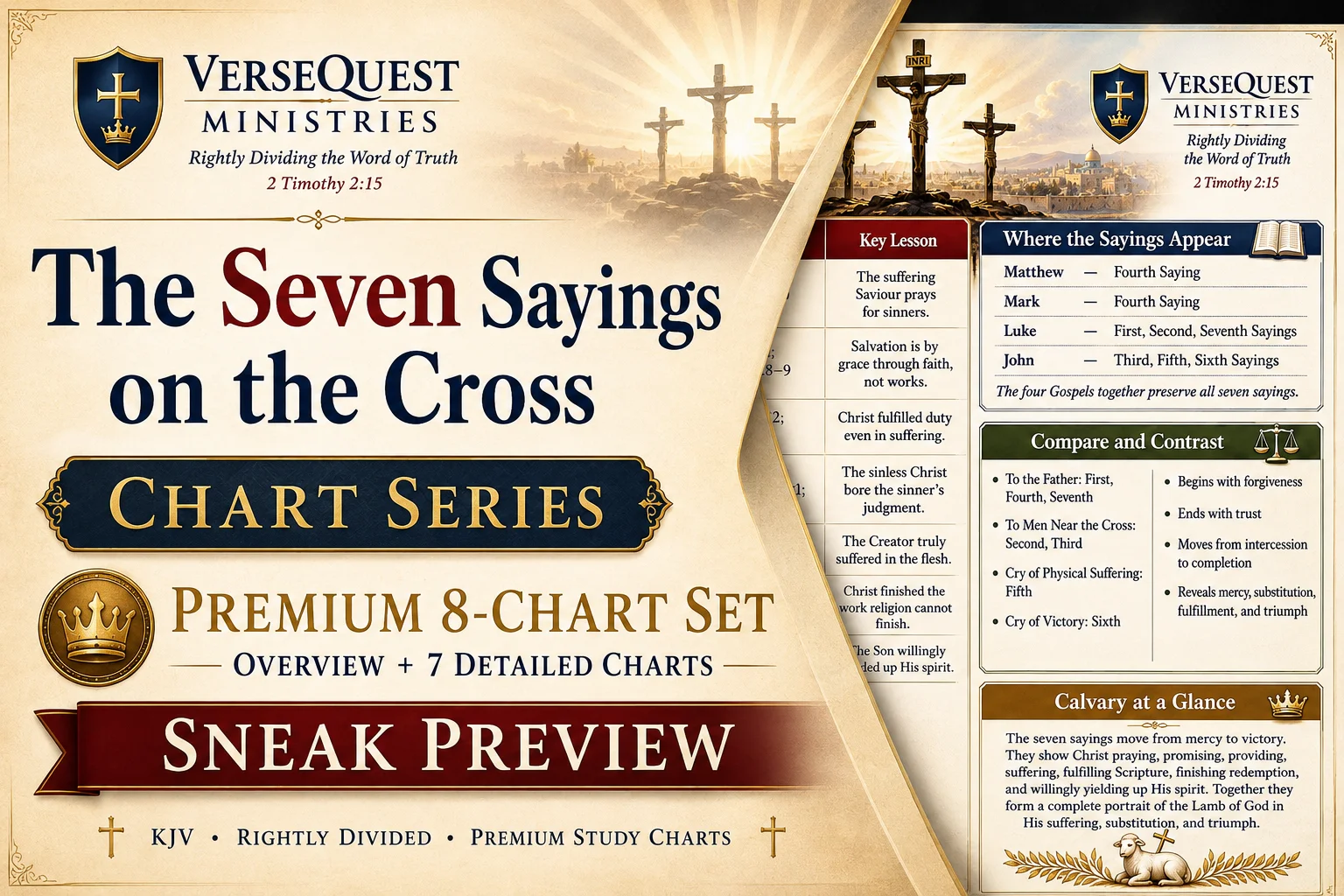
- The Seven Sayings on the Cross – Premium 8-Chart KJV Study Set
- A premium VerseQuest Ministries digital PDF study set on The Seven Sayings on the Cross, featuring an overview chart plus seven detailed KJV Bible study charts. This resource examines Calvary,…
- $12.99
- Add to cart
-
-
Heaven
-
- The Doctrine of Heaven Made Plain — 599-Page KJV Bible Study PDF
- A massive 599-page KJV, rightly divided study on heaven, covering the present heaven, resurrection body, Rapture, Millennium, New Jerusalem, eternal state, hard questions, funeral lies, and cult errors.
- $34.99
- Add to cart
-