
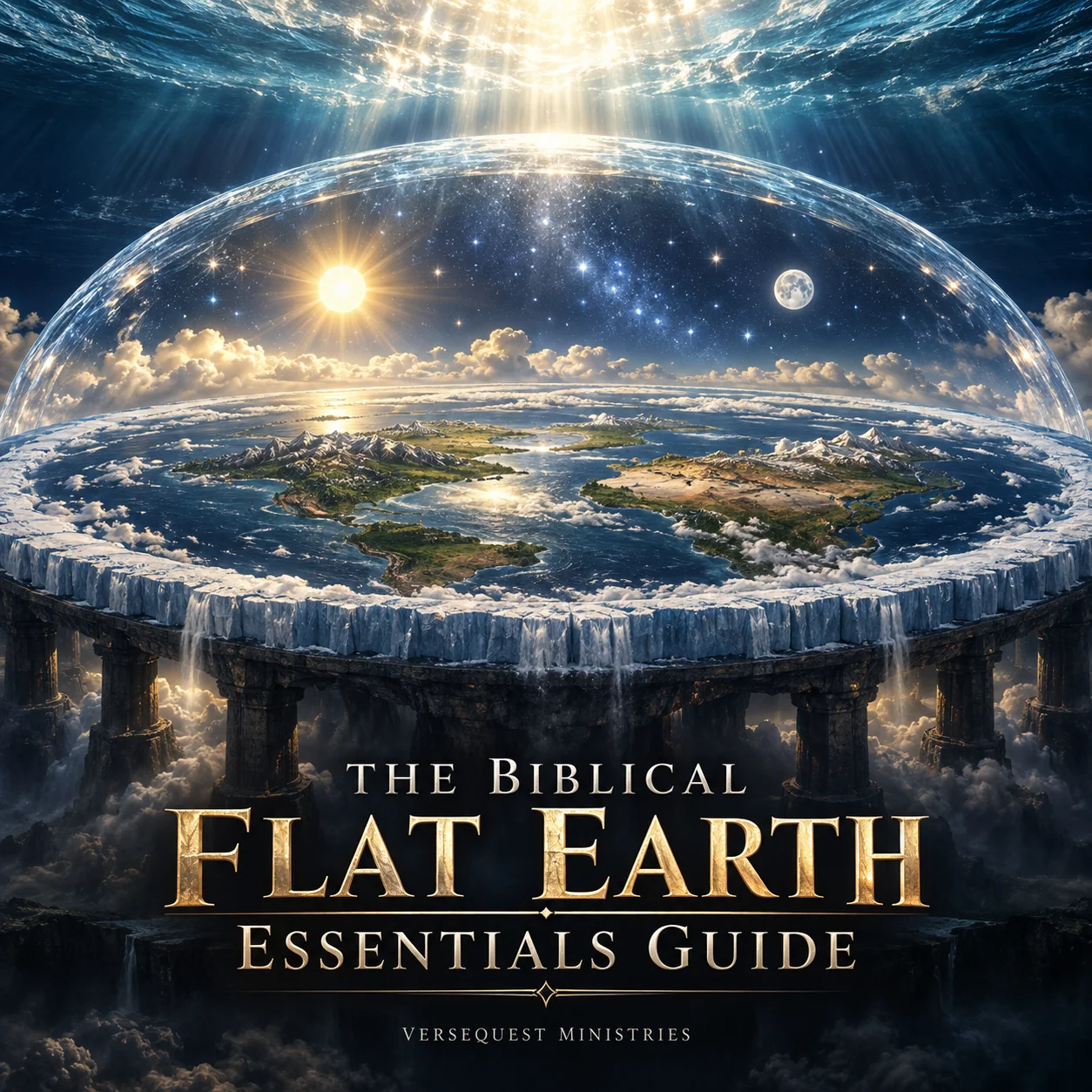
The Biblical Flat Earth Essentials Guide
The Biblical Flat Earth Essentials Guide is a 72-page downloadable and printable KJV study that introduces biblical cosmology in a clear, orderly, beginner-friendly format. It examines the firmament, waters above, established earth, foundations, pillars, circle, corners, heavenly lights, throne above, Noah’s Flood, prophecy, and common objections.
Every Bible reference used in the guide is accompanied by the complete King James Bible wording. Its 15 chapters include plain explanations, essential truths, review questions, chapter conclusions, a glossary, and a one-page summary.
This $14.99 digital guide is ideal for new students, skeptical readers, discipleship, family study, Sunday school, or anyone who wants the biblical case without beginning with a large commentary.
$14.99
Description
The Biblical Flat Earth Essentials Guide is a 72-page downloadable and printable KJV Bible study created for beginners, skeptical readers, new believers, and anyone seeking a clear introduction to biblical cosmology. Priced at $14.99, this digital guide presents the essential scriptural case without requiring the reader to begin with a large commentary or highly technical investigation.
The guide starts with the fundamental question of authority: Will creation be interpreted through the words of Scripture or through a model supplied before the Bible is opened? From that foundation, it walks the reader through the creation account, the firmament, the waters above, the established earth, foundations and pillars, the circle and breadth of the earth, the heavenly lights, the sides of the north, the throne above the firmament, Noah’s Flood, prophetic passages, common objections, and the proper way to teach the subject.
Its 15 chapters follow a consistent four-page teaching pattern. Each chapter begins with one central idea and the controlling King James Bible passages printed in full. Two pages of plain teaching then explain the subject, followed by a review page containing five essential truths, study questions, a chapter synthesis, and a concise conclusion. Every numerical Bible reference used in the guide is accompanied by the complete KJV text so readers do not need to stop and look up the verses.
This guide also makes several important distinctions. It separates the direct statements of Scripture from secondary theories and online speculation. It answers sincere objections without requiring the beginner to master every scientific or technical argument. Most importantly, it clearly explains that biblical cosmology is not the gospel. Salvation comes through faith in the Lord Jesus Christ, while the study of creation remains an important matter of biblical authority.
Additional study helps include an essential glossary, a one-page review of twelve central truths, a final summary, and recommendations for continuing into the complete fifty-study edition. The guide may be used for personal study, discipleship, family reading, Sunday school, small-group discussion, witnessing conversations, or as an accessible introduction for someone who would be intimidated by a much larger book.
The purpose is not merely to give the reader another label. It is to place the major creation passages together so the Bible’s repeated language can be examined as one connected testimony. The firmament, waters above, fixed earth, circle, corners, heavenly lights, throne above, fountains below, and prophetic departure of heaven are allowed to speak in their proper biblical relationship.
The King James Bible as the final authority for understanding creation The creation order presented during the first four days The firmament as a created divider called Heaven The continuing existence of waters above the firmament The earth established by God and described as unmovable Foundations, pillars, fastening, measurement, and structural language The circle, face, breadth, corners, and ends of the earth The distinction between a circle and a sphere The sun’s appointed circuit through heaven The moon as the lesser great light The placement of the sun, moon, and stars within the firmament The biblical relationship between stars and angelic beings Heaven above, the deep beneath, and the preservation of real direction The sides of the north and the mount of the congregation The throne of God above the firmament The fountains of the great deep and the windows of heaven Noah’s Flood as a revelation of the created world’s structure The high mountain and worldwide visibility passages Falling stars and the heavens departing as a scroll The relationship between creation, prophecy, and final judgment The distinction between biblical cosmology and the gospel of salvation Answering objections without depending upon speculation Teaching controversial truth with patience, wisdom, and grace Creation as a testimony to the glory and authority of God
Central Argument
The guide argues that biblical cosmology should be constructed from the cumulative language of the King James Bible. The case does not rest upon one word or one disputed passage. It arises from the relationship between the firmament, waters above, heavenly lights, established earth, foundations, pillars, circle, face, breadth, corners, ends, throne above, deep below, and prophetic departure of heaven.
Major Observations
The earth is introduced before the sun, moon, and stars are appointed. The firmament is created to divide waters below from waters above, and God calls that firmament Heaven. The heavenly lights are subsequently set within it to give light upon the earth.
The earth is repeatedly described with language associated with stability and construction. It is stablished, founded, set, fastened, measured, and supported. The world’s immovability is repeatedly connected with the reign and creative power of God.
The Bible’s geographical vocabulary includes circle, face, breadth, corners, and ends. These descriptions should be examined together instead of redefining each expression separately to protect an outside model.
The throne is presented above the firmament, while the fountains of the great deep are beneath. This preserves a meaningful biblical arrangement of above, below, ascent, descent, heaven, earth, and the deep.
Prophecy confirms the creation structure. Stars fall to the earth, the host of heaven is dissolved, and the heaven departs like a scroll. The Bible’s final events should be compared with its opening account of creation.
Important Distinctions
Biblical cosmology is not the gospel. A person is saved by believing on the Lord Jesus Christ, not by accepting a particular cosmological model.
Direct statements of Scripture must be distinguished from secondary experiments, internet theories, speculative maps, and unsupported claims. Rejecting questionable supporting arguments does not erase the primary biblical texts.
Sincere questions are not rebellion. The reader should be encouraged to investigate carefully, prove claims honestly, and admit where Scripture does not supply every requested detail.
Doctrinal Conclusions
God created the world intentionally and possesses the authority to describe it.
The firmament is an essential component of the biblical creation account.
The waters above remain part of the scriptural description after the creation week.
The world is presented as established beneath an ordered heaven.
The sun, moon, and stars are appointed lights serving the earth within the firmament.
The structure of creation testifies to the throne, authority, wisdom, and glory of its Creator.
Memorable Teaching Points
The Bible’s map should be read before man’s model is supplied.
A circle does not become a sphere merely because a modern interpreter requires one.
Poetry is truth with a trumpet behind it; poetic form does not give Scripture permission to become false.
The beginner does not need every argument at once. He needs the right foundation in the right order.
The gospel comes first, biblical authority remains essential, and creation should lead the student to worship rather than pride.
Subjects for Further Study
- The meaning and uses of “firmament” throughout the King James Bible
- The identity and function of the waters above
- Foundations and pillars in the creation passages
- The relationship between stars, angels, and the host of heaven
- The biblical meaning of the sides of the north
- The fountains of the deep and windows of heaven
- The role of biblical cosmology in prophecy
- New Jerusalem and the final created order
- The difference between direct revelation and secondary speculation
- How to discuss biblical cosmology without allowing the subject to replace the gospel
Personal Bible Study: Read one four-page chapter at a time, mark the repeated structural words, and answer the review questions before continuing.
New-Believer Discipleship: Introduce biblical authority and creation without immediately placing a large or technical commentary before the student.
Sunday School: Use each chapter as a self-contained lesson with a central truth, complete KJV passages, teaching material, review points, and discussion questions.
Small Groups: Assign one chapter before each meeting and use the review page to guide group discussion.
Family Study: Read the Scripture boxes aloud and discuss what the passages say before considering the chapter explanation.
Sermon Preparation: Use the chapter divisions to develop topical messages on the firmament, the established earth, the heavenly lights, Noah’s Flood, creation, or biblical authority.
Witnessing Conversations: Give the guide to a curious or skeptical person who wants to understand what biblical flat-earth believers actually teach.
Christian Education: Use the book as an introductory biblical-cosmology unit before moving into historical, observational, or technical arguments.
Ministry Training: Teach students how to distinguish direct scriptural statements from assumptions, speculation, and secondary supporting claims.
Apologetic Study: Examine common objections while keeping the Bible’s language at the center of the discussion.
A King James Bible for reading the surrounding chapters and comparing related passages
A complete Strong’s Exhaustive Concordance for tracing words such as firmament, established, foundations, pillars, circle, face, breadth, ends, corners, heaven, deep, and stars
A traditional Bible dictionary for studying biblical geographical and cosmological terminology
A reliable KJV cross-reference Bible for connecting creation passages across Genesis, Job, Psalms, Isaiah, Ezekiel, Daniel, and Revelation
A notebook for recording repeated words, observations, objections, and conclusions
The Biblical Flat Earth Made Plain for the complete fifty-study treatment of the subject
Genesis Essentials Guide for a concise foundation in creation, the early earth, Adam, the Flood, Babel, and the patriarchs
The Gap Theory Essentials Guide for an introduction to pre-Adamic judgment and the distinction between original creation and restoration
The Gap Theory Examined for a more extensive investigation of the subject
VerseQuest biblical-cosmology studies and charts already provided with related teaching material
A chronological Bible timeline for comparing creation, the Flood, Babel, Israel, the Church, future judgment, and the new earth
Related products
-
Mystery of Iniquity
-
- The Mystery of the Restrainer — 50-Study Bible Prophecy PDF Book
- Who is restraining the man of sin—and what happens when that restraint is removed? The Mystery of the Restrainer is a massive 399-page, 50-study Bible prophecy book examining 2 Thessalonians…
- $9.99
- Add to cart
-
-
Angels
-
-67%
- The Doctrine of Angels Made Plain – 620-Page KJV Bible Study PDF
- The Doctrine of Angels Made Plain is a 620-page KJV Bible study that traces angels from Genesis to Revelation. This premium VerseQuest PDF explains holy angels, Christ’s supremacy over angels,…
- Original price was: $29.99.$9.99Current price is: $9.99.
- Add to cart
-
-67%
-
Matthew Without Confusion
-
- Matthew Without Confusion: A Rightly Divided Guide to the Gospel of Matthew
- Understand the Gospel of Matthew without mixing Israel, the Church, the kingdom, the Tribulation, and the Second Advent. Matthew Without Confusion is a massive 936-page KJV Bible commentary containing 72…
- $9.99
- Add to cart
-
-
I Am the Lord
-
- I Am the LORD — When God Identifies Himself: 60-Essay KJV Bible Study PDF
- I Am the LORD — When God Identifies Himself is a 371-page downloadable KJV Bible-study PDF containing 60 detailed studies tracing the repeated declaration “I am the LORD” from Genesis…
- $19.99
- Add to cart
-
-
UFOs and the Bible
-
- Beneath the Firmament: Pyramids, UFOs, Ancient Rebellion, and the Coming King — 404-Page PDF Book
- Beneath the Firmament is a 404-page downloadable PDF containing 60 substantial KJV-centered studies divided into two books. Pyramids Beneath the Firmament investigates Babel, Nimrod, ancient engineering, worldwide pyramid traditions, sacred…
- $19.99
- Add to cart
-