
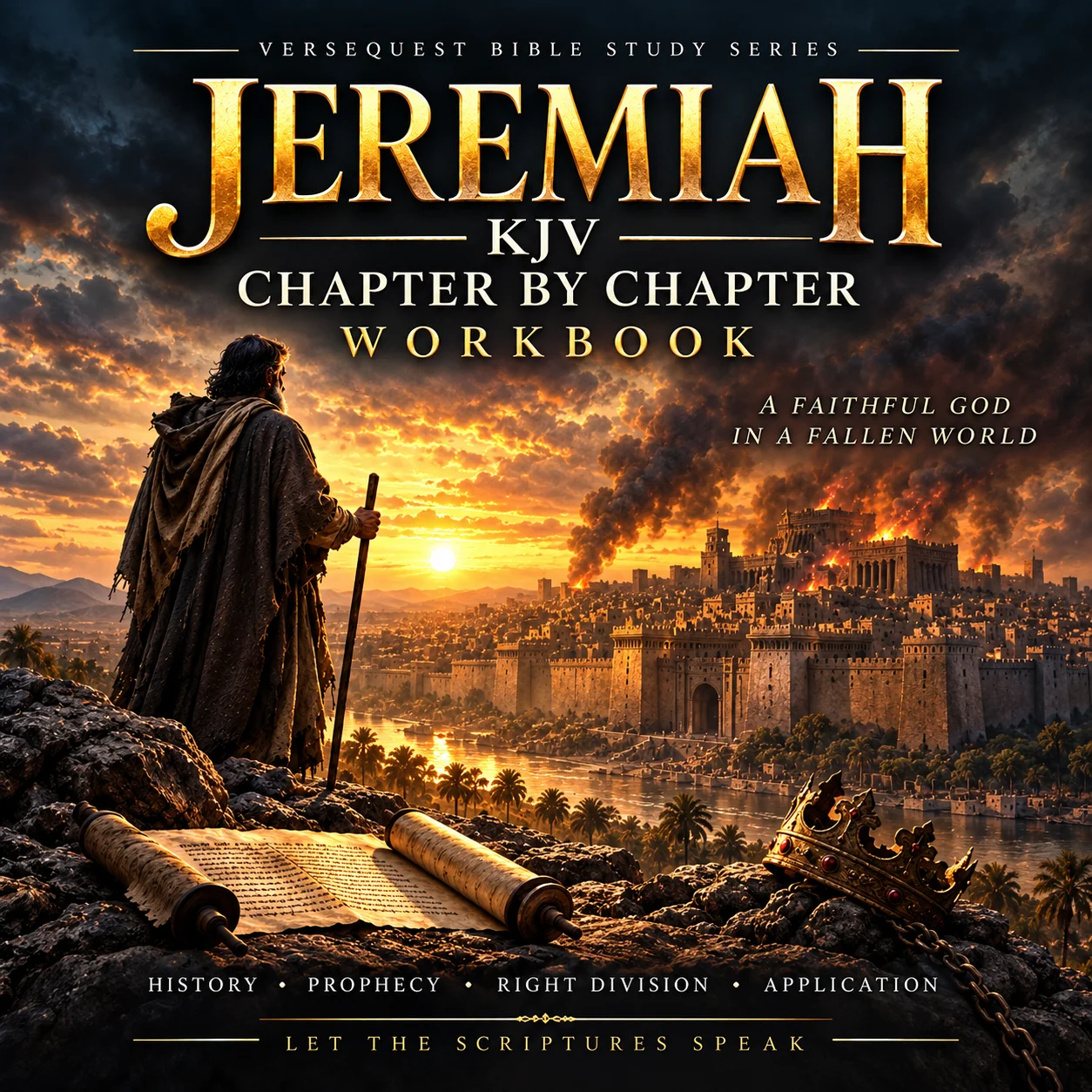
Jeremiah KJV Chapter-by-Chapter Workbook — Complete 1,450-Page Bible Study Curriculum
The Jeremiah KJV Chapter-by-Chapter Workbook is a complete 1,450-page downloadable PDF course covering all 52 chapters of Jeremiah from a Bible-believing, King James Bible-centered, rightly divided perspective.
Every chapter receives a 20-page coordinated study unit addressing close observation, historical setting, chronology, exposition, KJV vocabulary, doctrine, prophetic horizons, Messianic and kingdom connections, cross-references, later Scripture, difficult passages, symbolic actions, application, written review, teach-back work, and teacher guidance.
Beyond the chapter studies, the buyer receives 52 advanced studies with worksheets, 10 cumulative reviews, 60 pages of master charts, a 50-page final assessment and answer guide, 35-page expanded KJV glossary, detailed indexes, reusable teaching tools, final teaching project, and certificate of completion.
Designed for serious Bible students, pastors, preachers, teachers, homeschool families, Sunday schools, Bible institutes, discipleship groups, and prophecy students, this $44.99 digital curriculum provides a structured way to study one of the Bible’s most historically demanding and prophetically important books.
$44.99
Description
The Jeremiah KJV Chapter-by-Chapter Workbook is a complete 1,450-page downloadable PDF Bible-study curriculum designed to take serious students through all 52 chapters of the Book of Jeremiah. This is not a brief devotional guide or a collection of notes on selected famous verses. It is a full course built around an open King James Bible, with the goal of teaching the student how to read Jeremiah historically, doctrinally, prophetically, dispensationally, and practically while comparing Scripture with Scripture.
Jeremiah ministered during the final decades of the kingdom of Judah, when religious profession remained but national rebellion had reached the point of judgment. The workbook follows Jeremiah from his call and commission through Judah’s apostasy, the Temple Sermon, warnings of Babylonian invasion, confrontations with false prophets, symbolic signs, persecution, imprisonment, the destruction of Jerusalem, the remnant’s rebellion, judgments upon surrounding nations, and the final great prophecies against Babylon. At the same time, Jeremiah contains some of Scripture’s most important promises concerning Israel’s future restoration, Jacob’s Trouble, the righteous Branch, the Davidic throne, the New Covenant, and the faithfulness of God to His people.
Every one of Jeremiah’s 52 chapters receives a coordinated 20-page study unit, creating 1,040 pages of chapter-by-chapter curriculum. The workbook also includes 60 pages of course preparation, 52 advanced studies with corresponding worksheets, 10 cumulative reviews, 60 pages of master charts, and extensive assessment, glossary, index, teaching, and final-project material. Jeremiah_KJV_Chapter_by_Chapter…
The chapter studies are deliberately structured to make the student work through the biblical text rather than merely read somebody else’s conclusions. Students identify chapter movements, establish historical setting and chronology, examine KJV vocabulary, trace doctrine, distinguish Israel and Judah from the Body of Christ, classify prophetic horizons, investigate Messianic and kingdom passages, build cross-reference chains, compare later Scripture, examine difficult passages, study symbolic actions, answer written questions, summarize chapters, and practice teaching the material back from the Bible.
Jeremiah demands careful attention to chronology. Josiah, Jehoahaz, Jehoiakim, Jehoiachin, and Zedekiah appear during a period in which Assyria is fading, Egypt is active, Babylon is rising, Jerusalem is repeatedly threatened, deportations occur, and the kingdom finally collapses. The workbook helps the student keep the historical people, invasions, captivities, rulers, prophets, locations, and political developments organized so that Jeremiah’s sermons can be understood in their actual setting.
Major passages receive sustained treatment. Jeremiah 2 examines the fountain of living waters and broken cisterns. Jeremiah 6 studies the old paths and false declarations of peace. Jeremiah 7 examines the Temple Sermon, Shiloh, religious presumption, Tophet, and the queen of heaven. Jeremiah 17 treats trusting in man, trusting in the LORD, the deceitful heart, and God searching the heart. Jeremiah 18 examines the potter and clay in its actual national and prophetic context. Jeremiah 20 follows the persecuted prophet whose message became like a fire shut up in his bones.
Jeremiah 23 becomes a major Messianic and false-prophet study. The workbook examines the righteous Branch, the coming King, “THE LORD OUR RIGHTEOUSNESS,” the restoration of Israel, lying prophets, dreams, divine counsel, and the Word of God compared to fire and a hammer. Jeremiah 25 establishes the seventy-year captivity and connects Jeremiah’s chronology with later biblical history and prophecy.
Jeremiah 27–29 examines the Babylonian yoke, Hananiah’s false prophecy of quick deliverance, and the actual setting of Jeremiah 29:11. Rather than turning a promise to Jewish captives into an unrestricted slogan, the workbook teaches the reader to begin with audience, setting, chronology, and context before making application.
Jeremiah 30–33 forms one of the prophetic centers of the course. Students examine the time of Jacob’s Trouble, Israel’s deliverance, regathering, Davidic kingdom expectations, the New Covenant with the house of Israel and the house of Judah, the law written in the heart, forgiveness, the permanence of Israel, Jeremiah’s purchase of the field at Anathoth, the everlasting covenant, the Branch of righteousness, Jerusalem’s restoration, and the continuing Davidic promises. The master-chart section includes dedicated studies of Jacob’s Trouble, the Jeremiah 30–33 prophetic timeline, the New Covenant, and the Branch prophecies.
Jeremiah 36 provides one of the workbook’s most important studies concerning the written Word of God. Jeremiah speaks the LORD’s words, Baruch writes them on a roll, the words are publicly read, Jehoiakim cuts and burns the scroll, and God commands the words to be written again. The chapter becomes an extensive study of revelation, inspiration, writing, transmission, rejection of Scripture, and the inability of a rebellious king to destroy what God has spoken.
The final historical sections follow Jeremiah through prison, the miry dungeon, his rescue by Ebed-melech, his private conversations with Zedekiah, the fall of Jerusalem, the government of Gedaliah, the murder of Gedaliah, the surviving remnant, the decision to flee into Egypt despite God’s warning, and the continued rebellion surrounding the queen of heaven.
Jeremiah 46–51 broadens into judgment upon the nations. Egypt, Philistia, Moab, Ammon, Edom, Damascus, Kedar, Elam, and Babylon are studied in their historical settings while future prophetic connections are tested carefully. Jeremiah 50–51 receives substantial attention because Babylon occupies such an important place in biblical prophecy. Historical Babylon is compared with later prophetic and symbolic Babylon material without carelessly collapsing every biblical reference into the same event.
Throughout the entire workbook, interpretation follows the governing method: Text first — Context second — Scripture compared with Scripture. Prophetic conclusions are classified as Explicit, Strong Inference, Possible, or Speculative. This allows students to explore difficult prophecy and typology while learning not to turn an interesting possibility into a doctrine that the text itself does not establish.
After the chapter curriculum come 52 advanced studies and worksheets, 10 cumulative reviews, 60 master-chart pages, a 50-page final assessment and answer guide, a 35-page expanded KJV glossary, selected indexes, reusable teaching tools, and a final teaching project with certificate of completion.
The teaching section includes practical tools for chapter lessons, sermon preparation, Sunday school, homeschool assignments, prophetic-horizon classification, difficult passages, and cross-reference study.
This resource is designed for serious personal Bible study, pastors, preachers, Sunday school teachers, homeschool families, Bible classes, Bible institutes, discipleship ministries, prophecy students, and teachers preparing extensive studies through Jeremiah. At $44.99, the buyer receives one complete 1,450-page digital course intended not merely to tell the reader what Jeremiah says, but to teach the reader how to study Jeremiah thoroughly from an open King James Bible.
The Call of Jeremiah — God appoints Jeremiah to speak His words to Judah and the nations despite opposition. Judah’s Apostasy — Jeremiah repeatedly exposes covenant rebellion, idolatry, moral corruption, and refusal to hear God. The Fountain of Living Waters — Judah abandons the LORD and substitutes broken cisterns that cannot hold water. Backsliding Israel and Treacherous Judah — Jeremiah distinguishes the two houses while preserving their future restoration. False Religion — The people trust the temple, ceremonies, sacrifices, and religious identity while rejecting God’s commands. Shiloh and the Temple Sermon — Previous judgment becomes a warning that possession of sacred institutions does not guarantee protection. False Prophets and False Peace — Jeremiah repeatedly confronts prophets who speak comforting messages that God did not give them. The Authority of God’s Words — Jeremiah emphasizes hearing, speaking, writing, preserving, and obeying the actual words of the LORD. The Old Paths — Jeremiah 6 calls Judah back to the good way revealed by God rather than religious novelty or human tradition. The Potter and the Clay — Jeremiah 18 explains God’s dealings with nations in a context of warning, repentance, responsibility, and judgment. Jeremiah’s Persecution — Rejection, mockery, imprisonment, stocks, the dungeon, and threats accompany faithful prophetic ministry. The Seventy-Year Captivity — Babylonian domination and captivity become a precise prophetic and chronological anchor. Nebuchadnezzar and Babylon — Babylon is used as an instrument of judgment and is later itself judged by God. Hananiah and False Prophecy — Jeremiah 28 provides a clear contrast between popular optimism and the Word God actually gave. Jeremiah 29:11 in Context — The workbook restores this familiar verse to its setting among Jewish captives facing seventy years in Babylon. Jacob’s Trouble — Jeremiah 30 describes an unparalleled time of distress followed by Israel’s deliverance. The Righteous Branch — Jeremiah reveals the coming Davidic King who will reign in righteousness. THE LORD OUR RIGHTEOUSNESS — Jeremiah 23 presents one of the book’s greatest Messianic titles. The New Covenant — Jeremiah 31 explicitly promises a New Covenant with the house of Israel and the house of Judah. Israel’s Future Restoration — National judgment never becomes proof that God has permanently discarded Israel. The Davidic Covenant — Jeremiah 23 and 33 connect future restoration with David’s line, the Branch, kingship, and Jerusalem. The Land Promise — Jeremiah’s purchase of the field demonstrates confidence in a literal future restoration to the land. Inspiration and the Written Word — Jeremiah 36 provides a major biblical study of spoken revelation, written Scripture, rejection, destruction of a manuscript, and rewriting. Jerusalem’s Fall — The destruction of the city demonstrates the historical fulfillment of decades of prophetic warning. Ebed-melech — The Ethiopian official becomes an important example of courage and mercy during Jeremiah’s persecution. The Rebellious Remnant — Jeremiah 42–44 shows people requesting God’s direction while refusing the answer when it contradicts their plans. The Queen of Heaven — Jeremiah directly confronts idolatrous worship among the Jews in Egypt. Judgment of the Nations — Egypt, Philistia, Moab, Ammon, Edom, Damascus, Kedar, Elam, and Babylon all come under divine judgment. The Fall of Babylon — Jeremiah 50–51 becomes a major historical and prophetic study alongside Isaiah, Daniel, and Revelation. Right Division — Israel, Judah, Gentile nations, future kingdom promises, and the Body of Christ are not carelessly blended. Prophetic Horizons — Immediate history, Babylonian captivity, return, Tribulation, Second Advent, Millennium, and later prophetic fulfillment are distinguished where Scripture warrants them. Certainty in Interpretation — Conclusions are classified as Explicit, Strong Inference, Possible, or Speculative.
Jeremiah is the book of a nation running out of excuses. Judah possesses the temple, priesthood, sacrifices, Scriptures, prophets, Davidic history, and covenant identity, but none of those things can substitute for obedience to the LORD.
The book begins with God’s words placed in Jeremiah’s mouth. That sets the controlling issue for the entire prophecy: the question is not whether Jeremiah’s message is popular, comforting, politically useful, or welcomed by religious leaders. The question is whether God spoke it.
Jeremiah 2 supplies one of the book’s defining images. Judah forsakes the fountain of living waters and hews out broken cisterns. Sin is therefore not merely breaking a rule; it is abandoning the only true source in order to depend upon substitutes that cannot satisfy or save.
Jeremiah repeatedly confronts false confidence. Judah trusts the temple, Egypt, military alliances, idols, false prophets, familiar religious phrases, and the assumption that God will never judge Jerusalem. The historical fall of Jerusalem proves that religious presumption cannot cancel explicit revelation.
The false prophets are especially dangerous because they speak religiously. They use God’s name, claim dreams, promise peace, and tell the nation what it wants to hear. Jeremiah 23 therefore asks whether they have actually stood in the counsel of the LORD and heard His Word.
The potter-and-clay passage in Jeremiah 18 must be interpreted from its own explanation. God explicitly discusses a nation or kingdom being warned of destruction and responding to the warning. The passage must not be detached from its national and conditional context merely to support a theological system.
Jeremiah himself demonstrates the cost of speaking unpopular truth. He is mocked, beaten, imprisoned, placed in stocks, lowered into a dungeon, accused of treason, and repeatedly rejected. Yet Jeremiah 20 describes the Word as a burning fire shut up in his bones. His discouragement never turns the false message into the true one or the true message into the false one.
The seventy years provide a major chronological anchor. Jeremiah announces the captivity; later Daniel studies Jeremiah’s writings and recognizes the approaching completion of the predicted period. Prophecy is therefore presented as something sufficiently definite to be studied chronologically.
Jeremiah 29:11 must remain inside that context. The promise is addressed to Jewish captives who have been told that Babylonian captivity will not end immediately. God’s faithfulness is real, but the verse does not become a blank check promising every believer immediate earthly success.
Jeremiah 30 introduces “the time of Jacob’s trouble.” The same passage also promises deliverance, the breaking of the yoke, Israel’s return, and future rule. Trouble is not the end of Israel’s story.
Jeremiah 31 contains the New Covenant, and its parties are stated plainly: the house of Israel and the house of Judah. Later New Testament revelation must be welcomed, but it cannot be used to erase the nouns God placed in Jeremiah’s prophecy.
The New Covenant includes inward law, personal knowledge of the LORD, and forgiveness. Jeremiah then connects Israel’s continuing existence with the established ordinances of creation. Israel’s sin is severe; God’s covenant faithfulness is greater.
Jeremiah 32 makes restoration tangible. Jeremiah buys a field while Babylon is taking the country. Humanly, it appears to be terrible timing. Prophetically, it is a declaration that the land will not remain lost forever.
Jeremiah 33 returns to the Branch of righteousness, Jerusalem, Judah, David, and covenant promises. The future is not merely spiritual consolation; Jeremiah repeatedly uses national, geographical, governmental, and covenant language.
Jeremiah 36 is a remarkable chapter on Scripture. The words are spoken, written, read, rejected, cut, burned, and then written again. Jehoiakim can burn the roll, but he cannot burn the authority of the God who gave the words.
Jeremiah 37–39 demonstrates the difference between prophecy and hindsight. Jeremiah had repeatedly announced Jerusalem’s fall before the city actually fell. When Babylon finally enters Jerusalem, history verifies what the rulers, priests, false prophets, and people had refused to believe.
Jeremiah 42 contains another sobering lesson: people may ask God for direction while secretly reserving the right to reject His answer. The remnant promises to obey, receives an answer, dislikes it, and chooses Egypt anyway.
The judgments upon the nations demonstrate that Jeremiah is not merely a prophet of local Judean politics. The God judging Judah is also Lord over Egypt, Moab, Edom, Ammon, Babylon, and the rest of the nations.
Jeremiah 50–51 must be studied with precision. Historical Babylon is unquestionably present. Later Scripture also develops Babylon as a major prophetic symbol and reality. Similarities should be traced carefully without automatically declaring every detail identical.
The governing study rule throughout the course remains:
Text first. Context second. Scripture compared with Scripture.
Then ask: Who is speaking? To whom? In what historical setting? What does the passage explicitly say? Has later Scripture interpreted it? What prophetic horizon is warranted? What belongs to Israel, Judah, the nations, or another audience? What can be applied without stealing another group’s covenant promises?
The goal is not simply to finish 1,450 pages. It is to finish Jeremiah able to explain the movement from warning to judgment, from judgment to captivity, from captivity to restoration, from broken covenant to New Covenant, from failed kings to the righteous Branch, and from Babylon’s apparent triumph to Babylon itself standing under the judgment of the LORD.
Personal Bible Study: Work sequentially through all 52 chapters while recording observations, definitions, cross-references, prophetic horizons, difficult questions, and summaries.
Pastoral and Sermon Preparation: Use the exposition material, cross-reference chains, doctrinal guardrails, chapter outlines, sermon-preparation worksheets, and teaching exercises to develop expository sermons and series through Jeremiah.
Sunday School: Chapter focus pages, historical context, review questions, teaching applications, and the dedicated Sunday School Lesson Builder can be adapted into weekly lessons.
Homeschool Bible Curriculum: The 1,450-page course provides reading assignments, vocabulary, written work, maps, reviews, advanced studies, assessment, and teach-back opportunities suitable for a substantial Bible curriculum.
Bible Institutes and Ministry Training: Students can complete all chapter units, advanced studies, reviews, master charts, final assessment, teaching project, and certificate requirements as a formal Jeremiah course.
Prophecy Classes: The prophetic-horizon method makes the workbook useful for studying Jacob’s Trouble, Israel’s restoration, the New Covenant, the Davidic kingdom, judgments of the nations, and Babylon.
Discipleship and Small Groups: Selected studies on broken cisterns, the deceitful heart, false peace, the old paths, trusting the LORD, obeying God’s Word, and Jeremiah’s perseverance can be used independently.
Teacher Training: Teach-back exercises and reusable teaching tools develop the ability to explain Jeremiah from an open Bible rather than simply repeat workbook material.
Authorized King James Bible — The primary companion to the workbook and the controlling text for all chapter study.
KJV Concordance — Helpful for tracing recurring expressions such as word of the LORD, heart, backsliding, return, build, plant, destroy, Babylon, remnant, covenant, and Branch.
KJV Cross-Reference Bible — Useful for expanding Jeremiah’s connections to Deuteronomy, Kings, Chronicles, Isaiah, Ezekiel, Daniel, the Gospels, Hebrews, Romans, and Revelation.
Bible Dictionary — Helpful for kings, nations, ancient customs, idolatry, the priesthood, warfare, captivity, and unfamiliar KJV terms.
Bible Atlas and Historical Maps — Especially useful for Judah, Jerusalem, Anathoth, Babylon, Egypt, the Euphrates, Moab, Edom, Ammon, Damascus, Elam, and the Babylonian campaigns.
Timeline of Judah’s Final Kings — Helps organize Josiah, Jehoahaz, Jehoiakim, Jehoiachin, Zedekiah, Babylonian invasions, deportations, and Jerusalem’s destruction.
Isaiah KJV Chapter-by-Chapter Workbook — A valuable VerseQuest companion for Messianic prophecy, Babylon, Israel, the Second Advent, the Millennial Kingdom, and national restoration.
Revelation Without Confusion — Useful as a VerseQuest companion when comparing Jeremiah’s Babylon prophecies with Revelation 17–18 and later prophetic events.
Related products
-
Heaven
-
- The Doctrine of Heaven Made Plain — 599-Page KJV Bible Study PDF
- A massive 599-page KJV, rightly divided study on heaven, covering the present heaven, resurrection body, Rapture, Millennium, New Jerusalem, eternal state, hard questions, funeral lies, and cult errors.
- $34.99
- Add to cart
-
-
Premium VerseQuest Books
-
-75%
- Christ in the Old Testament Made Plain — 100-Essay KJV Study PDF
- A massive 670-page premium KJV Bible study PDF featuring 100 detailed essays showing Jesus Christ throughout the Old Testament in promise, type, sacrifice, Christophany, prophecy, suffering, resurrection, priesthood, and future…
- Original price was: $39.99.$9.99Current price is: $9.99.
- Add to cart
-
-75%
-
The Rapture
-
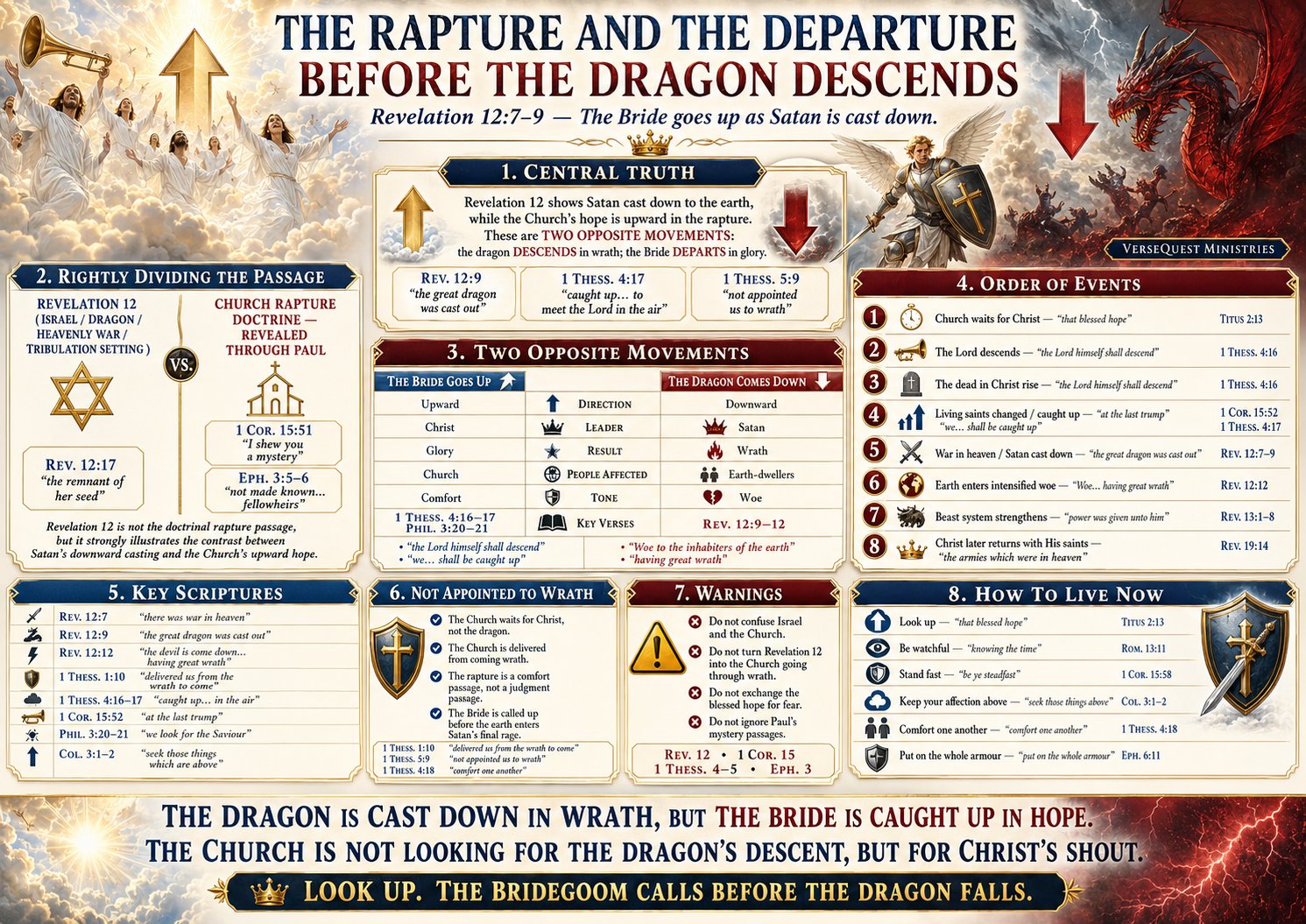
- The Rapture and the Departure Before the Dragon Descends – Printable Bible Study Chart
- Printable KJV Bible study chart on The Rapture and the Departure Before the Dragon Descends, showing the Bride caught up before Satan is cast down in wrath. This premium VerseQuest…
- $4.99
- Add to cart
-
-
Prophecy Studies
-
- The Resurrection of Jesus Christ Made Plain – 501-Page KJV Bible Study
- A massive 501-page VerseQuest Ministries PDF Bible study defending and explaining the bodily resurrection of Jesus Christ from a KJV, rightly divided perspective. This 80-essay study covers the empty tomb,…
- $34.99
- Add to cart
-
-
Jesus Christ / Christology
-
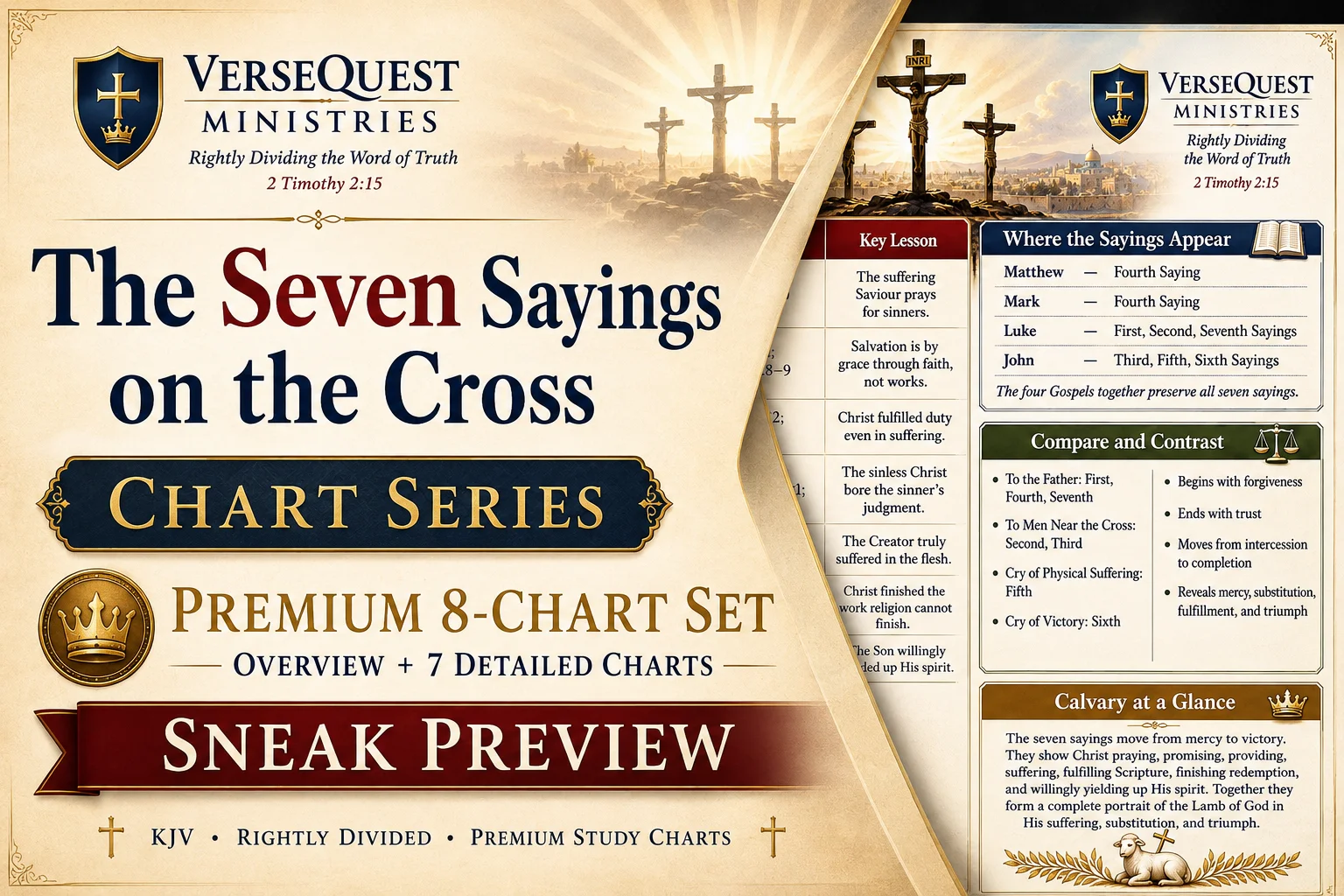
- The Seven Sayings on the Cross – Premium 8-Chart KJV Study Set
- A premium VerseQuest Ministries digital PDF study set on The Seven Sayings on the Cross, featuring an overview chart plus seven detailed KJV Bible study charts. This resource examines Calvary,…
- $12.99
- Add to cart
-