
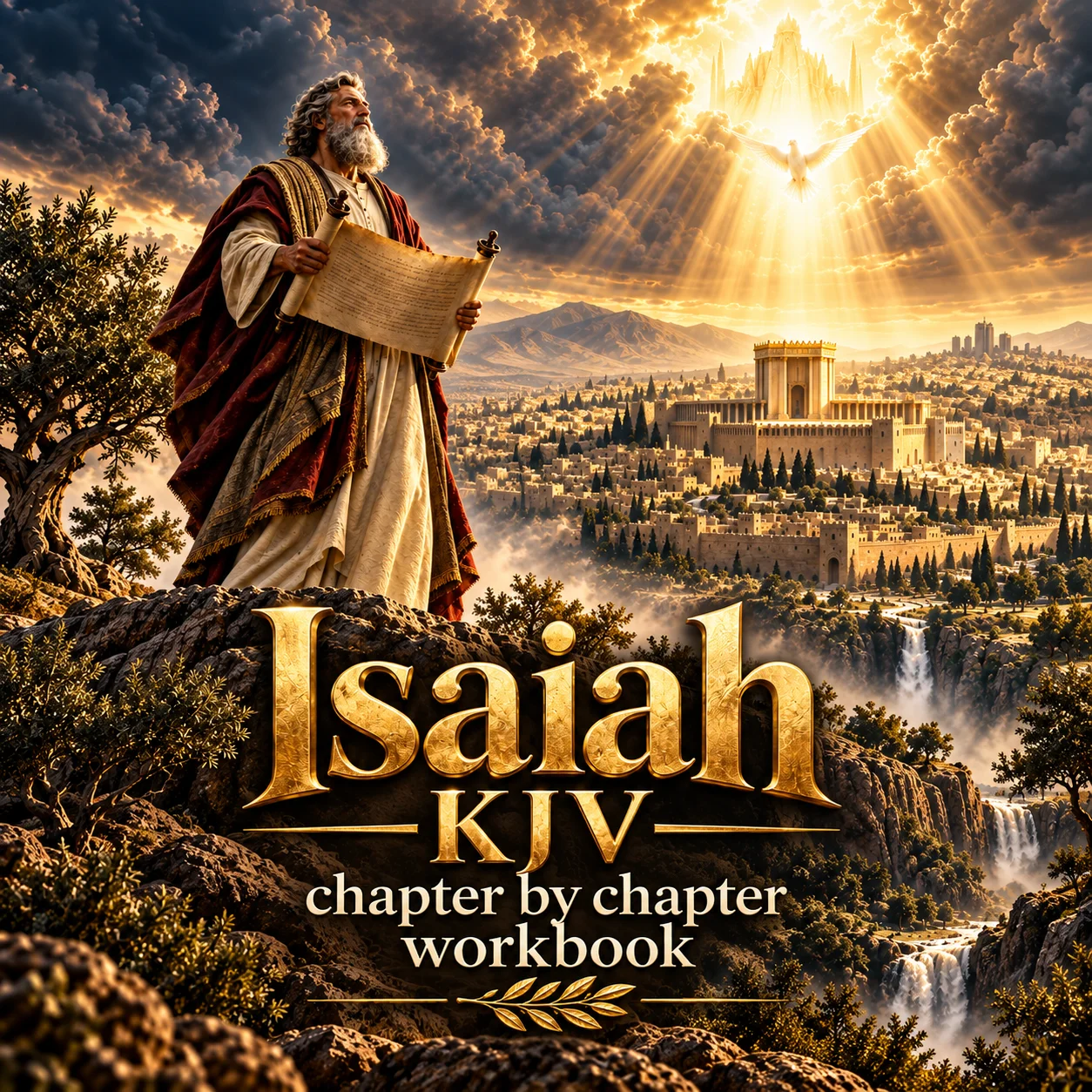
Isaiah KJV Chapter-by-Chapter Workbook — Complete 1,500-Page Bible Study Curriculum
The Isaiah KJV Chapter-by-Chapter Workbook is a complete 1,500-page downloadable PDF curriculum covering all 66 chapters of Isaiah from a KJV-centered, rightly divided, prophecy-conscious perspective.
Each chapter receives a structured 16-page study covering close Bible observation, historical context, exposition, KJV vocabulary, doctrine, prophetic horizons, Messianic connections, cross-references, New Testament use, difficult passages, themes, application, review, teach-back work, and teacher guidance.
The workbook also includes 66 advanced studies with worksheets, 11 cumulative reviews, 40 pages of master charts, a comprehensive final assessment and answer guide, expanded KJV glossary, subject index, Scripture index, prophecy index, teaching tools, final teaching project, and certificate of completion.
Designed for serious students, pastors, teachers, homeschool families, Sunday schools, churches, Bible institutes, discipleship groups, and prophecy students, this $44.99 digital curriculum is built for anyone who wants to move beyond isolated favorite verses and systematically master the message, doctrine, history, and prophecy of Isaiah.
$44.99
Description
The Isaiah KJV Chapter-by-Chapter Workbook is a massive 1,500-page downloadable PDF Bible-study curriculum designed to take serious students systematically through all 66 chapters of the Book of Isaiah. This is not a brief survey, devotional outline, or collection of selected prophecy notes. It is a full working course built to help the student read Isaiah carefully, understand its historical setting, identify its prophetic horizons, trace its Messianic revelations, compare Scripture with Scripture, preserve biblical distinctions, and learn to teach the book from an open King James Bible.
Isaiah is one of the richest books in all of Scripture. It moves from Judah’s apostasy and coming judgment to the throne vision of Isaiah 6; the virgin birth of Isaiah 7; the divine Son and Davidic throne of Isaiah 9; the Branch and coming kingdom of Isaiah 11; Babylon, Lucifer, Assyria, Egypt, Moab, Tyre, and the surrounding nations; worldwide judgment in Isaiah 24; resurrection and victory over death in Isaiah 25–26; the foundation stone of Isaiah 28; Ariel and Jerusalem; Hezekiah and Sennacherib; the great transition beginning with “Comfort ye” in Isaiah 40; the Servant passages; Cyrus; Israel’s restoration; the suffering Messiah of Isaiah 53; the free invitation of Isaiah 55; true fasting in Isaiah 58; Zion’s coming glory; the two Advents in Isaiah 61; the returning Warrior of Isaiah 63; and the new heavens and new earth material of Isaiah 65–66.
Every one of Isaiah’s 66 chapters receives a coordinated 16-page core study unit. These chapter units include chapter focus and principal movements, close KJV observation, historical setting and context, exposition, KJV vocabulary and key expressions, doctrine and right division, prophetic horizon analysis, Messianic and Christological connections where present, cross-reference workshops, New Testament use of Isaiah, difficult passages and error correction, repeated-word and theme tracing, lawful present application, written review, teach-back exercises, and teacher guidance with suggested answers. The workbook deliberately teaches the student to begin with the text rather than with a commentator.
One of the defining features of the workbook is its prophetic-horizon system. Isaiah frequently moves between immediate history, the First Advent, Tribulation events, the Second Advent, the Millennial Kingdom, and the new heavens and new earth. Instead of flattening these into one undifferentiated prophecy, the workbook teaches the student to identify the horizon carefully and to let later Scripture establish fulfillment where it does so.
The course also uses four certainty labels throughout: Explicit, Strong Inference, Possible, and Speculative. This is especially important in Isaiah because many passages have been overloaded with interpretations that go beyond what the text actually establishes. The student is taught to separate what Scripture directly states from what may be a strong conclusion, a possible connection, or an interpretation that should never be made into doctrine.
Right division is another central feature. Israel remains Israel. Judah remains Judah. Jerusalem, Zion, land promises, national restoration, Davidic throne promises, kingdom promises, and Millennial conditions are not automatically transferred to the Body of Christ. At the same time, where the New Testament directly identifies Isaiah’s prophecy with Jesus Christ, John the Baptist, Israel’s unbelief, the Gospel, or another fulfillment, that inspired interpretation is given full weight.
The workbook devotes extensive attention to Messiah in Isaiah. Students trace the virgin-born Immanuel, the Child and Son of Isaiah 9, the Branch of Isaiah 11, the chosen Servant of Isaiah 42, the One who gives His back to the smiters in Isaiah 50, the exalted yet suffering Servant of Isaiah 52–53, the anointed One of Isaiah 61, and the returning Warrior of Isaiah 63. Isaiah 53 receives special attention because of its importance to substitutionary suffering, sin-bearing, rejection, death, burial, justification, intercession, and its repeated use in the New Testament.
Beyond the 66 chapter units, the workbook contains 66 advanced studies with 66 corresponding worksheets, giving one deeper study for every chapter. It also contains 11 cumulative reviews, 40 pages of master charts, a 40-page final assessment and answer guide, a 40-page expanded KJV glossary, a subject index, Scripture index, prophecy index, teaching tools, and a final teaching project with certificate of completion.
Major master-chart subjects include Isaiah at a glance, historical kings and settings, Assyria, Babylon, Cyrus, First Advent prophecies, Second Advent prophecies, Messianic passages, Israel and the nations, the Servant passages, prophetic horizons, kingdom passages, and other major themes designed to make a 66-chapter prophetic book easier to see as a unified whole.
This workbook is designed to make the student work through Isaiah, not merely read information about it. Throughout the course, students answer questions, build cross-reference chains, classify prophetic claims, define KJV vocabulary from context, identify New Testament quotations, separate Israel from the Church, test difficult interpretations, summarize chapters, prepare teaching outlines, and record their own observations.
The Isaiah KJV Chapter-by-Chapter Workbook is suitable for serious personal Bible study, homeschool Bible curriculum, Sunday school, church Bible classes, Bible institutes, discipleship, pastoral preparation, sermon series development, ministry training, small groups, prophecy studies, and advanced independent study. At $44.99, the buyer receives one complete 1,500-page digital curriculum designed to take Isaiah from a book many Christians find intimidating and turn it into a book they can systematically read, understand, trace, and teach.
Judah’s Apostasy and Divine Judgment — Isaiah begins by confronting covenant rebellion, corrupt worship, injustice, pride, and refusal to hear the LORD. The Holy One of Israel — One of Isaiah’s defining divine titles, emphasizing God’s holiness in contrast with Israel’s sin. Isaiah’s Call and Commission — The throne vision of Isaiah 6 establishes holiness, cleansing, service, prophetic responsibility, blindness, and remnant theology. Messiah and the Two Advents — Isaiah repeatedly presents both the suffering and reigning Messiah, sometimes within closely connected prophetic passages. The Virgin Birth and Immanuel — Isaiah 7 provides one of Scripture’s foundational Messianic signs. The Divine Son and Davidic King — Isaiah 9 presents the promised Son whose government rests upon His shoulder and whose kingdom rests upon David’s throne. The Branch and Millennial Kingdom — Isaiah 11 connects Messiah, the Spirit of the LORD, righteous government, creation peace, and Israel’s restoration. Israel, Judah, Zion, and Jerusalem — These identities retain their biblical meaning and covenant setting throughout the workbook. The Remnant — Isaiah repeatedly distinguishes the judged nation from the preserved remnant. Assyria, Babylon, and Historical Judgment — Political powers become essential historical actors and, in some passages, possible prophetic patterns requiring careful interpretation. The Nations — Isaiah contains extensive burdens and judgments concerning Babylon, Moab, Damascus, Egypt, Tyre, Edom, and other nations. Lucifer and Isaiah 14 — The workbook carefully distinguishes immediate historical context from conclusions concerning Satan and future prophetic fulfillment. The Day of the LORD — Judgment, divine intervention, national overthrow, and future kingdom events are traced throughout Isaiah. Tribulation Prophecy — Numerous passages are examined for their relationship to Jacob’s trouble and end-time judgment. The Second Advent — The return of the LORD in judgment and glory is one of Isaiah’s dominant prophetic expectations. The Millennium — Isaiah contains some of Scripture’s richest descriptions of Messiah’s earthly reign, Jerusalem, Israel, peace, restored creation, longevity, agriculture, worship, and righteous government. The Servant of the LORD — The workbook carefully distinguishes Israel as servant from Messiah as the individual Servant where context and later Scripture require it. The Suffering Servant — Isaiah 52:13–53:12 receives intensive treatment concerning Christ’s rejection, substitutionary suffering, death, burial, justification, and intercession. Salvation — Isaiah moves continually from judgment toward deliverance, redemption, restoration, and the LORD as Saviour. Prophecy as Divine Evidence — Isaiah repeatedly contrasts the LORD’s ability to declare future events with the helplessness of idols. Cyrus — The naming and mission of Cyrus provide a major case study in fulfilled prophecy. Idolatry — Isaiah repeatedly exposes the absurdity, impotence, and spiritual danger of man-made gods. The Word of God — Isaiah emphasizes the enduring, effective, authoritative Word that accomplishes God’s purpose. Religious Hypocrisy — Empty worship, false fasting, outward profession, and lips that honor God while the heart is far away receive strong treatment. Right Division — Historical Israel, the Body of Christ, the Tribulation remnant, the nations, and future kingdom conditions are kept distinct. Prophetic Foreshortening — Isaiah frequently places events separated by long intervals side by side, requiring careful comparison with later revelation. New Testament Fulfillment — The workbook traces how Christ, the apostles, and New Testament writers quote and interpret Isaiah. Creation and the Coming Restoration — Wilderness, mountains, waters, animals, land, heavens, earth, and future restoration are examined from the language of the KJV itself. New Heavens and New Earth — Isaiah’s closing chapters require careful distinction between Millennial conditions and final eternal realities. Certainty in Interpretation — Explicit, Strong Inference, Possible, and Speculative conclusions are deliberately separated.
Isaiah begins with a courtroom. Judah possesses religion, sacrifices, assemblies, prayers, and outward ceremony, yet the nation has rebelled against the LORD. One of the first lessons of the book is therefore that religious activity does not excuse disobedience. Isaiah repeatedly returns to this distinction between outward profession and inward rebellion.
The holiness of God dominates Isaiah. In chapter 6, Isaiah does not begin by studying prophecy charts; he sees “the Lord sitting upon a throne, high and lifted up.” The seraphim cry, “Holy, holy, holy.” Isaiah’s first response is not confidence but conviction. Cleansing precedes commission. That pattern becomes important for anyone who wants to study prophecy without losing sight of the God who gave it.
Isaiah’s Messianic revelation unfolds progressively. Isaiah 7 introduces Immanuel. Isaiah 9 presents the Child and Son whose names include Wonderful, Counsellor, The mighty God, The everlasting Father, and The Prince of Peace. Isaiah 11 presents the Branch from Jesse. Isaiah 42 introduces the chosen Servant. Isaiah 49 develops His mission. Isaiah 50 shows His obedience and suffering. Isaiah 52–53 reaches the great revelation of the Servant wounded for transgressions and bearing iniquity.
The student must continually distinguish Israel as God’s servant from Messiah as the Servant. Context determines the referent. Later Scripture provides inspired identification where appropriate. This prevents a common interpretive mistake in which every occurrence of “servant” is forced into the same category.
Isaiah also teaches prophetic perspective. A single passage may begin in the prophet’s own historical environment and then move beyond it. Assyria, Babylon, Egypt, Edom, Jerusalem, or another historical setting may become part of a larger prophetic picture. The responsible student must first establish the immediate context before considering future fulfillment.
The two Advents are another essential distinction. Isaiah 61:1–2 provides one of the clearest examples. When Jesus reads the passage in Luke 4, He stops before “the day of vengeance of our God.” The words before that point apply to His First Advent ministry; the remaining judgment awaits His return. The comma effectively spans the present interval between those events.
Isaiah 53 must be read as one of Scripture’s clearest explanations of substitution. The Servant is rejected, wounded for transgressions, bruised for iniquities, chastised, made an offering for sin, cut off from the land of the living, buried, yet afterward sees His seed and prolongs His days. The New Testament repeatedly identifies these events with Jesus Christ.
Isaiah’s future kingdom should not be reduced to a metaphor for the present Church. Zion, Jerusalem, Israel, land, nations, government, judgment, agriculture, peace, longevity, worship, and restored creation appear in concrete combinations throughout the book. Spiritual application is legitimate; replacement of the text’s stated subjects is not.
The book also exposes false confidence. Judah trusts alliances, horses, Egypt, idols, riches, human wisdom, political maneuvering, and religious ceremony. Isaiah continually calls the reader away from human substitutes and back to the LORD.
Isaiah 40 begins with “Comfort ye, comfort ye my people.” From that point forward, the book increasingly develops God’s greatness, Israel’s restoration, the Servant, salvation, redemption, and future glory. Yet comfort never means that God abandons holiness or judgment.
Isaiah 55 emphasizes the freeness of God’s invitation and the certainty of His Word. The rain and snow accomplish their purpose; so does the Word that proceeds from God’s mouth. Scripture is not presented as an uncertain human experiment.
Isaiah 58 demonstrates that outward religious practices may coexist with oppression and self-interest. The LORD’s chosen fast concerns loosening wickedness, relieving burdens, feeding the hungry, housing the poor, and clothing the naked. The passage must be interpreted in its covenant setting, but its exposure of religious hypocrisy remains powerful.
Isaiah 63 presents a very different picture of Messiah from the gentle suffering Servant. Here the returning figure comes from Edom with garments stained in judgment. Isaiah therefore presents both the Lamb-like sufferer and the conquering King.
The final chapters demand precision. Isaiah moves through Israel’s rebellion, the faithful servants, Jerusalem’s future joy, Millennial conditions, judgment, new-heavens/new-earth language, worship, and the final warning concerning those who transgress against the LORD. The student must resist the urge to collapse all of these into one undifferentiated event.
A reliable working method for Isaiah is therefore:
Text first. Context second. Scripture compared with Scripture. Historical setting established. Prophetic horizon identified. New Testament fulfillment honored. Israel and the Church distinguished. Certainty stated honestly.
The goal of the workbook is not merely to finish 1,500 pages. The goal is to finish Isaiah able to explain why the prophet moves from judgment to comfort, from Assyria to Messiah, from Jerusalem’s ruin to Jerusalem’s glory, from the suffering Servant to the reigning King, and from a sinful nation to the final triumph of the Holy One of Israel.
For personal Bible study, this workbook provides a disciplined route through all 66 chapters. Rather than jumping only to familiar passages such as Isaiah 7, 9, 40, or 53, the student works through the complete argument, historical setting, prophetic transitions, vocabulary, cross-references, and doctrinal distinctions of the entire book.
For homeschool curriculum, the 1,500-page structure allows Isaiah to become a substantial long-term Bible course. Students can work through the 16-page chapter units, advanced worksheets, cumulative reviews, master charts, glossary, indexes, final assessment, and teaching project at a pace appropriate to age and ability.
For Sunday school and church Bible classes, teachers can use chapter focus pages, historical context, prophetic-horizon studies, cross-reference workshops, difficult-passage sections, applications, teacher guidance, and master charts to build either a complete Isaiah course or selected units.
For pastors and preachers, the workbook provides material for expository preaching, prophecy studies, Messianic sermon series, doctrinal teaching, Israel studies, Second Advent studies, Millennial teaching, and New Testament fulfillment studies.
For Bible institutes and ministry training, Isaiah provides an exceptional laboratory for learning hermeneutics. Students must distinguish historical fulfillment from future prophecy, Israel from the Church, direct prophecy from typology, and explicit New Testament fulfillment from speculation.
For discipleship and small groups, chapters addressing holiness, pride, false religion, trust, prayer, fear, idolatry, repentance, salvation, waiting upon the LORD, the Word of God, and true worship provide extensive practical material.
For prophecy studies, the workbook is especially useful because it organizes Isaiah according to prophetic horizons instead of treating every future passage as though it referred to the same event.
For teacher preparation, teach-back exercises require students to explain a chapter from the KJV itself, helping develop the ability to teach without permanent dependence upon notes or commentary.
The most important companion is an Authorized King James Bible. The workbook is built around reading and marking the biblical text rather than replacing it.
A KJV concordance is valuable for tracing repeated expressions such as Holy One of Israel, in that day, remnant, Zion, Jerusalem, servant, salvation, righteousness, judgment, glory, nations, and comfort.
A good KJV cross-reference Bible will help expand the reference chains started throughout the workbook, particularly for Messianic passages and New Testament quotations.
A Bible atlas is especially useful for understanding Judah, Jerusalem, Assyria, Babylon, Egypt, Damascus, Moab, Edom, Tyre, Lebanon, and other geographical references.
A reliable Bible dictionary can assist with historical rulers, ancient nations, unfamiliar KJV vocabulary, warfare, agriculture, worship, and prophetic terminology.
The Psalms KJV Chapter-by-Chapter Workbook complements Isaiah through its Messianic, kingdom, judgment, Israel, creation, and prophetic material.
The Proverbs KJV Chapter-by-Chapter Workbook complements Isaiah in its study of wisdom, righteousness, folly, speech, government, judgment, and the fear of the LORD.
The Ecclesiastes KJV Chapter-by-Chapter Workbook provides additional study of Solomon, mortality, judgment, earthly life, and the necessity of reading difficult statements in their proper context.
The Song of Solomon KJV Chapter-by-Chapter Workbook complements Isaiah’s Bridegroom, marriage, love, Zion, and prophetic imagery while reinforcing careful distinctions between literal meaning and typology.
Related products
-
Bible Overview Series
-
- The New Jerusalem Made Plain — 621-Page PDF Study
- The New Jerusalem Made Plain is a massive 621-page KJV/rightly divided PDF study on the literal holy city revealed in Revelation 21–22. This 100-essay book makes the New Jerusalem plain…
- $34.99
- Add to cart
-
-
Doctrine Series
-
- The Lost Tribes Myth Exposed (213-Page Premium Study)
- A 213-page premium KJV study exposing the Lost Tribes myth, tribal identity errors, prophecy abuse, race theories, and false Israel claims through 35 detailed essays.
- $24.99
- Add to cart
-
-
Angels
-
-67%
- The Doctrine of Angels Made Plain – 620-Page KJV Bible Study PDF
- The Doctrine of Angels Made Plain is a 620-page KJV Bible study that traces angels from Genesis to Revelation. This premium VerseQuest PDF explains holy angels, Christ’s supremacy over angels,…
- Original price was: $29.99.$9.99Current price is: $9.99.
- Add to cart
-
-67%
-
KJV Studies
-
-67%
- The Blood of Christ – 66-Study KJV Bible Doctrine PDF
- A 441-page premium VerseQuest PDF featuring 66 detailed KJV Bible studies on the blood of Jesus Christ. This powerful doctrinal resource covers redemption, justification, propitiation, cleansing, access to God, eternal…
- Original price was: $29.99.$9.99Current price is: $9.99.
- Add to cart
-
-67%
-
Bible Prophecy Charts
-
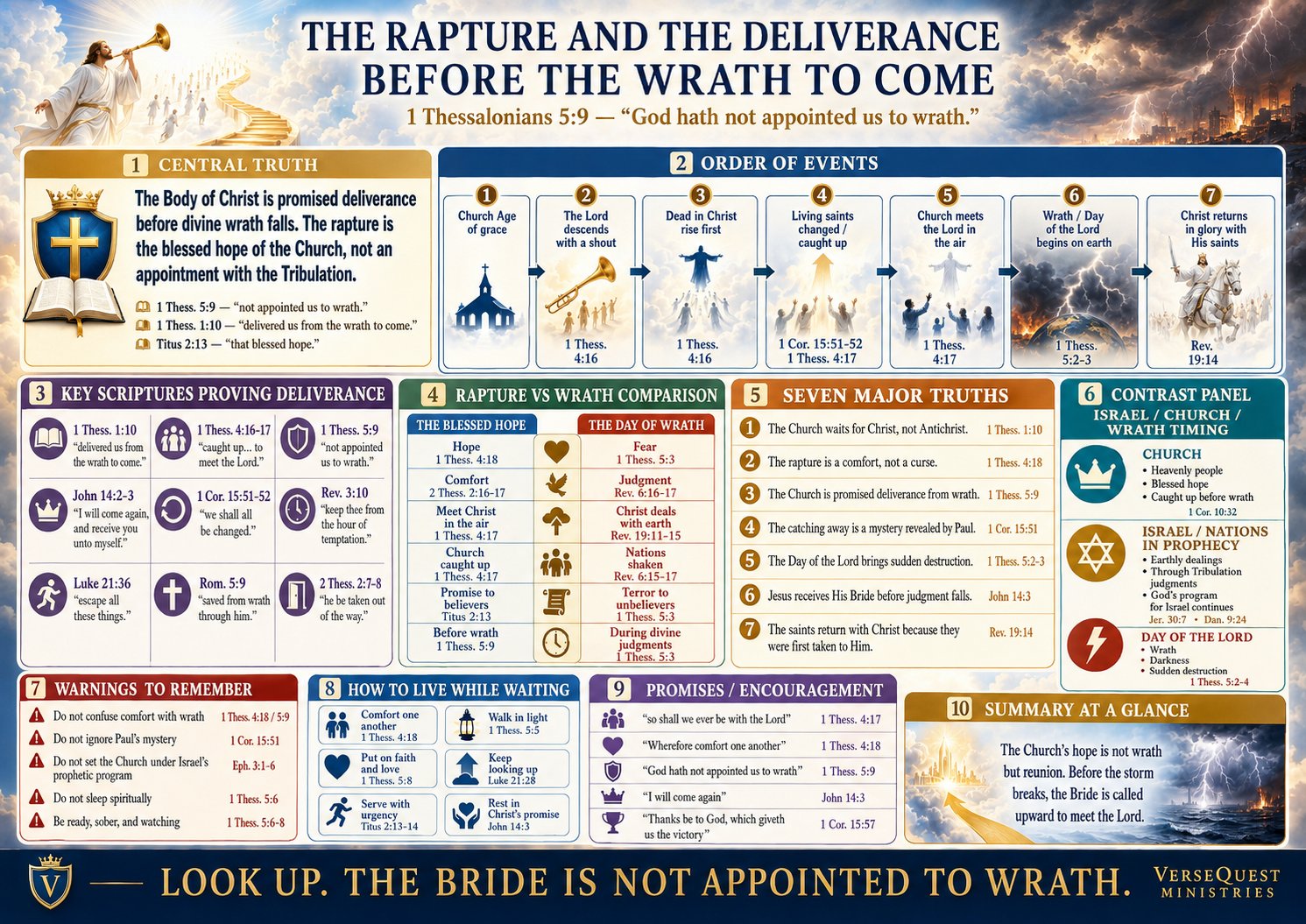
- The Rapture and the Deliverance Before the Wrath to Come – Printable Bible Study Chart
- Printable KJV Bible study chart on The Rapture and the Deliverance Before the Wrath to Come, showing from 1 Thessalonians 5:9 that the Church is not appointed to wrath. This…
- $4.99
- Add to cart
-