
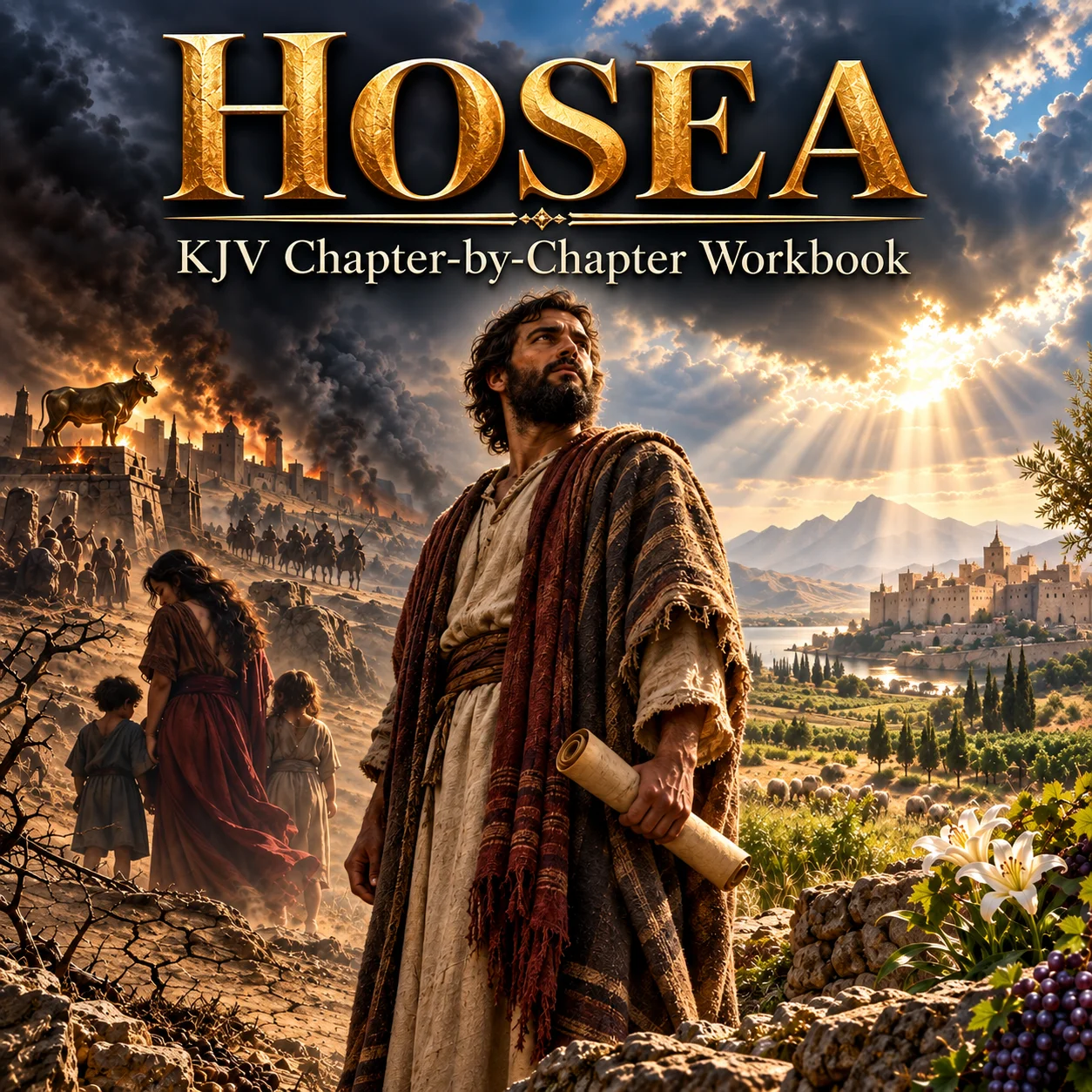
Hosea KJV Chapter-by-Chapter Workbook
The Hosea KJV Chapter-by-Chapter Workbook is an in-depth, interactive study of all 14 chapters of Hosea from a King James Bible-centered, rightly divided perspective. Rather than simply reading commentary, students are guided into the text itself through chapter analysis, doctrinal study, prophecy, cross-references, key words, historical context, comparisons, review questions, charts, glossary work, personal observations, and dedicated space for their own study notes.
Follow Hosea from the prophet’s extraordinary marriage and the prophetic naming of his children through Israel’s spiritual adultery, the judgment of the northern kingdom, the warnings to Ephraim, Assyrian captivity, God’s covenant dealings with Israel, and the tremendous promises of national restoration and future blessing. Special attention is given to passages that connect Hosea with the New Testament, Israel’s prophetic future, the Second Advent, resurrection, the Millennium, and the distinction between Israel and the Church.
This downloadable PDF workbook is designed for serious personal Bible study, homeschool, Sunday school, Bible classes, pastoral preparation, teaching, and anyone who wants to work through Hosea instead of merely reading about it. Study it digitally or print the pages you need and build your own working record of one of Scripture’s most powerful prophetic books.
Price: $24.99
$24.99
Description
The Hosea KJV Chapter-by-Chapter Workbook is an extensive, interactive Bible-study resource designed to take the student systematically through all fourteen chapters of the Book of Hosea. Rather than treating Hosea as a collection of isolated devotional verses, this workbook approaches the prophecy as a unified book that must be read in its historical setting, followed through its prophetic movements, compared carefully with other Scripture, and understood according to the distinctions God Himself places in His Word.
Hosea is one of the most striking prophetic books in the Old Testament. God takes the prophet’s own marriage and family circumstances and makes them part of His message to a spiritually adulterous nation. Gomer, Jezreel, Lo-ruhamah, and Lo-ammi become more than names in a narrative. They form part of a living prophetic picture involving Israel’s departure from the LORD, approaching judgment, dispersion, divine chastening, future regathering, and eventual restoration. The workbook helps the student trace these movements without confusing Israel with the Church or turning plainly national promises into vague religious symbolism.
The study follows Hosea chapter by chapter and repeatedly brings the student back to the actual words of the King James Bible. Major passages are examined through observation questions, cross-reference work, vocabulary study, doctrinal distinctions, historical connections, prophetic analysis, comparison exercises, charts, lists, review material, and opportunities for personal notes. The goal is not simply to tell the reader what Hosea says but to train the reader to work through the text and see how its individual passages fit together.
Special attention is given to the recurring subjects that make Hosea so important: spiritual adultery and idolatry, the northern kingdom and Ephraim, the Assyrian threat, Israel’s rejection of knowledge, false worship, the consequences of sowing wickedness, God’s holiness, judgment and mercy, repentance, the Davidic hope, Israel’s future restoration, resurrection language, the Second Advent, and the promised kingdom. Important expressions such as Jezreel, Lo-ruhamah, Lo-ammi, Ephraim, Baalim, Beth-aven, backsliding, whoredom, knowledge of God, latter days, sowing and reaping, and David their king are studied in their biblical contexts.
The workbook also helps students distinguish historical fulfillment from passages that reach beyond Hosea’s own generation. Hosea spoke into an actual political and spiritual crisis, but his prophecy does not end with Assyria. The book repeatedly looks beyond judgment toward Israel’s future. The student is therefore encouraged to identify the immediate historical setting, the doctrinal audience, the prophetic horizon, and relevant New Testament applications without collapsing those categories into one another.
This is not intended to be a book that the reader merely skims. It is a downloadable digital PDF workbook built for active study. Students can work digitally or print pages as desired, answer questions, follow cross-references, create personal observations, prepare teaching material, and return to completed chapters for review. It is particularly suited to serious personal Bible study, homeschool Bible curriculum, family study, Sunday school preparation, sermon research, Bible institutes, ministry training, and anyone who wants more than a surface-level introduction to Hosea.
For the student willing to open a King James Bible and work, Hosea becomes far more than the story of an unfaithful wife. It becomes a tremendous testimony to the holiness of God, the consequences of national apostasy, the certainty of God’s prophetic Word, and the remarkable fact that divine judgment does not cancel the promises God made to Israel.
Israel's Spiritual Adultery — Hosea repeatedly presents idolatry and covenant unfaithfulness in the language of marital betrayal. Hosea and Gomer — The prophet's marriage forms a living sign through which God communicates Israel's spiritual condition. The Prophetic Children — Jezreel, Lo-ruhamah, and Lo-ammi communicate judgment while also pointing toward future reversal and restoration. The Northern Kingdom and Ephraim — Hosea's repeated references to Ephraim require the student to understand the divided kingdom and the identity of his primary historical audience. Knowledge of God — Hosea exposes a nation filled with religious activity while lacking genuine knowledge of the LORD. Priestly Failure — Spiritual leadership is held accountable for rejecting knowledge and contributing to national corruption. Idolatry and False Worship — Calves, Baalim, high places, false altars, and corrupted worship demonstrate that religious activity is not automatically acceptable to God. Assyrian Judgment — The coming Assyrian invasion forms an essential historical backdrop to Hosea's warnings. Sowing and Reaping — Hosea vividly demonstrates that rebellion eventually produces its own harvest. Backsliding — Israel's recurring departure from the LORD is diagnosed rather than excused. Judgment and Mercy — Hosea holds both together. God's holiness requires judgment, while His promises guarantee that judgment will not be the final word concerning Israel. National Israel and Future Restoration — The workbook preserves Hosea's promises to Israel rather than transferring them wholesale to the Church. The Latter Days — Hosea reaches beyond his immediate historical circumstances to Israel's future return and restoration. David Their King — Hosea 3:5 introduces an important Davidic and Messianic element in Israel's future. Second Advent and Kingdom Hope — Restoration passages are studied within the larger prophetic program surrounding Christ's return and reign. Resurrection and Redemption from Death — Hosea 13:14 becomes an important bridge into New Testament resurrection teaching. Repentance and Return — Hosea does not merely expose sin; the book repeatedly calls Israel to return to the LORD. God's Unchanging Faithfulness — Human rebellion does not make God's Word unreliable or erase His declared purposes.
10. STUDY NOTES
The book of Hosea is one of the strongest Old Testament demonstrations that covenant privilege never gives a nation permission to disregard the holiness of God. Hosea ministers primarily to the northern kingdom of Israel, frequently called Ephraim, during a period when outward prosperity concealed deep spiritual corruption. Idolatry, political compromise, false worship, moral uncleanness, and rejection of the knowledge of God had become woven into national life. The tragedy of Hosea is that Israel possessed the truth, the history, the covenant, and the testimony of God and nevertheless departed from Him. “My people are destroyed for lack of knowledge” (Hosea 4:6) is therefore not merely a statement about ignorance. Israel had rejected the knowledge God had given them.
Hosea’s marriage and family form a living prophetic sign. Gomer’s unfaithfulness pictures Israel’s spiritual adultery, while the names of the children communicate judgment and broken fellowship: Jezreel, Lo-ruhamah, and Lo-ammi. Yet judgment is not the end of the prophecy. Hosea 1 moves from “ye are not my people” to the promise that Israel will again be called “the sons of the living God” (Hosea 1:10). This judgment-restoration pattern runs throughout the book. God disciplines Israel without canceling the promises connected with Israel’s ultimate restoration. That distinction is essential when studying Hosea: temporary rejection, dispersion, and chastisement must not be confused with permanent abandonment.
The book repeatedly exposes the danger of religious activity without genuine knowledge of God. Israel maintained sacrifices, altars, feast days, and religious forms while pursuing idols and committing spiritual whoredom. Hosea 6:6 states the principle plainly: “For I desired mercy, and not sacrifice; and the knowledge of God more than burnt offerings.” Religious ceremony cannot substitute for obedience. Hosea also demonstrates the destructive consequences of divided allegiance. Ephraim could seek Assyria, imitate surrounding nations, multiply altars, and make political arrangements, but none of those things could heal the spiritual wound produced by rebellion against the LORD.
Several recurring images should be marked throughout the workbook. Israel is compared with an unfaithful wife, a backsliding heifer, a silly dove, an empty vine, grapes in the wilderness, a cake not turned, and other vivid pictures. God is presented through equally powerful imagery as husband, healer, lion, dew, and the One who ultimately restores His people. Students should not rush past these comparisons. Each image reveals another dimension of Israel’s condition or God’s dealings with the nation. Building a chapter-by-chapter list of these figures is one of the most effective ways to see Hosea’s argument develop.
Prophetically, Hosea repeatedly looks beyond the immediate Assyrian crisis. Passages concerning Israel’s regathering, restoration, David their king, renewed relationship with the LORD, and latter-day blessing require careful comparison with the rest of Scripture. Hosea 3:4–5 is especially important: Israel would abide “many days” without a king, prince, sacrifice, image, ephod, or teraphim, followed by a future return in which “the children of Israel shall return, and seek the LORD their God, and David their king.” The student should distinguish the historical setting, prophetic fulfillment, doctrinal application, and legitimate spiritual lessons rather than collapsing every reference into the Church.
Hosea also contains important passages later used in the New Testament. Hosea 1–2 should be compared carefully with Romans 9 and 1 Peter 2. Hosea 6:6 is cited by the Lord Jesus in Matthew 9:13 and 12:7. Hosea 10:8 connects with Luke 23:30 and Revelation 6:16. Hosea 11:1 appears in Matthew 2:15. Hosea 13:14 provides language taken up by Paul in 1 Corinthians 15:54–55. These connections demonstrate why context matters: a New Testament use of an Old Testament passage does not automatically erase its original historical or prophetic meaning.
The closing chapter provides the proper destination for the entire study. “O Israel, return unto the LORD thy God” (Hosea 14:1). Judgment has been severe because Israel’s departure was real, but restoration remains possible because God’s mercy is greater than Israel’s failure. The final verse supplies an appropriate interpretive key to the book: “Who is wise, and he shall understand these things? prudent, and he shall know them? for the ways of the LORD are right” (Hosea 14:9). Hosea therefore should be studied as more than a record of national apostasy. It is a carefully constructed prophetic book of sin, chastisement, covenant faithfulness, promised restoration, and the unchanging righteousness of the LORD.
The Hosea KJV Chapter-by-Chapter Workbook can function as a complete personal-study course. A student can read one chapter of Hosea, work through the corresponding material, answer the questions directly from Scripture, trace the cross-references, complete vocabulary work, and record conclusions and personal notes. This turns Bible reading into deliberate Bible study.
Pastors and preachers can use the workbook as a research and sermon-development tool. Hosea contains rich material for preaching on apostasy, idolatry, spiritual leadership, judgment, repentance, mercy, sowing and reaping, backsliding, national accountability, prophecy, Israel, and restoration. The workbook's chapter structure helps separate immediate context from legitimate doctrinal and practical applications.
Sunday school teachers, Bible-study leaders, and Bible institutes can divide the material into individual lessons or multiweek units. Questions and comparison work can be assigned before class, while charts, chapter summaries, key terms, and cross-references can become teaching material during class.
Families and homeschool students can use the workbook as a structured Old Testament course. Older students can complete written responses and research assignments, while parents can select key questions, passages, vocabulary, and charts for guided family discussion.
The workbook is also useful for ministry training because Hosea forces the student to practice several essential Bible-study disciplines simultaneously: determining the audience, respecting historical context, comparing Scripture with Scripture, identifying prophetic horizons, recognizing New Testament use of Old Testament passages, distinguishing Israel from the Church, and separating interpretation from application.
A King James Bible should remain open throughout the entire study. Hosea is best understood by repeatedly comparing its language with the Law, the historical books, the other prophets, the Gospels, Romans, and Revelation rather than studying individual verses in isolation.
A Strong's Exhaustive Concordance or comparable KJV concordance is especially useful for tracing recurring terms such as Ephraim, Israel, whoredom, knowledge, return, mercy, judgment, Baal, Assyria, and David. A reliable Bible dictionary can assist with historical names, geography, kings, nations, agricultural imagery, and ancient religious practices.
A Bible atlas and divided-kingdom map will help students locate Samaria, Judah, Jezreel, Bethel, Gilgal, Gibeah, Ramah, Assyria, and Egypt. A chronology of the kings of Israel and Judah is also valuable for placing Hosea alongside the reigns mentioned in Hosea 1:1 and the events recorded in Kings and Chronicles.
For cross-reference study, particular attention should be given to Deuteronomy 28–30, 1–2 Kings, Isaiah, Jeremiah, Ezekiel 36–37, Daniel, Matthew, Romans 9–11, 1 Corinthians 15, and Revelation. These passages help the student see Hosea as part of the larger prophetic testimony concerning Israel's rebellion, judgment, dispersion, repentance, restoration, resurrection, and kingdom hope.
Related products
-
Rightly Divided
-
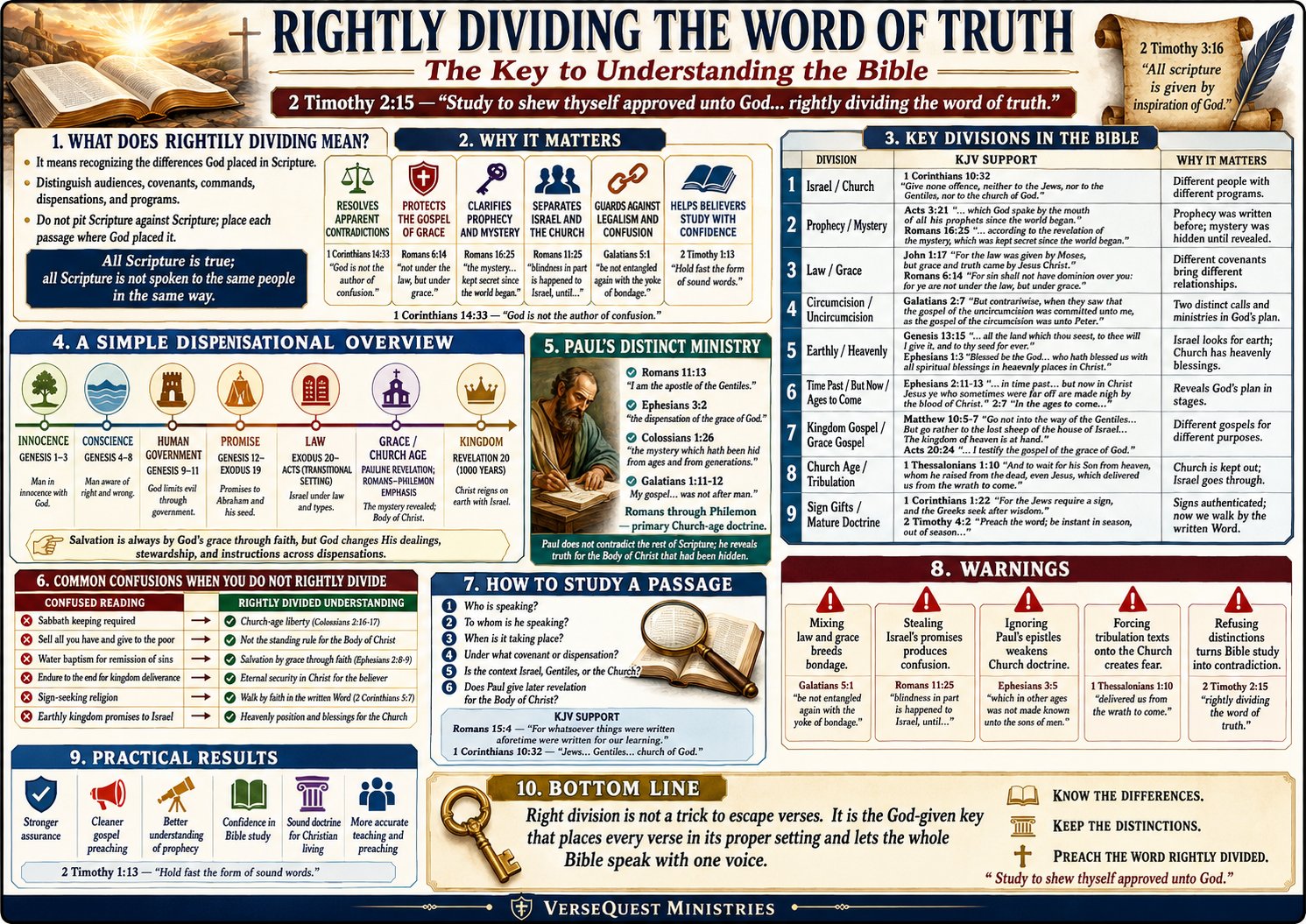
- Rightly Dividing the Word of Truth – KJV Bible Study Chart
- A premium KJV Bible study chart explaining how to rightly divide the word of truth, distinguish key biblical divisions, and study Scripture with clarity and confidence.
- $3.99
- Add to cart
-
-
Law vs Grace
-
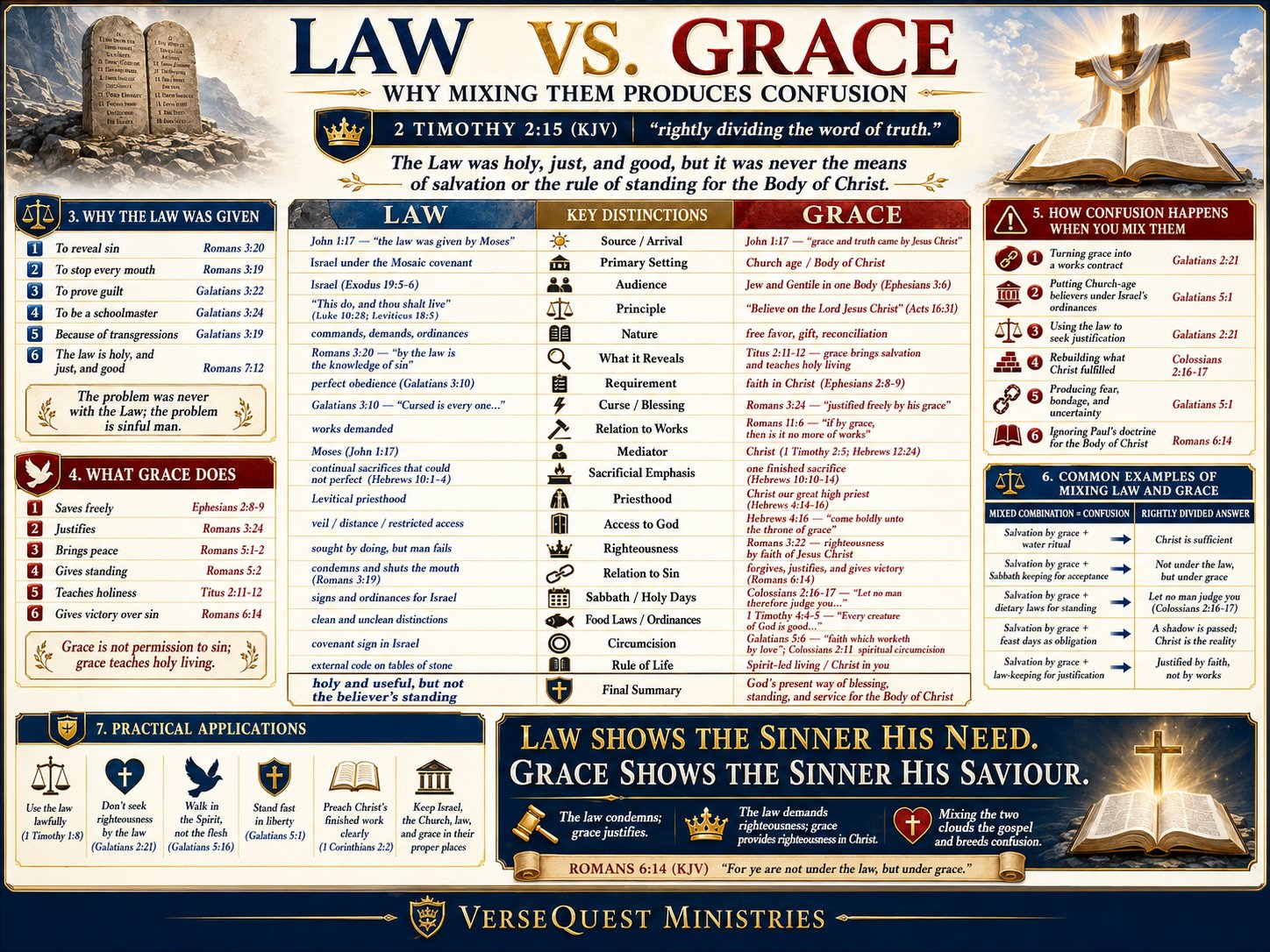
- Law vs. Grace Bible Study Chart – Why Mixing Them Produces Confusion (KJV)
- Compare law and grace with this detailed KJV Bible study chart explaining salvation, justification, holiness, Israel’s Mosaic covenant, Christian liberty, and the danger of mixing law with the gospel.
- $3.99
- Add to cart
-
-
Digital Bible Study Collections
-
-53%

- The Complete Revelation and End-Times Library – 7-Book Digital Collection
- Seven complete KJV prophecy books in one premium digital collection—632 detailed Bible studies and more than 4,100 pages covering the seven churches, pre-Tribulation Rapture, last-days spiritual sleep, Judas and the…
- Original price was: $214.93.$99.99Current price is: $99.99.
- Add to cart
-
-53%
-
Doctrine
-
-50%
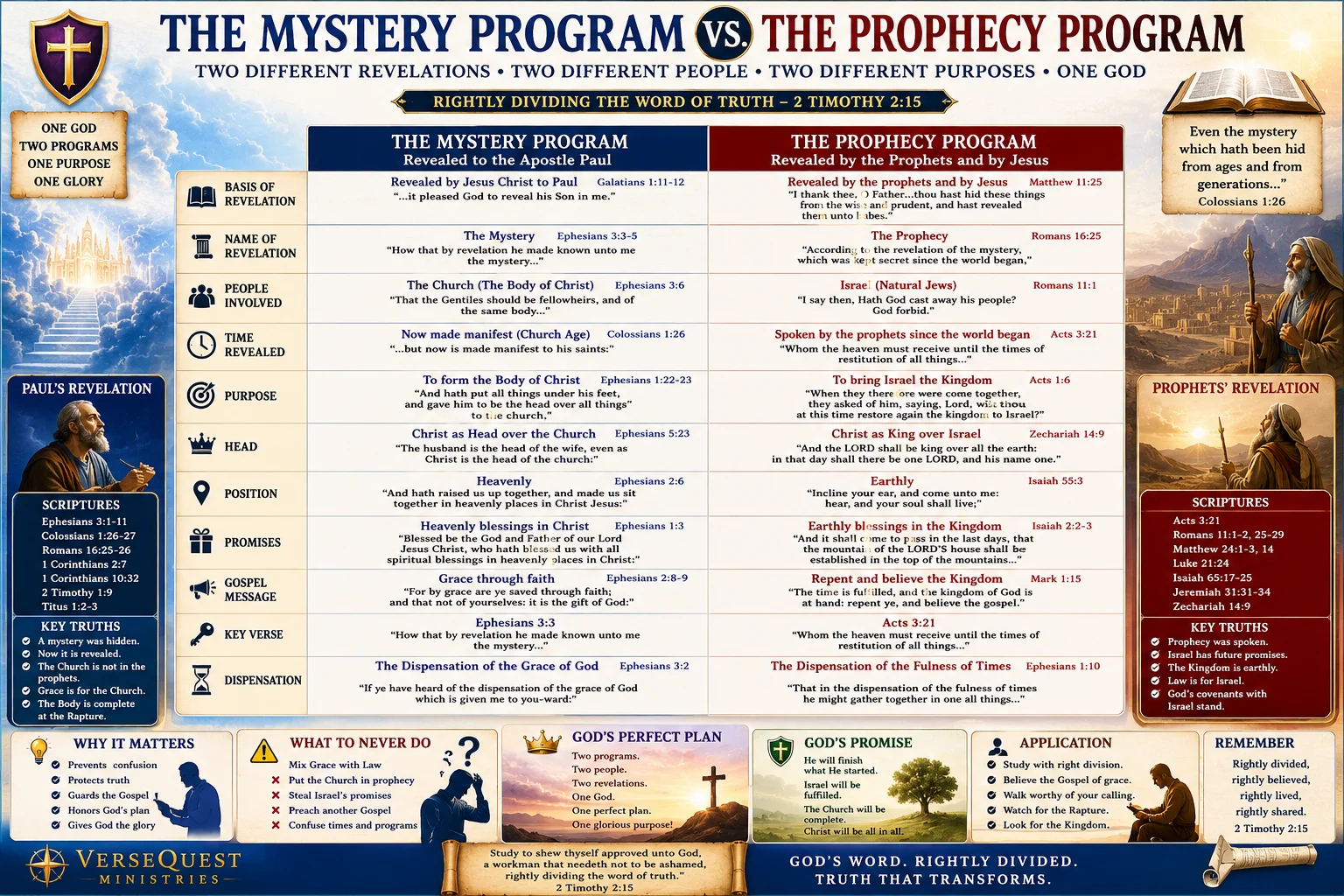
- The Mystery Program vs. Prophecy Program Chart — KJV Rightly Divided
- Premium printable KJV Bible study chart comparing the mystery program revealed through Paul with the prophecy program spoken by the prophets. Rightly divided and designed for teaching and personal study.
- Original price was: $10.00.$4.99Current price is: $4.99.
- Add to cart
-
-50%
-
The Seven Dispensations
-
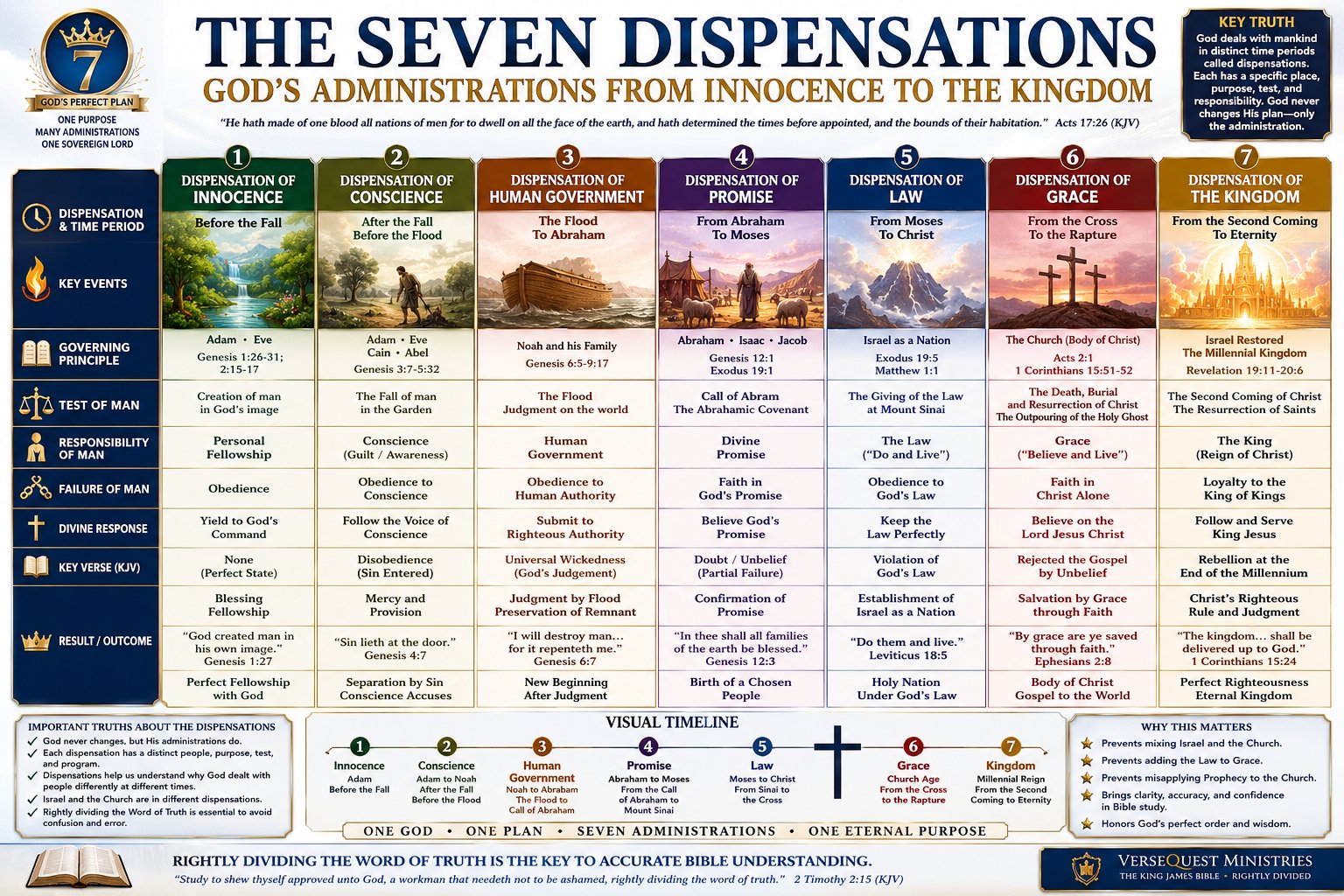
- The Seven Dispensations Bible Study Chart – God’s Administrations from Innocence to the Kingdom (KJV)
- Explore the seven dispensations with this detailed KJV Bible study chart covering Innocence, Conscience, Human Government, Promise, Law, Grace, the Kingdom, and the importance of rightly dividing Scripture.
- $3.99
- Add to cart
-