
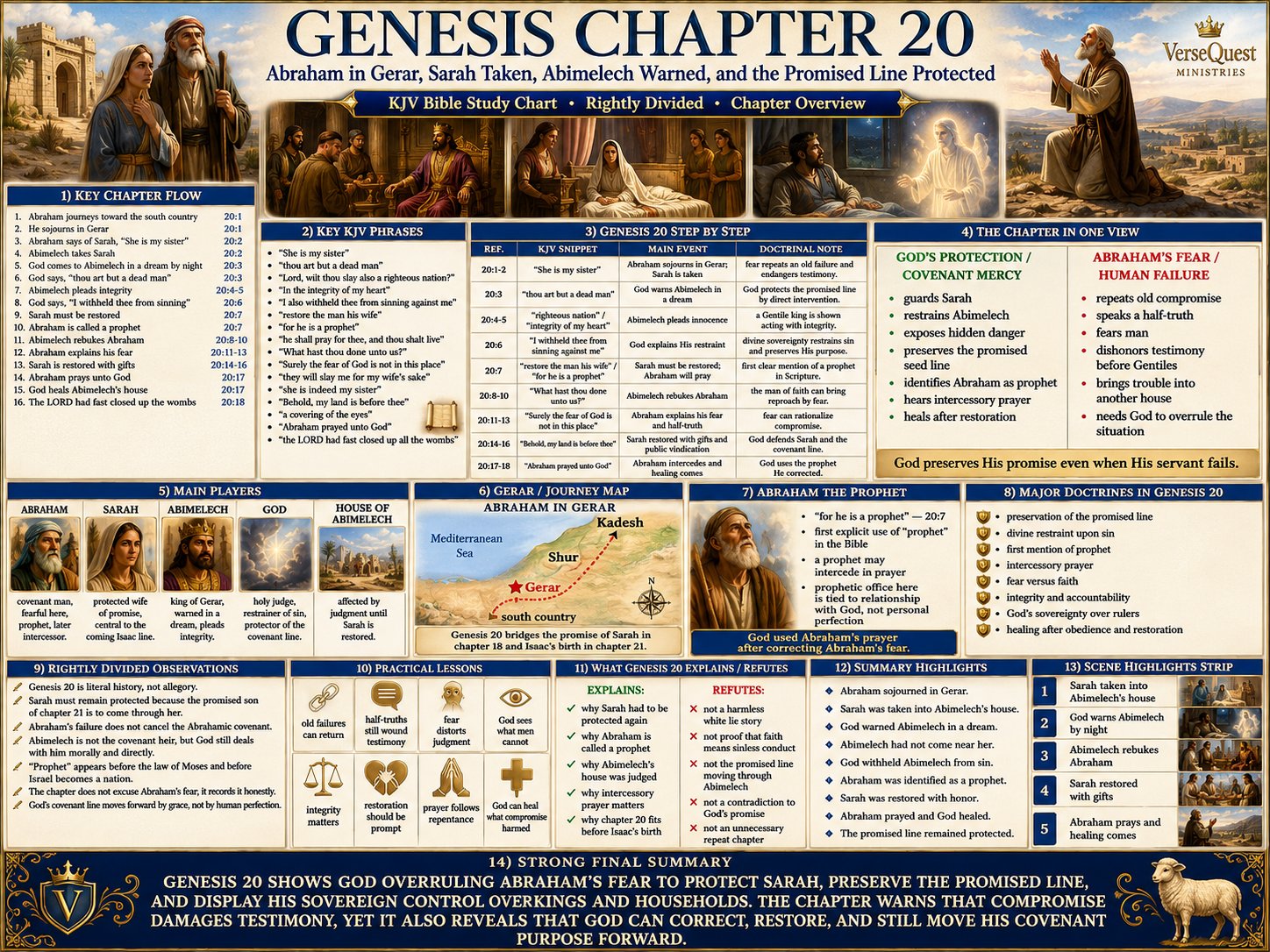
Genesis Chapter 20 Bible Study Chart – Abraham in Gerar, Sarah Taken, Abimelech Warned, and the Promised Line Protected (KJV)
Explore Genesis Chapter 20 with this detailed KJV Bible study chart covering Abraham’s fear in Gerar, Sarah and Abimelech, half-truths, divine intervention, intercessory prayer, healing, and God’s protection of the promised line.
$3.99
Description
Genesis Chapter 20: Abraham in Gerar, Sarah Taken, Abimelech Warned, and the Promised Line Protected is a detailed KJV Bible study chart examining Abraham’s repeated failure through fear, God’s warning to Abimelech, Sarah’s restoration, Abraham’s identification as a prophet, intercessory prayer, divine healing, and the preservation of the covenant line before Isaac’s birth.
The chapter begins as Abraham journeys toward the south country and sojourns in Gerar. Although God has repeatedly confirmed His covenant and promised that Sarah will bear Isaac, Abraham again introduces Sarah as his sister. This repeats the compromise previously seen in Egypt and places Sarah, Abimelech’s household, Abraham’s testimony, and the promised line in immediate danger.
Abimelech, king of Gerar, takes Sarah into his household. Before he can approach her, however, God comes to him in a dream by night and warns him plainly: “Behold, thou art but a dead man.” The warning reveals God’s sovereign intervention and His determination to protect Sarah and preserve the promised seed.
Abimelech pleads the integrity of his heart, explaining that Abraham had called Sarah his sister and that Sarah herself had identified Abraham as her brother. God acknowledges that Abimelech acted without full knowledge and declares, “I also withheld thee from sinning against me.” The passage demonstrates that divine restraint may prevent a person from completing a sinful action even when dangerous circumstances have already developed.
God commands Abimelech to restore Sarah because Abraham is a prophet who will pray for him. This is the first explicit use of the word “prophet” in Scripture. Abraham’s prophetic standing does not mean he is personally flawless. His failure is exposed honestly, yet God still uses him as an intercessor after correction and restoration.
Abimelech rises early, gathers his servants, and reports the divine warning. His household responds with great fear. He then confronts Abraham and asks what he has done and how Abimelech had offended him to deserve such danger. The rebuke is especially humiliating because a Gentile king speaks more honestly and responsibly in this moment than the covenant man who acted from fear.
Abraham explains that he believed the fear of God was absent from Gerar and that the people would kill him for Sarah’s sake. His assumption reveals how fear can distort judgment. Abraham concluded that everyone around him was dangerous while failing to recognize the danger created by his own compromise.
Abraham also explains that Sarah is indeed his half-sister and that they had agreed to use this description during their travels. The statement contained factual information, but it concealed the essential truth that Sarah was Abraham’s wife. Genesis 20 therefore demonstrates that a half-truth deliberately used to mislead is not biblical honesty.
The chart contrasts God’s protection and covenant mercy with Abraham’s fear and human failure. God guards Sarah, restrains Abimelech, exposes the hidden danger, preserves the promised line, identifies Abraham as a prophet, hears intercessory prayer, and brings healing after restoration. Abraham repeats an old compromise, fears man, damages his testimony, and brings trouble into another household.
Abimelech restores Sarah with gifts, livestock, servants, and silver. He publicly vindicates her and permits Abraham to dwell wherever he chooses in the land. The restoration protects Sarah’s honour and prevents confusion concerning the miraculous birth of Isaac recorded in the following chapter.
Abraham then prays for Abimelech, and God heals the king, his wife, and the women of his household. The LORD had closed their wombs because Sarah had been taken. The healing demonstrates that intercessory prayer can follow repentance, correction, restitution, and restored relationships.
The chapter presents several major doctrines, including God’s preservation of the promised line, divine restraint upon sin, the first biblical mention of a prophet, intercessory prayer, fear versus faith, integrity and accountability, God’s sovereignty over rulers, and healing after obedience and restoration.
Genesis 20 also shows that spiritual maturity does not make a believer incapable of repeating an old failure. Abraham had walked with God for years, received remarkable promises, rescued Lot, met Melchizedek, interceded for Sodom, and entered covenant fellowship with God. Yet fear reopened a weakness that had appeared earlier in his life.
The chapter does not excuse Abraham’s conduct because he is a covenant man. Scripture records his failure plainly. At the same time, his failure does not cancel the Abrahamic covenant because the promise rests upon God’s faithfulness rather than Abraham’s personal perfection.
This chart is ideal for personal Bible study, Genesis teaching, studies of Abraham and Sarah, fear and compromise, integrity, divine providence, intercessory prayer, spiritual restoration, Sunday school, homeschool Bible curriculum, Bible institutes, sermon preparation, discipleship, and rightly divided covenant study.
Abraham in Gerar, Sarah and Abimelech, fear versus faith, repeated compromise, half-truths, damaged testimony, divine intervention, God’s restraint upon sin, preservation of the promised line, Abraham the prophet, intercessory prayer, integrity, accountability, restoration, public vindication, divine healing, covenant faithfulness, God’s sovereignty over rulers, repentance, spiritual recovery
Genesis 20 demonstrates that an old spiritual weakness can return even after years of growth and remarkable experiences with God. Abraham had received repeated covenant promises, yet fear caused him to repeat the same compromise previously made in Egypt.
Abraham’s statement that Sarah was his sister contained partial truth, but it concealed their marriage. A technically accurate statement becomes deceptive when it is intentionally used to produce a false conclusion.
Fear distorted Abraham’s judgment. He assumed that there was no fear of God in Gerar and that he would be killed, yet Abimelech responded to God’s warning with fear, urgency, integrity, and restitution.
God protected Sarah because Isaac’s birth was approaching and the promised line had to remain unmistakably preserved. Divine intervention prevented Abimelech from approaching her and guarded the integrity of the covenant narrative.
The statement “I also withheld thee from sinning against me” reveals God’s restraining providence. Abimelech remained responsible for his actions, but God mercifully prevented the situation from developing further.
Abraham is identified as a prophet despite his failure. The prophetic office rests upon God’s calling rather than human perfection. Nevertheless, prophetic privilege does not place a servant above correction or accountability.
Abimelech’s rebuke exposes the public consequences of private fear. Abraham’s compromise endangered another household and damaged his testimony before people he had already judged unfairly.
Restoration required more than private regret. Sarah had to be returned, her honour publicly defended, and the matter openly corrected. Biblical repentance seeks to repair the damage caused wherever possible.
Abraham’s prayer becomes part of Abimelech’s healing. God uses the corrected servant as an intercessor, showing that failure need not permanently disqualify a believer who responds to truth and returns to obedience.
The closing of the wombs in Abimelech’s household demonstrates God’s control over life and reproduction. The same chapter that records closed wombs prepares for the miraculous opening of Sarah’s womb in Genesis 21.
Genesis 20 magnifies God’s faithfulness. Abraham fails, but God does not abandon His promise. He corrects His servant, protects Sarah, restrains Abimelech, restores the household, and moves the covenant purpose forward.
Genesis chapter study, overcoming fear, honesty and integrity, dangers of half-truths, repeated spiritual failures, restoring damaged relationships, intercessory prayer, accountability before God, trusting covenant promises, pastoral counseling, marriage instruction, Sunday school lessons, homeschool Bible curriculum, Christian school teaching, Bible institute classes, sermon preparation, discipleship training, biblical leadership, spiritual restoration
King James Bible, Strong’s Concordance, Thompson Chain-Reference Bible, Treasury of Scripture Knowledge, Nave’s Topical Bible, Bible atlas, maps of Gerar and the south country, Genesis commentary notes, Abrahamic covenant studies, biblical integrity resources, prayer and intercession studies, Scripture memory cards, pastoral counseling materials, VerseQuest Genesis chapter charts
Related products
-
Prophecy Studies
-

- The Resurrection of Jesus Christ Made Plain – 501-Page KJV Bible Study
- A massive 501-page VerseQuest Ministries PDF Bible study defending and explaining the bodily resurrection of Jesus Christ from a KJV, rightly divided perspective. This 80-essay study covers the empty tomb,…
- $34.99
- Add to cart
-
-
Study Books (PDF)
-
-25%

- The Mysteries of God Revealed for the Church Age – Premium Essay Series PDF
- A premium 404-page VerseQuest Ministries digital PDF study book featuring 54 detailed KJV-only essays on the mysteries of God revealed for the Church Age. This rightly divided study covers the…
- Original price was: $39.99.$29.99Current price is: $29.99.
- Add to cart
-
-25%
-
Christology Studies
-

- The Deity of Christ Defended — 66 KJV Studies Proving Jesus Christ Is God Manifest in the Flesh
- he Deity of Christ Defended is a 444-page premium KJV Bible study defending the full deity of the Lord Jesus Christ. This 66-study book proves from Scripture that Jesus is…
- $29.99
- Add to cart
-
-
Jesus Christ
-
-67%

- The Millennium Made Plain – 416-Page KJV Study on Christ’s Future Reign
- A premium 416-page KJV, rightly divided Bible study on the literal future Millennial reign of Jesus Christ. The Millennium Made Plain explains Revelation 19–20, Israel’s restoration, Satan’s binding, the Kingdom…
- Original price was: $29.99.$9.99Current price is: $9.99.
- Add to cart
-
-67%
-
The Rapture
-
-67%
- Caught Up Before the Wrath – 66-Essay KJV Rapture Study
- Caught Up Before the Wrath is a 430-page premium KJV Bible study defending the pre-tribulation Rapture of the Church from a rightly divided, dispensational perspective. This 66-essay VerseQuest Ministries book…
- Original price was: $29.99.$9.99Current price is: $9.99.
- Add to cart
-
-67%