
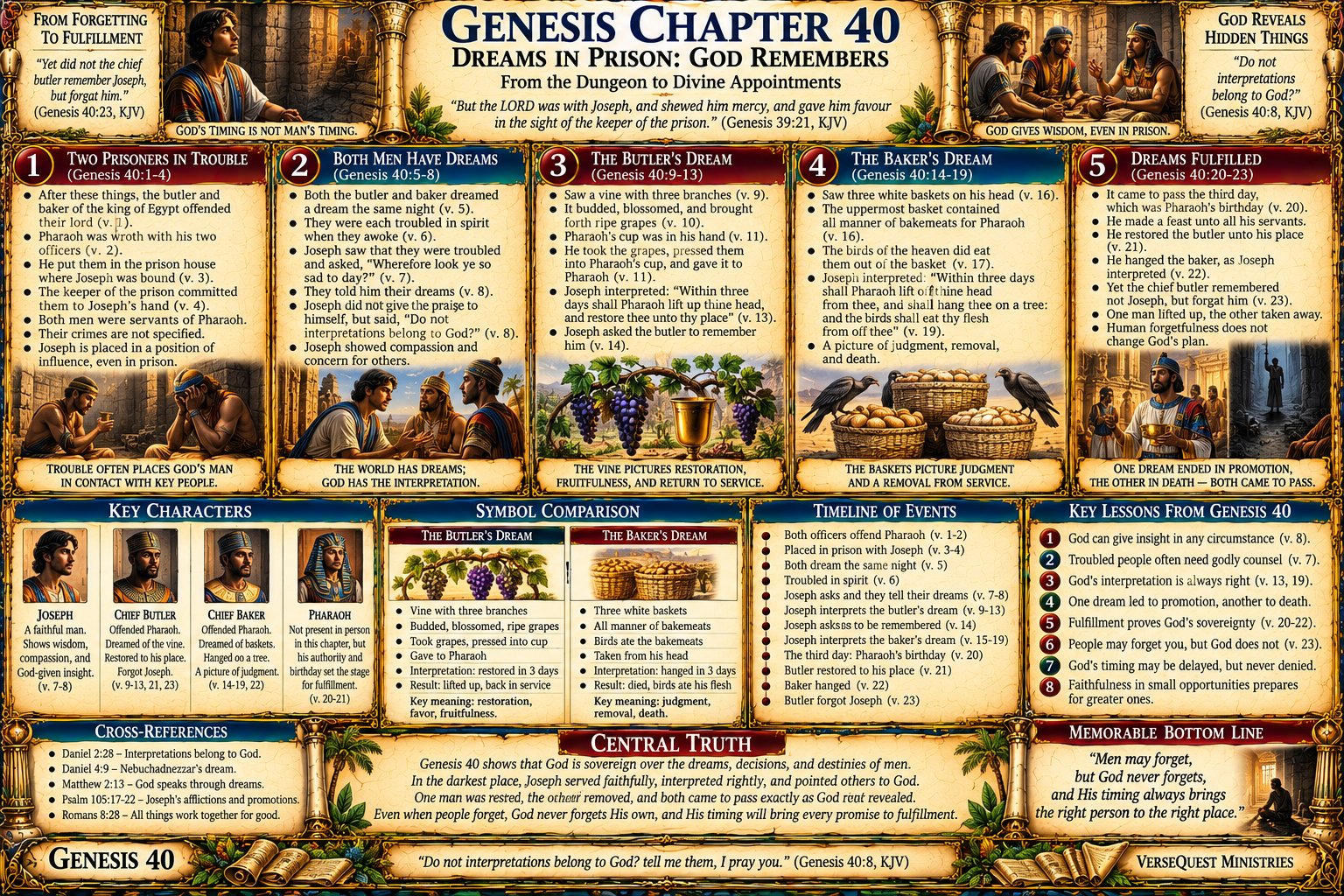
Genesis 40 – Dreams in Prison: Joseph, the Chief Butler, the Chief Baker, God’s Interpretations, and the Forgotten Prisoner (KJV Bible Study Chart)
Explore Genesis 40 with this detailed KJV Bible study chart tracing Joseph’s encounter with Pharaoh’s chief butler and chief baker inside the prison. Follow the two officers through their troubling dreams, Joseph’s declaration “Do not interpretations belong to God?”, the vine and three branches, the three baskets, and the precise interpretations that are fulfilled three days later on Pharaoh’s birthday. The chart also examines the butler’s restoration, the baker’s execution, Joseph’s request to be remembered, and the sobering ending: “Yet did not the chief butler remember Joseph, but forgat him.” Genesis 40 provides a powerful study of divine wisdom, providence, faithfulness in obscurity, delayed deliverance, and God’s preparation of future opportunities. Ideal for Bible study, Sunday school, homeschool, sermon preparation, and Joseph studies.
$4.99
Description
Genesis 40: Dreams in Prison—God’s Providence Behind Forgotten Circumstances is a detailed KJV Bible study chart tracing Joseph’s encounter with Pharaoh’s chief butler and chief baker while all three men are confined in prison. The chapter follows two troubling dreams, Joseph’s God-given interpretations, their exact fulfillment on Pharaoh’s birthday, and the painful conclusion that the restored butler “forgat him.” Though Joseph remains in confinement, the chapter quietly moves him one step closer to Pharaoh’s court and the fulfillment of God’s larger purpose.
Pharaoh becomes angry with two of his officers, the chief butler and chief baker, and commits them to the prison where Joseph is already bound. The captain of the guard charges Joseph with their care. Even in prison Joseph remains useful, responsible, and attentive to people around him.
Both officials dream during the same night, each dream carrying its own interpretation. The following morning Joseph notices their troubled expressions and asks, “Wherefore look ye so sadly to day?” Their response opens one of the chapter’s central truths: they have dreamed, but there is no interpreter. Joseph answers, “Do not interpretations belong to God? tell me them, I pray you.” He refuses to claim supernatural wisdom as his own and directs attention to God.
The chief butler describes a vine with three branches that buds, blossoms, produces ripe grapes, and fills Pharaoh’s cup. Joseph interprets the three branches as three days. Within that time Pharaoh will lift up the butler’s head and restore him to his former office. Joseph then asks the man to remember him and mention his unjust imprisonment to Pharaoh.
Encouraged by the favorable interpretation, the chief baker tells his dream. He carries three white baskets on his head, with baked foods for Pharaoh in the upper basket, while birds eat from it. Joseph gives a very different interpretation: within three days Pharaoh will lift the baker’s head from off him, hang him on a tree, and the birds will eat his flesh.
On the third day, Pharaoh’s birthday, both interpretations are fulfilled exactly. The chief butler is restored to his position, while the chief baker is executed.
Yet the chapter ends with a painful sentence: “Yet did not the chief butler remember Joseph, but forgat him.” Human gratitude fails, but divine providence has not stopped. The man who will eventually introduce Joseph to Pharaoh is already in position; the timing simply has not arrived.
Genesis 40 therefore teaches faithfulness in obscurity, compassion during hardship, dependence upon God for wisdom, and confidence that delay is not denial. Joseph remains in prison, but the next stage of God’s plan has already been prepared.
Genesis 40, Joseph in prison, chief butler, chief baker, Pharaoh’s officers, dreams in prison, God’s interpretations, divine wisdom, three branches, Pharaoh’s cup, three baskets, Pharaoh’s birthday, butler restored, baker hanged, Joseph forgotten, providence, faithfulness in prison, divine timing, delayed deliverance, God’s sovereignty, Joseph’s compassion, Joseph’s imprisonment, preparation for promotion
Genesis 40 continues Joseph’s imprisonment after the false accusation of Potiphar’s wife. The chapter opens when Pharaoh’s chief butler and chief baker offend their king and are confined in the same prison. Their exact offenses are not revealed. The keeper places them under Joseph’s care, showing that even while unjustly imprisoned Joseph continues to receive responsibility.
Both officers dream during the same night. The following morning Joseph notices their sadness and asks why they look troubled. This small detail reveals his character. Joseph has his own reasons for discouragement, yet he remains attentive to the condition of others rather than becoming consumed with himself.
The men explain that they have dreamed but lack an interpreter. Joseph immediately answers, “Do not interpretations belong to God?” This establishes the chapter’s doctrinal center. Joseph possesses God-given insight, but he refuses to present himself as the source of revelation. Later Daniel will display the same principle before Nebuchadnezzar: hidden things are revealed by God.
The chief butler’s dream contains a vine with three branches. The branches bud, blossom, produce grapes, and the butler presses the grapes into Pharaoh’s cup. Joseph explains that the three branches represent three days, after which Pharaoh will restore the butler to his office.
Joseph then makes a personal request. He asks the butler to remember him when restored and to mention him to Pharaoh. Joseph explains that he was stolen from the land of the Hebrews and has done nothing deserving imprisonment. His faith in God does not prevent him from using a legitimate opportunity to seek release.
The chief baker, encouraged by the favorable first interpretation, recounts his own dream of three baskets upon his head. Birds eat Pharaoh’s baked foods from the upper basket. Joseph faithfully gives the difficult interpretation: the three baskets also mean three days, but the baker will be executed.
On Pharaoh’s birthday, both prophecies are fulfilled precisely. The chief butler is restored to his cupbearing office, while the chief baker is hanged. The exact fulfillment confirms that Joseph’s interpretations came from God.
The final verse is deliberately painful: “Yet did not the chief butler remember Joseph, but forgat him.” Genesis 40 does not explicitly say here that God “remembered” Joseph, but the larger narrative proves that divine providence continued while human memory failed.
Joseph must remain in prison for another season. Yet the very man who will eventually speak his name before Pharaoh has now been restored to court. Delay is therefore not evidence that God’s plan has failed. Genesis 40 teaches that God may prepare deliverance long before His servant can see it.
Genesis 40 is useful for teaching faithfulness when advancement seems delayed, compassion for others while personally suffering, dependence upon God rather than personal ability, and confidence that God can use apparently insignificant encounters to prepare future opportunities. It also demonstrates that divine timing may include periods when faithful people are overlooked or forgotten by others. The chapter is valuable for personal Bible study, Sunday school, homeschool instruction, Bible institutes, sermon preparation, leadership training, prison-ministry lessons, providence studies, dream passages, discipleship, and teaching on patience, service, humility, wisdom, and trusting God during prolonged waiting.
King James Bible, Strong’s Concordance, Thompson Chain-Reference Bible, Treasury of Scripture Knowledge, Nave’s Topical Bible, Genesis 37–41 study notes, Joseph life timeline, Joseph in Egypt charts, Psalm 105 Joseph studies, Acts 7 studies, Daniel 2 dream interpretation studies, biblical dream Scripture chains, providence studies, Romans 8:28 studies, biblical patience and waiting studies, Joseph and Christ typology charts, VerseQuest Genesis charts
Related products
-
Biblical Submission
-
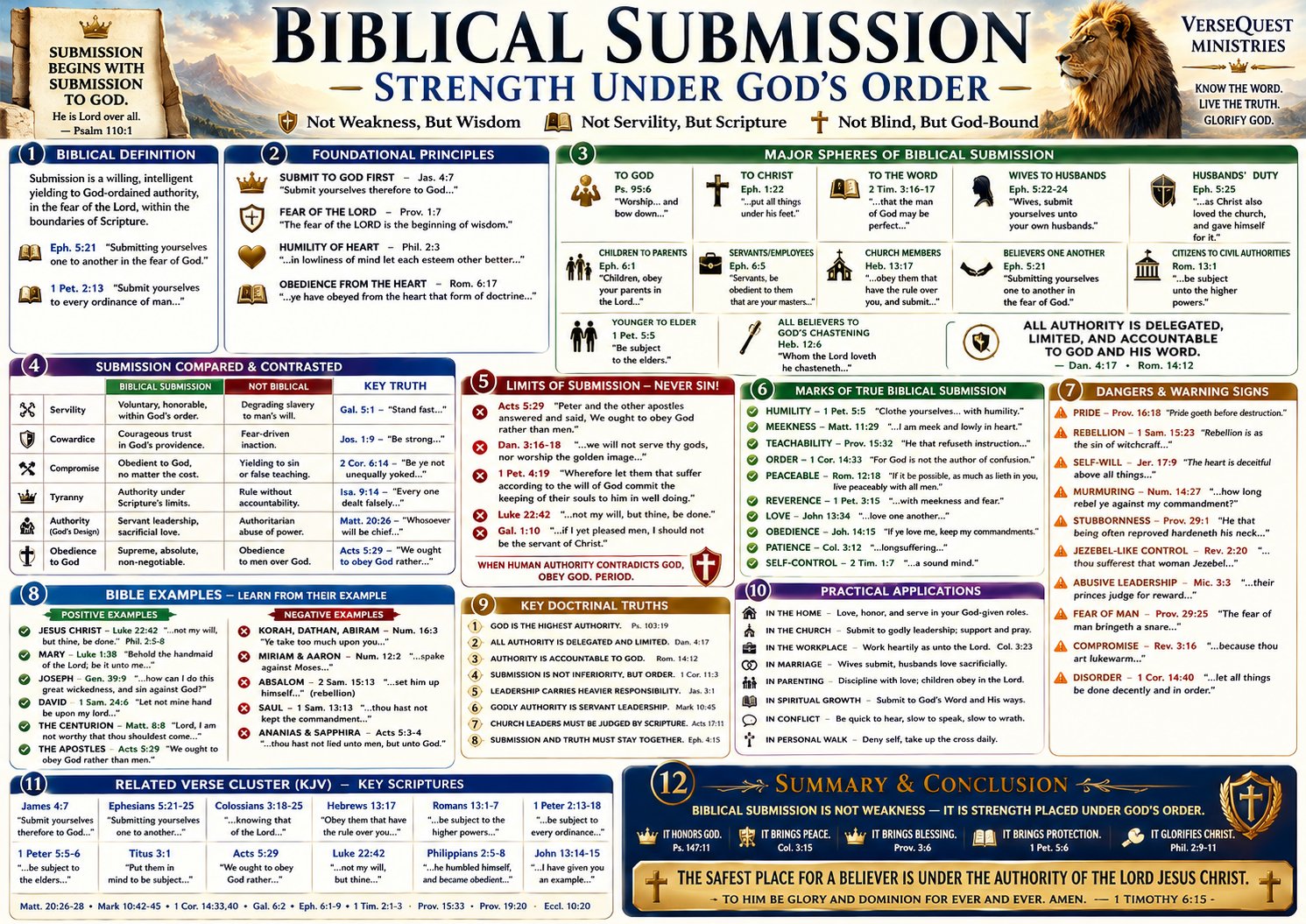
- Biblical Submission Bible Study Chart – Strength Under God’s Order, Authority, and Scriptural Limits (KJV) Product Description
- Study biblical submission with this detailed KJV chart covering God-ordained authority, servant leadership, obedience, marriage, church, government, and the Scriptural limits of submission.
- $3.99
- Add to cart
-
-
Chart Collections
-
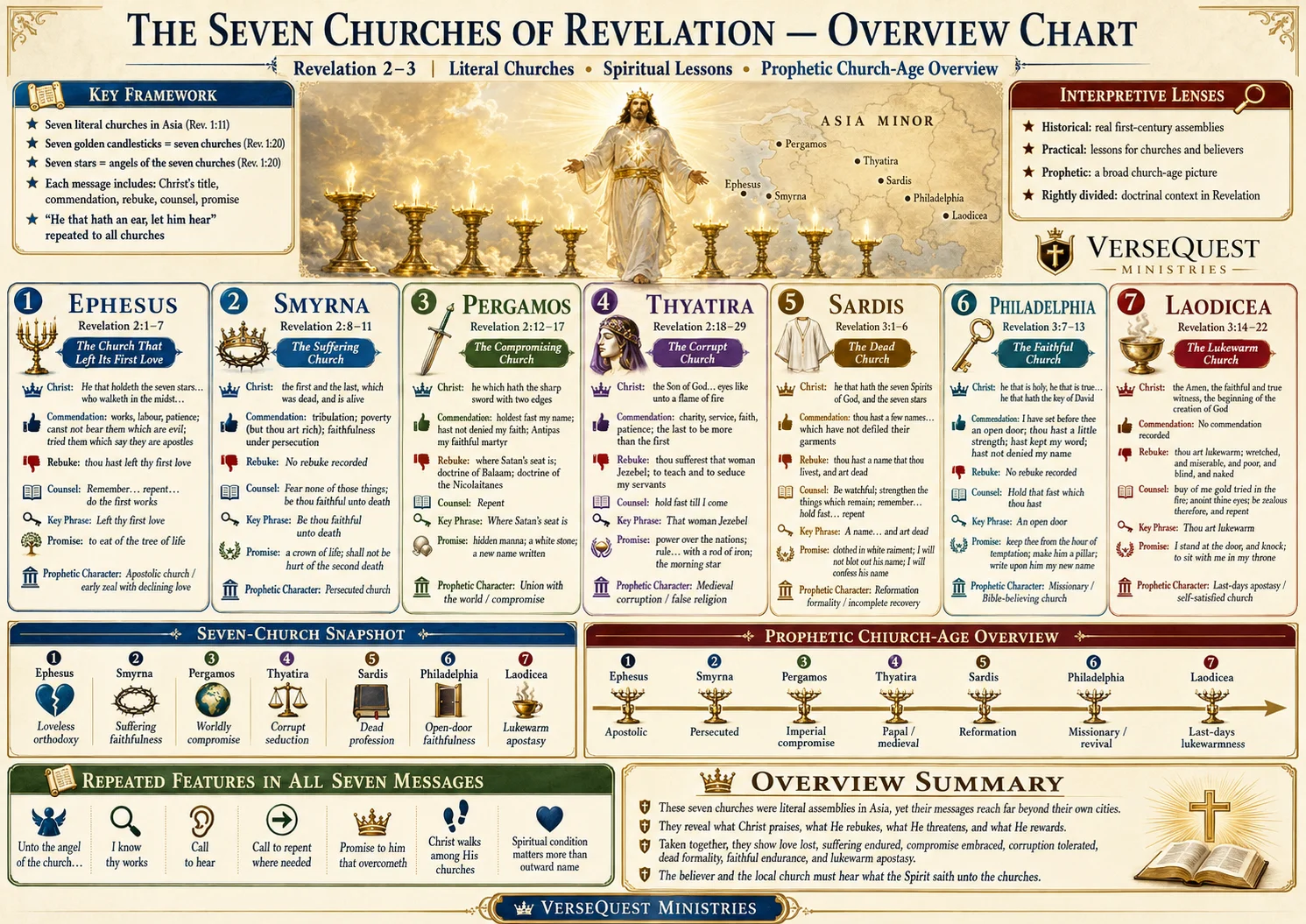
- The Seven Churches of Revelation Chart Collection – Christ Walking Among the Candlesticks
- A premium VerseQuest Ministries™ PDF chart collection covering the Seven Churches of Revelation in Revelation 2–3. Includes one overview chart plus individual KJV Bible study charts for Ephesus, Smyrna, Pergamos,…
- $12.99
- Add to cart
-
-
The Serpent's Footnotes
-
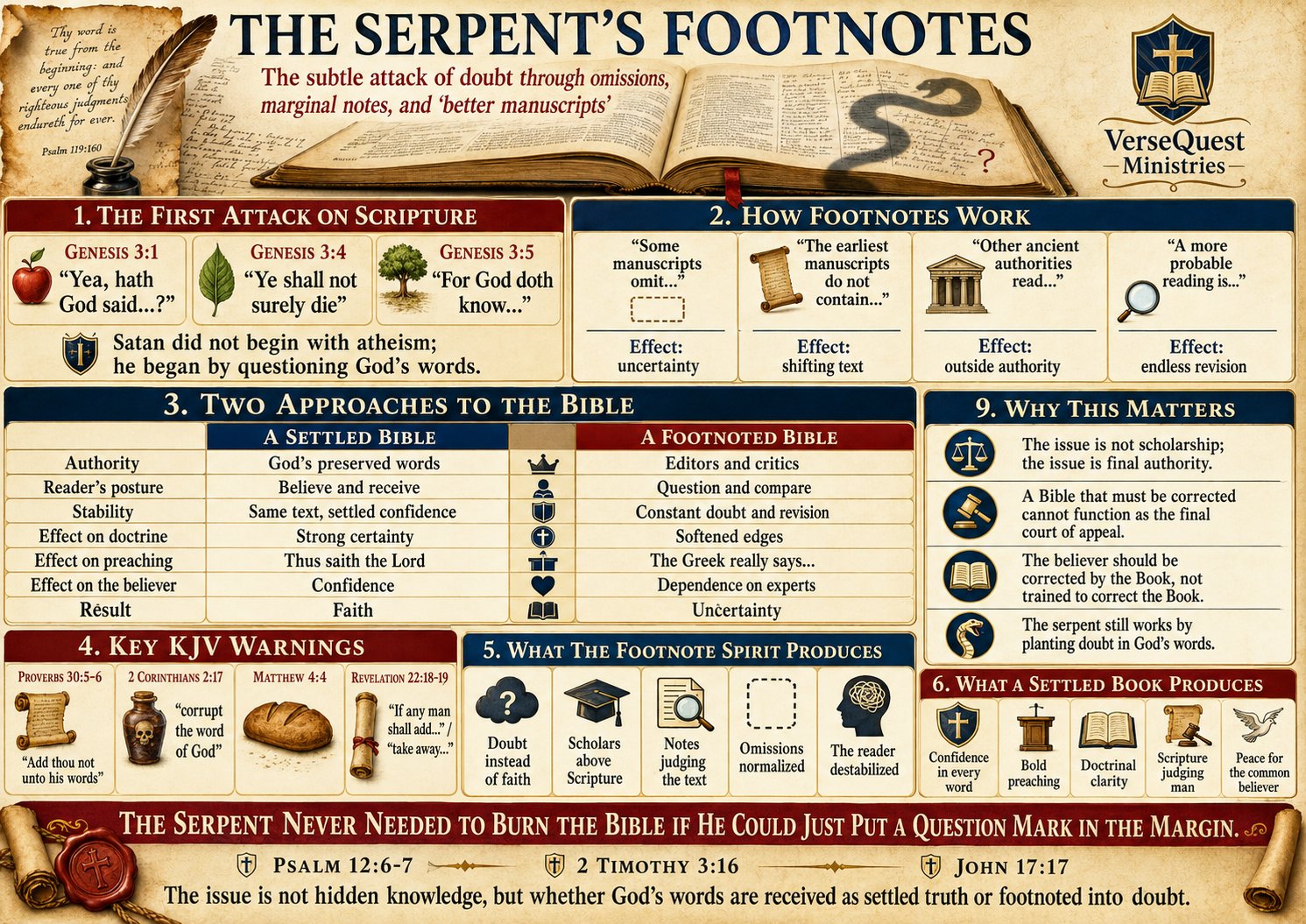
- The Serpent’s Footnotes Bible Study Chart – KJV Preservation, Textual Criticism, Omissions, and Manuscript Doubt
- Examine the attack of textual doubt with this detailed KJV Bible study chart covering manuscript footnotes, omissions, biblical preservation, final authority, and confidence in God’s settled words.
- $3.99
- Add to cart
-
-
Uncategorized
-
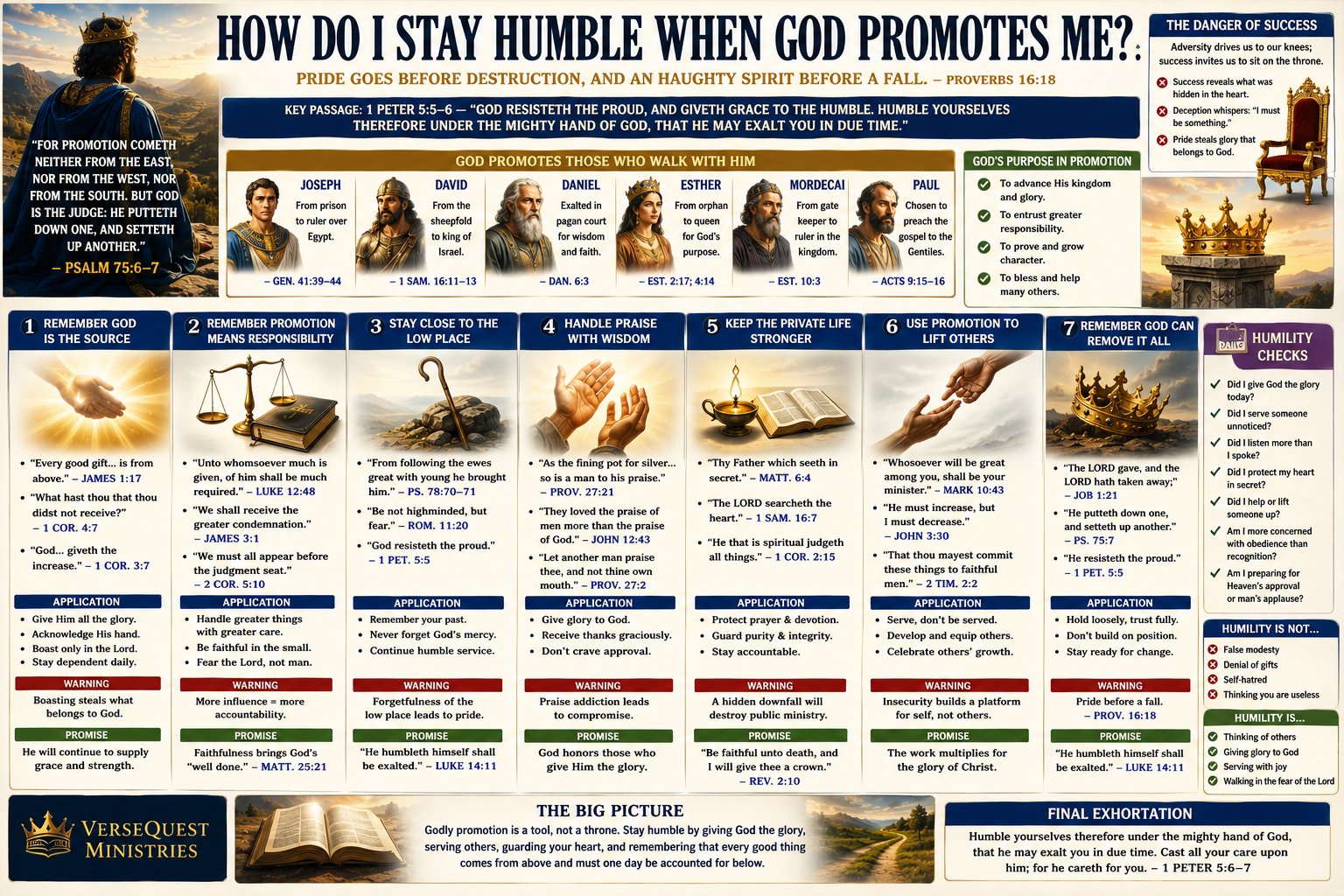
- How to Stay Humble When God Promotes You – Biblical Humility, Success, and Faithful Stewardship (KJV Bible Study Chart)
- Learn how to remain humble when God increases your influence with this detailed KJV Bible study chart covering pride, praise, responsibility, private devotion, servant leadership, and faithful stewardship.
- $3.99
- Add to cart
-
-
Abassadors For Christ
-
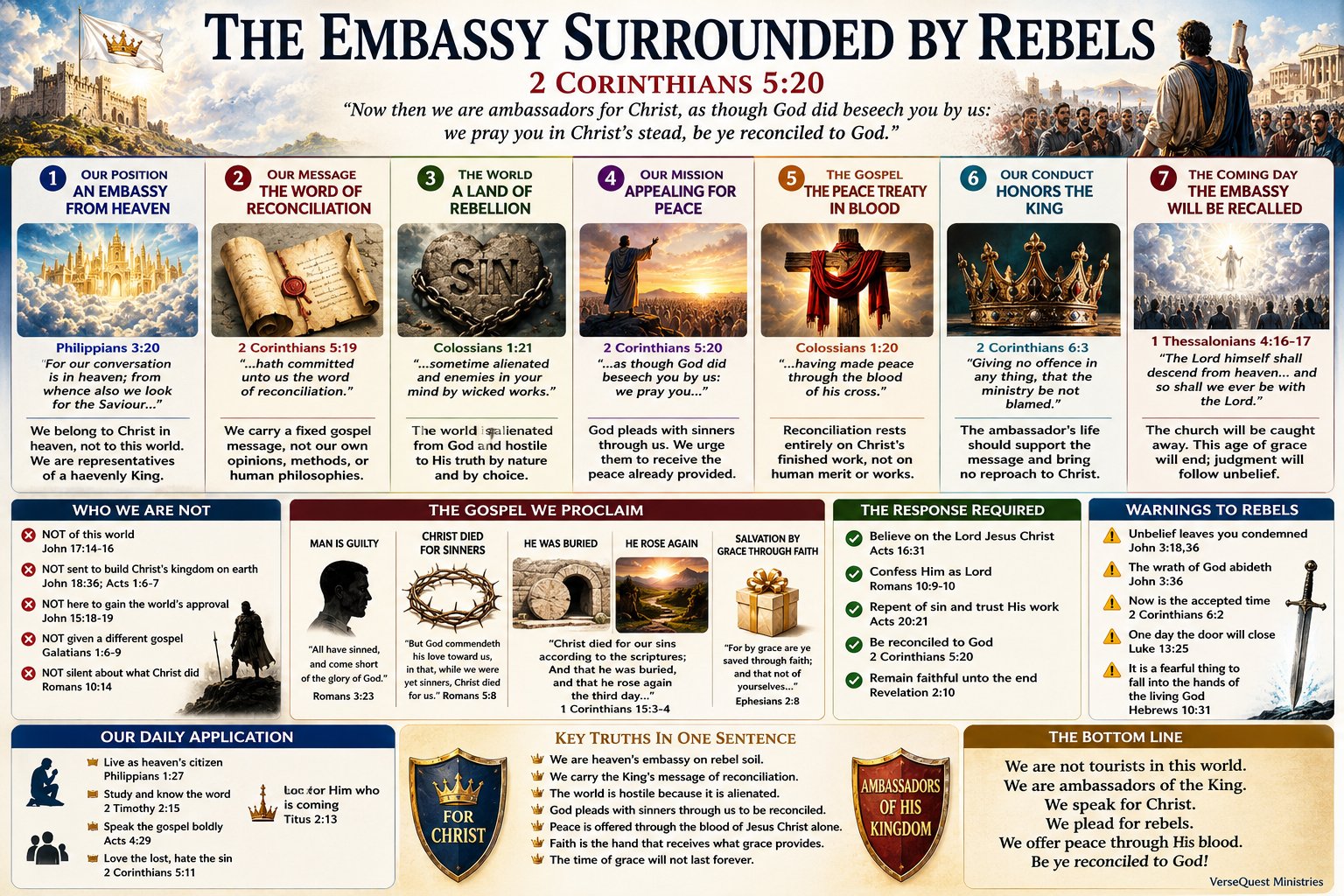
- The Embassy Surrounded by Rebels Bible Study Chart – Ambassadors for Christ and the Ministry of Reconciliation (KJV)
- Understand the Christian’s mission with this detailed KJV chart covering ambassadors for Christ, heavenly citizenship, the gospel of reconciliation, faithful conduct, evangelism, and the coming Rapture.
- $3.99
- Add to cart
-