
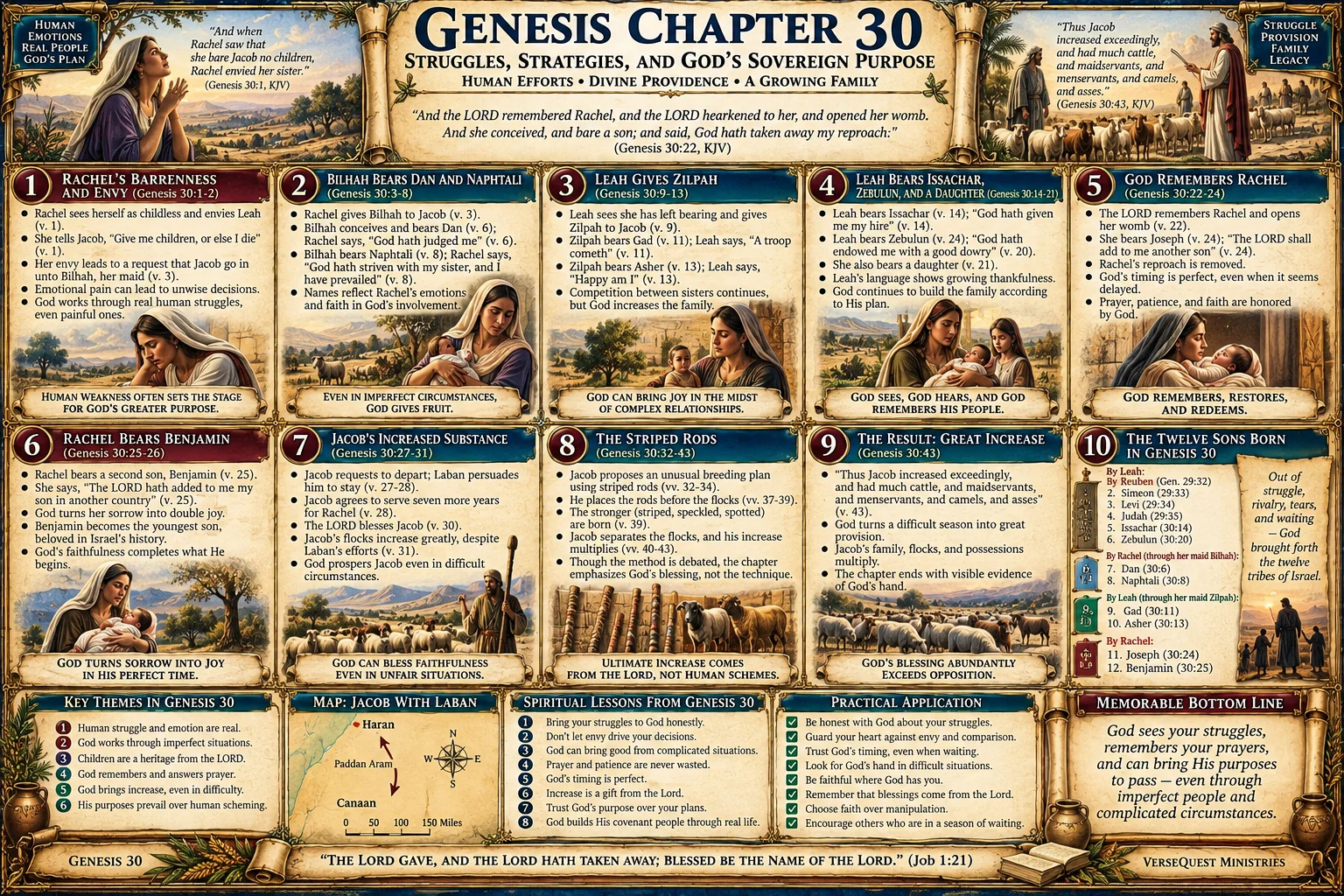
Genesis 30 – Jacob’s Growing Family and Flocks: Rachel and Leah, Joseph’s Birth, Laban’s Wages, and God’s Providence (KJV Bible Study Chart)
Explore Genesis 30 with this detailed KJV Bible study chart tracing the rivalry between Rachel and Leah, the births through Bilhah and Zilpah, Issachar, Zebulun, Dinah, and the long-awaited birth of Joseph. See how “God remembered Rachel” and opened her womb, then follow Jacob’s request to return home, Laban’s recognition that God has blessed him through Jacob, and the unusual livestock arrangement involving speckled, spotted, and striped animals. The chart also examines Jacob’s increasing wealth, the developing family of Israel, and God’s providence amid envy, barrenness, household conflict, changing wages, and human strategy. Ideal for Bible study, homeschool, Sunday school, sermon preparation, patriarchal studies, twelve-tribes teaching, and lessons on patience, providence, family relationships, and God’s faithfulness.
$4.99
Description
Genesis 30: Struggles, Strategies, and God’s Sovereign Purpose is a detailed KJV Bible study chart tracing the continued growth of Jacob’s household through Rachel, Leah, Bilhah, and Zilpah, the birth of Joseph, Jacob’s dealings with Laban, and the remarkable increase of his flocks. The chapter is filled with rivalry, barrenness, human planning, emotional conflict, changing wages, and complicated family circumstances, yet God continues advancing the family from which the nation of Israel will arise.
Rachel begins the chapter deeply distressed because she has borne Jacob no children. Envious of Leah, she tells Jacob, “Give me children, or else I die.” Jacob responds that the power to give children belongs to God. Rachel then gives her maid Bilhah to Jacob, and Bilhah bears Dan and Naphtali. Leah later gives Zilpah, her maid, and Zilpah bears Gad and Asher. The household grows, but the rivalry between the sisters remains painfully evident.
The narrative then records the mandrake episode involving Reuben, Leah, and Rachel. Leah subsequently bears Issachar and Zebulun, followed by Dinah. The names of the children repeatedly reveal the emotional struggles within the household—competition, longing for affection, hopes of acceptance, and recognition of God’s provision.
Genesis 30:22 marks a major turning point: “And God remembered Rachel, and God hearkened to her, and opened her womb.” Rachel conceives and bears Joseph, declaring that God has taken away her reproach and expressing hope for another son. Benjamin will eventually fulfill that hope, but his birth occurs later in Genesis 35.
After Joseph’s birth, Jacob asks Laban to send him away so he may return to his own country. Laban recognizes that the LORD has blessed him because of Jacob and persuades Jacob to remain under a new wage arrangement involving speckled, spotted, and brown animals.
The latter portion of Genesis 30 describes Jacob’s use of peeled rods and selective breeding as his flocks increase. The exact mechanics of the breeding procedure have generated considerable discussion, but the chapter’s ultimate emphasis is not magical power in the rods. Later revelation in Genesis 31 makes clear that God was overseeing Jacob’s prosperity despite Laban’s manipulation and repeatedly changing wages.
The result is extraordinary increase: “the man increased exceedingly,” possessing abundant cattle, servants, camels, and asses. Genesis 30 therefore shows an imperfect household growing beneath divine providence. Human beings scheme, compete, grieve, negotiate, and struggle, yet God continues building the family through whom His covenant purposes will move forward.
Genesis 30, Jacob, Rachel, Leah, Bilhah, Zilpah, Dan, Naphtali, Gad, Asher, Issachar, Zebulun, Dinah, Joseph, Rachel’s barrenness, God remembered Rachel, Jacob and Laban, changing wages, mandrakes, striped rods, speckled flocks, spotted cattle, Jacob’s prosperity, twelve tribes background, divine providence, family rivalry, God’s faithfulness
Genesis 30 continues the troubled household situation established in Genesis 29. Rachel sees that Leah has borne children while she remains barren and becomes envious. Her cry, “Give me children, or else I die,” reveals real anguish, but Jacob correctly answers that he is not in God’s place. The chapter repeatedly demonstrates that conception ultimately belongs to the LORD, even while human beings attempt various arrangements to solve their difficulties.
Rachel gives Bilhah to Jacob, and Bilhah bears Dan and Naphtali. Leah, after temporarily ceasing to bear, gives Zilpah, who bears Gad and Asher. These practices are recorded historically but should not be mistaken for God’s original marriage pattern. Genesis consistently records the jealousy, rivalry, and domestic instability associated with the arrangement rather than presenting polygamy as an ideal.
The mandrake episode further exposes competition between Rachel and Leah. Afterward Leah bears Issachar and Zebulun, and then Dinah. The sons’ names frequently reflect the mothers’ emotional experiences and interpretations of God’s dealings. Through a deeply divided family, God is nevertheless assembling the household that will eventually become Israel.
Genesis 30:22 gives the decisive explanation for Rachel’s eventual conception: “God remembered Rachel, and God hearkened to her, and opened her womb.” Rachel bears Joseph and says God has removed her reproach. She also expresses hope that the LORD will add another son. That additional son is Benjamin, but Benjamin is not born in Genesis 30; his birth occurs in Genesis 35:16–18.
Likewise, Genesis 30 does not record the births of all twelve sons. Reuben, Simeon, Levi, and Judah were born in Genesis 29. Genesis 30 adds Dan, Naphtali, Gad, Asher, Issachar, Zebulun, and Joseph, bringing Jacob’s sons to eleven at this stage. Dinah is also born in verse 21.
After Joseph’s birth, Jacob asks Laban, “Send me away, that I may go unto mine own place, and to my country.” Genesis 30:25–26 therefore concerns Jacob’s desire to return home, not Benjamin’s birth. Laban persuades Jacob to remain because he recognizes that the LORD has blessed him for Jacob’s sake.
Jacob and Laban then agree upon livestock as wages. Jacob employs peeled rods and manages the breeding of the flocks so that the stronger animals increasingly become his. The exact relationship between the rods and the breeding outcome should not be treated as a scientific formula or supernatural technique. Genesis 31 later attributes Jacob’s increase to God’s intervention despite Laban’s attempts to disadvantage him.
Genesis 30 closes by saying Jacob “increased exceedingly.” His family, flocks, servants, camels, and possessions multiply. The larger message is providential: complicated people use imperfect methods, yet God remains faithful to the covenant purpose and continues building the family that will become Israel.
Genesis 30 is useful for teaching patience during seasons of barrenness and delay, the dangers of envy and comparison, the damage caused by family rivalry, and God’s ability to work through deeply imperfect circumstances without approving every human action involved. It also provides essential background for the twelve tribes of Israel, Joseph’s birth, Jacob’s conflict with Laban, and God’s providential protection of the covenant family. The chapter works well for personal Bible study, Sunday school, homeschool instruction, Bible institutes, sermon preparation, family studies, patriarchal history, providence studies, and lessons on prayer, contentment, patience, honesty, and trusting God rather than manipulating circumstances.
King James Bible, Strong’s Concordance, Thompson Chain-Reference Bible, Treasury of Scripture Knowledge, Nave’s Topical Bible, Genesis 29–35 study notes, Jacob family charts, twelve tribes of Israel charts, Rachel and Leah comparison studies, Jacob and Laban studies, patriarchal genealogy charts, maps of Haran and Padan-aram, Joseph timeline studies, biblical providence Scripture chains, family rivalry studies, Genesis 31 livestock and wages studies, VerseQuest Genesis charts
Related products
-
Angels
-
-67%
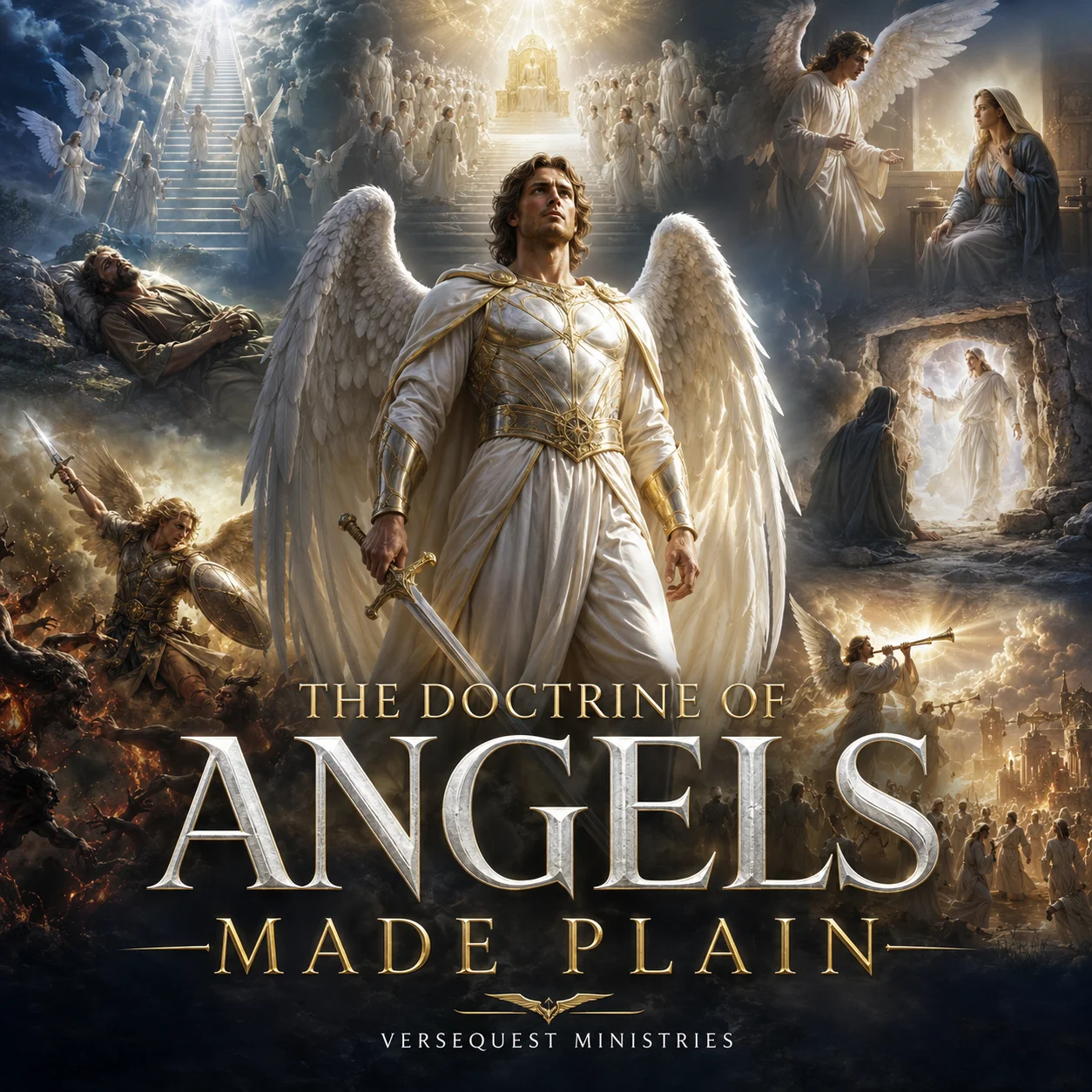
- The Doctrine of Angels Made Plain – 620-Page KJV Bible Study PDF
- The Doctrine of Angels Made Plain is a 620-page KJV Bible study that traces angels from Genesis to Revelation. This premium VerseQuest PDF explains holy angels, Christ’s supremacy over angels,…
- Original price was: $29.99.$9.99Current price is: $9.99.
- Add to cart
-
-67%
-
Jesus Christ Studies
-
-67%
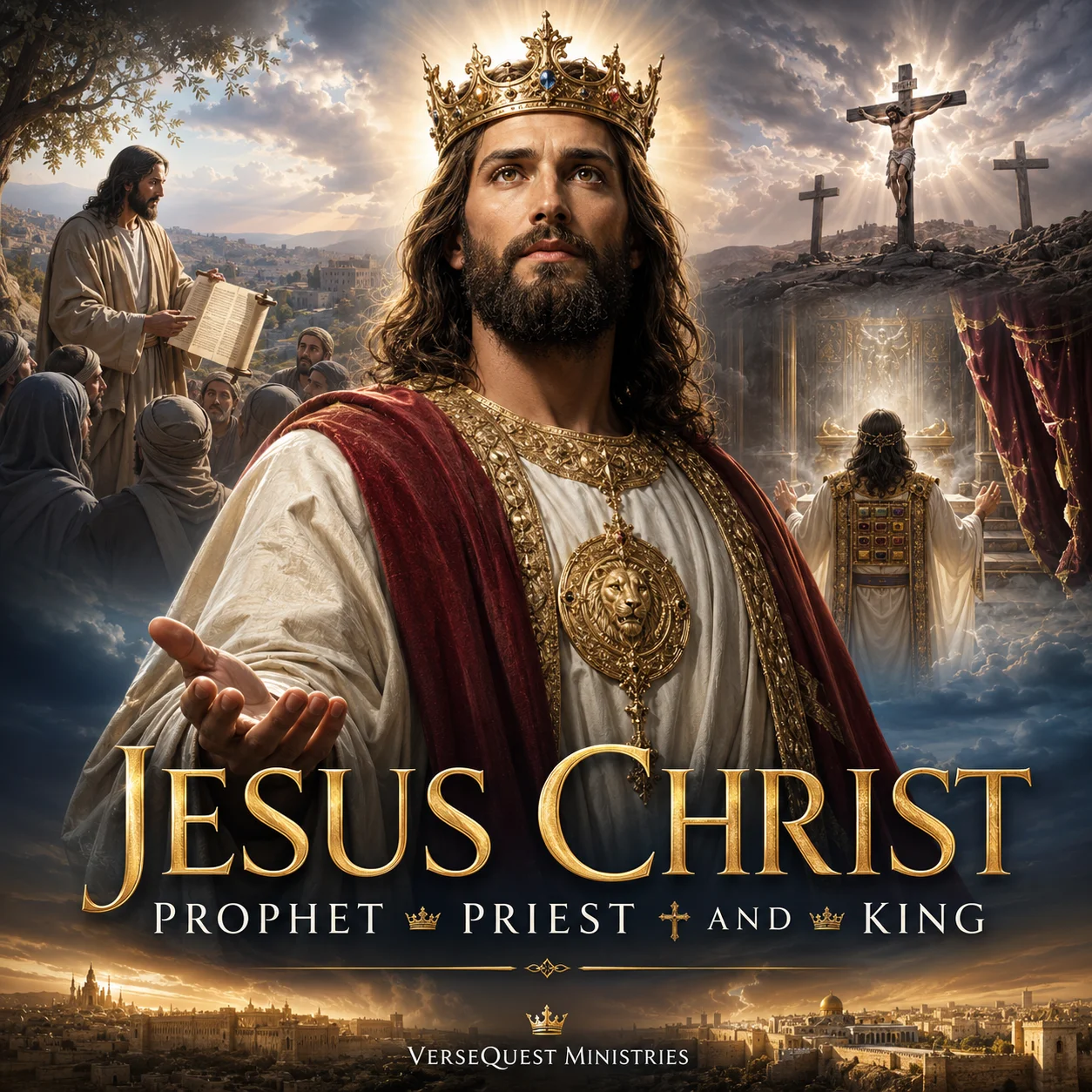
- Jesus Christ Prophet Priest and King – 441-Page PDF Study
- A 441-page premium KJV PDF study on Jesus Christ as Prophet, Priest, and King. This detailed VerseQuest book covers Christ’s prophetic ministry to Israel, His finished sacrifice and present intercession…
- Original price was: $29.99.$9.99Current price is: $9.99.
- Add to cart
-
-67%
-
Kingdom Hall
-
-71%

- Jehovah’s Witnesses Made Plain – 574-Page KJV Watchtower Study
- A massive 574-page VerseQuest study exposing the Watchtower system from the King James Bible. This detailed 100-essay book covers the false Christ, false gospel, New World Translation, failed prophecy, 144,000,…
- Original price was: $34.99.$9.99Current price is: $9.99.
- Add to cart
-
-71%
-
Doctrine Series
-
Christology Studies
-

- The Deity of Christ Defended — 66 KJV Studies Proving Jesus Christ Is God Manifest in the Flesh
- he Deity of Christ Defended is a 444-page premium KJV Bible study defending the full deity of the Lord Jesus Christ. This 66-study book proves from Scripture that Jesus is…
- $29.99
- Add to cart
-